



The world’s oil supply will sink to just 98 days of demand by the end of May, according to new research from Goldman Sachs. Europe’s jet fuel supplies are even lower, according to analyst Yulia Zhestkova Grigsby and her colleagues. In Europe, jet fuel availability will fall below the International Energy Agency’s 23-day shortage threshold in June, she says.
“We see large risks of jet fuel shortages in Europe already this summer,” Grigsby said. “The U.K. appears most at risk of jet fuel rationing given its large net imports.”
“Days of demand” are the number of days that fuel would run out if replenishment went to zero—the qualification is that there is likely always going to be some replenishment of supply. Nonetheless, with supplies running this low, many industries will be forced to change how they operate or cease certain activities to make supplies last, Fortune’s Jordan Blum reports.
South Korea could be among the hardest hit. It has already reduced its local jet fuel inventory by 66%. Japan’s has been reduced by 46%. And Taiwan and the U.K. are down by 41%. The U.S., by contrast, has maintained 100% of its local supply; Europe has dwindled by only 21%.
The 98-day supply of other oil products may overstate the amount of usable oil, she said in a note seen by Fortune. “Pipelines, refineries, and storage tanks must maintain minimum oil to operate. Storage tanks with a floating roof (most crude landed storage) need to be filled by at least 20% to support the roof,” she wrote. Refineries “typically need at least 15 days of crude storage on site for smooth operations.” Thus the amount of available oil may only sustain 30 to 40 days of demand.
Even then, “major operational issues would likely be triggered in some locations well before reaching the global operational minimum storage level,” she warned.

Photo by Amirhossein KHORGOOEI / ISNA / AFP
Secretary of State Marco Rubio announced at the White House yesterday that "Operation Epic Fury is concluded. We achieved the objectives of that operation" and that the war with Iran was "over." President Trump then said on Truth Social that Project Freedom—the U.S. effort to escort ships through the Strait of Hormuz—“will be paused for a short period of time to see whether or not the Agreement can be finalized and signed.”
Yes, the situation is confusing. Experts are scratching their heads this morning, frankly: From the U.S. point of view, assassinating the top level of the regime in Tehran has not worked. Bombing Iran has not worked. Blockading the Strait has not worked. Economic sanctions have not worked. Military experts told the Financial Times they are unsure what happens next.
From the Iranian point of view, blockading the Strait and retaining the capability of striking critical infrastructure in other Gulf countries has given Tehran a surprising amount of leverage, despite the destruction of the country’s infrastructure and the loss of dozens of senior political and military leaders. Iran’s neighbours fear the war will merely embolden it, the WSJ says.
The war might not be over. The White House has declared an end to the hostilities multiple times only to resume fighting. Its policy rhetoric has taken dozens of twists and turns. And the operation never had a clear timeline.
Inside Anduril: Meet the quiet engineer-CEO building America’s $31 billion weapons startup - Allie Garfinkle
A Michigan farm town voted down plans for a giant OpenAI-Oracle data center. Weeks later, construction began - Sharon Goldman
The CEO who was told he’d never run American Express has made Amex cool again—and is beating JPMorgan, Visa, and the S&P 500 - Shawn Tully
Salesforce CEO Marc Benioff turned his earnings call into a vodcast. Why other Fortune 500 CEOs might follow - Rachel Ventresca
The hidden bottleneck holding back American manufacturing isn’t machines — it’s knowledge - Theo Saville
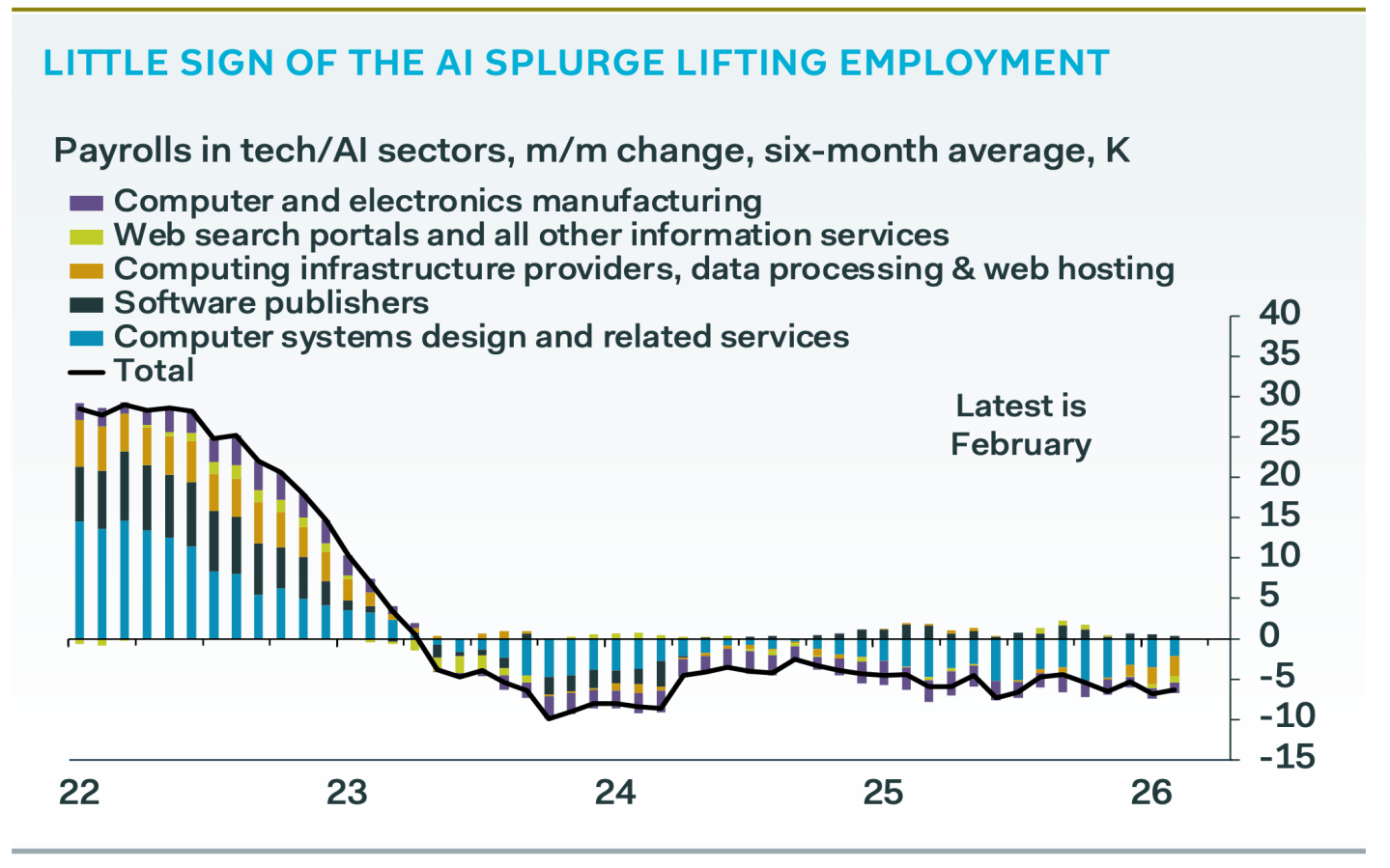
There has been negative growth in payrolls in tech sectors linked to AI for about two years, according to Pantheon Macroeconomics. That suggests AI is slowly destroying jobs, not creating them. Yesterday’s announcement by Coinbase that it was laying off 14% of its staff because AI had made the company more efficient is Exhibit A.
Although spending on AI may be boosting GDP, “The relatively low labor intensity of the tech sector suggests this boost to growth is doing little to support the jobs market. Software and computer systems design payrolls have been grinding lower recently, as have those of computer and electronics manufacturers. Admittedly, AI probably also is boosting growth through more indirect channels, but these are trickier to quantify,” Pantheon’s Oliver Allen said in a recent note.
The percentage of the U.S. electricity supply taken by data centers, according to Hannah Ritchie, the head of research at Our World in Data and a senior researcher at the University of Oxford. Across the world, the average is 1.5%. It’s as high as 20% in Ireland.
China’s Big Bet on Wind Power Is Paying Off - NYT
DeepSeek nears $45bn valuation as China’s ‘Big Fund’ leads investment talks - FT
Novo Nordisk stock jumps 6% after drugmaker hikes forecast as Wegovy pill sales smash forecasts - CNBC
Federal employment agency sues NYT for discrimination - Axios
Storied Toolmaker Closes Its Last Hometown Plant—and Blames Its Tape Measures - WSJ
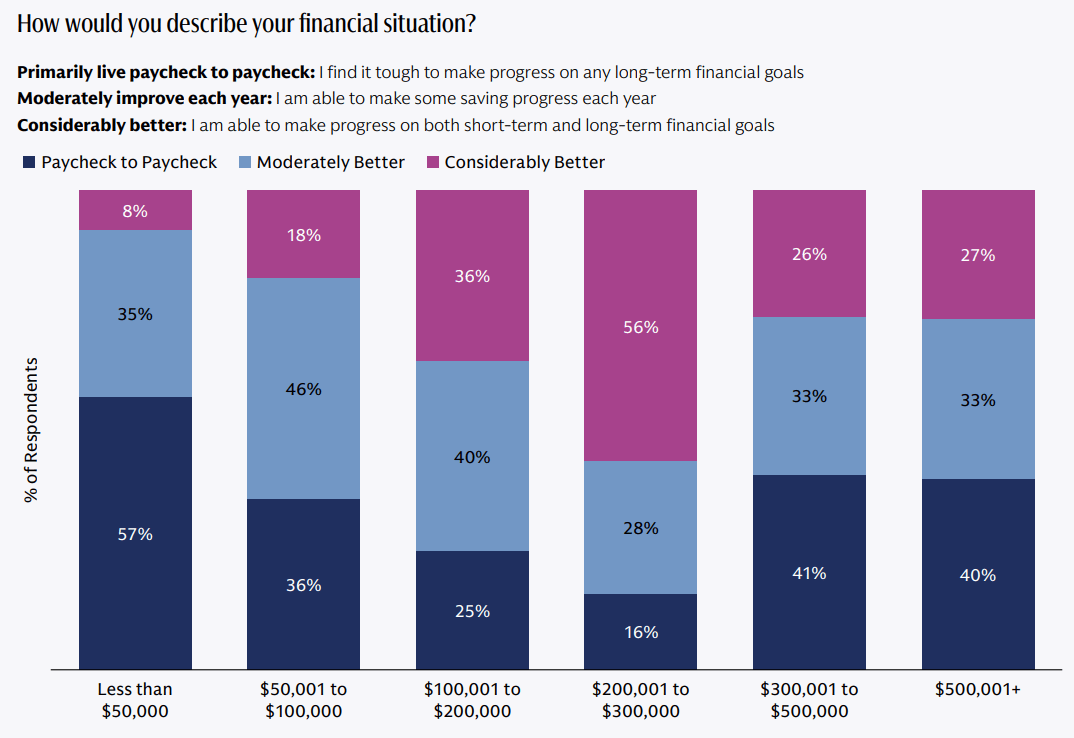
40% of households earning $500,000-plus annually believe they live paycheck-to-paycheck—a statistic Ben Carlson of Ritholtz Wealth Management says is completely bonkers. “It’s ridiculous to believe 40% of people making half a million dollars live paycheck-to-paycheck. Making $300k a year puts you in the top 3% of wage earners. If you make $500k a year you’re in the top 1%. Come on! Paycheck-to-paycheck?! No,” he told his readers recently, in reference to the Goldman Sachs chart above.
What's really going on, Carlson argues, is FOMO. “Social media is full of influencers, billionaires, grifters, and people who craft fake lives that are meant to make you feel like you don’t have enough money.” He also notes that surveyed rates of happiness fell off a cliff after Covid and haven’t yet recovered.
此内容由惯性聚合(RSS阅读器)自动聚合整理,仅供阅读参考。 原文来自 — 版权归原作者所有。