
惯性聚合 高效追踪和阅读你感兴趣的博客、新闻、科技资讯
阅读原文 在惯性聚合中打开

推荐订阅源

G
Google Developers Blog
有赞技术团队
有赞技术团队
WordPress大学
WordPress大学
博客园 - 司徒正美
D
Docker
B
Blog
V
Visual Studio Blog
Blog — PlanetScale
Blog — PlanetScale
U
Unit 42
S
SegmentFault 最新的问题
小众软件
小众软件
J
Java Code Geeks
美团技术团队
腾讯CDC
MyScale Blog
MyScale Blog
爱范儿
爱范儿
H
Help Net Security
宝玉的分享
宝玉的分享
Microsoft Azure Blog
A
About on SuperTechFans
Google DeepMind News
钛媒体:引领未来商业与生活新知
钛媒体:引领未来商业与生活新知
博客园 - 三生石上(FineUI控件)
博客园 - 【当耐特】

Fortune | FORTUNE

One man can kill Bill Ackman’s $64 billion bid for Universal Music Group—and no one knows what he’ll do | Fortune Poppi’s cofounder pitched her startup on Shark Tank while 9 months pregnant and landed a $400,000 deal—now it's worth $2 billion | Fortune Teen boys are choosing AI girlfriends over real ones for 'maximum control, zero rejection'—experts say it could make them unemployable | Fortune A United American merger is by no means impossible given the president 'loves big deals' | Fortune Reed Hastings’s planned exit from $455 billion Netflix ‘had nothing to do with’ the failed deal for Warner Bros., says Ted Sarandos | Fortune Meet Joe McCann: The high-flying crypto trader held in Tanzania after sudden death of his influencer fiancée Ashly Robinson | Fortune Gen Z is carving a different path in the housing market by doing it alone | Fortune U.S. Catholic leaders criticize Trump for ‘disparaging words’ about the pope as Vatican clash risks alienating Catholic voters | Fortune China has ‘nearly erased’ America’s lead in AI—and the flow of tech experts moving to the U.S. is slowing to a trickle, Stanford report says | Fortune Self-made millionaire behind $5 billion Skims Emma Grede says it all began with a cold call to Kris Jenner: Emma Grede—the self-made millionaire behind the $5 billion Skims empire—says it all began with an audacious cold call to Kris Jenner: ‘The difference between me and someone else is, I made it happen’ | Fortune Americans have never been this gloomy about the economy. Wall Street has never cashed in harder | Fortune ‘The college grading system [is] almost meaningless’: People see the Ivy League as an easy A and with flawed admissions standards | Fortune The CEO of $8.5 billion Japanese car giant Nissan plays the drums in a band and hits the tennis courts to destress from the top job | Fortune New York governor's take on a millionaires tax: fancy pied-à-terre second apartments worth over $5 million | Fortune Pope Leo XIV: A ‘handful of tyrants’ are ravaging earth with war and exploitation | Fortune Trump has no plan to cut the $39 trillion national debt, but he does want to cut childcare. His budget director is scrambling to clarify | Fortune China's economy grows 5% in first quarter, surprising economists to the upside | Fortune Everyone was wondering what Trump wanted more: Warsh smoothly seated at the Fed, or for Powell to pay. We have our answer | Fortune Palantir exec: the biggest mistake retailers are making with AI? Trying to do it all with one agent | Fortune American YouTuber who calls himself a 'troll' sentenced to 6 months in Korean prison for literally dancing on wartime graves | Fortune BBC plans to cut up to 2,000 jobs to save 10% of annual budget | Fortune Canva debuts a new suite of agentic tools, as the design app quietly becomes one of the world’s most used AI services | Fortune Moody's CEO: AI has a trust problem – better models won’t fix it | Fortune Top New York surgeon: Americans have better data for choosing restaurants than surgeons. That has to change | Fortune The Iran war’s fertilizer shock is hammering American farmers, and 70% can’t afford what they need for this year’s growing season | Fortune Education experts to Mamdani: Why are you foisting AI on our kids? | Fortune This CEO pirated video games as a teen and became a hacker for the Air Force. Now he’s built a $3 billion cyber firm | Fortune Teacher, blame thyself: Yale report savages Ivy League schools for destroying American trust in higher education | Fortune Fed chair nominee Kevin Warsh is worth more than $100 million and has stakes in SpaceX and Polymarket | Fortune From wool sneakers to GPUs: Allbirds’ desperate AI pivot and 600% stock surge, explained | Fortune
China will remain an 'incomplete superpower' until it can...
Jason Ma · 2026-05-18 · via Fortune | FORTUNE

President Donald Trump’s summit with Chinese counterpart Xi Jinping ended last week without a major breakthrough, but still achieved Beijing’s goal of putting itself on equal footing with the U.S.

Meanwhile, China’s industrial might continues to drive export dominance, its AI is nearly on par with the top models, and its military is increasingly advanced.

With the U.S. bogged down in Iran, alliances fracturing, and debt soaring, the narrative on America has pointed in the opposite direction, namely a superpower in decline.

“But in at least one field — financial competition — the opposite is true. China is stagnating, allowing America to dominate by default,” Ruchir Sharma, chair of Rockefeller International, pointed out in a Financial Times op-ed.

The history of the world’s previous empires shows that increasing economic clout typically leads to a currency taking a greater share of global reserves, he noted.

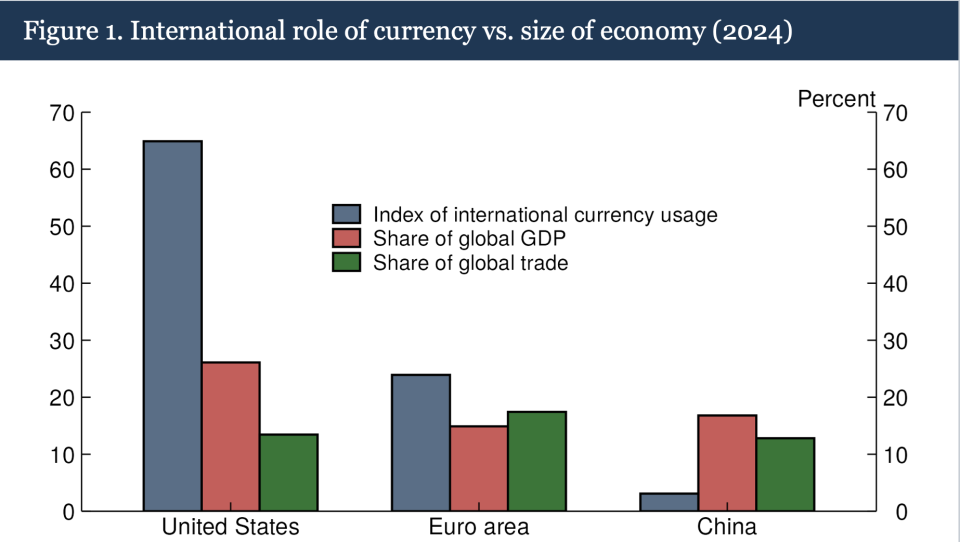
But China’s yuan, or renminbi, claims just 2% of central bank assets around the world, even as the Chinese economy accounts for 17% of global GDP. Similarly, China commands 15% of global trade, while the yuan is used in only 2% of invoices.

By contrast, the dollar accounts for about 58% of global reserves, though that share is slipping, and 54% of trade invoices. Plus, nearly 90% of over-the-counter foreign exchange transactions are in dollars.

Sharma estimated that the world’s second largest economy is running 30 to 40 years behind the historical trajectory of superpowers. This lag is also notable given how much global finance has exploded, with the value of financial assets quadrupling over the last five decades.
Federal Reserve

The “exorbitant privilege” of dollar dominance has long been known, allowing the U.S. to borrow more cheaply than its profligate finances would otherwise allow. The U.S. has also leaned heavily on the dollar to impose financial sanctions—a weapon the yuan can’t provide.

“China will remain an incomplete superpower until it can match this financial firepower,” Sharma wrote. “For decades, it has kept its financial system more tightly sealed than any other major nation.”

As a result, foreign investors own less than 5% of the stocks and bonds in China, while capital controls have largely bottled up a massive surge in domestic money supply, he added, describing Chinese markets as a “local prison.”

Beijing is afraid capital will flee the country if restrictions are relaxed, but investors won’t see China as safe until the yuan is traded more freely, Sharma said.

To be sure, China is trying to make the yuan a more international currency. It’s being used in the oil trade more often, and the Iran war has led to speculation that the “petrodollar” could give way to the “petroyuan.”

In addition, use of the yuan among global central banks is up lately. By the end of March, the People’s Bank of China had provided $16.4 billion via foreign-exchange swap lines, the most in two years and the steepest quarterly increase in three years.

Signaling how seriously the U.S. views currency swaps, Treasury Secretary Scott Bessent recently suggested swap lines can help reinforce the dollar’s dominance and reserve status.

Elsewhere, the yuan also advanced in world rankings by one rung to become the fifth most active currency in global payments, according to the SWIFT financial platform.

Still, Sharma thinks China must loosen up more, adding that less strict controls can actually encourage capital inflows rather than an exodus.

“Without a bolder opening, China will never challenge America’s financial dominance and fully realize its superpower ambition,” he said.