


惯性聚合 高效追踪和阅读你感兴趣的博客、新闻、科技资讯
阅读原文 在惯性聚合中打开

推荐订阅源

D
DataBreaches.Net
MongoDB | Blog
MongoDB | Blog
GbyAI
GbyAI
L
LangChain Blog
B
Blog
博客园 - 三生石上(FineUI控件)
Martin Fowler
Martin Fowler
博客园 - 【当耐特】
Recent Announcements
P
Proofpoint News Feed
U
Unit 42
Last Week in AI
Last Week in AI
WordPress大学
WordPress大学
有赞技术团队
有赞技术团队
雷峰网
雷峰网
Microsoft Security Blog
T
The Blog of Author Tim Ferriss
爱范儿
爱范儿
小众软件
小众软件
I
InfoQ
G
Google Developers Blog
大猫的无限游戏
大猫的无限游戏
人人都是产品经理
人人都是产品经理
C
Check Point Blog

Fortune | FORTUNE

One man can kill Bill Ackman’s $64 billion bid for Universal Music Group—and no one knows what he’ll do | Fortune Poppi’s cofounder pitched her startup on Shark Tank while 9 months pregnant and landed a $400,000 deal—now it's worth $2 billion | Fortune Teen boys are choosing AI girlfriends over real ones for 'maximum control, zero rejection'—experts say it could make them unemployable | Fortune A United American merger is by no means impossible given the president 'loves big deals' | Fortune Reed Hastings’s planned exit from $455 billion Netflix ‘had nothing to do with’ the failed deal for Warner Bros., says Ted Sarandos | Fortune Meet Joe McCann: The high-flying crypto trader held in Tanzania after sudden death of his influencer fiancée Ashly Robinson | Fortune Gen Z is carving a different path in the housing market by doing it alone | Fortune U.S. Catholic leaders criticize Trump for ‘disparaging words’ about the pope as Vatican clash risks alienating Catholic voters | Fortune China has ‘nearly erased’ America’s lead in AI—and the flow of tech experts moving to the U.S. is slowing to a trickle, Stanford report says | Fortune Self-made millionaire behind $5 billion Skims Emma Grede says it all began with a cold call to Kris Jenner: Emma Grede—the self-made millionaire behind the $5 billion Skims empire—says it all began with an audacious cold call to Kris Jenner: ‘The difference between me and someone else is, I made it happen’ | Fortune Americans have never been this gloomy about the economy. Wall Street has never cashed in harder | Fortune ‘The college grading system [is] almost meaningless’: People see the Ivy League as an easy A and with flawed admissions standards | Fortune The CEO of $8.5 billion Japanese car giant Nissan plays the drums in a band and hits the tennis courts to destress from the top job | Fortune New York governor's take on a millionaires tax: fancy pied-à-terre second apartments worth over $5 million | Fortune Pope Leo XIV: A ‘handful of tyrants’ are ravaging earth with war and exploitation | Fortune Trump has no plan to cut the $39 trillion national debt, but he does want to cut childcare. His budget director is scrambling to clarify | Fortune China's economy grows 5% in first quarter, surprising economists to the upside | Fortune Everyone was wondering what Trump wanted more: Warsh smoothly seated at the Fed, or for Powell to pay. We have our answer | Fortune Palantir exec: the biggest mistake retailers are making with AI? Trying to do it all with one agent | Fortune American YouTuber who calls himself a 'troll' sentenced to 6 months in Korean prison for literally dancing on wartime graves | Fortune BBC plans to cut up to 2,000 jobs to save 10% of annual budget | Fortune Canva debuts a new suite of agentic tools, as the design app quietly becomes one of the world’s most used AI services | Fortune Moody's CEO: AI has a trust problem – better models won’t fix it | Fortune Top New York surgeon: Americans have better data for choosing restaurants than surgeons. That has to change | Fortune The Iran war’s fertilizer shock is hammering American farmers, and 70% can’t afford what they need for this year’s growing season | Fortune Education experts to Mamdani: Why are you foisting AI on our kids? | Fortune This CEO pirated video games as a teen and became a hacker for the Air Force. Now he’s built a $3 billion cyber firm | Fortune Teacher, blame thyself: Yale report savages Ivy League schools for destroying American trust in higher education | Fortune Fed chair nominee Kevin Warsh is worth more than $100 million and has stakes in SpaceX and Polymarket | Fortune From wool sneakers to GPUs: Allbirds’ desperate AI pivot and 600% stock surge, explained | Fortune
Forget U.S. debt, China’s total borrowing is in 'a league...
Jason Ma · 2026-05-12 · via Fortune | FORTUNE

As President Donald Trump gets set to meet Chinese counterpart Xi Jinping this week, China’s technological prowess will be on display, but its state-led growth model has been slowing—and a rapidly expanding mountain of debt is a warning sign.

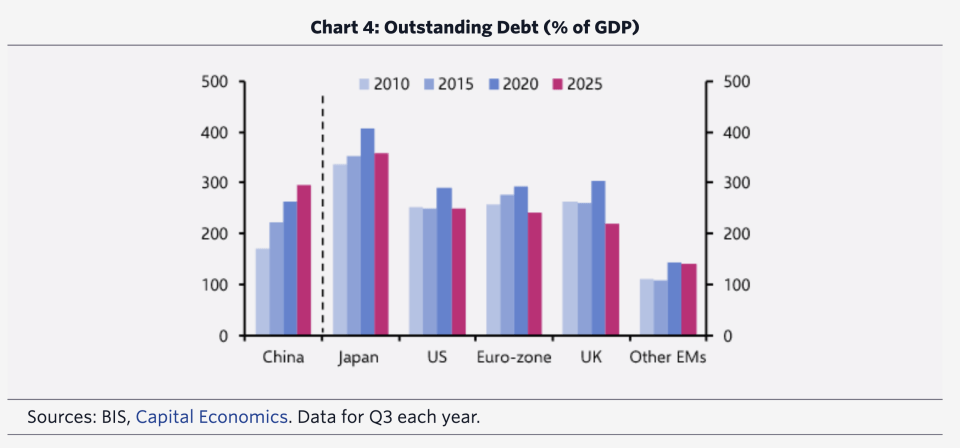
In fact, while the recent explosion in U.S. federal debt has raised numerous red flags, a broader measure of indebtedness across the public and private sectors shows borrowing as a share of GDP is actually down since 2010.

By contrast, China’s total debt-to-GDP ratio, excluding the financial sector, doubled in that span and has now topped 300%, according to Mark Williams, chief Asia economist at Capital Economics.

In a note late last month, he pointed out China’s debt surge has come despite weaker borrowing from households, which have been battered by the real estate market’s collapse.

But borrowing by companies as well as the central and local governments has continued to far outpace GDP growth, which has slowed in recent years, pushing the overall debt ratio higher.

Nearly 40% of outstanding debt is now owed by the public sector, including so-called local government financing vehicles, Williams calculated.

The result is total debt that surpasses the U.S., eurozone, the U.K., and other emerging markets. Aside from some smaller economies, only Japan has more debt.

“China’s current level of indebtedness puts it in a league of its own,” Williams said.

Of course, U.S. federal debt has set its own grim milestones, and is now more than 100% of GDP for the first time since the immediate aftermath of World War II.

But total public and private debt last year was about 265% of GDP, which has been robust lately. It’s also down sharply from pandemic-era highs, when governments unleashed a flood of stimulus. The eurozone and U.K. have similar trajectories.
Beijing is aware of its debt situation, particularly among local governments that often seek to boost favored industries like AI, electric vehicles, and robotics with low-cost loans.

Over the weekend, authorities vowed to ramp up efforts to ease local government debt risk with a restructuring program that helps borrowers meet payments on schedule.

Officials also called for preventing new hidden borrowing, along with strengthening the domestic economy and advancing infrastructure, according to Bloomberg, citing China Central Television.

But Chinese companies are borrowing more than they are selling. Business debt has doubled since 2019, while revenues are only 30% higher, according to Capital Economics.

Creditors continue to roll over loans to keep struggling firms afloat, even as nearly one-third of them are losing money, Williams noted. That worsens overcapacity and deflation, while preventing that capital from going to healthier borrowers.

China’s overcapacity and its support for manufacturers over consumers have stoked excess supply that drags down prices. An economy-wide price gauge shows China has been suffering from deflation for three straight years, the longest such streak since its transition to a market economy in the late 1970s.

The central government has tried to combat overproduction and excess competition, but China’s reliance on export-led growth continues to encourage more output.
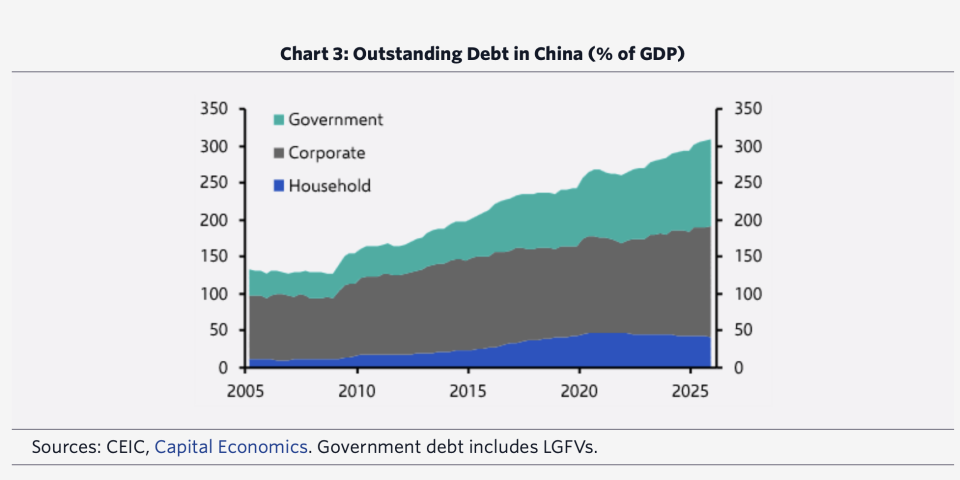
In addition to the level of total Chinese debt as a share of GDP, Williams sounded the alarm on its rate of growth, noting the ratio increased by more than 120% of GDP over the past 15 years.

To be sure, this doesn’t necessarily mean China is on the brink of a Lehman Brothers-style crisis. The financial system survived a major stress test in the form of the property market crash, he noted.

High domestic savings and capital controls, plus the fact the state dominates the financial sector, also make China less vulnerable.

But even though the government’s outsized role in the surge debt helps lower the risk of a crisis, it’s not helping the economy.

“The irony is that one driver of both government borrowing and the lax lending standards of (state-owned) banks is the desire to prop up economic growth and prevent job losses,” Williams said. “But the product of a credit boom that has been underway for 18 years is a banking system propping up unproductive firms, widespread losses across industry and entrenched overcapacity.”