





When Chris Caldwell, the chief information officer at Brinker International, is asked about his artificial intelligence strategy, he first gently guides the conversation to a less glamorous, but crucial IT topic: reliable Wi-Fi.
“Before we jump into AI use cases, we have to make sure a lot of the core technology is working well,” says Caldwell. “You can’t do AI without a solid network infrastructure in all your restaurants.”
In February 2024, Caldwell joined the Chili’s and Maggiano’s restaurant operator after serving as CIO for nine years at rival chain KFC, reuniting with Brinker CEO Kevin Hochman, also a veteran of KFC’s parent company, Yum! Brands. Hochman told Caldwell that when he initially joined Brinker in June 2022, he quickly discovered that up to 70% of restaurant employee feedback centered on technological challenges that made work harder. One of the biggest issues was that Wi-Fi outages were far too common.
Caldwell began by exploring a variety of network infrastructure vendors, but ended up sticking with the incumbent, Comcast. Together, they installed new networking gear, replaced every Wi-Fi access point at 1,200 restaurants, added a cellular backup system to prevent outages, and in some locations, tore up parking lots to install fiber connections.
“Over the last two years, we would basically just rip the guts out of every bit of the network infrastructure, and now we’re in a stable spot,” says Caldwell.
Then, he shifted his attention to complaints from managers that their back-office computers were too slow. Caldwell thought he would need to convince the C-suite to invest in new hardware, so he showed the leadership team a video of the painstakingly slow workflow processes that were hampering restaurant teams. “All right, how fast can we go,” Caldwell recalls of the response he received. “It wasn’t a funding question.” Each location got a new laptop.
Other fixes included deploying 23,000 new iPads with longer battery life and revamping 9,000 touchscreens to track orders in the back of the kitchen, which now show only the work that needs to be done at each station, rather than the full list of orders that previously made screens difficult to read. At 12 restaurants, Caldwell is currently testing a new user experience for the iPad, with a goal of reducing clicks by 50% to input an order and create an application design that’s intuitive enough for a new hire to require minimal training.
“Truthfully, I’ll admit, when someone handed me one of these handhelds when I started, I couldn’t even take an order,” says Caldwell of the ordering software.
Under Hochman and Caldwell, Brinker has been a strong performer in a restaurant sector that’s faced pressure from inflation-weary consumers, especially for the Chili’s concept, which has notched 20 consecutive quarters of same-store sales growth.
Over the past several years, the restaurant industry has notched a few key technology wins. Self-service kiosk systems, especially popular in fast-food and fast-casual concepts, often result in higher average orders and are beloved by diners. Internally developed mobile apps and integration with third-party channels such as Seamless and DoorDash have bolstered digital sales. Some restaurants are beginning early experiments with robotics for food delivery and food preparation in the kitchen.
Progress on AI has been far choppier. Coffee giant Starbucks recently dumped an AI tool intended to automate some inventory processes, while Yum is being sued by a Pizza Hut franchisee that alleges an AI system led to operational breakdowns that hurt sales at 100 locations. After a failed attempt to infuse AI into the drive-thru, McDonald’s is back at it again with a second big attempt to roll out this form of automation.
At Brinker, Caldwell says his AI priority use cases must improve the food, service, or atmosphere. Within the corporate office, he’s started to ramp up the deployment of Microsoft Copilot and there’s growing usage of AI to assist with coding.
But Caldwell is more enthralled by what’s possible at the restaurant level. He cites lighter-touch AI projects for helping forecast demand and to improve other functions via employee scheduling tech vendor HotSchedules. Caldwell says there are even greater opportunities ahead to use AI for forecasting, inventory management, logistics, and the possible creation of a restaurant-level focused AI chatbot that can assist with operational questions.
“We’re very early on,” he says, adding that he’s actively exploring vendors in the space and evaluating when it makes sense to build tools in house versus buying what’s available in the marketplace.
Caldwell is also attuned to when he must say no. Brinker did some limited testing with robotics, but after Hochman joined he ended those efforts and there are no immediate plans to revisit that form of technology. Another AI use case that Brinker explored was using AI to handle phone orders, but the company wasn’t satisfied with the quality of service the technology offered.
“If you look at it just in a spreadsheet, it probably makes sense,” says Caldwell, about AI’s ability to cut labor costs for that use case. “But, we absolutely think about it from a hospitality perspective, and if it’s not a great customer experience, we’re not going to do it.”
John Kell
Send thoughts or suggestions to CIO Intelligence here.
SpaceX’s IPO takes flight, pays $60 billion for Cursor. Elon Musk’s SpaceX officially went public on Friday with a $2 trillion market valuation, which makes it the seventh most valuable company and values it above titans such as Walmart and Meta. As Fortune reports, a core element of SpaceX’s pitch to investors has been centered on Musk’s belief that he can capture a great deal of market share in the booming AI industry, even outmaneuvering peers like Alphabet and Microsoft who have far stronger positions today. Musk has forecast a future total addressable market of $28.5 trillion and estimates that 93% of it will account for AI. Just a few days after the IPO, SpaceX's soaring shares propelled a $60 billion acquisition of AI coding startup Cursor using stock to fund the deal.
Anthropic faces off against White House again. The Claude maker has halted access to its Fable 5 and Mythos 5 models for all customers after the U.S. government issued an export control directive to suspend all access by any foreign national whether inside or outside the U.S. As Fortune and others report, Amazon CEO Andy Jassy played a role in flagging the concerns to the Trump administration, after researchers were able to access information about cyberattacks that was supposed to be restricted when using the Mythos-class model. The New York Times, meanwhile, reports that government officials have escalated their rhetoric against Anthropic over the weekend and that tensions between the two parties are expected to persist in the near future.
State AGs are probing OpenAI. A group of states, reportedly including New York and Oregon, have opened an investigation into OpenAI that encompasses how the AI startup handles user data and safety of minors. The move comes after Florida earlier this month became the first state to sue OpenAI, alleging that ChatGPT was a risk to children. Separately, on Monday, OpenAI won in court again against Elon Musk. A California federal judge tossed a lawsuit from the newly minted trillionaire in which xAI had accused OpenAI of having recruited a former engineer in an attempt to steal trade secrets.
Meta’s AI mea culpa. Reuters recently reported on an internal memo that was shared at Meta in which CEO Mark Zuckerberg acknowledged that the company had made mistakes as the social media giant hunted for a sturdy position in the AI race and that he was aiming to provide “as much stability as possible” regarding future organization changes. And, after a 10% cut to Meta’s workforce announced in May, Zuckerberg said he didn’t anticipate any further cuts in 2026. Similarly, Wired reports that Meta CTO Andrew Bosworth conceded in an internal memo that the AI reorganization was poorly handled and had hurt employee morale. CIOs and CTOs featured in this newsletter frequently tout their relationships with the "Big Three" AI providers: OpenAI, Anthropic, and Google. Despite its massive spending, Meta has fallen behind on the race and media reports have focused on the challenges Zuckerberg and his team now face.
Abridge inks deals with Eli Lilly, Nvidia. Last week, AI startup Abridge announced a strategic investment from drug maker Eli Lilly while also unveiling a new system that can document patient-clinician conversations and use them as the foundation for billing, clinical decision support, and other use cases. Already, more than 300 health systems are live on the platform, supporting upward to 100 million clinical conversations annually. “For us, the most important first priority that we would love to explore, that we are working to explore with them, is around clinical trials,” Dr. Shiv Rao, founder and CEO of Abridge, told Fortune. Other major news that came out of Abridge’s event in New York was the announcement of a partnership with AI chipmaker Nvidia. The pair are co-developing the first foundational model for clinical conversations.
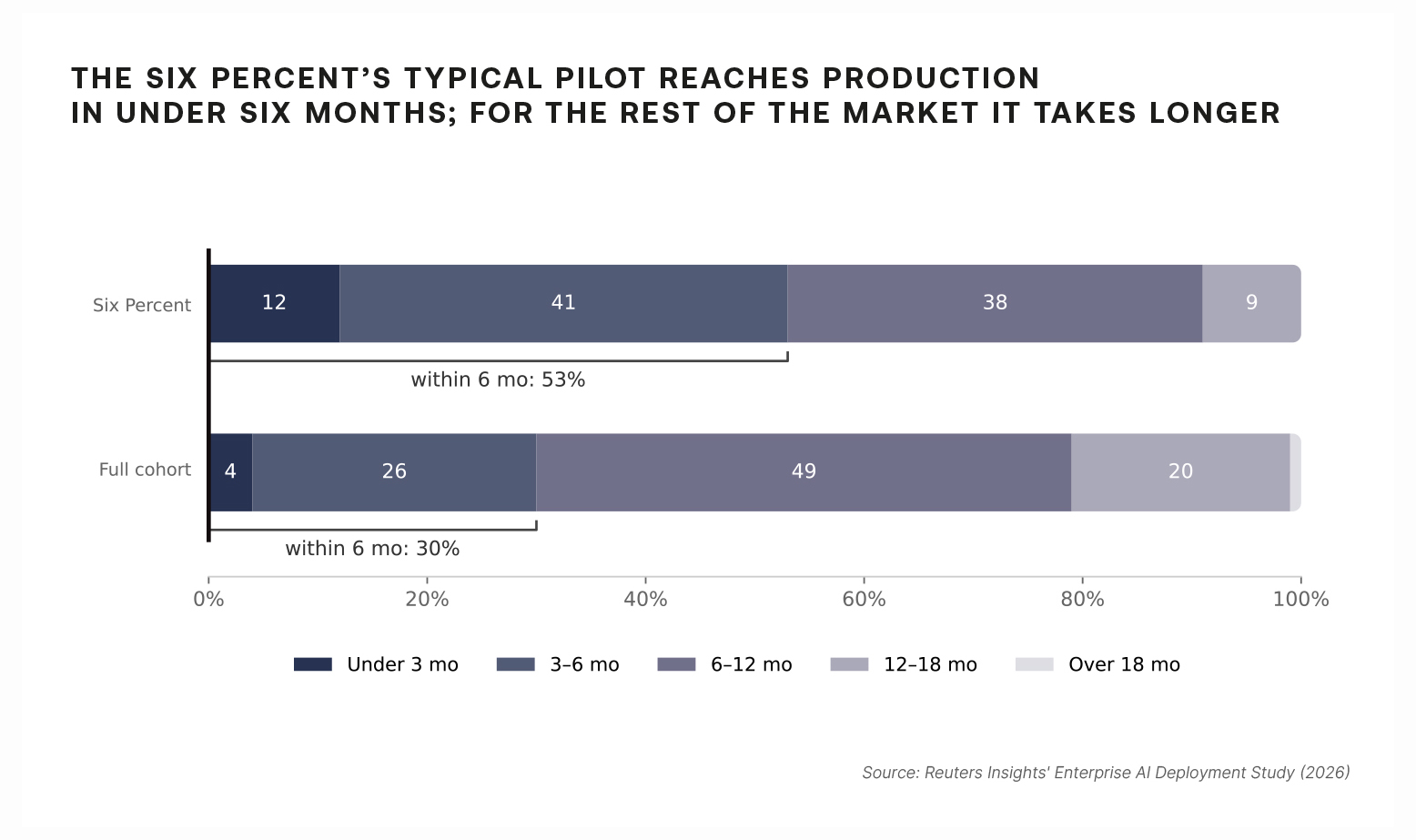
Where AI moves quickly through pilot, there’s more employee training and less human reviews. A new study that looked at 494 large companies found that just 32, merely 6%, had integrated AI thoroughly across most functions, moved a majority of pilots into full production, and felt they were significantly ahead of their internal targets, according to findings published this week from Scale, an AI startup that Meta invested in for $14.3 billion in June 2025.
Among the 6% cohort, Scale says 53% advanced pilots to full production within six months, far above the 30% of the broader cohort who reported the same pace of development. Two-thirds of the elite group also saw a measured business outcome within six months from when a pilot kicked off, versus 31% of the laggards.
The study also found that the more advanced group over-indexed on senior leadership sponsorship, training and change management, and data preparation and labeling—all by at least 10 percentage points. Conversely, they under-indexed by 15 percentage points on “ongoing human review and feedback.”
“When the senior leadership are willing to sponsor and invest in the change management and invest the time to incorporate AI into the workflows, things are going to dramatically change,” Emily Xue, head of enterprise AI at Scale, tells Fortune.
Courtesy of Scale
Hiring:
- New York Life is seeking a VP, head of corporate functions technology, based in New York. Posted salary range: $250K-$300K/year.
- Wego is seeking a global head of IT, digital, and AI, based in Great Neck, New York. Posted salary range: $300K-$400K/year.
- Crunchbase is seeking a director of IT and cybersecurity, a remote-based role. Posted salary range: $206K-$242K/year.
- JD Power is seeking a VP of global IT infrastructure and operations, a remote-based role. Posted salary range: $230K-$240K/year.
Hired:
- Stitch Fix appointed Sree Sreedhararaj as chief product and technology officer, where he will lead the online personal-styling services company’s technology, product, data science, security, and IT teams. Most recently, Sreedhararaj served as CTO at beauty product subscription service IPSY. He also previously held engineering leadership roles at Walmart and served as a consultant at Infosys.
- Mars appointed Kemal Cetin as global chief digital and information officer for the food and pet care giant’s snacking business, effective August 3. Cetin joins Mars from dairy cooperative FrieslandCampina, where he served as global business and digital solutions officer. He also previously worked at Diageo, Coca Cola Enterprises and Whirlpool.
- Goosehead Insurance announced the appointment of Eben Hewitt as CTO, joining the insurance broker from hospitality giant Hyatt, where he served as global CIO. Prior to Hyatt, Hewitt held senior technology leadership roles at Sabre Hospitality Solutions, Choice Hotels, and O'Reilly Media. At Goosehead, he will oversee data and analytics platforms and the expansion of AI capabilities.
- Opteon appointed Daniel Warren as global CTO, where he will oversee IT services, AI, and data for the appraisal property services company. Prior to joining Opteon, Warren most recently served as CTO at IT services firm Blueprint. He also previously held senior technology leadership roles including chief data architect at Nationwide and global head of data center analytics at Amazon Web Services.
- Acertus announced the appointment of Margaret Cartwright as CIO, where she will lead the automotive logistics company’s tech strategy, including platform engineering, infrastructure, and AI. Cartwright most recently served as CVP of data intelligence at food distributor US Foods and as CIO at land lender AgAmerica.
- Activate named Scott Shultz as CTO, joining the live-action gaming company after most recently serving as SVP of infrastructure and techops at auto lender Exeter Finance. Previously, Shultz served as VP of technology innovation at Topgolf and as a senior director at Holiday Retirement and NCR.
- KnowBe4 promoted Alex Callihan to the role of CTO, reporting to CEO Bryan Palma. Callihan joined the cybersecurity vendor in 2017 and has previously served as an engineer at Malwarebytes and ConnectWise.
此内容由惯性聚合(RSS阅读器)自动聚合整理,仅供阅读参考。 原文来自 — 版权归原作者所有。