


President Donald Trump announced Sunday that the U.S. Navy would immediately impose a blockade on the Strait of Hormuz after ceasefire talks with Iran failed to produce a deal.
That would turn the tables on the Islamic republic, which has effectively kept the narrow waterway closed with missile and drone strikes, keeping one-fifth of the world’s oil and liquefied natural gas bottled up in the Persian Gulf.
At the same time as it’s been halting global supplies, Iran is letting its own oil exports through the strait, capitalizing on the massive spike in prices for crude.
But a U.S. blockade of Hormuz would cut off the financial windfall Tehran is reaping and further hobble an economy that was crashing even before the war started six weeks ago.
Retired Admiral James Stavridis, who previously served as NATO’s supreme allied commander, estimated that blockading the Strait of Hormuz would require two aircraft carrier strike groups that would provide air cover, plus a dozen destroyers and frigates operating outside the Persian Gulf.
Another half dozen U.S. warships as well as vessels from the UAE and Saudi navies would also be needed inside the Gulf, he told CNN on Sunday.
“So you try and bottle it up on both sides,” Stavridis added. “The bottom line: This is a big task, and it’s a big gamble.”
Just before the U.S. and Israel began bombing Iran, 18 warships were in the Middle East, according to the Center for Strategic and International Studies. That included two aircraft carriers and the escort ships that are part of each strike group.
Since the war started, the U.S. has deployed a Marine Expeditionary Unit, which typically includes three warships and more than 2,000 Marines. Another MEU and a third carrier strike group are on their way to the Middle East.
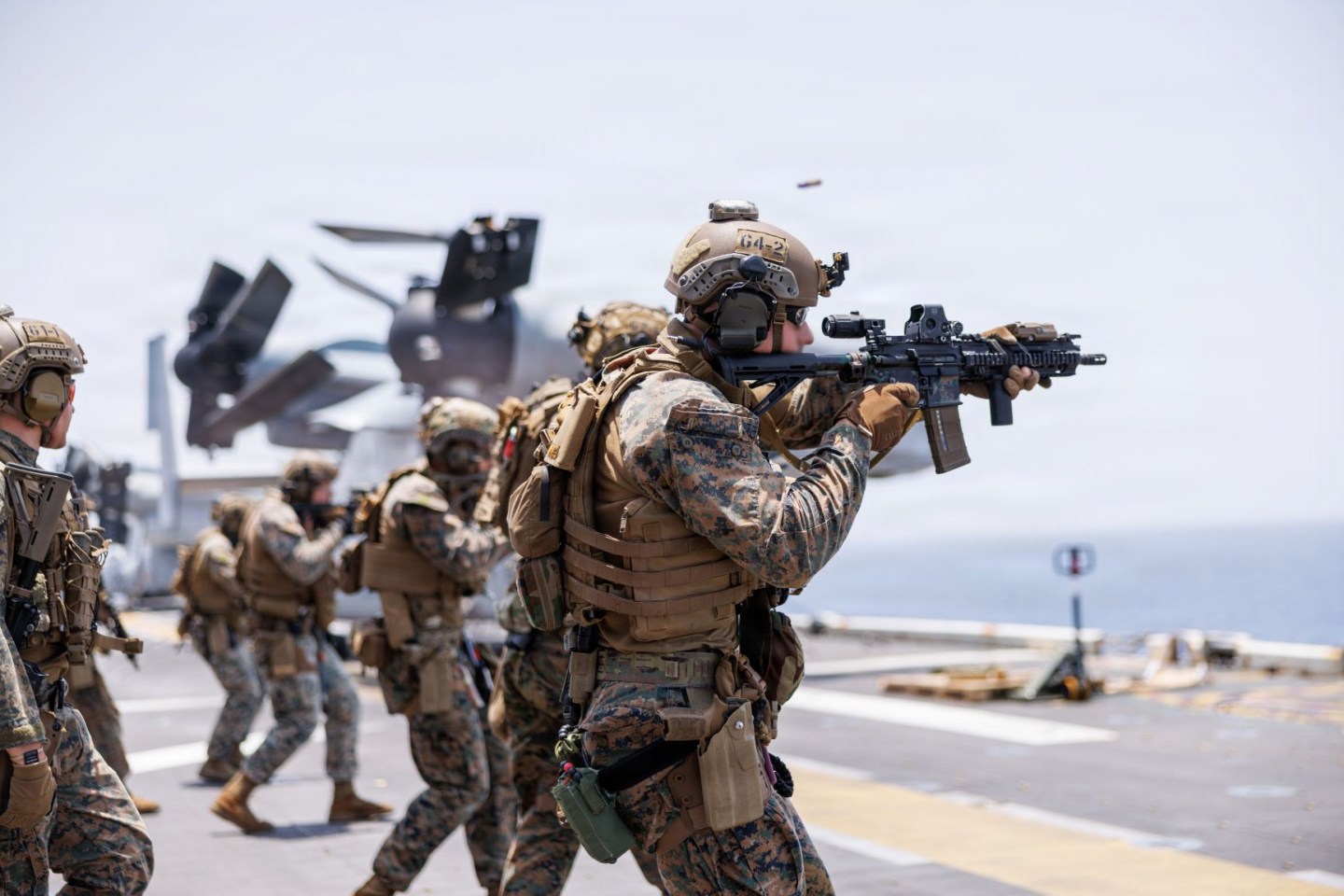
Courtesy of the U.S. Marine Corps
Stavridis characterized a blockade of the strait as falling halfway between leaving it under Iranian control and Trump’s earlier threat to wipe out Iran as a civilization.
“It puts economic pressure on Tehran without destroying the oil facilities, which you should want to preserve into the future,” he said. “So [a] big complicated undertaking, hardly a trivial move on the chessboard we’ve been watching.”
Cutting off the trickle of oil that’s been coming out of the Persian Gulf would likely send energy markets into more turmoil. Futures have already soared, and prices for delivery of physical barrels are even higher as shortages mount.
Markets would also fear renewed fighting since a blockade would be perceived as a hostile act that triggers retaliation from Iran. U.S. warships near the strait could be vulnerable as Navy officials previously have described it as an Iranian “kill box” filled with numerous threats, including anti-ship missiles, drones, fast-attack boats, and mines.
But two destroyers crossed the strait on Saturday to begin setting conditions for clearing mines and eventually establishing “a new passage” for the maritime industry for the free flow of commerce.
Stavridis said that Iranian ships could try to look for ways around a blockade to smuggle oil or deploy more mines. He also warned Russia and China could come to Iran’s aid with cyberattacks.
Despite the risks of a blockade, analysts have touted it as an option that would avoid putting boots on the ground.
“The U.S. can implode Iran’s economy by shutting down its oil exports,” Robin Brooks, senior fellow at the Brookings Institution, wrote in a Substack on March 13. “That might open up the Strait of Hormuz a lot faster than anything else. Time to implode Iran’s economy and give the ayatollahs a taste of their own medicine.”
While he has been skeptical that the U.S. Navy has enough ships to escort all the tankers that typically transit the Strait of Hormuz, he said it has the resources to blockade Iran’s oil exports.
Removing more supply from global oil markets should send prices even higher, but Brooks argued crude might do the opposite if a U.S. blockade is seen ending the war quickly.
China, which buys most of Iran’s oil, would be incentivized to lobby Tehran to reopen the strait, and a blockade of Iran’s exports would deprive the regime of hard currency needed to prop up its war machine, he added.
“An embargo of Iranian oil, if the collapse in Iran’s economy is deep enough, could convince markets that the closure of the strait might end sooner rather than later. As a result, Brent might only spike briefly or even fall,” Brooks wrote in a later post.
此内容由惯性聚合(RSS阅读器)自动聚合整理,仅供阅读参考。 原文来自 — 版权归原作者所有。