


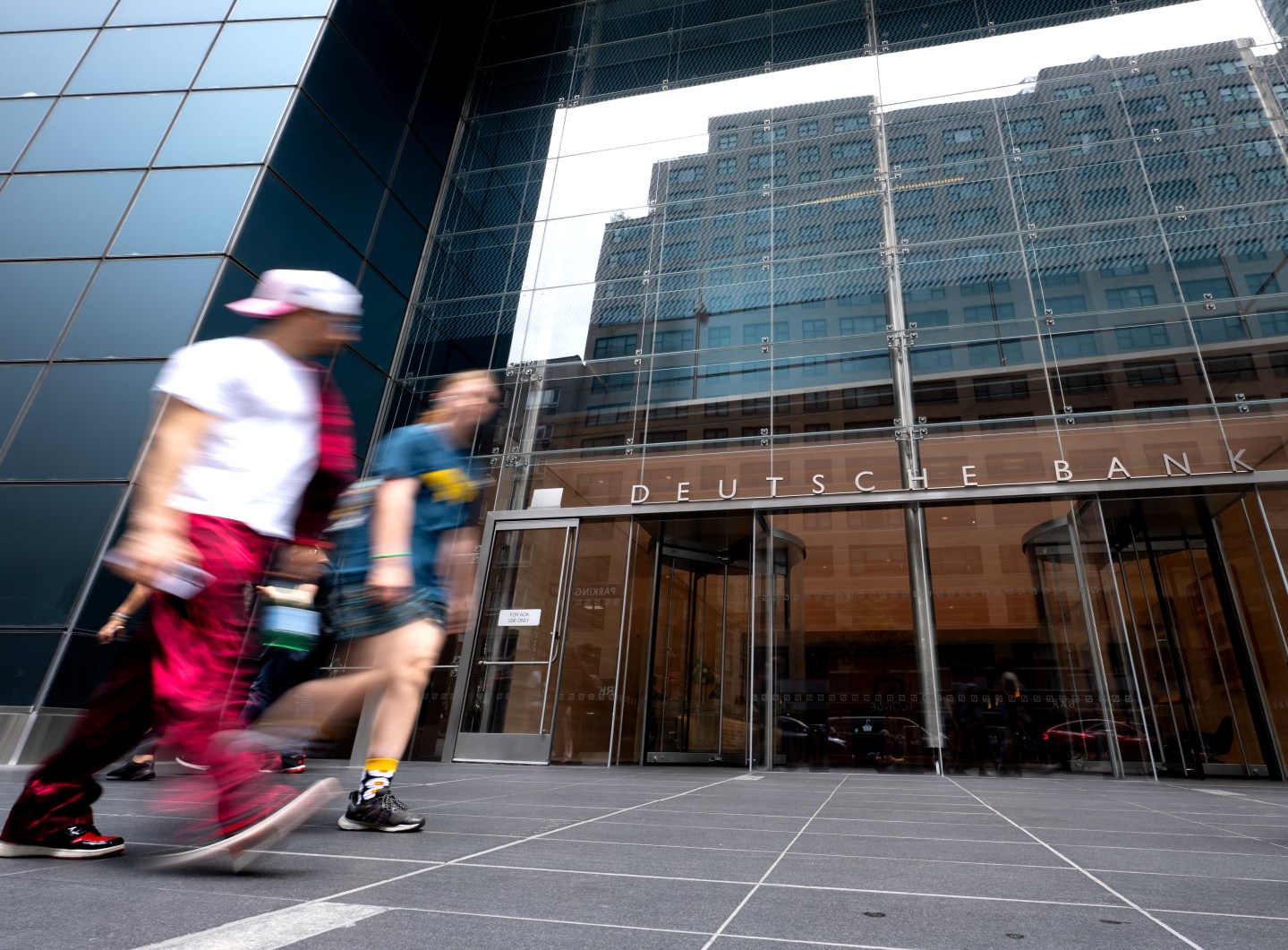
SVEN HOPPE—Picture Alliance/Getty Images
Internal communications, trading confirmations, and cash‑handling emails released by the DOJ show Epstein’s money still pulsing through the bank’s systems well into 2019; his aides still getting concierge‑level service on six‑figure cash pickups; and his banker, Oldfield, still treating him as an A-List client in the lead-up to his arrest.
Perhaps most seriously in terms of Epstein’s victims—the women and girls he raped and trafficked—Deutsche maintained a special account for Epstein until it was emptied May 2019 and closed two months later. It was named “The Butterfly Trust,” according to a presentation by the Southern District of New York and DOJ files, and it was used to make nearly $3 million in payments to “alleged co‑conspirators or women with Eastern European surnames, for the stated purpose of covering hotel expenses, tuition, and rent,” according to documents filed with New York state. And, as emails reviewed by Fortune show, Deutsche staff who asked questions about who these women were, and why they received such large amounts of cash, were repeatedly brushed off by Epstein’s client-handlers at the bank. The account was one of two still open days after Epstein’s 2019 arrest.
The files reviewed by Fortune—internal trade confirmations, email chains, and newly detailed financial accounts from Epstein’s in‑house trader Paul Barrett—call into question the story Deutsche Bank and New York regulators agreed to in 2020: that a high‑risk client onboarded in 2013 despite his 2008 sex‑crime conviction was monitored badly and finally terminated in December 2018 after a fresh wave of negative press.
Instead, the records show a bank that welcomed a convicted sex offender with open arms—giving him access to senior executives, tailored trading lines, and bespoke structured products—and then took months to fully close the door even after the risks became impossible to ignore.
“As we said in 2020, we acknowledge our error of onboarding Epstein in 2013 and the weaknesses in our processes, and have learnt from our mistakes and shortcomings. Immediately following Epstein’s arrest, we contacted law enforcement and offered our full assistance with their investigation. We have been fully transparent and have addressed these matters with our regulators, adjusted our risk tolerance and systematically tackled the issues,” a spokesperson for Deutsche Bank told Fortune. “We have invested significant sums in training, controls and operational processes, and have increased our anti-financial crime team. We have repeatedly stated that we deeply regret our association with Epstein.”
The spokesperson emphasized that the bank “notified Epstein in December 2018 that the bank intended to close his accounts. The bank worked to ensure that Epstein’s assets were transferred out of the bank in the following months.”
According to an internal bank source, by May 2019 (three months after the original deadline given to Epstein), his accounts were drawn down to zero or nominal interest balances, while certain accounts allegedly required manual closure.
The gap between the timeline Deutsche Bank gave its regulator, which appears to be inaccurate, and the timeline the documents describe is where potential legal exposure for the bank begins. The consent order was signed for the bank by its various general counsel staff and heads of litigation—senior lawyers who attested that its factual claims were accurate.
“Anytime you affirm something, you’re basically saying, I swear this is the truth,” Priya Chaudhry, a high-profile white-collar criminal defense lawyer, told Fortune. “Once you submit something like that, you can be prosecuted for making false statements.” Chaudhry drew a line between two kinds of inaccuracy. “Incorrect is, you make a mistake. False is when you know that you’re either saying something that isn’t true in a material way, or you’re omitting something on purpose so that you deceive,” she explained.
The relevance for a corporation, she said, runs through the people who sign. “Whenever you have a corporation, like a bank, it’s a thing. It can only act through people. And so then the question is, is the person who’s making the affirmation aware of whether or not that is accurate? In something like this, those people have a duty to become knowledgeable about it. They can’t put their head in the sand.”
“In something like this, those people have a duty to become knowledgeable about it. They can’t put their head in the sand.”
Priya Chaudhry
That duty matters because the relevant New York statutes don’t require affirmations to be in a public court filing or a press release.
Under New York state statute section 175.10, “falsifying business records in the first degree” is a felony. Under that law, intent has only to include the aim of concealing another offense.
A separate statute, “offering a false instrument for filing, ”under section 175.35, prohibits offering a document containing false information to a public agency. It is also a felony.
And section 175.05, “falsifying business records in the second degree,” an internal record alters the legal calculus the moment “the intent to defraud” attaches. Breaking this law is a misdemeanor.
New York’s Department of Financial Services (DFS) qualifies as a public servant, said Steve Pilnyak, former chief of the Manhattan District Attorney’s oversight and investigations unit. The question is what was on the page when the bank handed it over, and what the people whose names were on it knew. “If DFS knew that they lied to them in this way and they still entered into a plea and didn’t do anything about it,” Pilnyak told Fortune, “that would be very detrimental to DFS.” He believed the regulator would be “very interested” in any evidence that the August 2013 to December 2018 timeframe the order cites was not the relationship’s true length.
An internal bank source told Fortune that DFS must have been aware that Epstein’s accounts were still open well into 2019 because the consent order references a pair of reference letters which they say were written for Epstein in 2019. The year 2019, however, is never mentioned in the consent order and the reference letters are the only items included that allegedly occurred that year.
The New York Department of Financial Services repeatedly declined a Fortune request for comment.
According to both Pilnyak and Chaudhry, the through‑line for both statutes is the same: a record kept inside a company can become a crime when the company’s people know it doesn’t match reality. “The records can be kept anywhere: in a cabinet, computer, or in the cloud,” said Chaudhry. “You don’t even have to give them to anyone to be criminally liable.”
When Epstein first surfaced as a prospect in 2013, one of Deutsche’s star private bankers, Paul Morris, newly arrived from J.P. Morgan, which had also handled Epstein’s business, presented him as both a risk and an opportunity, a previous Fortune investigation revealed. A relationship coordinator’s memo didn’t hide his 2008 plea to soliciting a minor for prostitution, nor the fact that he had been accused of paying “young woman [sic] for massages” in his Florida home, according to the consent order. It noted 17 civil settlements with alleged victims and his status as a registered sex offender. But it also described a potential bonanza: “100–300 million” in prospective cash flows, $2–4 million a year in revenues, and introductions to other rich clients.
The internal debate that followed was short. The co‑head of Wealth Management Americas and the regional COO canvassed the head of anti‑money‑laundering and the bank’s general counsel informally. The answer came back in an email from one of the bank’s managing directors that has since become notorious inside Deutsche Bank: “we can move ahead so long as nothing further is identified through KYC and AML client adoptions,” it said. The initials refer to “know your customer” and “anti-money laundering” regulations.
Crucially, the decision to not escalate the decision to the Americas Reputational Risk Committee before onboarding, according to the consent order, went against bank policy. It was mandated that clients believed to potentially pose a reputational risk to the bank be escalated for review by that committee. The bank instead classified Epstein as “high‑risk” and an “Honorary PEP,” (politically exposed person), flagging him for enhanced monitoring, but accepted him as a client anyway.

Courtesy of United States Department of Justice
Once inside, Epstein didn’t behave like a conventional private‑bank customer. He behaved like a small hedge fund plugged directly into an investment bank’s dealing rooms. Deutsche Bank opened more than 40 accounts for Epstein, his entities, and his associates. Some were routine checking and money‑market accounts, including personal accounts used to fund everyday expenses and cash withdrawals. Others were brokerage and custody accounts for Southern Financial LLC and Southern Trust Company, vehicles in the U.S. Virgin Islands through which he held much of his wealth.
Epstein could deploy interest‑rate swaps, foreign‑exchange options, and more exotic structures out of Deutsche Bank’s London branch. In internal know-your-customer materials from 2017, the bank described his in‑house trader, Paul Barrett, as “a talented full‑time trader” who had been “JE’s primary contact when he worked at JPM” and now ran positions for Epstein via a registered investment adviser called Alpha Group. Barrett, it said, had been “hired to trade financial markets for him,” leveraging his J.P. Morgan experience.
Barrett didn’t respond to a Fortune request for comment.
The “trade blotter”—a log of transactions—from 2018 shows how far that mandate went. In May of that year, Deutsche Bank’s London desk issued confirmations for large euro currency options for an account in the name of Southern Financial, a company Epstein owned. Epstein’s account was able to take views on, or hedge, vast euro-dollar currency moves. On May 3 and May 8 of that year, his entities entered Argentine peso trades totalling ARS 88,291,500 against $3,738,372.18 in notional value at the height of that country’s currency crisis, when the Argentina central bank hiked interest rates to 40%.
Then, on May 22 and again in June, the bank confirmed an interest‑rate swap with Southern Financial for a notional amount of $45 million. One Deutsche Bank internal memo reviewed by Fortune summed up his portfolio aptly: “Jeffrey is one of our most sophisticated clients and has also been one of our most challenging.”
At the other end of the spectrum sat something less complex but more viscerally troubling: bundles of cash. Between 2013 and 2017, according to New York’s banking regulator, Epstein’s personal attorney made 97 cash withdrawals from Deutsche Bank accounts, totaling more than $800,000, the consent order shows. Almost all were for $7,500, the bank’s internal ceiling for withdrawals that didn’t require the account holder to appear in person. The regulator said that was consistent with “structuring” to avoid enhanced scrutiny. Banks are required to report to regulators any time a customer transacts more than $10,000, in order to deter criminals from moving large amounts of money easily.
Epstein and his representatives also sent wires above the $10,000 threshold throughout his time at the bank, including at least 18 of which were sent to unnamed alleged co-conspirators of the disgraced financier, the consent order with DFS details. Deutsche Bank, the consent order says, was aware of these individuals’ suspected involvement in Epstein’s operation.
One internal email quoted in the consent order said that Epstein’s attorney, Darren Indyke, asked a branch employee how often he could withdraw cash “without creating some sort of alert.” The question was escalated, but there is no record that the bank issued a firm answer or insisted on changing the behavior.
Indyke, through his attorney, told Fortune that he had no input into the DFS consent order, “was not interviewed in its preparation, was not asked to consent to its entry, and disagrees with several of its statements and conclusions.” He added, however, that the large amount of cash being withdrawn in general was because “following his prison term in 2008, Mr. Epstein didn’t have ready access to credit cards and instead required cash to pay for a wide variety of items.”
Emails between wealth‑management staff and Epstein’s office show how that pattern played out. In September 2017, under the subject “Large withdrawal,” one Deutsche vice president coordinated a $35,000 cash withdrawal from the “Jeffrey E. Epstein” account. He told an assistant branch manager that Epstein’s lawyer, Indyke, armed with power of attorney, would collect the money and was a “familiar face at the branch.” To satisfy the know‑your‑customer checklist, Bradley Gillin, a vice president at Deutsche Bank, provided Epstein’s Social Security number, listed his occupation as “President of Southern Financial LLC,” described Indyke as his in‑house lawyer, and confirmed Epstein’s address on Little St. James in the U.S. Virgin Islands. He also offered an explanation: Hurricane Irma had damaged Epstein’s home in St. Thomas, the island had “no power,” and “cash is the only way to insure payment to construction crews.” When Indyke’s ID on file had expired, staff quickly confirmed that a current ID was available; shortly afterward, the branch reported back that “the cash is all ready.”
Indyke’s representative added that Indyke “can’t comment on specific transactions from more than eight years ago, or on Mr. Epstein’s motivations for appointing executors to any trust he created before his death.”
Gillin didn’t respond to a Fortune request for comment.
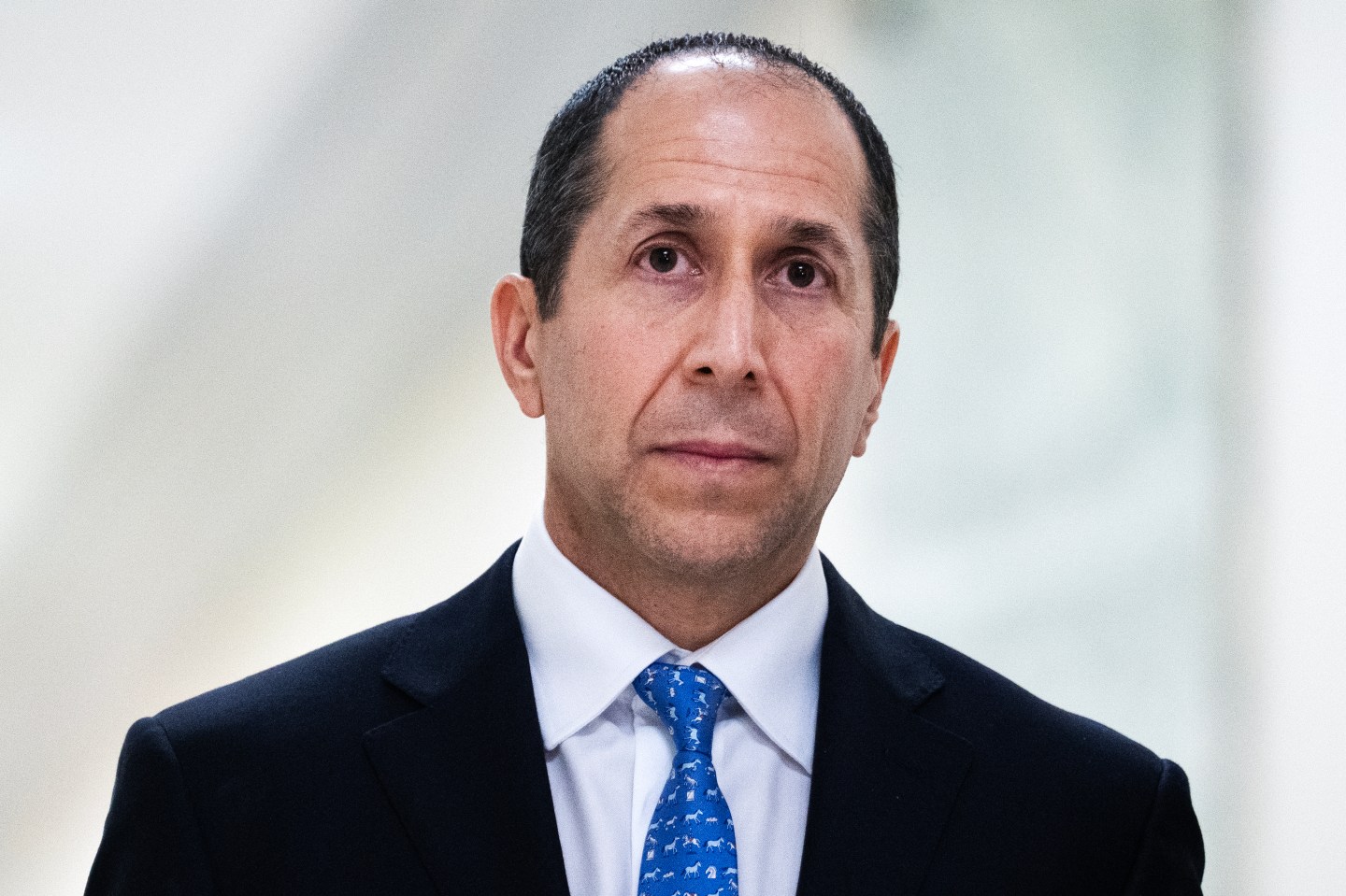
TOM WILLIAMS—CQ-Roll Call/Getty Images
Four months later, in January 2018, an assistant vice president at the bank and Epstein’s accountant, Richard Kahn, arranged a $100,000 withdrawal. Their exchange reads like a luxury‑bank concierge service. The banker explained that the Park Avenue branch could either provide $60,000 in $100 bills and the remaining $40,000 in fifties that week, or wait a few days to deliver the entire amount in hundreds. Kahn answered that “all 100s are ok.” They fixed a Tuesday pickup “around 11am.” The banker reminded him that “Darren” would need to bring photo ID.
Kahn’s attorney declined a request for comment on his behalf and referred Fortune to his testimony before the House Oversight Committee in March 2026 during which he denied having knowledge of Epstein’s crimes. During his testimony, he never addressed this transaction.
Regulators later concluded that the broader pattern—frequent $7,500 withdrawals, occasional six‑figure cash pickups, and limited documentation of how that cash was used—should have raised more serious suspicions, according to the consent order.
“It is a matter of public record that, during the time period covered by the consent order, Deutsche Bank had a $7,500 limit on daily cash withdrawals; it couldn’t have been “structuring” for Mr. Indyke to comply with those Bank requirements,” Indyke’s attorney told Fortune in a written statement. He rejected any suggestion that Indyke “knowingly facilitated or assisted Mr. Epstein in his sexual abuse or trafficking of women, or that he was aware of Mr. Epstein’s actions while he provided legal services to Mr. Epstein.” Indyke has not been charged with any crimes in connection to Epstein.
When Christian Sewing took over as chief executive of Deutsche Bank in April 2018 he almost immediately had to tackle several different crises at the same time:
First, the bank announced global headcount would be cut from about 97,000 to below 90,000. Then U.S. regulators added the bank’s U.S. business to a group of troubled lenders monitored by the deposit insurance regulator, and Deutsche Bank’s stock fell to a record low, Bloomberg reported. The next day, the Wall Street Journal reported that the Fed had classified Deutsche Bank’s U.S. operations as being in “troubled condition.” This label is one of the Fed’s most severe classifications, with constraints affecting trading and customer lending.
That news was quickly compounded by S&P downgrading Deutsche Bank’s long-term issuer credit rating from A- to BBB+, citing execution risks in the bank’s restructuring and weak profitability. All the while, the bank also faced anti-competition charges in Australia over a share issue.
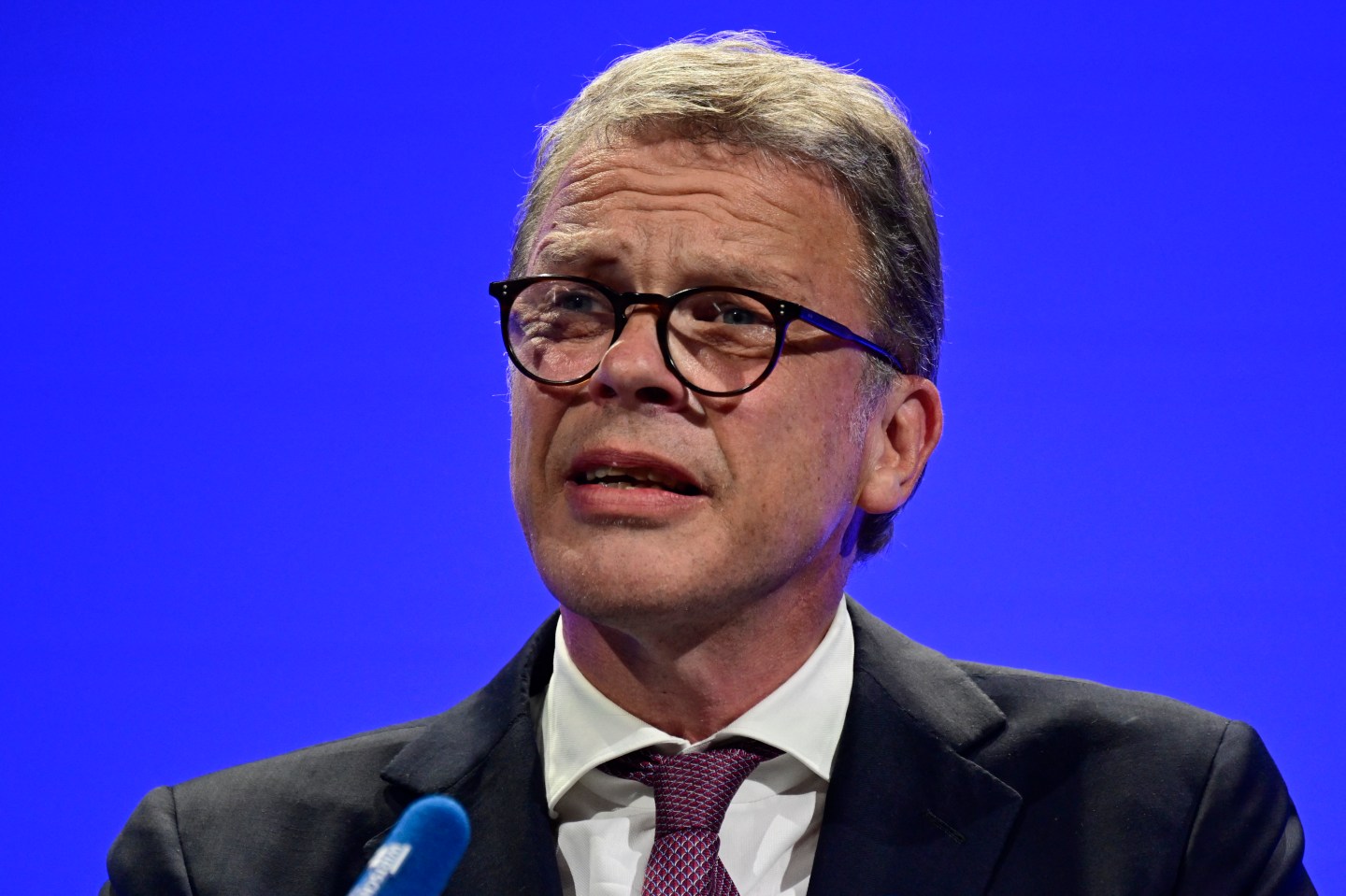
JOHN MACDOUGALL—AFP/Getty Images
The new boss agreed to host a private call for select U.S. wealth clients to explain “Deutsche Bank in the news” and outline his vision. Oldfield, the wealth director who handled the Epstein relationship at Deutsche starting in 2017, decided two of those clients should be Paul Barrett and Richard Kahn. There is no evidence that Sewing knew Epstein’s people were on the call.
“Paul and Rich,” Oldfield wrote on May 31, 2018, “We’ve arranged a client call [tomorrow] with Christian Sewing to discuss the recent news cycle and talk more specifically about our US business. I thought it might be helpful for you to hear the story directly from the source since you’ve both asked about it recently.” The next morning, a few hours before the call, Kahn replied: “thanks please call when free as i wanted to talk about our euro account.” Oldfield wrote back that his flight was delayed and that he was “free for an hour now and again after noon.”
Deutsche Bank has since told the Financial Times that neither Epstein nor his staff actually dialled into the Sewing call. Nonetheless, at the very moment when the bank’s new chief was trying to reassure clients about its future and standing, one of Sewing’s employees was trying to get Epstein’s accountant on a conference call with the CEO.
Internally, there were sporadic attempts to slow the relationship. In late 2014 and early 2015, as new civil suits and press reports brought Epstein’s past back into focus, Deutsche’s Americas Reputational Risk Committee finally took up his file. Three senior wealth executives visited his 28,000-square-foot Upper East Side townhouse for a brief meeting. They met with Epstein in his in-house conference room, which was decorated in an opulent style—lacquered cabinetry, intricate silk wallpaper and lush upholstered chairs, according to individuals present who later spoke to Fortune. During the meeting, the trio reported to the committee, Epstein downplayed the allegations and presented himself as a victim of sensational media coverage.
The committee opted not to exit. Instead, it agreed to “continue business as usual,” with three conditions: that large or “unusually significant” transactions should be scrutinised; that any corporate‑banking activity for Epstein be coordinated with wealth management; and that staff remain alert to reputational risk.
Those conditions were never fully or consistently communicated to all the relationship managers and traders serving him, according to the consent order and a class action lawsuit filed against Deutsche Bank. One monitoring officer later resolved an alert about payments to a Russian model with the line, “this type of activity is normal for this client,” in an email.

KEVIN HAGEN—Getty Images
The federal Bank Secrecy Act and its implementing rules require banks to use risk-based anti-money-laundering and customer-due-diligence procedures. Banks are expected to develop customer risk profiles, apply more scrutiny to higher-risk customers, and conduct ongoing monitoring to identify and report suspicious transactions, according to the FFIEC BSA/AML Examination Manual. When a financial institution detects activity that may signal criminal conduct, it must file a Suspicious Activity Report (SAR), generally within 30 days. Those reports, however, are confidential.
Deutsche Bank declined to comment on whether or not SARs were filed in relation to Epstein.
For Epstein in particular, whom the bank itself had already classified as “high‑risk,” the legal duty to ask questions rose. “When a bank has a customer that they know has been credibly accused of certain criminal acts,” Chaudhry, the criminal defense lawyer, said, “they are on heightened notice. So that all falls under their KYC and anti‑money‑laundering responsibilities.”
If Epstein’s brokerage accounts were where Deutsche Bank’s front office made money, a small trust opened in early 2014 is where, in retrospect, the bank’s compliance failures are easiest to read.
Epstein created the Butterfly Trust on December 27, 2006—about a month after the FBI began interviewing witnesses in its sex‑trafficking probe of him, according to a Miami Herald timeline cited in Deutsche Bank’s own records. The original beneficiaries included Ghislaine Maxwell, Epstein’s former girlfriend and fixer. Epstein’s attorneys, Darren Indyke and Richard Kahn, were appointed trustees.
The New York Department of Financial Services would later conclude that the beneficiary list included three of Epstein’s alleged co‑conspirators and “a number of women with Eastern European surnames.” When bank personnel asked Epstein and his representatives how he knew them, the consent order says, he “represented that they were employees or friends.” The Butterfly Trust was not separately escalated to Deutsche’s Americas Reputational Risk Committee, according to the consent order; like the rest of the Epstein relationship, it was approved on the back of the initial onboarding email (cited in the consent order) that said the bank could “move ahead so long as nothing further is identified.”
But something “further” had already been identified. In October 2013, three months before the trust account opened, a Deutsche Bank compliance officer ran background checks on the beneficiaries and flagged that one individual (whose name is redacted in the filings reviewed by Fortune) had been publicly alleged to be one of Epstein’s co‑conspirators. The relationship coordinator’s reply, quoted by DFS, didn’t contest the point. “[She] was accused as a co‑conspirator in a case but was never brought to trial nor ever convicted,” the coordinator wrote. The alert was cleared on the strength of the original 2013 approval email—the one that infamously said, “we can move ahead so long as nothing further is identified.”
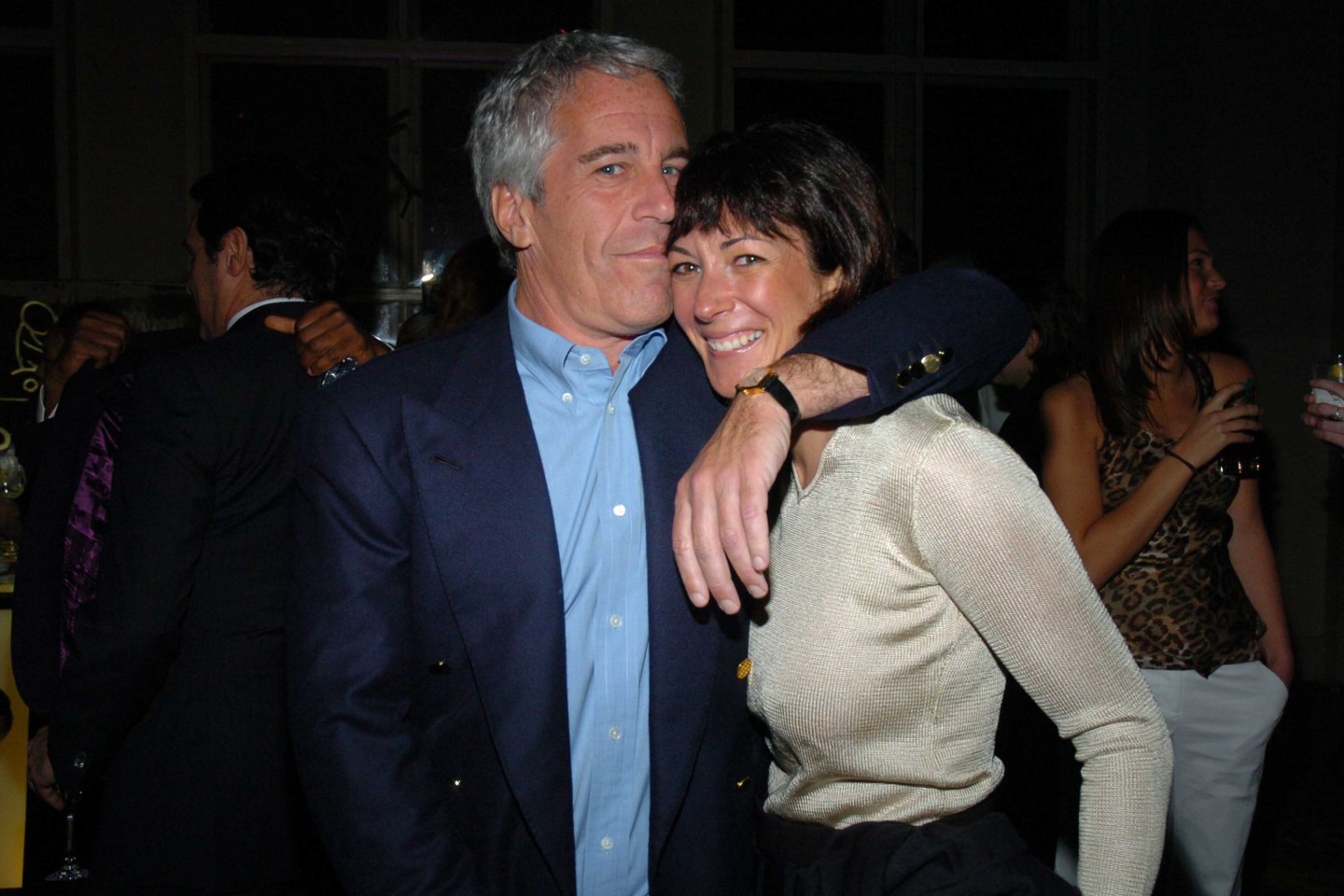
JOE SCHILDHORN and PATRICK MCMULLAN—Getty Images
Over the next five years, DFS found, Epstein used the Butterfly Trust account and other accounts to send “over 120 wires totaling $2.65 million” to Butterfly beneficiaries, “including some transfers to alleged co‑conspirators or women with Eastern European surnames, for the stated purpose of covering hotel expenses, tuition, and rent.”
While this might be suspicious on its face, Chaudhry, the criminal defense lawyer, said she was uncomfortable with banks using “Eastern European last names” alone as a basis for suspicion. The heightened‑notice doctrine doesn’t turn on national origin. It revolves around what the bank already knows about the client paying the bill, she said.
The Butterfly’s cast of beneficiaries—people who received money—kept changing.
A timeline of the trust prepared by Deutsche Bank for federal prosecutors in September 2019, and reviewed by Fortune, lists more than a dozen amendments between 2011 and 2017. On December 9, 2014, two new “acting trustees”—Harry Beller and Erika Kellerhals, the latter at a law firm in St. Thomas—deleted Maxwell and added Karyna Shuliak, Epstein’s girlfriend. In her KYC, Shuliak, a Slovakian national, was listed as a “Student/Interior Decorator.” Indyke and Kahn were added to the beneficiary roster as well.
Shuliak, through her attorney, declined a Fortune request for comment. Neither Beller nor Kellerhals returned a Fortune request for comment.
In late 2016, according to KYC records summarized in the bank’s prosecutor presentation, the female beneficiaries’ listed professions, where the bank captured them, ranged from “Student/Interior Decorator” to “Homemaker” to no entry at all.
Through 2017 and 2018, Epstein’s banking continued to generate internal compliance inquiries.
In March 2017, a transaction monitoring officer reviewing alerts on payments to a Russian model and a Russian publicity agent closed the alert in an email that said: “Since this type of activity is normal for this client it isn’t deemed suspicious,” according to the consent order.
“Since this type of activity is normal for this client it isn’t deemed suspicious.”
2017 Deutsche Bank Employee Internal Email
A year later, a compliance officer asked Epstein’s relationship manager about the wires to “women with Eastern European surnames” at a Russian bank. The reply, forwarded from Epstein’s accountant and reproduced in DFS’s order, was eight words in capital letters: “SENT TO A FRIEND FOR TUITION FOR SCHOOL.” When the compliance officer pressed, the relationship manager wrote that Epstein had “separate accounts to manage each of his properties,” but that “when making one‑off transfers to people, he and his finance staff have the flexibility to use any account they like that is funded.” The transaction was ultimately cleared.
That same fall, even as Deutsche Bank’s senior wealth executives were reevaluating the Epstein relationship after the Miami Herald series, Oldfield pushed to keep the Butterfly Trust’s paperwork moving. “Rich, please send the KYC approval for our Butterfly account along with contact info for Harry and Erika,” he wrote on October 22, 2018. To a colleague in compliance on the same chain, he added: “Perhaps Alan can exert some pressure for Dan to approve.”
The trust didn’t quietly wind down with the rest of the Epstein relationship.
According to the bank’s presentation to federal prosecutors investigating Epstein, the Butterfly Trust’s money‑market account was only closed on July 9, 2019—three days after Epstein was arrested—with the funds appearing to transfer to a Fidelity account in the trust’s name. On July 10, an automated notice from Deutsche Bank’s customer relationship system confirmed the change: “All the Accounts associated to Butterfly Trust are now closed… the Status has been changed from Active to Inactive, and the ‘Former Client’ field has been checked.”
But closing the accounts didn’t end the bank’s internal review of what had moved through them. On July 16, Kimberly Hart, a managing director and divisional control officer in Wealth Management Americas, wrote to Patrick Campion, the head of the unit, under the subject line “Payments,” according to the DOJ files. Her note flagged two transfers, cleared months earlier, totalling $350,000, to redacted recipients.
Both recipients, Hart wrote, appeared in media reports as alleged accomplices of Epstein. One had been “designated as such in the original KYC” of the Butterfly Trust and “removed as a beneficiary in late 2014.” The other was associated with a current Butterfly Trust beneficiary. “Both,” Hart concluded, were “alleged accomplices.” And both individuals had been on the Butterfly Trust’s beneficiary list, in one form or another, since the trust was first onboarded in 2014.
Neither Hart nor Campion returned a Fortune request for comment.
Whether those payments were used to settle old claims, support friends, cover tuition, or for some other purpose is, as DFS framed the broader cash question, a matter “that must be left to the criminal authorities.”
By 2018, the pressure on Epstein had increased. The Miami Herald’s investigation into his Florida plea deal and his non‑prosecution agreement with federal prosecutors sparked a national outcry. Within Deutsche Bank, senior wealth executives evaluated the relationship for a third time. It was then, according to people familiar with an internal review who talked to the Financial Times, that Oldfield told colleagues Epstein was generating more than $1 million a year for the bank and had approximately $200 million on account, internal emails detail. A decision was made in December to terminate the relationship, the consent order says. However, Fortune was not able to corroborate this date. Instead, the earliest internal correspondence confirming any sort of offboarding of Epstein obtained by Fortune occurred on Jan. 4, 2019, in regards to cutting ties with one of the financier’s more than 40 accounts at the bank.
Yet the decision didn’t instantly alter the bank’s behavior. Months later, in April 2019, one of Epstein’s accountants wrote to Deutsche Bank asking for $7,500 to be shipped to her and for €50,000 in cash to be delivered to Indyke. When compliance staff questioned the orders, Oldfield defended them as ordinary.
“This is a fairly typical withdrawal for them,” he said in one internal exchange. “Jeffrey has an apartment in Paris and likes to have cash with him when he travels there.”

ADNAN FARZAT—NurPhoto/Getty Images
Oldfield and Khan continued to chat over email in the time leading up to Epstein’s arrest, even scheduling a dinner with each other days before Epstein was taken into custody. And, despite the offboarding process, Oldfield ensured Epstein’s in‑house trader Paul Barrett was invited to exclusive Deutsche Bank events, including the Frieze modern art fair in New York.
Around the same time, he was also helping Epstein facilitate a property deal. A private bank in Liechtenstein handling a transaction involving one of Epstein’s trusts linked to his Belarusian girlfriend Karyna Shuliak’s attempt to buy a $23 million “palace” near Marrakech, Morocco, was asking for proof of funds, according to the DOJ files.
Kahn told Congress in March that he was aware Epstein was pursuing a property in Morocco and had an interest in the country. (Morocco doesn’t have a formal extradition treaty with the U.S. but the nations are allies.)
But the trust’s Deutsche Bank accounts were by that time empty. In an email, Kahn, Epstein’s accountant, told Epstein that Oldfield had suggested “redacting” financial statements of the trust’s parent companies to “show significantly more assets” to the Liechtenstein bank. After Oldfield spoke directly with the Liechtenstein banker, Kahn sent a follow‑up asking him to “confirm you didn’t disclose Mr Epstein’s name.”
Kahn testified to Congress that “Epstein held stocks and securities. He had plenty of funds in the account.”
Of all the conduct the documents describe, the exchange around the Liechtenstein property bank is the one Chaudhry said could sit squarely under federal bank fraud law, as opposed to New York state law. The relevant statute, 18 U.S.C. Section 1344, makes it a federal crime to defraud a financial institution, or to obtain its money or property by means of false pretenses, even if that institution is foreign. Unlike most federal fraud statutes, Section 1344 carries a 10-year statute of limitations, and is punishable by up to 30 years in prison and a $1 million fine, per count.
“Even trying to get a line of credit for someone else by sending a fraudulent letter is an attempt at bank fraud,” she told Fortune. Either Deutsche Bank as an entity, or the individual banker, she said, could in principle face exposure: “That’s the problem with corporate liability—both the corporation and the individual can be charged.”
Neither Oldfield nor Deutsche Bank have ever been charged with or convicted of bank fraud as it relates to their relationship with Epstein. According to Finra filings reviewed by Fortune, however, Oldfield was eventually terminated from Deutsche Bank for an alleged “lack of expected … diligence for a particular client.”
And, as of late April 2026, Oldfield has since stepped down CEO of Third Lake Associates, a US financial advisory and broker-dealer firm targeting real estate transactions, according to Bloomberg.
The Liechtenstein debacle set the stage for what happened next. On July 6, 2019, Epstein was arrested at Teterboro Airport in New Jersey as he was trying to board his Gulfstream private jet. He was transported to New York and charged with sex trafficking of minors. In the early hours of Sunday, July 7, a Deutsche senior executive circulated the news internally. A few hours later, Patrick Campion, head of Wealth Management Americas, wrote to Oldfield: “Hi Stew—I recall that all accounts are closed out. Please confirm back. Thanks.”
For at least two years, Oldfield had been the person who arranged Epstein’s cash pickups, booked dozens of millions in swaps, and who slowrolled his offboarding.
Oldfield’s answer that evening wasn’t entirely clear-cut. “Sorry for the delay here. Yes, he is out, we don’t have any balances,” he replied. “I need to confirm that all accounts are officially closed, I know some were not yet as of a couple of weeks ago. Thanks.” Campion responded: “Thank you. Yes please let’s get everything officially closed on our systems. See you tomorrow.”
Fortune, however, found know-your-customer reports for Epstein regarding the Butterfly Trust that were marked “approved” and apparently printed on both July 11, 2019 and July 15, 2019— a week after his arrest. A Deutsche Bank source told Fortune that the dates simply reflected when the reports were printed, but they couldn’t confirm the dates the reports were created.
In the days following Epstein’s arrest, the same two men were still combing through the past. Under the subject “Epstein – negative media,” Oldfield forwarded Campion details of an old Ponzi‑scheme complaint involving Financial Trust Co, the hedge fund where Epstein worked in the 1980s, explaining that the suit alleged Epstein and the fund received money from a fraud for which Epstein’s former business partner was later convicted.
“Financial Trust Co appears to be a hedge fund that JE ran,” Oldfield wrote. “No mention of DB that I can see,” Oldfield wrote. “All I can see here is that he ran a hedge fund that went out of business and pursued some enormous deals in the 1980s and 1990s which is consistent with his role as a prominent financier of the time.”
Campion asked his business manager to “run Financial Trust Corp through our WM databases and see if that entity ever showed up historically as a client or prospect.” Nothing came up.
The 2020 consent order, as former prosecutor Steve Pilnyak observed, substituted a negotiated outcome for the criminal one. “Corporations don’t go to jail,” Pilnyak said. “Banks negotiate consent decrees, often repeatedly, to avoid felony pleas,” he added.
The order is one of a long line of NYDFS settlements Deutsche Bank has signed in the last decade. In 2015, the bank’s London subsidiary pleaded guilty to wire fraud and the parent paid $775 million for manipulating LIBOR—part of a global resolution exceeding $2.5 billion. In 2017, NYDFS imposed a $425 million penalty for a so‑called “mirror trade” scheme that moved $10 billion out of Russia. In a January 2019 letter to CEO Sewing—six months before Epstein’s arrest—the ranking Republican on the House Financial Services Committee asked the bank to account for the “vulnerabilities that allowed billions of dollars tied to criminal activities to flow through” its systems.
Despite all this, DFS has kept in reserve the most powerful weapon in its armory. Under New York banking law, the regulator can revoke a bank’s state charter for serious criminal violations, regulatory violations, and unsafe or unsound business practices, Pilnyak said. “That’s game over.”
The Manhattan District Attorney’s office, the New York Attorney General, and the U.S. Attorney’s Office for the Southern District of New York—the same prosecutors’ office to which Deutsche Bank made its September 12, 2019, presentation about the Butterfly Trust—each retain their own jurisdictions over the various bank fraud statutes. None has, to date, brought a charge tied to the Epstein relationship. Whether the Epstein files will change that, Pilnyak said, rests on if an office decides to pick up the file.
Ultimately, in legal settlements, Deutsche Bank went on to pay $150 million to New York regulators and $75 million to Epstein’s victims. It described the relationship as a “huge mistake,” and insisted it had strengthened its controls. The emails from that Sunday night capture the institution more candidly than any consent order: a bank that had decided, months earlier, that Jeffrey Epstein couldn’t remain a client, and yet—through a series of quiet extensions, concessions, and a reluctance to slam the door—found itself scrambling to close his ghost accounts (and write him a check for residual interest) only after his mug shot was on the evening news.
此内容由惯性聚合(RSS阅读器)自动聚合整理,仅供阅读参考。 原文来自 — 版权归原作者所有。