



惯性聚合 高效追踪和阅读你感兴趣的博客、新闻、科技资讯
阅读原文 在惯性聚合中打开

推荐订阅源

奇客Solidot–传递最新科技情报
奇客Solidot–传递最新科技情报
大猫的无限游戏
大猫的无限游戏
博客园 - 聂微东
Jina AI
Jina AI
The Cloudflare Blog
V
Visual Studio Blog
博客园_首页
量子位
酷 壳 – CoolShell
酷 壳 – CoolShell
博客园 - 【当耐特】
爱范儿
爱范儿
博客园 - 三生石上(FineUI控件)
小众软件
小众软件
博客园 - 司徒正美
阮一峰的网络日志
阮一峰的网络日志
Last Week in AI
Last Week in AI
V
V2EX
钛媒体:引领未来商业与生活新知
钛媒体:引领未来商业与生活新知
博客园 - 叶小钗
freeCodeCamp Programming Tutorials: Python, JavaScript, Git & More
WordPress大学
WordPress大学
宝玉的分享
宝玉的分享
T
Tailwind CSS Blog
博客园 - Franky

Fortune | FORTUNE

One man can kill Bill Ackman’s $64 billion bid for Universal Music Group—and no one knows what he’ll do | Fortune Poppi’s cofounder pitched her startup on Shark Tank while 9 months pregnant and landed a $400,000 deal—now it's worth $2 billion | Fortune Teen boys are choosing AI girlfriends over real ones for 'maximum control, zero rejection'—experts say it could make them unemployable | Fortune A United American merger is by no means impossible given the president 'loves big deals' | Fortune Reed Hastings’s planned exit from $455 billion Netflix ‘had nothing to do with’ the failed deal for Warner Bros., says Ted Sarandos | Fortune Meet Joe McCann: The high-flying crypto trader held in Tanzania after sudden death of his influencer fiancée Ashly Robinson | Fortune Gen Z is carving a different path in the housing market by doing it alone | Fortune U.S. Catholic leaders criticize Trump for ‘disparaging words’ about the pope as Vatican clash risks alienating Catholic voters | Fortune China has ‘nearly erased’ America’s lead in AI—and the flow of tech experts moving to the U.S. is slowing to a trickle, Stanford report says | Fortune Self-made millionaire behind $5 billion Skims Emma Grede says it all began with a cold call to Kris Jenner: Emma Grede—the self-made millionaire behind the $5 billion Skims empire—says it all began with an audacious cold call to Kris Jenner: ‘The difference between me and someone else is, I made it happen’ | Fortune Americans have never been this gloomy about the economy. Wall Street has never cashed in harder | Fortune ‘The college grading system [is] almost meaningless’: People see the Ivy League as an easy A and with flawed admissions standards | Fortune The CEO of $8.5 billion Japanese car giant Nissan plays the drums in a band and hits the tennis courts to destress from the top job | Fortune New York governor's take on a millionaires tax: fancy pied-à-terre second apartments worth over $5 million | Fortune Pope Leo XIV: A ‘handful of tyrants’ are ravaging earth with war and exploitation | Fortune Trump has no plan to cut the $39 trillion national debt, but he does want to cut childcare. His budget director is scrambling to clarify | Fortune China's economy grows 5% in first quarter, surprising economists to the upside | Fortune Everyone was wondering what Trump wanted more: Warsh smoothly seated at the Fed, or for Powell to pay. We have our answer | Fortune Palantir exec: the biggest mistake retailers are making with AI? Trying to do it all with one agent | Fortune American YouTuber who calls himself a 'troll' sentenced to 6 months in Korean prison for literally dancing on wartime graves | Fortune BBC plans to cut up to 2,000 jobs to save 10% of annual budget | Fortune Canva debuts a new suite of agentic tools, as the design app quietly becomes one of the world’s most used AI services | Fortune Moody's CEO: AI has a trust problem – better models won’t fix it | Fortune Top New York surgeon: Americans have better data for choosing restaurants than surgeons. That has to change | Fortune The Iran war’s fertilizer shock is hammering American farmers, and 70% can’t afford what they need for this year’s growing season | Fortune Education experts to Mamdani: Why are you foisting AI on our kids? | Fortune This CEO pirated video games as a teen and became a hacker for the Air Force. Now he’s built a $3 billion cyber firm | Fortune Teacher, blame thyself: Yale report savages Ivy League schools for destroying American trust in higher education | Fortune Fed chair nominee Kevin Warsh is worth more than $100 million and has stakes in SpaceX and Polymarket | Fortune From wool sneakers to GPUs: Allbirds’ desperate AI pivot and 600% stock surge, explained | Fortune
Oil bosses warn prices will soar in a matter of weeks as ...
Jason Ma · 2026-05-31 · via Fortune | FORTUNE

The two biggest U.S. oil companies joined the growing chorus of voices sounding the alarm on the imminent doom global markets could soon face.

With the Strait of Hormuz still effectively closed, top oil-consuming countries have been rapidly draining their reserves, helping keep crude prices in check.

But Exxon Senior Vice President Neil Chapman warned at an industry conference on Thursday that such drawdowns can’t go on indefinitely.

“We’re approaching unheard of inventory levels,” he said, according to CNBC. “I mean really, really low levels. You can debate whether that’s going to hit those really low levels in two weeks or three weeks. Once you get to that point, then you’ll see price shoot up.”

For now, the U.S.-Iran ceasefire talks are deadlocked while the Strait of Hormuz remains a contested waterway. That was on display Saturday, when U.S. forces fired a missile at a blockade runner to disable it after ignoring repeated warnings.

Iran has also kept up attacks on commercial ships attempting to cross the strait without its authorization, though the U.S. is guiding more ships to safety.

The U.S. has released about 50 million barrels from its Strategic Petroleum Reserve since the war with Iran started, sending the stockpile down by 12% to 365 million barrels, the lowest since April 2024.

But in key regional oil hubs like Cushing, Okla.—where West Texas Intermediate crude is priced—the situation is more dire. Data from Kpler indicates that inventories there have fallen from 33 million barrels nearly two months ago to about 24.5 million, near operational lows of about 20 million barrels.

JPMorgan has predicted that commercial oil inventories in the developed world could “approach operational stress levels” by early June. Capital Economics has said stockpiles in top economies could hit “critically low levels” by the end of June.

“I don’t know, whether it’s two to three weeks or three to four weeks,” Exxon’s Chapman said on Thursday. “What I’m really saying is, once you get to the minimum inventory levels and all-time low inventory levels, there’s only one way to go.”
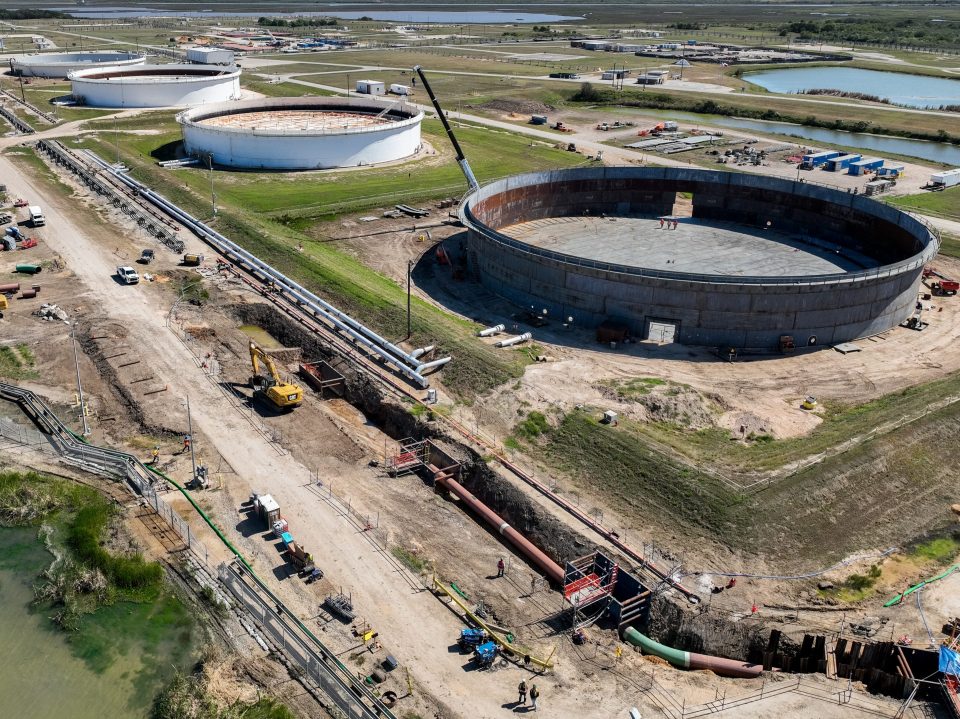
The Strategic Petroleum Reserve storage at the Bryan Mound site is seen on October 19, 2022 in Freeport, Texas.

Brandon Bell/Getty Images

Similarly, Chevron CEO Mike Wirth said at the same conference Thursday that oil prices will likely soon jump as the market’s “shock absorbers” are depleted, weakening its ability to continue absorbing the disruption.

“Over the next few weeks, we’re likely to see those pressures flow through more directly to physical prices and there’s more upwards pressure that I would expect as we get into June and certainly into July,” he added, according to the Financial Times.

When the strait first shut down after the U.S. and Israel launched their war on Iran, analysts predicted crude prices could skyrocket as high as $200 a barrel.

That hasn’t happened as massive releases from oil reserves blunted the impact. At the same time, the U.S. temporarily eased sanctions on supplies from Iran and Russia, while countries in Asia began rationing.

Wirth acknowledged that oil prices had not risen as much as people had expected, but said he expects governments to focus on building reserves back up as “insurance” against a future shock, adding more demand and putting upward pressure on prices.

“The likelihood that another shock is around the corner is something policymakers are going to have to bear in mind . . . how long they want to roll the dice before they refill inventories is a question that I think we’re going to see policymakers have to grapple with,” he explained.

Karen Young, a senior researcher at Columbia’s Center on Global Energy Policy, said the best-case scenario is for oil flows to return in 60 days.

But the more likely scenario is that they come back intermittently, dragging the timeline into next year. As a result, markets must deal with the fallout from inventory depletion and industrial disruption, she said in a post on X on Friday.

“A new normal is a higher energy price environment until demand declines,” Young added. “A new regional normal is a constant threat environment, costly infrastructure diversions and redundancies, asymmetrical violence risk and hardened security surveillance states. Hardly a prescription for growth or trust. Supply shock to price shock to systemic rebalance underway.”