






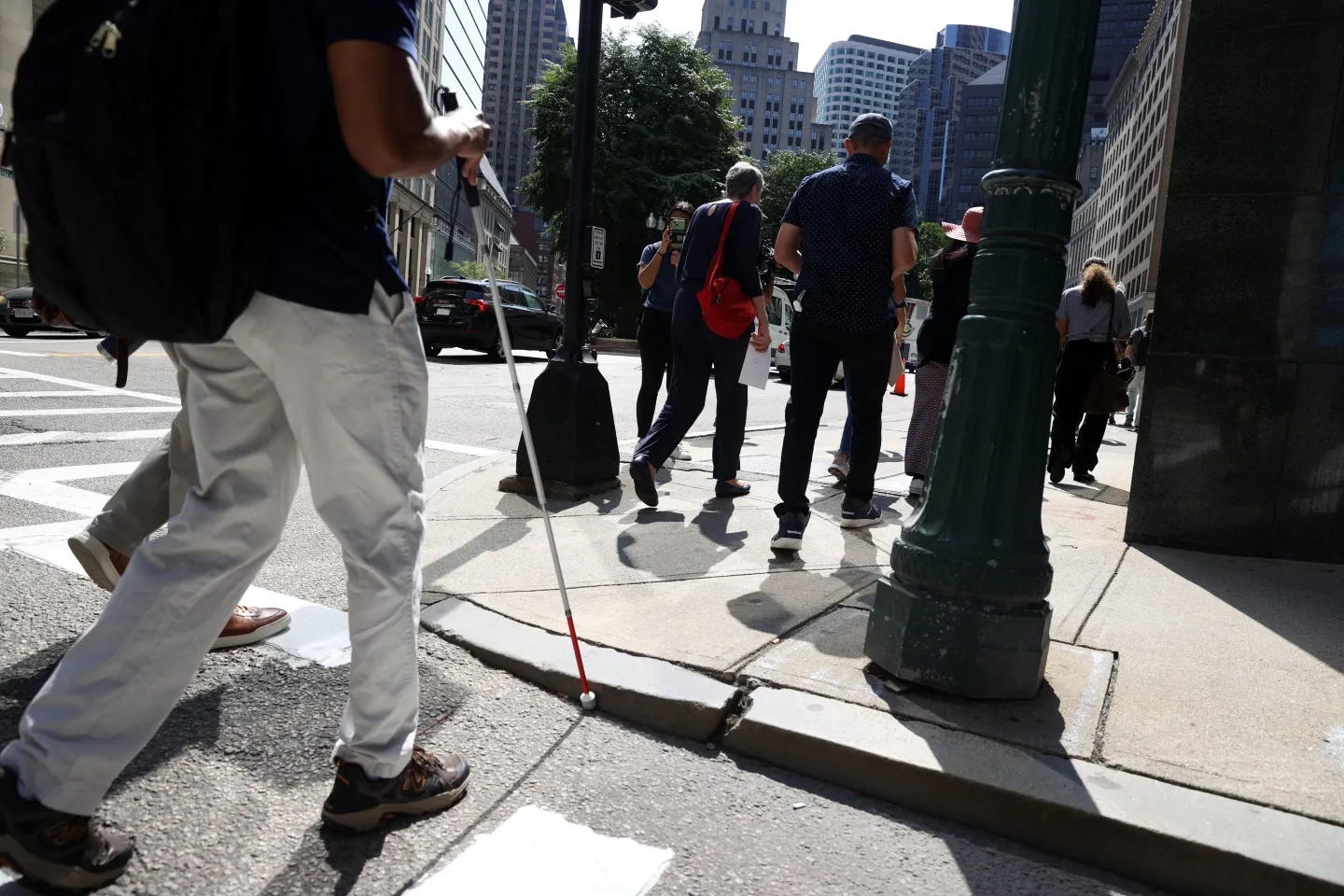
The delivery robots rolling down your sidewalk have cameras, sensors, and a constant need to dodge whatever is in their path. Think fallen e-scooters, construction zones, and tricky curbs. That data gets stored so that other robots know what lies ahead of them—and it’s now going to the world’s most widely used GPS app for the blind so they can better navigate city streets.
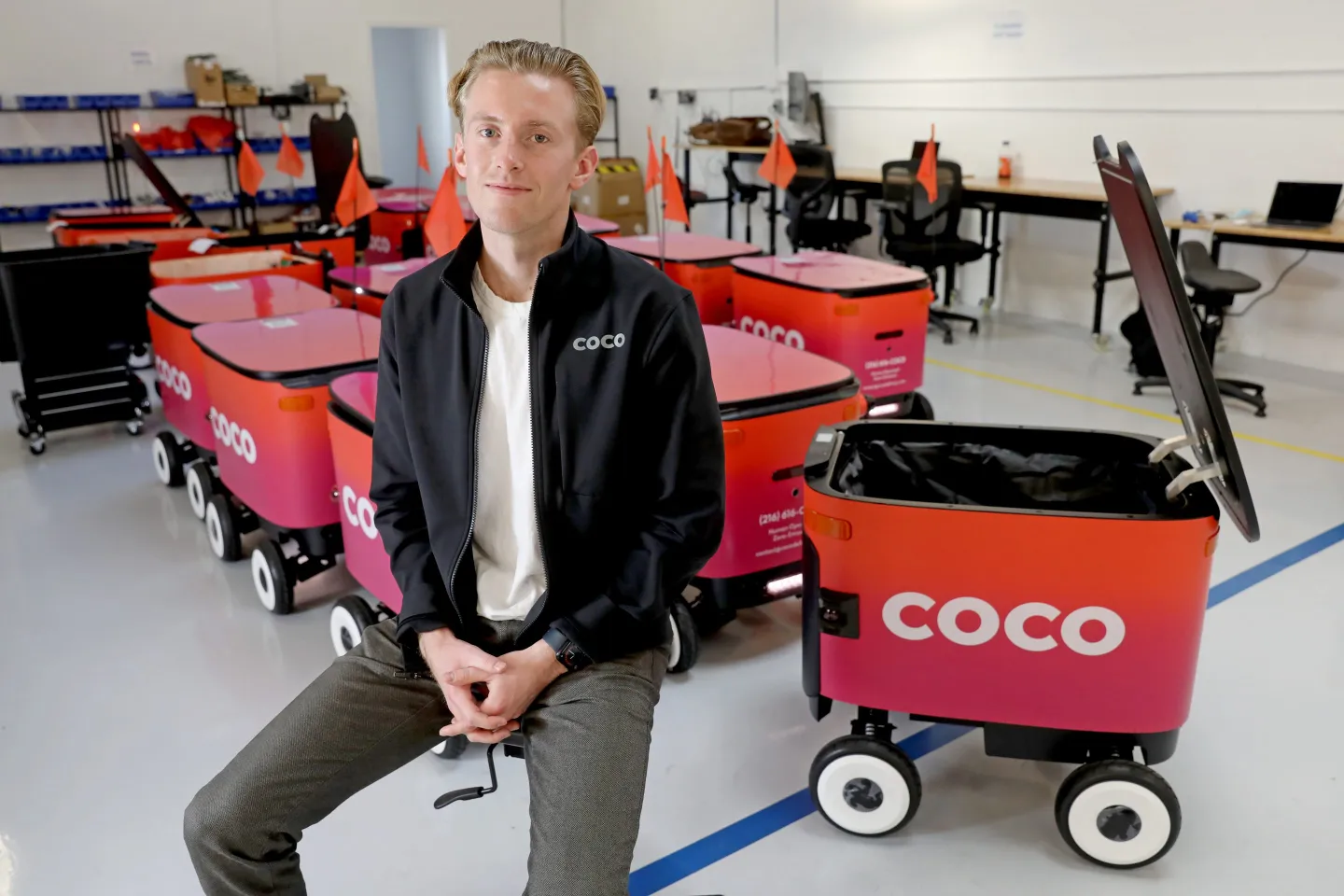
Coco Robotics, the Los Angeles-based startup operating roughly 10,000 delivery bots across the United States and Europe, is partnering with BlindSquare to remit real-time sidewalk hazard data directly to visually impaired pedestrians. The partnership, announced today, will go live across all six of Coco’s operating markets: Los Angeles, Miami, Chicago, and Jersey City in the U.S. and Helsinki and Turku in Finland.
As Coco’s robots make food deliveries for local restaurants, they continuously log every obstacle they encounter. That data feeds into Coco’s sidewalk map, updated to the minute, and under the new partnership, it will also flow to BlindSquare. The self-voicing app converts the information into spoken alerts delivered in 26 languages, warning users roughly 10 meters before they reach a hazard. In effect, thousands of delivery robots become on-the-ground eyes for people who cannot see what’s ahead.
Jonathan Wiggs/The Boston Globe via Getty Images
The partnership grew out of a European Union grant funding Coco’s operations in Helsinki, where the city’s innovation arm, Forum Virium Helsinki, connected the two companies. Ilkka Pirttimaa, the Finnish developer who built BlindSquare 14 years ago and has watched it grow to roughly 90,000 downloads across 190 countries, was already part of the Helsinki grant consortium alongside Swarco, the traffic-signal manufacturer.
He told Fortune “I didn’t even know any blind persons” when he built BlindSquare. Instead, as someone who loved open data and looking at city maps, he followed blind users on Twitter and read their blog posts about daily obstacles, from wrong trams and unmarked intersections to missing audio cues and downright broken sidewalks. From there, he began assembling an app that could describe a surrounding environment entirely through sound.
The Coco partnership addresses a problem Pirttimaa said has worsened. “Sidewalks, they are a space where blind people sometimes are afraid to go because of e-scooters,” the founder said, adding both Bolt and Voi operate in Finland where he lives. “They are silent. They can go really fast. They can be parked incorrectly.”
But rather than calling for bans on them, Pirttimaa sees a technological fix: “If blind people would know about those e-scooters that are incorrectly parked, it would be beneficial. Robots, they are sharing the same space, and they encounter the same problems. But if that is shared to BlindSquare, then I can notify a blind user that, hey, there is an e-scooter on your way.”
The core value proposition is data that municipalities simply do not collect. Carl Hansen, Coco’s vice president of government relations, said the company has discovered that even cities with existing sidewalk data are working off stale information.
“Often when we first go to cities, we ask, what mapping data do you have?” he told Fortune. “Maps that haven’t been updated in a long, long time.”
The data points collected by Coco robots differ from that. “This is fresh to the day, to the hour, to the minute.”
The mapping system works on tiered persistence. When a robot encounters an obstacle, the system categorizes it and assigns a duration. A toppled e-scooter might stay in the map for six hours; active construction could remain for a week.
“The next Coco that comes along checks if it’s there again, and if it’s still there, maybe it gets added for another longer period,” Hansen explained, while structural issues get logged permanently, until the city fixes them.
The companies are also building a two-way exchange. BlindSquare users who pass a previously flagged location can report that an obstacle has been cleared, which in turn updates Coco’s internal routing maps. “There’s a kind of feedback loop making this better for all users,” Hansen said.
Coco CEO Zach Rash framed the partnership as the natural extension of infrastructure the company built for its own survival. “One of the first things we had to build as a company was turn-by-turn directions that are distinct for a robot, and that’s different than car directions. That’s also different than walking directions,” Rash said. “As a byproduct of that, that’s probably the best way for most people to walk through the city. But particularly if you’re blind or in a wheelchair, you’re just rolling the dice if you try to take the straightest path in some of these cities.”
Gary Coronado / Los Angeles Times via Getty Images
Rash pointed to the Abbot Kinney neighborhood in Venice Beach, California (Coco’s most operationally difficult market) as an early proof of concept. The area’s old sidewalks are riddled with 14-inch curbs and missing curb cuts—ramps that ease the transition between sidewalk and road—effectively creating “islands” inaccessible to anyone in a wheelchair or navigating without sight.
Using its mapping data, Coco ran an accessibility analysis and identified just three locations where, if the city installed curb cuts, it would unlock connectivity across the entire neighborhood. “You don’t need to fix everything,” Rash said. “There’s a very small number of choke points that, if you fix that, the city gets super accessible.”
Los Angeles installed the cuts, but Rash said the BlindSquare partnership is what makes the improvement legible to the people who need it most. “Fixing it is cool, but now people need to know to go that way and know how much more accessible it is.”
The partnership also hints at both BlindSquare and Coco’s broader ambitions for its sidewalk data. In Helsinki, they’re working with Swarco on a system where a robot waiting at an intersection could detect a crowd of pedestrians and dynamically extend the crossing time by communicating with smart traffic lights. Pirttimaa noted that Swarco already implemented a feature allowing robots to virtually “press” crosswalk buttons, a capability that was subsequently extended to BlindSquare users.
“Robots were kind of opening roads to the blind user side,” he said. “It’s not always something we need to build for the blind people. We can build services in a city that benefit everyone.”
此内容由惯性聚合(RSS阅读器)自动聚合整理,仅供阅读参考。 原文来自 — 版权归原作者所有。