
惯性聚合 高效追踪和阅读你感兴趣的博客、新闻、科技资讯
阅读原文 在惯性聚合中打开

推荐订阅源

V
Visual Studio Blog
量子位
大猫的无限游戏
大猫的无限游戏
Hugging Face - Blog
Hugging Face - Blog
S
SegmentFault 最新的问题
Blog — PlanetScale
Blog — PlanetScale
月光博客
月光博客
Google DeepMind News
小众软件
小众软件
WordPress大学
WordPress大学
宝玉的分享
宝玉的分享
MongoDB | Blog
MongoDB | Blog
B
Blog RSS Feed
博客园 - Franky
奇客Solidot–传递最新科技情报
奇客Solidot–传递最新科技情报
B
Blog
博客园 - 聂微东
The GitHub Blog
The GitHub Blog
Recent Announcements
Y
Y Combinator Blog
Microsoft Security Blog
雷峰网
雷峰网
Jina AI
Jina AI
酷 壳 – CoolShell
酷 壳 – CoolShell

Fortune | FORTUNE

One man can kill Bill Ackman’s $64 billion bid for Universal Music Group—and no one knows what he’ll do | Fortune Poppi’s cofounder pitched her startup on Shark Tank while 9 months pregnant and landed a $400,000 deal—now it's worth $2 billion | Fortune Teen boys are choosing AI girlfriends over real ones for 'maximum control, zero rejection'—experts say it could make them unemployable | Fortune A United American merger is by no means impossible given the president 'loves big deals' | Fortune Reed Hastings’s planned exit from $455 billion Netflix ‘had nothing to do with’ the failed deal for Warner Bros., says Ted Sarandos | Fortune Meet Joe McCann: The high-flying crypto trader held in Tanzania after sudden death of his influencer fiancée Ashly Robinson | Fortune Gen Z is carving a different path in the housing market by doing it alone | Fortune U.S. Catholic leaders criticize Trump for ‘disparaging words’ about the pope as Vatican clash risks alienating Catholic voters | Fortune China has ‘nearly erased’ America’s lead in AI—and the flow of tech experts moving to the U.S. is slowing to a trickle, Stanford report says | Fortune Self-made millionaire behind $5 billion Skims Emma Grede says it all began with a cold call to Kris Jenner: Emma Grede—the self-made millionaire behind the $5 billion Skims empire—says it all began with an audacious cold call to Kris Jenner: ‘The difference between me and someone else is, I made it happen’ | Fortune Americans have never been this gloomy about the economy. Wall Street has never cashed in harder | Fortune ‘The college grading system [is] almost meaningless’: People see the Ivy League as an easy A and with flawed admissions standards | Fortune The CEO of $8.5 billion Japanese car giant Nissan plays the drums in a band and hits the tennis courts to destress from the top job | Fortune New York governor's take on a millionaires tax: fancy pied-à-terre second apartments worth over $5 million | Fortune Pope Leo XIV: A ‘handful of tyrants’ are ravaging earth with war and exploitation | Fortune Trump has no plan to cut the $39 trillion national debt, but he does want to cut childcare. His budget director is scrambling to clarify | Fortune China's economy grows 5% in first quarter, surprising economists to the upside | Fortune Everyone was wondering what Trump wanted more: Warsh smoothly seated at the Fed, or for Powell to pay. We have our answer | Fortune Palantir exec: the biggest mistake retailers are making with AI? Trying to do it all with one agent | Fortune American YouTuber who calls himself a 'troll' sentenced to 6 months in Korean prison for literally dancing on wartime graves | Fortune BBC plans to cut up to 2,000 jobs to save 10% of annual budget | Fortune Canva debuts a new suite of agentic tools, as the design app quietly becomes one of the world’s most used AI services | Fortune Moody's CEO: AI has a trust problem – better models won’t fix it | Fortune Top New York surgeon: Americans have better data for choosing restaurants than surgeons. That has to change | Fortune The Iran war’s fertilizer shock is hammering American farmers, and 70% can’t afford what they need for this year’s growing season | Fortune Education experts to Mamdani: Why are you foisting AI on our kids? | Fortune This CEO pirated video games as a teen and became a hacker for the Air Force. Now he’s built a $3 billion cyber firm | Fortune Teacher, blame thyself: Yale report savages Ivy League schools for destroying American trust in higher education | Fortune Fed chair nominee Kevin Warsh is worth more than $100 million and has stakes in SpaceX and Polymarket | Fortune From wool sneakers to GPUs: Allbirds’ desperate AI pivot and 600% stock surge, explained | Fortune
Iran proved it can close the Strait of Hormuz, but the U....
Jason Ma · 2026-06-15 · via Fortune | FORTUNE

Regardless of a ceasefire deal that reopens the Strait of Hormuz, Iran’s demonstrated ability to shut it down will continue to hang over the global economy, rendering the narrow waterway a contested space.

But while the U.S. has failed to restore freedom of navigation in the strait, a steady drumbeat of messaging recently suggests an effort to dilute Tehran’s new leverage.

Starting late last month, U.S. officials began revealing that more ships had been quietly crossing the strait with U.S. assistance through a route along the Omani coast. Subsequent reports pointed to a more robust U.S. role as “naval overwatch” offered protection from Iranian attacks.

The traffic uptick still represented just a fraction of pre-war levels, but it gave oil markets more breathing room before inventories reach critical levels while providing the U.S. additional leeway in negotiations with Iran.

On Tuesday, Energy Secretary Chris Wright admitted in congressional testimony that traffic in the strait was rising “very meaningfully” in a military operation that wasn’t being disclosed openly.

Then on Wednesday, President Donald Trump described a “secret mission” that he claimed had put more than 100 million barrels of oil on the market, or about five day’s worth of shipments before the war started. 

“I can say it now. Something you didn’t know,” he said. “Do you know we’ve been taking out millions of barrels of oil? Nobody knows it. You know who doesn’t know about it? Iran — until right now.”

On Thursday, U.S. Central Command posted a message saying the Strait of Hormuz is open for transit, touting routes for safe passage, the hundreds of ships that have already crossed, and forces in place to defend against attacks.

“Iran does not control the Strait of Hormuz,” it added.

Interior Secretary Doug Burgum added to the chorus on Friday, when he said more than 20 ships exit the Persian Gulf on some nights under the cover of darkness with help from U.S. forces.

And for good measure, Defense Secretary Pete Hegseth told CBS News on Sunday that the U.S. naval blockage in Iran is “impenetrable” and 125 million barrels of oil have now exited the Gulf, “showing that we control the strait.”
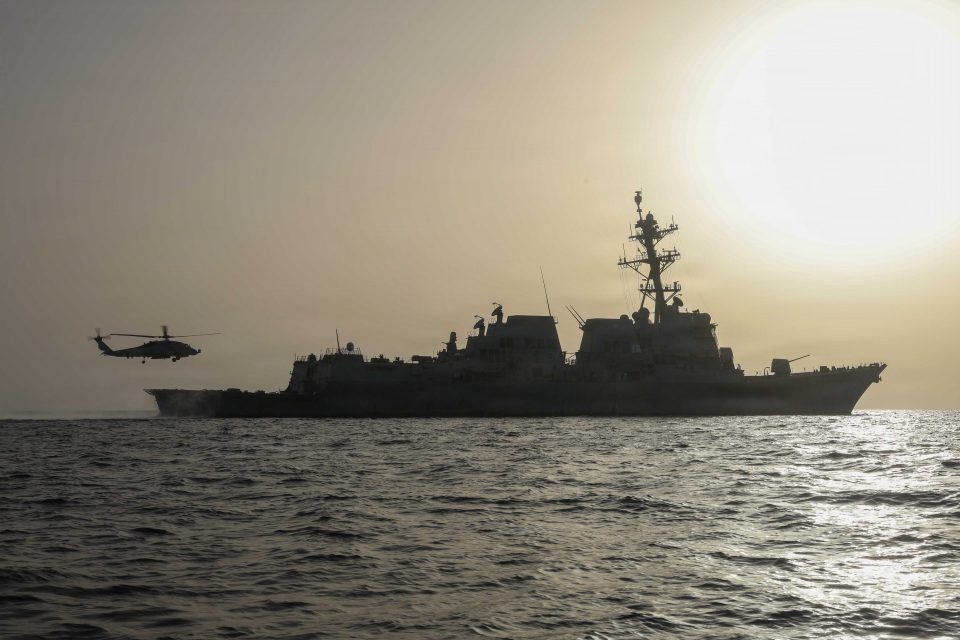
An MH-60R Sea Hawk, assigned to Helicopter Maritime Strike Squadron (HSM) 50, takes off of the flight deck of Arleigh Burke-class guided-missile destroyer USS Thomas Hudner (DDG 116) during flight deck operations, May 19, 2026.

U.S. Navy

Meanwhile, Iran established a separate channel through the strait that runs along its coast, demanding tolls from ships that want to cross and attacking any that try to skirt it.

As a result, U.S. forces and Iran’s Islamic Revolutionary Guard Corps continue to exchange fire on a regular basis as both sides maintain competing lanes.

U.S. aircraft have bombed Iranian missile sites and destroyed fast-attack boats, while the IRGC launches drones at commercial ships and even downed an Apache attack helicopter, forcing the crew to be rescued from the water.

With protection from the U.S. military, tankers are crossing the strait from the Persian Gulf into the Gulf of Oman, where they offload their oil via ship-to-ship transfers—borrowing a tactic that the Iranian and Russian “shadow fleet” have used for years to avoid Western sanctions.

After the transfers, the newly loaded ships take their oil to customers around the world, while the empty tankers cross back into the Persian Gulf to full up on more crude supplies.

This has allowed Kuwait, which has no meaningful routes to export oil other than the Strait of Hormuz, to finally draw down its inventories that had built up during the closure.

In fact, Kuwait began offering to sell its crude to refiners in Asia on Tuesday, marking the first time since the Iran war started.

The United Arab Emirates, which has used a pipeline to get some supplies around the strait, has also been selling oil from inside the Persian Gulf to customers in Asia. 

But Kuwait’s shipments are especially notable as they originate from deep inside the Gulf, meaning tankers must first travel while exposed to much of Iran’s coast before even reaching the strait.
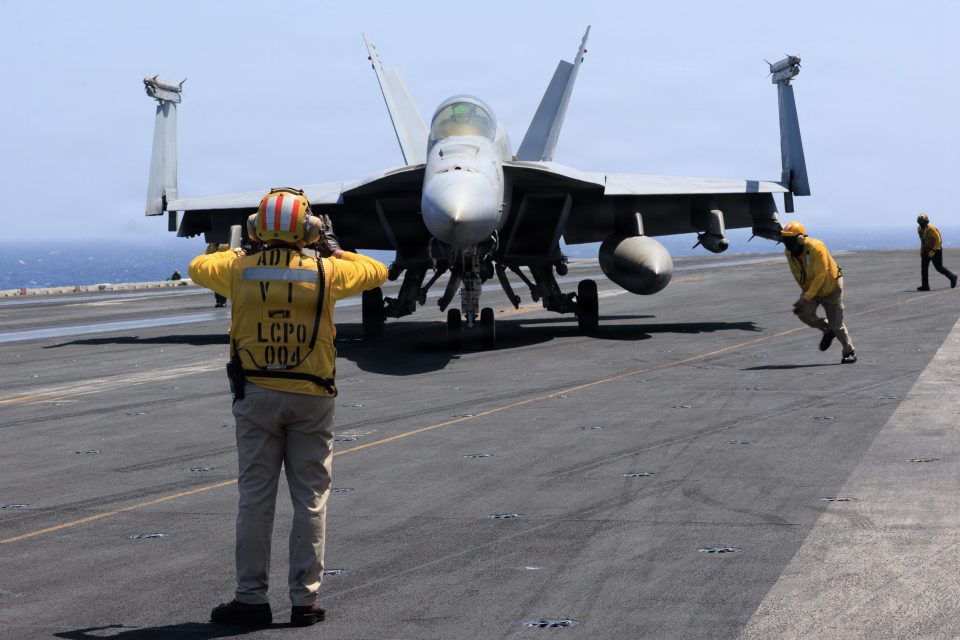
A sailor signals an F/A-18F Super Hornet, attached to Strike Fighter Squadron (VFA) 103, aboard Nimitz-class aircraft carrier USS George H.W. Bush (CVN 77), May 20, 2026.

U.S. Navy