


Less than a year after Palantir cofounder Joe Lonsdale’s move to Austin during the pandemic, the venture capitalist got on the phone with the Texas capital’s then-mayor and pitched him on a deal that would transform a key part of the city’s infrastructure—and also happen to benefit one of his investments.
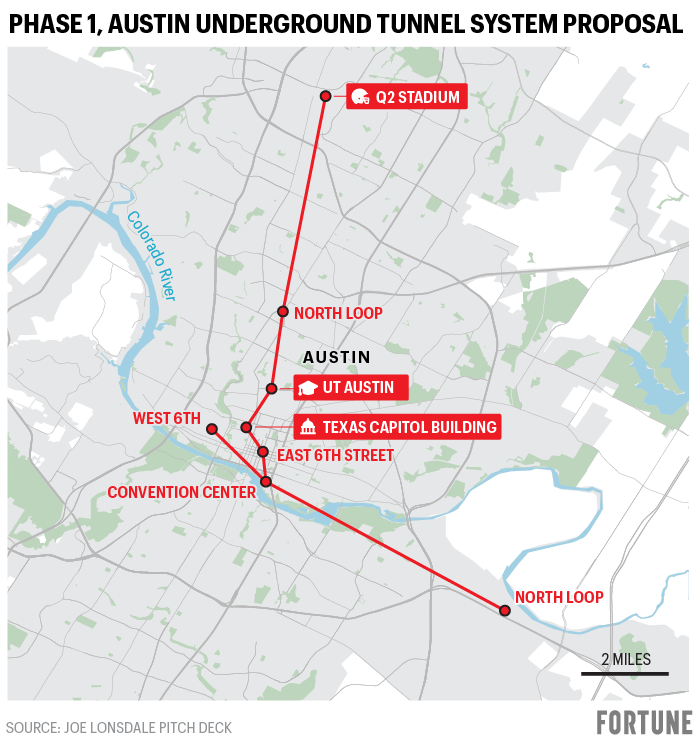
Over that phone call and in subsequent email correspondence, Lonsdale suggested starting small: He and some of his friends would pay for a one-mile, approximately $6 million to $7 million underground tunnel system, built by Elon Musk’s the Boring Company, that would connect his friends’ land around town. He said that the initial mile-long tunnel could spark interest from leadership for a citywide tunnel system that the Boring Company could ultimately build in partnership with the city, and a pitch deck he sent after the call refers to “a growing group of successful citizens” willing to donate or sell land at below-market prices for stations near the airport, Tesla’s Austin gigafactory, the Q2 Stadium, Lonsdale’s house, and his venture capital firm, 8VC.
“i [sic] want to learn what it takes to permit a tunnel to get going that my friends and I help sponsor between various land we own here, just to show it off and inspire our leaders and others how fast and affordable this can be,” Lonsdale wrote in an email to then-Mayor Steve Adler Sept. 19, 2021. (The email, as well as a pitch deck put together by him and other people at Lonsdale’s venture capital firm, 8VC, was obtained by Fortune as part of a Freedom of Information Act request.)
Lonsdale said there would be “two sites” for the stations above ground that would be about a tenth of an acre each and then, “very deep underground,” a “small tunnel” that “would not interfere with anything or be heard when being built.”
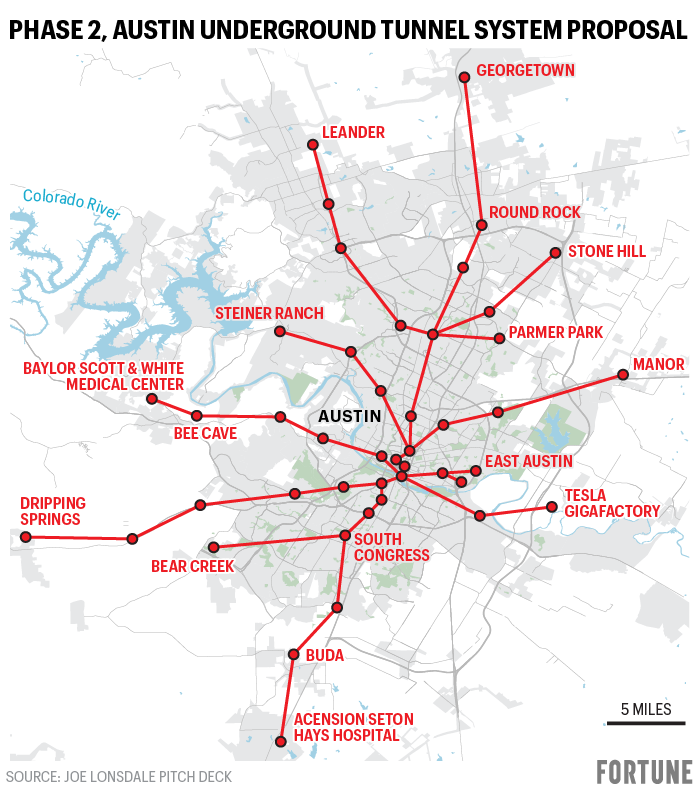
Lonsdale, a Boring Company investor, laid out more details in the pitch deck on what could ultimately become a tunnel commuter system to be developed in two phases. The first would be a 34-mile tunnel with eight stations, connecting Austin’s international airport and Q2 Stadium to downtown hotspots. The second phase would add another 278 miles, expanding into the surrounding suburbs with 37 additional stations.
While the proposed 45-station tunnel systems are clearly described as infrastructure for Austin, it’s not clear from the emails and the other documents if Lonsdale’s email suggesting to initially connect his friends’ land with a tunnel was being offered as a transportation system accessible to the public, or as a private subterranean passageway that could be incorporated into any future system for the public.
“I would be fine if this became part of a public project later that might end up covering our costs, but understand we’d be taking some risks if it didn’t,” Lonsdale wrote. “But we can do something that’s for example a mile long for just 6-7 million dollars that a few of us could cover to show it off.”
The pitch didn’t specify if Teslas—electric vehicles from another Elon Musk company—would be used to transport people through the tunnel, as some Boring Company pitches or the small-scale Las Vegas project have incorporated, though the deck said that the Boring Company would provide electric vehicle “ferries” to travel through the tunnel system “in minutes,” and it included a photo of a Tesla driving through a tunnel. (Lonsdale and the Boring Company did not respond to multiple requests for comment.)
Adler, whose mayoral term expired at the beginning of this year, said in an interview with Fortune that Lonsdale’s pitch was akin to the 1.7-mile convention center single-lane loop in Las Vegas built by the Boring Company. (It opened in April 2021.) Lonsdale wanted to see something similar in Austin, according to Adler: “To do what they were doing in Las Vegas, but to do that at a greater scale.”
Lonsdale disclosed that he was an investor in the Boring Company in his pitch deck to the mayor, but also noted that he was making his pitch as a “concerned citizen” and that the deck was not an “official document published by the Boring Company,” documents show. Lonsdale’s slides pegged the estimated cost of the two phases of a Boring Company build-out at $304 million and $2.3 billion.
The Boring Company sent in a separate pitch around the same time, Adler says, wanting to bore the tunnels that would be needed for the underground light-rail system the city was working on at the time as part of the Austin transit expansion project approved in 2020 called Project Connect. (The Boring Company reportedly pitched at least eight separate projects to various Texas officials between 2021 and June 2022.)
Adler referred both proposals to the city’s transportation and Capital Metropolitan Transportation Authority staff, who ultimately did not pursue either, he says. “I don’t think there was a formal report out from city staff or from Capital Metro with respect to involving the Boring Company. I just know that it didn’t happen,” Adler says. (A representative for the Austin Transit Partnership declined to comment and the Capital Metropolitan Transportation Authority did not respond to a request for comment. Fortune has requested a final report regarding the Boring Company’s light-rail tunnel proposal, but did not receive a response before time of publication.)
Transportation has become a hot-button topic in Austin over the last decade, as transplants like Lonsdale have moved into the city in droves, whether it be for the state’s zero income tax, lower cost of living, or music scene. Between 2010 and 2020, Austin’s population grew by 36%, according to Census Bureau data, leading to increased traffic and skyrocketing housing costs.
Austin’s Project Connect plan is meant to alleviate some of the newfound traffic and make the city more accessible on foot, though it’s coming with a steep price tag and the initial proposal has undergone several adjustments. The Austin Transit Partnership, which is responsible for implementing the project, has walked back plans for a downtown tunnel and an underground shopping center due to the estimated $11 billion price tag, and the project’s financing may be under threat from legislators, according to the Austin American-Statesman. Lonsdale’s pitch emphasized cost and speed, asserting that the Boring Company could complete the second phase of its electric-car-based tunnel in 3.3 years, at a 92% cheaper cost per mile than the Project Connect light-rail system. That being said, the Boring Company does not have a strong track record for bringing proposed city projects to fruition.
In the slide proposing that his friends would pitch in land to the project, Lonsdale described the unnamed participating landowners as citizens who were “ready to help.”
“We have gathered a growing group of successful citizens who are invested in protecting our city’s culture, cost of living, and environment,” the slide reads.
Adler said he was glad Lonsdale was interested and had taken the time to put forth a plan. “It takes some effort to do that,” he says, “and most people don’t put forth that effort. So I was pleased he did it.”
Update, June 28, 2023: This story was updated to include that the Austin Transit Partnership declined to comment.
此内容由惯性聚合(RSS阅读器)自动聚合整理,仅供阅读参考。 原文来自 — 版权归原作者所有。