






Early this year, Jacob Andreou had a crucial goal. The Microsoft executive set out to order a McDonald’s cheeseburger to his apartment across from the company’s Silicon Valley campus using a homegrown AI tool. Andreou and his team had worked nonstop to get the tool, named Copilot Tasks, up and running. If the AI agent inside Tasks could autonomously order the burger and get it to Andreou’s home, it would prove the tool worked as designed.
By the time Andreou reached his apartment, the burger had arrived.
What made the accomplishment so notable inside Microsoft is that Andreou, a polished 33-year-old executive with Hollywood ties and a knack for pitching and presentations, had been hands-on with software developers to release Tasks, employees said. It’s one reason the fast-rising executive has won respect from colleagues: He is technically savvy and immerses himself in projects.
The speed at which the tool was completed, which was about two months, also impressed Microsoft Chief Executive Satya Nadella, who has placed great trust in Andreou to guide Copilot, the company’s pivotal AI product, in a more competitive direction. Having fallen behind after leading early in the AI race, Microsoft is counting on Copilot, and Andreou, the product’s executive vice president, to pull it ahead. Andreou’s duty is to get the 51-year-old tech giant to move fast without breaking the trusted business relationships it has. The result is an organized chaos of employees driving hard every day to compete with OpenAI, Anthropic, and other top labs as Microsoft claws to get back to the top of the AI world.
Andreou, a talkative executive who relishes the intricate details of AI models and once led product at social media firm Snap, has had a rapid ascent. In March, after only a year at Microsoft, Andreou was promoted by Nadella to one of the company’s most important roles—an unusual move at the tech giant that signaled both Nadella’s urgency to improve Copilot and the leadership traits he believes are necessary to succeed in the new environment.
“The moment we’re in is about focus and urgency,” Andreou told Fortune in an interview from Microsoft’s Mountain View, Calif. campus. “This is one of the most intensely competitive environments tech has seen in the last 20 years. Because the technology is moving so quickly, the reality is a six to twelve month roadmap doesn’t really exist in the way it used to.”
Andreou represents a changing of the guard. He is one of several young executives Nadella has promoted to major roles as the company competes with the nimbler AI startups. As traditional enterprise software executives depart Microsoft, they leave room for leaders like Andreou, or Xbox’s new chief, Asha Sharma, who is also in her 30s.
Copilot has struggled, and Microsoft’s shares are down double-digits in the past year as investors have fretted over AI’s impact on software, Microsoft’s reliance on OpenAI, and its heavy data center spending. Only about 4.5% of the 450 million Microsoft 365 customers pay for Copilot features, and its free consumer version trails far behind OpenAI’s ChatGPT. But Microsoft has seen recent momentum. England’s National Health Service recently rolled out Microsoft 365 Copilot to more than 500,000 staff, Nadella posted on X this month, proving that massive, regulated enterprise customers trust Microsoft to securely deliver AI.
Still, Copilot is going through a reset, with Andreou eliminating extraneous versions of the AI tool and merging the teams that focused on consumer and enterprise versions of the product. Though seat licenses remain crucial, Andreou and Microsoft have also tweaked how they charge customers, introducing a consumption-based model becoming common in the AI era as investors look for greater returns. Copilot Cowork, its autonomous agent platform, bills by usage based on factors like model use and runtime (though it still requires a 365 Copilot license).
Microsoft is “getting rid of multiple levels of bureaucracy and becoming more focused on the end product and the user,” said Chad A. Morganlander, senior portfolio manager at Microsoft investor Washington Crossing Advisors.
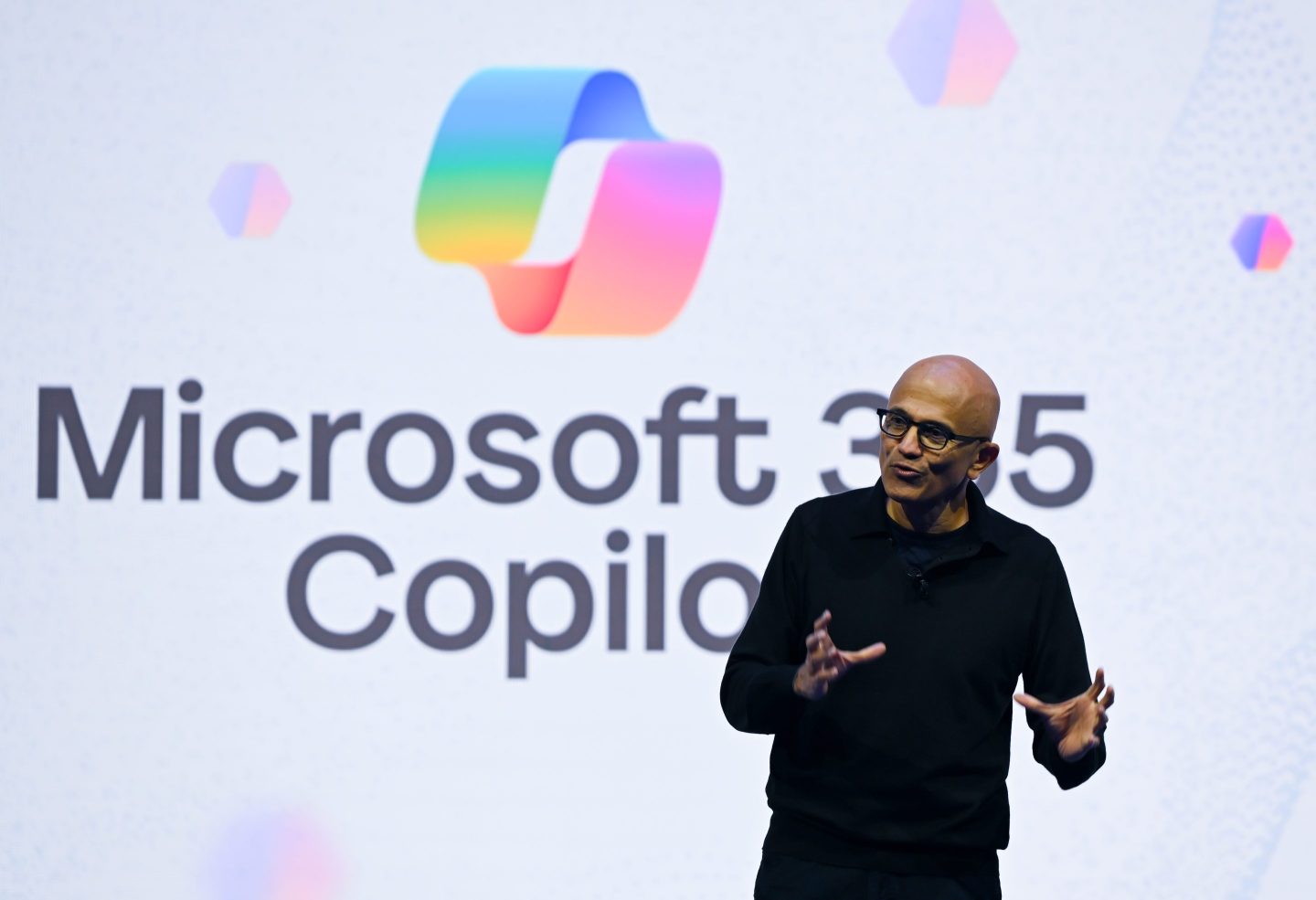
Sven Hoppe/picture alliance via Getty Images
Andreou, who now oversees more than 11,000 people, is part of a new breed transforming Microsoft’s culture, especially within Copilot and its AI lab. Some changes are modest, like Microsoft AI employees using Slack instead of Microsoft’s own Teams product for many of their communications (Microsoft said Andreou’s staff all use Teams). Others are starker, such as lab groups locking themselves inside offices to hack all day, according to people familiar with the hacks. Microsoft has also hosted developer hackathons near Seattle, San Francisco, and other hubs. Andreou favors so-called 10x developers, employees said, an industry term for workers ten times more productive than their peers.
Andreou said that building world-class AI products requires periods where teams “do have to surge,” but “at the same time, you want to make sure that you’re building things in a way that is sustainable.”
This can include runs when staff may go hard Monday through Thursday but then have Friday off for home duties, he said.
Known to get into the minutiae of coding himself, Andreou actively participates in building tools, with a vibrant personality that commands the room. One former employee likened him to Bill Clinton, recognized for knowing how to work a crowd and making everyone feel completely engaged. People who have worked with Andreou say his ability to ship products fast, along with his charisma, confidence, and ability to inspire others, gives him an executive presence in spades.
Not everyone likes the new culture, though. Current and former employees said the new order, which effectively requires some teams to work 12-hour days, is burning people out. Many also feel a daily panic to keep up with Anthropic and other labs, and some worry that the speed at which Copilot teams now operate risks shipping products out of compliance with internal standards.
Those critical of Andreou say he can be overly confident, even when it’s not always clear that he’s correct, and that he still has to prove himself in enterprise software. His burden is to build long-lasting businesses that generate ample revenue at one of the world’s most important companies, a challenge he hasn’t had before.
Nadella has overseen one of Microsoft’s largest corporate overhauls this past year. When he consolidated Copilot teams earlier this year, he elevated Andreou and shifted Mustafa Suleyman, the former consumer Copilot head, to focus on proprietary AI models. Andreou’s Copilot organization and Suleyman’s lab are separate, but the two work closely together. In April, the company offered its first voluntary buyouts. Nadella is also supervising major changes in units such as Xbox and has become more hands-on with product development.
Copilot and Microsoft AI leadership have told employees that the barrier to entry in AI has dropped, allowing smaller companies to ship rapidly and threaten the tech giant. Some executives have been blunt about expectations. At a March meeting of roughly 80 developers, Suleyman told staff that the future of software development means fewer people working harder by leveraging AI agents, according to people familiar with the meeting.
At its Build conference earlier this month, Microsoft unveiled new AI models to showcase its competitiveness. It also teased a purpose-built agentic platform for devices, including a desktop device and a wearable badge for interacting with agents.
Nadella recently warned against industry reliance on only a few AI models, and he has in the past said he’s focused on making Copilot an accessible AI assistant. The company is bringing more compute capacity online to train Copilot and has embraced popular external tools, like OpenClaw, the trendy personal assistant now integrated into Windows. Suleyman has stated his goal is to make Microsoft AI a self-sufficient, top-tier lab.
A milestone of Andreou’s work so far is a super app rolling out in phases, which Andreou aims to make a tool where users view personal and work information side-by-side. The app will include coding, chat, and a new agentic workflow capability dubbed Autopilot, Fortune reported in May. Competing effectively means eliminating product redundancies, building premium proprietary models, connecting them to popular AI tools, and delivering enterprise utility while keeping costs low.
Microsoft’s strategy has evolved. The company spent years closely tethered to OpenAI, investing $13 billion. But as OpenAI outgrew the partnership and sought other collaborators like Amazon, Microsoft and OpenAI agreed to restructure, giving each more flexibility to pursue independent goals.
Andreou said his top three objectives are to deliver a superior AI chat product, achieve leading model quality without being late to market, and provide a trusted, safe, and compliant way to integrate various models.

River Callaway/Variety via Getty Images
At 6-foot-7, Andreou literally stands above most people at Microsoft. He’s a fast-talker who can chat about products for hours. In 2020, he married former Entertainment Tonight host and actress Carly Steel at Beverly Hills Presbyterian Church, and the two are frequently pictured on red carpets, including for Los Angeles Museum of Contemporary Art fundraisers.
Andreou, who primarily lives in the Los Angeles area, grew up near Vancouver, where he was a recognized basketball player who managed to juggle athletics, his school’s tech department, and DJing while maintaining top marks.
He attended Queen’s University in Ontario, graduating with a Bachelor of Science in biomedical computing. He helped develop software and image-guided therapy approaches for tumor resection. On weekends, he built apps for fun.
In the early 2010s, he won a hackathon hosted by Meta Platforms (then Facebook) by designing a personalized consumer shopping application with his longtime friend, Khalid Karim.
During college, the duo won virtually every hackathon they entered, Karim told Fortune, largely due to Andreou’s ability to weave technical execution and product vision into an engaging pitch. The two once presented a live demo minutes after a computer cloud crash wiped out their materials, winning anyway after Andreou pitched the product entirely from memory.
Andreou loves diving deep into a variety of topics, Karim said, from AI to how products affect people’s psychology. He is a fan of rap and electronic music, DJ Skrillex, and Formula 1, closely following 19-year-old Italian sensation Kimi Antonelli this season. On weekends, Karim and Andreou weight-lift together, though it’s not unusual for Andreou to also hack on his off-days. A few months ago, Andreou arrived late to a workout because he was using OpenClaw to order an Uber to the gym.
“There’s definitely a portion of his brain that’s constantly engaged in thinking about” technical problems, Karim said.
In 2015, Snap hired Andreou as a design engineer. Two years later, he became director of growth, and in 2018, he was promoted to vice president of product, overseeing design, data science, and product. He worked closely with Chief Executive Evan Spiegel to increase daily active users and build out an advertising strategy.
In 2023, he joined venture capital firm Greylock as a partner to back consumer AI companies. He sought to invest in startups like Perplexity and Mercor, though no deals materialized with those companies. One of his investments was photo-centered startup Lapse.
In 2025, Microsoft recruited Andreou to help build Microsoft AI, then led by Suleyman as a consumer product. In his first year, Andreou focused heavily on user experience.
In the months since his March promotion, Andreou has worked to release the Copilot super app, scaled back the ubiquitous Copilot icons that irked Windows users, and launched Copilot Cowork to compete with Anthropic’s highly popular Claude Cowork. Microsoft is also exploring hosting open-source models like China’s DeepSeek, as first reported by Axios. While frontier models like Anthropic’s Opus 4.8 top leaderboards, Andreou said that a growing share of everyday tasks can be adequately performed by less powerful, more efficient models.
Some of Microsoft’s bets are paying off. Its Build event earned positive reviews, with analysts noting improved usability and functionality, saying Copilot’s role can be a “safe harness” for highly regulated sectors such as healthcare and finance.
“They’re the best distribution in software and tech,” Jefferies analyst Brent Thill said. But, the analyst added, the company faces a cascade of issues. The general perception of Copilot is that “it stinks,” he said. Microsoft also wasted time with its previous distinct divisions for consumer and enterprise AI, and some portfolio managers are selling Microsoft shares to make room for newer names like Anthropic, OpenAI, and SpaceX.
Andreou’s vision aligns with a recent message from Nadella.
In an essay earlier this month, Nadella wrote that the stakes of AI are not about new digital tools, but about how companies build intellectual property around models to create human-driven value—where humans set goals, provide direction, and connect the dots.
Andreou said the burden is on CEOs and executive teams to prevent their unique corporate culture from being eaten by external AI models. If a company’s internal data such as Teams transcripts and email is used to train an external model, that model would “start to become special in the ways that your company is differentiated,” he said.
Addressing public anxieties over AI-driven displacement, which tech companies have fueled, Andreou argued that the people using AI daily don’t feel replaced.
“This is [an] unbelievable moment of human empowerment, actualization, and leverage,” he said. “The people using this technology on a daily basis are feeling bigger, more productive, and more capable than ever before.”
此内容由惯性聚合(RSS阅读器)自动聚合整理,仅供阅读参考。 原文来自 — 版权归原作者所有。