


It doesn’t take long for Tony Aquila, CEO of electric vehicle company Canoo, to compare himself to Elon Musk.
“Guys like us—we’re founders. We’re founders that built big companies, and we operate them,” he says as he sits across from me in the back of one of Canoo’s futuristic electric campervans, about three minutes into our conversation. “We have a nature about us of wanting to do things differently. Not just better, but different.”
For an executive whose public company hasn’t reported a dollar of revenue since 2020, Aquila seemed exceedingly confident. But at the time, in early June, Canoo’s financials and risk disclosures were telling a story that clashed with that confidence—showing that the company was hanging on by a thread.
Canoo’s vehicles were still going through test programs and not yet on the market. Production wouldn’t begin until at least the end of 2022, and the company hadn’t started construction on its own manufacturing facilities. Canoo had just recently signed an agreement with hedge fund Yorkville Advisors to sell up to $250 million worth of its shares at a discount to their already depressed market price. The Securities and Exchange Commission was investigating the company over its 2020 SPAC merger, and the company was tied up in an array of other legal battles. (Canoo says it is “cooperating fully” with the SEC probe.)
Indeed, right there in an SEC filing from March 31, Canoo itself had said it might not make it another year.
And yet, Aquila—the tattooed, 57-year-old private-equity executive who had begun taking control of the company in 2020—looked me right in the eye when I asked about whether Canoo had the funding it needed for the next year. “I am a just-in-time capital guy,” he assured me.
While electric vehicle industry insiders have marveled at the chaos that has swirled around Canoo in the last few years, and Wall Street analysts have speculated about the timing of the company’s demise, Aquila had his own reasons to be a bit more optimistic.
On July 12, about a month after we talked, the company got a burst of just-in-time good news. Canoo announced its first major contract—a deal with Walmart, the world’s largest retailer. The deal, which included a warrant agreement for Walmart to purchase more than 20% of the EV company’s shares, immediately gave Canoo’s share price a plump boost—and promised to become a revenue lifeline for a struggling startup.
It’s not the first financial boost that Aquila has received from Walmart Country, Fortune has learned. In 2019, after his contentious departure from a previous company he had founded, vehicle data management software company Solera Holdings, Aquila apparently received significant financial support from Alice Walton, a philanthropist and the daughter of the late Walmart founder Sam Walton, and one of America’s wealthiest individuals. Alice Walton was the original backer of AFV Partners, a private equity firm Aquila set up after leaving Solera, according to a person with direct knowledge of the matter. Walton backed Aquila’s two early deals at the firm, that person says: An investment in a sports betting company called Sportradar, and the acquisition of airline company Aircraft Performance Group. A former Canoo employee, who asked not to be identified, says that Aquila would talk about how he was “great friends” with Walton.
At the end of 2020, AFV Partners invested $35 million in Canoo ahead of its public debut—an investment that propelled Aquila from a third-party outsider into the driver’s seat of the newly public company as executive chairman, and later CEO. Now AFV owns 19% of Canoo, or 51.2 million shares, according to public filings—worth approximately $190 million at the company’s current stock price. Multiple sources told Fortune that they believed Alice Walton was also an investor in Canoo, though none of those sources had firsthand knowledge of that investment.

Rick T. Wilking—Getty Images
Asked whether Walton was an investor in AFV, Michael Horvath, head of the investment group at the firm, said, “I am not aware of the detailed names behind investors. I usually speak with representatives so I can’t speak to this.” A representative for Alice Walton’s family office declined to comment on whether Walton is an investor in AFV or Canoo.
Meanwhile, Canoo’s ties to Walton’s home base (and Walmart’s) of Bentonville, Ark. have grown thicker. At the end of 2021, Canoo announced it was moving its headquarters to Bentonville. Earlier this year, Arkansas Gov. Asa Hutchinson named Aquila as one of more than a dozen members of the state’s newly-minted Council on Future Mobility. And Canoo has been offered some $400 million in tax incentives from Arkansas and nearby Oklahoma to build two new facilities in those states, including a manufacturing operation and headquarters in Bentonville.
Canoo is hardly the only EV startup to take investors and employees on a wild ride over the past couple of years. Concern over climate change has lured an unprecedented amount of investor capital into the space, but the logistical challenges of launching an automaker from scratch haven’t gotten any less daunting. The booming popularity of SPACs in 2020 and 2021, meanwhile, has helped some of those companies jump into the public markets to access capital before their business models were on secure footing.
“The real questions are around the company’s financing.”
Craig Irwin, analyst, Roth Capital
Crack open the hood even an inch, however, and it’s clear that, even with the Walmart deal, Canoo is floundering to an extreme degree. Its marketing efforts, including glowing announcements of relatively small and not yet revenue-generating contracts with the U.S. Army and NASA, have helped the company hobble along quarter by quarter. But executives have been bleeding from the company—many of them off to start new ventures themselves. Institutional and retail investors have lost interest, with Canoo’s stock hovering around $3.50—down from $8 earlier this year, and from $15 shortly after its SPAC merger at the end of 2020. Canoo is burning cash—with nearly $300 million lost in the first six months of this year. Canoo’s regulatory filings are muddled with generous payment arrangements between the company, its CEO, and Aquila’s affiliated business entities.
Aquila may have won favor in Arkansas, in other words, but it’s far from clear whether Canoo’s vehicles will ever even make it to the streets.
When Canoo hosted its very first earnings call as a public company, on March 29, 2021, it wasn’t Ulrich Kranz, Canoo’s then-CEO, who addressed investors. It was Aquila.
“Can you maybe talk about the high turnover and what’s going on here? And is Uli still chief executive officer?” was one of the first questions asked on the earnings call. It was posed by an analyst who pointed out that there had been several “significant surprises” before the Q&A started. One of those surprises was that, earlier that morning, Canoo had announced the resignation of its CFO. Aquila also made statements on the call that indicated Canoo was completely departing from the strategy that its senior executives had sold to investors when taking the company public mere months earlier.
Canoo had been the brainchild of nine co-founders, including former execs from BMW and Ford, who had left EV startup Faraday Future to launch something new: an affordable, electric-powered vehicle for young professional urbanites. The car would be built on a “skateboard” chassis that could serve as the base of a plethora of vehicle types: A B2B delivery vehicle, adventure campervan, or sports car, for example.
The initial plan was to roll out the “lifestyle vehicle” model to residents in the Los Angeles area, near the company’s headquarters in Torrance, for a subscription fee. In early 2020, the EV company had inked a deal with Hyundai Motor Group to use Canoo’s tech platform for its new electric vehicles. And by that August, the company was planning to go public by merging with Hennessy Capital Acquisition Corp. IV, a special purpose acquisition company. At the time, Canoo had hired around 300 people.
“Everybody really wanted to be there… and was super passionate and committed to the project,” says one former employee, who spoke with Fortune on condition of anonymity.
But even then, things had long been chaotic at Canoo—and going public only drew more attention to the disarray. With nine co-founders, there were quite a few people with decision-making authority, and weekly meetings would sometimes go on for several hours, say two former employees. Not long before Canoo’s SPAC announcement, the company’s original CEO, Stefan Krause, had departed from the company. He left after the head of communications, who was also his wife at the time, filed a lawsuit against him and the company alleging wrongful termination and harassment, among other claims. The company declined to comment at the time, and the lawsuit was dismissed within four months.
The company was navigating other unusual hurdles, as well. Early on, Canoo had been backed by three major investors, one of whom was Pak Tam Li, a Chinese investor and the son-in-law of one of China’s former top political leaders, Jia Qinglin.
The company’s financial ties to Li would ultimately draw scrutiny from the U.S. Department of Defense, Department of Justice, and Treasury Department as the company planned to go public, per SEC filings. Those agencies aimed to impose certain national security-related restrictions on Canoo because of the sizable stake Li’s holding company held. The company agreed to follow certain data restrictions; adopt a “comprehensive security plan”; and attend annual information meetings with the aforementioned federal departments, as well as set up restrictions on Li’s holding company being able to nominate or appoint members to the board.
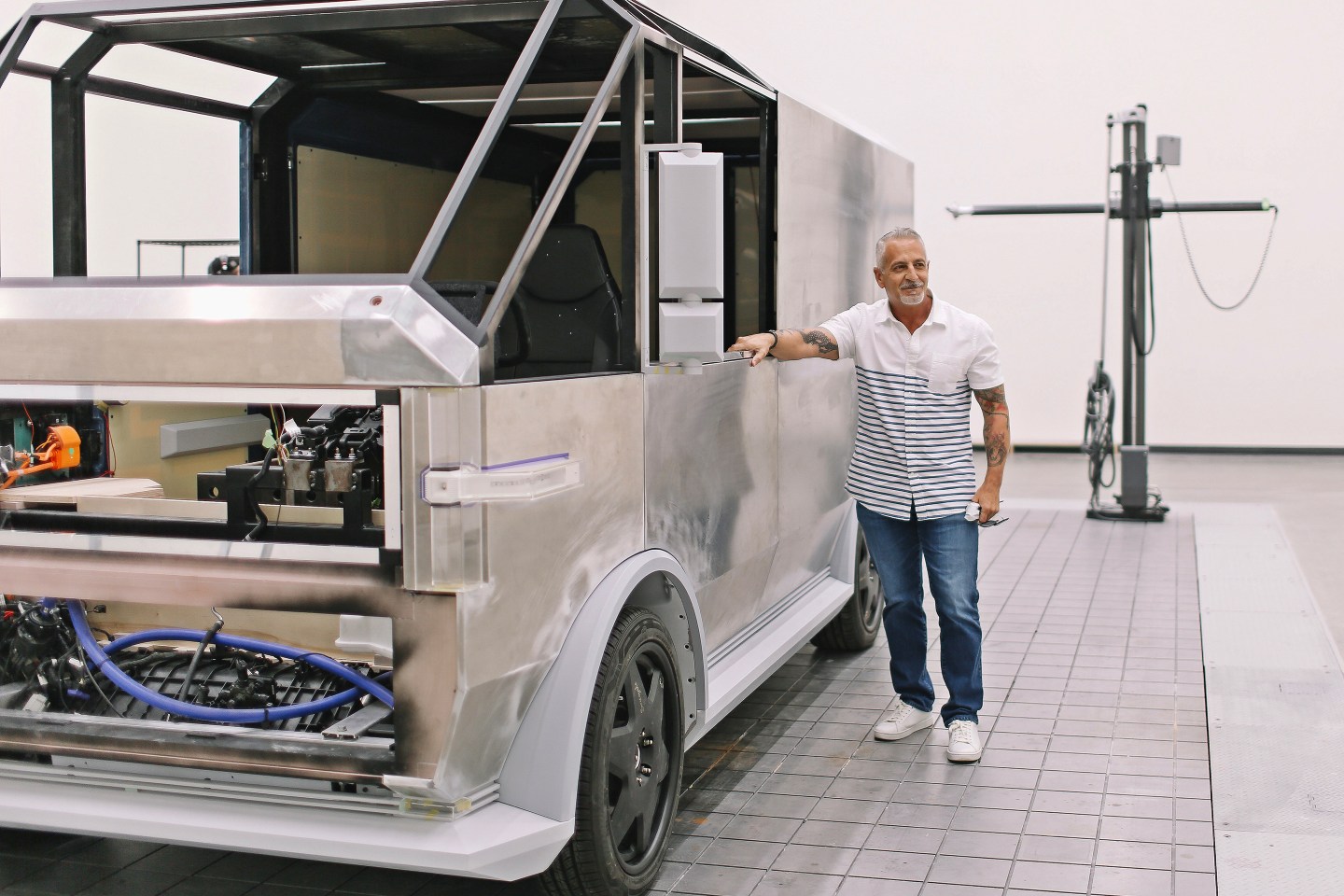
Still, there was a notable culture shift at Canoo once Aquila arrived, say two former employees. Those employees describe Aquila’s first few months as chaotic, and said he wouldn’t take advice from others. One former employee described meetings with him as “haphazard” and said he had already made up his mind about decisions before the meetings had begun. Both former employees mentioned that Aquila repeatedly compared himself to Musk in meetings.
Courtesy of Canoo
Asked about Aquila’s behavior, Canoo connected Fortune with two former Solera Holdings employees who had gone on to keep working under Aquila. They both spoke positively of Aquila’s management style and about him as a person.
“Let me say this: He is sure not the easiest person to work for, but a person—you cannot learn more from anybody else,” says Renato Giger, who served as CFO at Solera, then chief financial operating officer at AFV Partners, then interim CFO at Canoo. Both Giger and Horvath, the head of the investment group at AFV Partners, described Aquila as very data-oriented and driven by certain management principles, such as the 80/20 rule for time management, which references that 20% of a person’s efforts are responsible for 80% of the results. “Tony’s the best boss I’ve ever worked for,” Horvath says.
Aquila’s entry into Canoo management coincided closely with his private equity firm’s investment. In November 2020, according to an SEC filing, Aquila was named executive chairman of the company after his private equity firm agreed to purchase $35 million of PIPE shares, in which a private investor commits to purchase shares of a public company at a specified price rather than at the market price. Around that time, Canoo renegotiated its contract with then-CEO Kranz, who would maintain his position as chief executive for a few more months, though he also became a “special advisor” to Aquila.
In early 2021, there was a widespread employee shakeup, with the company’s CFO, head of corporate strategy, chief counsel, and head of powertrain development all departing from the company. On that first earnings call, Aquila introduced four new executives, some of whom had worked for Aquila in the past. Shortly after, Kranz left to take a position at Apple. By the end of 2021, Canoo’s interim CFO, Giger, had retired, its CTO had resigned, and it had lost its head of vehicle programs and powertrain division head. All but three of Canoo’s co-founders had parted ways with the firm by the end of 2021.
Richard Kim, one of Canoo’s co-founders and the current chief design officer at the company, says that startups are dynamic, and it’s normal for the culture to evolve and for founders to leave. “People who start a company—eventually they do have to hand off the baton to someone else when they feel like the time is right,” Kim says. A Canoo spokesperson added that “leadership changes drive culture changes and entrepreneurial environments are intense. In every aggressive high-tech company there are differences and disputes.”
Others, however, have expressed concern over the unusual amount of turnover at the company.
“Anytime you see high executive turnover, that’s not a good thing,” says Edwin Dorsey, a public company watchdog who has written about Canoo’s troubles in his newsletter, Bear Cave. (Dorsey has not traded any of the company’s shares.) “Because people tend to not leave thriving companies—they leave when things are bad and the situation’s getting worse.”
The ride has indeed been getting rockier. Canoo’s deal with Hyundai, which its then-executives had broadcast throughout the SPAC process as a sign of the company’s promise, dissolved in early 2021. A potential deal between Canoo and manufacturing company Magna International fell through, say two people with knowledge of the matter. In December, just six months after its announcement, Canoo withdrew from an agreement it had arranged with Dutch company VDL Nedcar to manufacture their first batch of vehicles. “We got frightened about rising inflation and the shipping costs,” Aquila says of the company terminating its U.S. manufacturing agreement. A VDL Nedcar representative declined to comment.
Even as the company’s revenue prospects were floundering, Aquila was running up extensive expenses of his own. He began billing Canoo for expenses shortly after his arrival, per public fillings, including reimbursements for approximately $2.3 million in aircraft travel by the end of 2021; payments of $500,000 last year to staff members of his AFV Partners for “shared services support”; and $1.5 million worth of rent to an entity controlled by Aquila for Canoo’s usage of an office space in Justin, Texas as an interim headquarters. Canoo also covered $189,292 of Aquila’s temporary housing expenses while he was living in Los Angeles.
“Anytime you see high executive turnover, that’s not a good thing.”
Edwin Dorsey, author of the Bear Cave investing newsletter
One of the former employees who spoke with Fortune said that the payments had raised concerns among Canoo staffers during their time at the company. Dorsey says that these arrangements, among other things, raise “concerns if executives are really acting in the best interest of the shareholders or are just trying to reap as much money as possible.”
Giger, who served as interim CFO of Canoo for most of 2021, says that he conducted market analysis on those expenses and made sure that AFV Partners was billing Canoo at or below market rates. He says that he never once received a complaint or question about the expenses from the board or investors at Canoo or AFV. Giger says that the “shared services support” was in reference to IT services that AFV provided; he notes that Canoo did not have people to do that work and was not “ready to be a public company” when it had gone public in December 2020.
Asked whether these payments had come up at board meetings, Canoo board member and president Josette Sheeran says Canoo has “all the controls that a public company would have, and all of those go through the audit committee as appropriate.” In a statement to Fortune about the payments, a Canoo spokesperson added, “Mr. Aquila is not drawing a salary for his work at Canoo…He has a vested interest in the company’s success and will see returns when the company shares rise—just like every other shareholder.”
Some of these payments and employee complaints echo grievances raised in a contentious lawsuit between Aquila and Vista Equity Partners, the private equity firm that had acquired Aquila’s previous company, Solera Holdings. In filings, Vista accused Aquila of billing Solera for hotel rooms and $700,000 worth in flights he took on his Gulfstream IV private jet to Austria, Qatar, Kuwait, France, among other places, around the time he had been trying to raise money for AFV Partners. Vista also had accused Aquila of “brash, vulgar, and belittling comments to colleagues” that had resulted in “significant personnel turnover.” (A Vista Equity Partners spokesperson declined to comment. A Canoo spokesperson said in a statement that Aquila “is a significant shareholder in Solera and he remains very supportive of the company.”)
Aquila tells a different story of his early days at Canoo, describing his relationship with the startup as one of a “stepfather.” He says the company’s prior management didn’t understand the market and was in need of someone who saw the capabilities of what the vehicle could be. Aquila represented to Fortune that he, like Musk, put a lot of his own money on the line to take the company in a new direction.
“I am the single largest shareholder now,” Aquila said during the June interview. “Honestly, I don’t pay attention to that—I just put more money in, and I’ll put more money in again. I mean, like I said, it’s like Elon: Once we’re in, we’re in.” (Fortune was unable to verify how much of the nearly $296 million in capital managed by his AFV Partners, per its SEC investment filings, is Aquila’s personal capital. Individually, Aquila owns less than 3 million shares of Canoo, or about $9.4 million worth at current prices.)
When Canoo announced its deal with Walmart in mid-July, it made the exact kind of splash that the EV company had desperately needed.
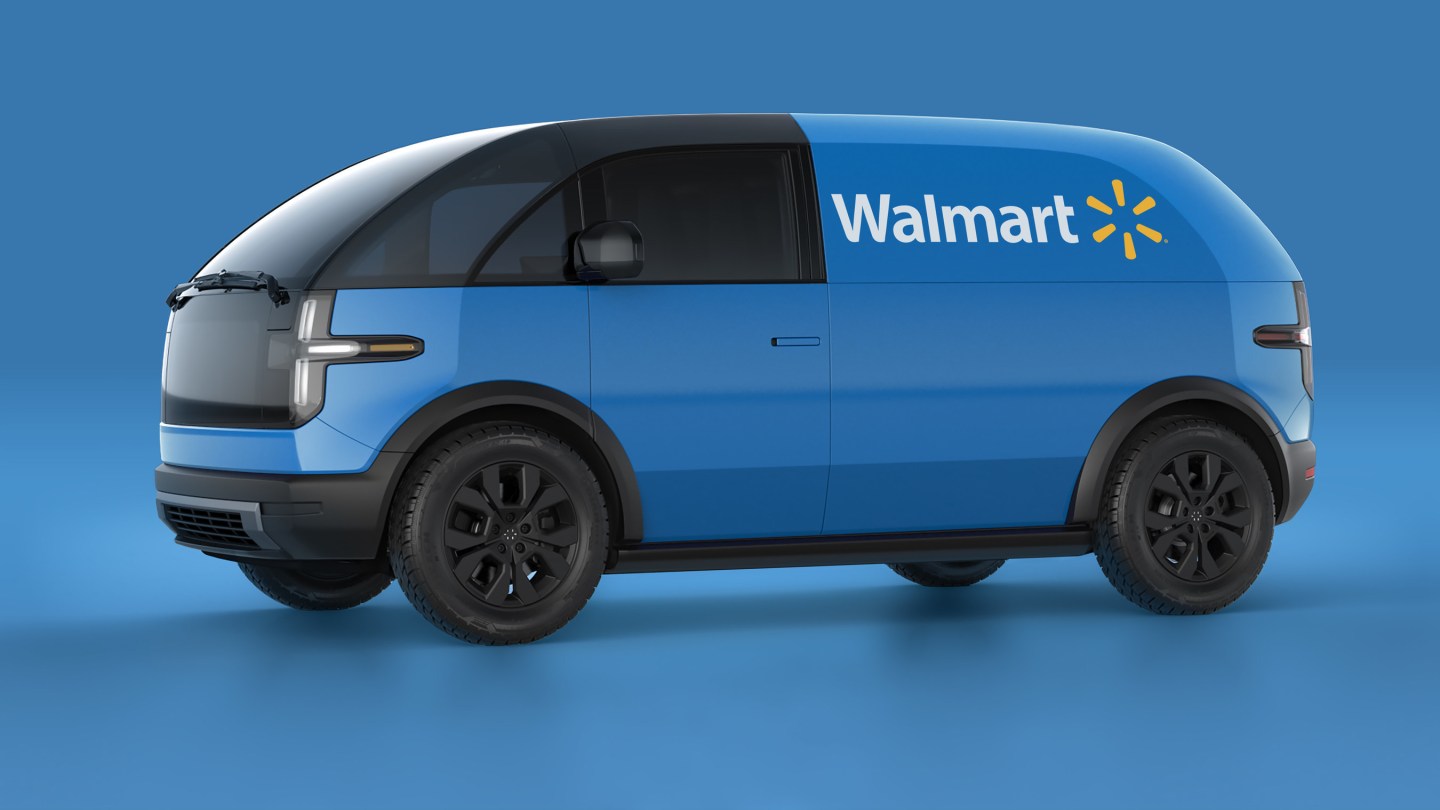
As part of the arrangement, the world’s largest retailer agreed to purchase 4,500 of Canoo’s vehicles for its last-mile delivery fleet, with the option to buy 5,500 more. Canoo issued Walmart warrants to purchase 61.2 million Canoo shares at $2.15 per share, according to disclosures. Some of those warrants vested immediately: The rest will vest over a 10-year period, or until Walmart has generated $300 million in net revenue for Canoo. That would ultimately equate to a more than 20% stake in the company.
That deal could be enormous for the Bentonville-based EV company—which is now projecting a pipeline of $1 billion in sales. Walmart will make up a “substantial portion” of Canoo’s initial revenue streams, according to the company’s disclosures. (Canoo has announced other small contracts with the U.S. Army and with NASA, and also says it has a pipeline of direct consumer orders.) “Obviously we have a pipeline that’s been built that’s quite dynamic,” says Sheeran, Canoo’s president, who oversees government affairs and commercial sales. Sheeran declined to discuss details of the Walmart agreement, but said that Aquila had driven that deal.
It’s unclear whether there is any connection between Alice Walton’s apparent past support for Aquila and Walmart’s recent deal with Canoo. Walton is a major shareholder in Walmart, and, together with her two brothers, holds more than 48% of voting shares at the retailer. Her nephew, Steuart Walton, is a current board member and her brother, Rob Walton, is the former chairman. While she is famously silent about her investments, Alice Walton’s philanthropy and art patronage have often been credited with building up business and culture in and near Bentonville. Walton’s family office declined to comment for this story, and Alice Walton’s name is nowhere to be seen within the Walmart-Canoo agreement materials. Walmart declined to comment on the issue.
Courtesy of Canoo
What is clear from the materials is that Walmart may not end up purchasing any vehicles—and it has plenty of “outs” if Canoo doesn’t deliver. The company can give Canoo 30 days’ written notice to cancel the deal, according to SEC disclosures, and Canoo’s vehicles are also subject to “certain acceptance and performance criteria” that the EV company will need to meet. The hedges seem prudent: After all, Canoo’s final version of its product isn’t out yet, and it doesn’t yet have the infrastructure to manufacture it in-house.
Canoo is also barred under the new deal from working with—or selling shares to—one of Walmart’s largest competitors, Amazon, which has also been vying for new, greener last-mile delivery methods—underscored by its investment in Rivian Automotive, the Irvine, Calif.-based electric vehicle competitor that went public in 2021. (Amazon recently took a $7.8 billion hit on its stake in Rivian, after the company’s shares lost half their value during the recent tech market plunge)
Canoo’s deal with Walmart immediately enthused investors, however; On July 12, Canoo saw its stock price rise 63% by mid-day on the news. Notably, one of the company’s major investors took it as an opportunity to sell. In a four-day period shortly following the announcement, Li sold more than 4 million shares at more than $4 a piece, per SEC filings. (He still owns nearly 27 million shares through two holding companies, records show)
Walmart or no, Canoo still has plenty of hurdles to grapple with: The company is working with a third party based in Detroit to manufacture its initial vehicles for now until it builds out its own facilities, which will be expensive. In eastern Oklahoma, Canoo has begun moving trees and clearing land on property in the state’s MidAmerica Industrial Park, but it has yet to begin construction, according to David Stewart, Chief Administrative Officer of the park. “They are making progress on their development agreement,” Stewart says. Aquila says Canoo’s Bentonville facility won’t start manufacturing vehicles until at least the second quarter of 2023.
Building those facilities will take capital, and the company is already losing hundreds of millions, with net losses of nearly $290 million in the first six months of this year, according to Canoo’s most recent quarterly earnings statement—more than twice the company’s reported losses from the same period in 2021. Meanwhile, the company was sitting on only $33.8 million in cash as of the end of June.
“The real questions are around the company’s financing” and how Canoo will be able to pay for it, says Roth Capital’s Craig Irwin, an analyst who has been covering the company since it went public.
This year, Canoo has entered into a series of capital arrangements with a fund affiliated with hedge fund Yorkville Advisors, then later the investment banks Evercore and H.C. Wainwright, under less than favorable terms, to free up cash.
Meanwhile, Canoo still hasn’t finalized its vehicle. It has been building and testing what it calls its “Gamma” fleet; then will move into the “fit and finish” phase before starting production, according to Aquila. The company projects it will start production in the fourth quarter of this year.
“I think the first couple thousand units should be delivered on time, as expected,” Irwin says of Canoo’s ability to deliver product. “Where we go beyond that is a question I don’t know how to answer.”
When Aquila was showing me around Canoo’s nearly-empty Bentonville facility in early June, I found it difficult to discern whether the few employees who were present feared or respected their chief executive.
During our conversations, Aquila casually interrupted his communications person twice and didn’t bother to apologize. During our interview, one of his employees stood patiently outside the vehicle for the duration of the conversation, arms held behind his back, ready to open the car door for us at Aquila’s bidding. Earlier that morning, as I sat on a bench near the front door of the facility, wrapping up a phone call and waiting to meet with Aquila, I had been repeatedly interrupted and questioned by a security agent.
But as uncomfortable as those moments may have felt, Aquila seemed relaxed, and he had clearly envisioned how all this would ultimately pan out. As he put it in our interview, he believes his own trajectory at Canoo parallels Musk’s at Tesla. That comparison sets a high bar: Musk, after all, had come in as an investor, taken control, pointed the company in a new direction, and ultimately transformed the automotive industry.
“I think, you know, we’re on the cusp of some really, really great things,” Aquila would go on to tell me.
The alternative, of course, would be utter failure.
此内容由惯性聚合(RSS阅读器)自动聚合整理,仅供阅读参考。 原文来自 — 版权归原作者所有。