


惯性聚合 高效追踪和阅读你感兴趣的博客、新闻、科技资讯
阅读原文 在惯性聚合中打开

推荐订阅源

K
Kaspersky official blog
Engineering at Meta
Engineering at Meta
D
DataBreaches.Net
Stack Overflow Blog
Stack Overflow Blog
Microsoft Security Blog
Y
Y Combinator Blog
B
Blog RSS Feed
GbyAI
GbyAI
P
Proofpoint News Feed
aimingoo的专栏
aimingoo的专栏
MyScale Blog
MyScale Blog
D
Docker
阮一峰的网络日志
阮一峰的网络日志
Cyber Security Advisories - MS-ISAC
Recorded Future
Recorded Future
美团技术团队
The Register - Security
V
Visual Studio Blog
H
Hackread – Cybersecurity News, Data Breaches, AI and More
T
Tailwind CSS Blog
爱范儿
爱范儿
freeCodeCamp Programming Tutorials: Python, JavaScript, Git & More
T
The Blog of Author Tim Ferriss
博客园 - 司徒正美
量子位
B
Blog
F
Fortinet All Blogs
Martin Fowler
Martin Fowler
博客园 - 【当耐特】
MongoDB | Blog
MongoDB | Blog
A
About on SuperTechFans
I
InfoQ
钛媒体:引领未来商业与生活新知
钛媒体:引领未来商业与生活新知
有赞技术团队
有赞技术团队
雷峰网
雷峰网
大猫的无限游戏
大猫的无限游戏
J
Java Code Geeks
L
LangChain Blog
Latest news
Latest news
S
SegmentFault 最新的问题
Exploit-DB.com RSS Feed
Blog — PlanetScale
Blog — PlanetScale
Threat Intelligence Blog | Flashpoint
Cisco Talos Blog
Cisco Talos Blog
F
Full Disclosure
C
Cisco Blogs
D
Darknet – Hacking Tools, Hacker News & Cyber Security
W
WeLiveSecurity
T
Tenable Blog
T
Tor Project blog

Fortune | FORTUNE

One man can kill Bill Ackman’s $64 billion bid for Universal Music Group—and no one knows what he’ll do | Fortune Poppi’s cofounder pitched her startup on Shark Tank while 9 months pregnant and landed a $400,000 deal—now it's worth $2 billion | Fortune Teen boys are choosing AI girlfriends over real ones for 'maximum control, zero rejection'—experts say it could make them unemployable | Fortune A United American merger is by no means impossible given the president 'loves big deals' | Fortune Food companies are finally cutting prices. PepsiCo shows it’s worth it | Fortune Reed Hastings’s planned exit from $455 billion Netflix ‘had nothing to do with’ the failed deal for Warner Bros., says Ted Sarandos | Fortune Meet Joe McCann: The high-flying crypto trader held in Tanzania after sudden death of his influencer fiancée Ashly Robinson | Fortune Gen Z is carving a different path in the housing market by doing it alone | Fortune U.S. Catholic leaders criticize Trump for ‘disparaging words’ about the pope as Vatican clash risks alienating Catholic voters | Fortune China has ‘nearly erased’ America’s lead in AI—and the flow of tech experts moving to the U.S. is slowing to a trickle, Stanford report says | Fortune Self-made millionaire behind $5 billion Skims Emma Grede says it all began with a cold call to Kris Jenner: Emma Grede—the self-made millionaire behind the $5 billion Skims empire—says it all began with an audacious cold call to Kris Jenner: ‘The difference between me and someone else is, I made it happen’ | Fortune Americans have never been this gloomy about the economy. Wall Street has never cashed in harder | Fortune ‘The college grading system [is] almost meaningless’: People see the Ivy League as an easy A and with flawed admissions standards | Fortune The CEO of $8.5 billion Japanese car giant Nissan plays the drums in a band and hits the tennis courts to destress from the top job | Fortune New York governor's take on a millionaires tax: fancy pied-à-terre second apartments worth over $5 million | Fortune Pope Leo XIV: A ‘handful of tyrants’ are ravaging earth with war and exploitation | Fortune Trump has no plan to cut the $39 trillion national debt, but he does want to cut childcare. His budget director is scrambling to clarify | Fortune China's economy grows 5% in first quarter, surprising economists to the upside | Fortune Everyone was wondering what Trump wanted more: Warsh smoothly seated at the Fed, or for Powell to pay. We have our answer | Fortune Palantir exec: the biggest mistake retailers are making with AI? Trying to do it all with one agent | Fortune American YouTuber who calls himself a 'troll' sentenced to 6 months in Korean prison for literally dancing on wartime graves | Fortune BBC plans to cut up to 2,000 jobs to save 10% of annual budget | Fortune Canva debuts a new suite of agentic tools, as the design app quietly becomes one of the world’s most used AI services | Fortune Moody's CEO: AI has a trust problem – better models won’t fix it | Fortune Top New York surgeon: Americans have better data for choosing restaurants than surgeons. That has to change | Fortune The Iran war’s fertilizer shock is hammering American farmers, and 70% can’t afford what they need for this year’s growing season | Fortune Education experts to Mamdani: Why are you foisting AI on our kids? | Fortune This CEO pirated video games as a teen and became a hacker for the Air Force. Now he’s built a $3 billion cyber firm | Fortune Teacher, blame thyself: Yale report savages Ivy League schools for destroying American trust in higher education | Fortune Fed chair nominee Kevin Warsh is worth more than $100 million and has stakes in SpaceX and Polymarket | Fortune From wool sneakers to GPUs: Allbirds’ desperate AI pivot and 600% stock surge, explained | Fortune The Sam Altman attack is putting two anti-AI groups under scrutiny—but the story is more complicated | Fortune Elizabeth Warren on her proposal to bring back IRS Direct File: ‘For just one day of bombing Iran, we could pay for 20 years’ | Fortune ‘I am certain’: Harvard policy expert warns the true cost of the Iran war to U.S. taxpayers will exceed $1 trillion | Fortune The CEO of a $24 billion Dutch lender has sandwiches once a week with the staff to hear their views and get them on side with cost cuts | Fortune Why insurance giant Travelers' CTO is placing fewer, bigger bets on AI | Fortune Current price of oil as of April 15, 2026 | Fortune The dirty secret behind Big Tech’s AI arms race: Massive hardware investments that are obsolete in 3 years | Fortune Dow’s CEO handoff elevates an insider and seasoned operator | Fortune Anthropic faces user backlash over reported performance issues with its Claude AI chatbot | Fortune Stock futures sink while oil spikes as the U.S. Navy looks to squeeze Iran's economy and break its grip on the Strait of Hormuz | Fortune A major U.S. gasoline production hub is in such a severe drought that its refineries may be hobbled. 'We are actively praying for a hurricane' | Fortune U.K. won’t take part in Trump’s planned blockade of Hormuz strait | Fortune Hungarian voters oust Viktor Orbán, a close ally of Trump and Putin, despite late campaign push from JD Vance | Fortune Blazing hot IPOs, an AI agent craze, and a new word for ‘token’: Here’s what’s happening in the world of Chinese AI | Fortune Iran’s crumbling economy is the regime’s greatest weakness with prices up 40% since the war began while authorities worry about making payroll | Fortune Here’s how a U.S. naval blockade of the Strait of Hormuz could work. ‘This is a big task, and it’s a big gamble’ | Fortune Intuit was an AI pioneer. Why its stock became a SaaSpocalypse casualty | Fortune Artemis III will practice docking Orion with lunar landers in Earth orbit next year while Musk’s Starship and Bezos’ Blue Moon compete for Artemis IV | Fortune Oil tankers U-turn in Hormuz as U.S.-Iran talks break down Saudi Arabia says East-West pipeline restored to full capacity In 2011, Barack Obama said it was time to ‘pivot’ to Asia. But 15 years later, the U.S. is still at war in the Middle East Trump says U.S. Navy to impose Hormuz blockade after Iran ceasefire talks end with no deal. ‘No one who pays an illegal toll will have safe passage’ This TikTok sensation sold her startup for $2 billion. Now Pepsi is letting ‘Poppi be Poppi’ ‘Almost unmanageable’: Raising a child in the U.S. now costs more than $300,000 As Iran peace talks fail, Trump and Joe Rogan watch a hobbled fighter triumph in a brutal cage match Haiti stares down starvation as Iran War drives 200,000 into acute food emergency status ‘I just keep seeing a lot of different aspects of life getting more expensive’: New car prices are up 30% over 6 years America is not ready for its own longevity crisis — and 2026 is the wake-up call | Fortune JD Vance leaves Pakistan after marathon talks with Iran end without a deal as Tehran refuses U.S. demand not to develop nuclear weapons | Fortune Average price of new cars nears $50,000 as automakers focus on big pickups and SUVs while cheaper sedans get phased out | Fortune Navy tests Hormuz blockade as expert says U.S. military prepares for round 2 and could degrade Iran’s hold over the strait to a ‘manageable level’ | Fortune Pakistan sends military force to Saudi Arabia as part of pact | Fortune Three oil supertankers sail through the Strait of Hormuz | Fortune Trump downplays talks for ceasefire deal with Iran, claiming military victory. 'It doesn’t matter. From the standpoint of America, we win' | Fortune Boeing’s moon rocket faces uncertain future under Trump’s NASA | Fortune Appeals court says national security implications of halting White House ballroom construction must be weighed | Fortune Some of cheapest fuel can be found on Native American reservations as tribes are exempt from state gas taxes | Fortune JD Vance begins talks with Iran in Pakistan while Trump claims U.S. has begun 'clearing out' the Strait of Hormuz | Fortune 'This is the last warning.' Iran threatens U.S. warships after they throw down the gauntlet for winner-take-all Strait of Hormuz | Fortune U.S. Navy ships transit Hormuz ahead of mine-clearing mission | Fortune Over a third of Ireland's fuel stations are empty and truck and tractor drivers are protesting nationwide | Fortune Some communities are enduring unprecedented long waits on federal disaster requests, and Democrat-led states say they're being denied | Fortune These niche AI startups are trying to protect the Pentagon’s secrets | Fortune Former Tesla president reveals the ‘single most important thing’ you can do for your career—it’s a habit Elon Musk and Warren Buffett share too | Fortune Ingersoll Rand CEO: here's how employee ownership helped drive more than 8x enterprise value growth | Fortune The petrodollar faces increased risk, but a petroyuan is ‘far-fetched’ as fears of U.S. losing superpower status are overhyped, strategist says | Fortune Palantir CEO says AI ‘will destroy’ humanities jobs, but there will be ‘more than enough jobs’ for people with vocational training | Fortune Warren Buffett says 'accumulating great amounts of money' doesn’t achieve greatness—He still lives in a $31,500 Nebraska home and clipped coupons | Fortune Starbucks' game plan to roll out AI chatbots at cafes could serve as a 'litmus test' for the industry, analyst says | Fortune Data centers and gas demand make boring pipelines great again | Fortune The 'Tuscan Mom' aesthetic is taking over TikTok as Gen Z glamorize McMansions and reject millennial gray | Fortune Man's best friend may soon live a little longer thanks to a new pill promising to extend your pup's lifespan | Fortune Danantara CIO: Indonesia can anchor the AI and energy economy—if governance keeps pace | Fortune OpenAI’s TBPN deal shows how talent, media, and influence are collapsing into one | Fortune AI promises to free workers from grunt work, but psychologists say those mindless tasks are exactly what our brains need to recover | Fortune The 'affordability economy' has created a housing market nobody predicted: Prices collapsing in the Sun Belt, soaring in the Rust Belt | Fortune 'It’s 13 minutes of things that have to go right': Artemis II splashes down despite faulty heat shield | Fortune Fed seeks details on U.S. banks' exposure to private credit firms | Fortune The Navy confirmed an ‘abundant amount’ of Uncrustables when the Artemis II crew lands. Smucker’s just offered them a lifetime supply | Fortune Meet ‘trendslop,’ the new, AI-fueled scourge of workplace consultants everywhere | Fortune Amazon is still paying Jeff Bezos an $80,000 yearly salary—but $1.6 million for travel and security | Fortune Trump-backed World Liberty Financial crypto tokens reach all-time low on reports of insider loans | Fortune Iran is demanding tankers in the Strait of Hormuz pay tolls in crypto: What we know so far | Fortune First they went after medtech, then Kash Patel. Iranian hackers’ next target is likely ‘low-hanging fruit’ in water, energy, and tourism, experts say | Fortune The AI that found 27-year-old vulnerabilities no human ever caught before just forced an emergency meeting with every major Wall Street CEO | Fortune Inflation goes up by a whopping monthly rate of nearly 1%—and it’s hitting you at the grocery store and gas station | Fortune H&R Block is betting it can be more than a tax company | Fortune The real engine of innovation is trust | Fortune Huntington is powering digital growth—by opening a branch almost every 2 weeks, says CFO | Fortune
How the 173-year-old glass-maker behind Edison's light bulb and iPhone screens became a Silicon Valley darling | Fortune
2024-12-05 · via Fortune | FORTUNE

In his corner office at Corning Inc.’s towering steel-and-glass headquarters in Corning, N.Y., CEO Wendell Weeks keeps a small, yellowed piece of paper in a dark wood frame behind his desk. Dated Nov. 17, 1880, it’s Thomas Edison’s $311.97 order for Corning Glass Works to produce the glass for a risky new invention of his: the lightbulb. 

“I keep that to always remind me: If someone comes to you with an idea that seems small, but there’s a way to make the world just a little bit better, say yes,” Weeks says. “A lot of ideas won’t work, but the ones that do, those are really good.”

The 173-year-old glass company has proved this concept again and again. The creator of iconic kitchen brands such as Pyrex and CorningWare also developed the glass for telescopes, the earliest TV picture tubes, and heat-resistant glass windows for spacecraft. It answered the call of Apple’s Steve Jobs to create Gorilla Glass—that touch-sensitive, hard-to-shatter glass encasing your smartphone. And it created the fiber-optic cables connecting much of the internet—and those now powering the AI revolution.

Those innovations help explain why the CEO of a company in upstate New York with just $13 billion in 2023 revenue has the admiration and friendship of some of the biggest names in business, from Silicon Valley tycoons such as Amazon’s Jeff Bezos to Motor City moguls like Ford’s Jim Farley. Jony Ive, Apple’s former head of design, says there are few collaborators he holds in higher regard—high praise from the man who crafted the industry-shifting iPhone. “As a designer, as a creative, it’s a complete honor to work with somebody like Wendell,” Ive says. “He is utterly consumed by trying to work with you to solve difficult, sometimes almost seemingly impossible challenges.” 
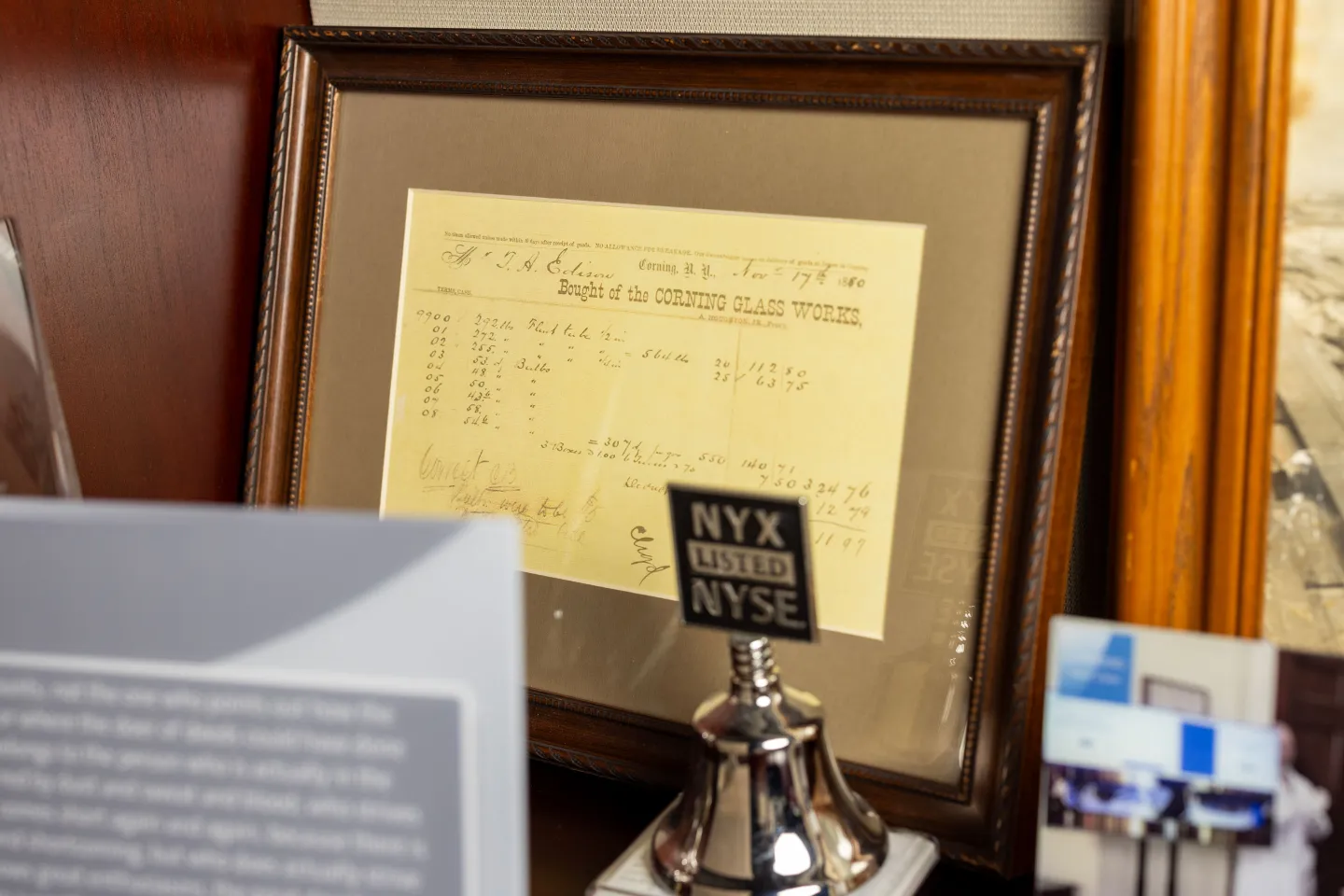
The original purchase order from Thomas Edison to Corning for the glass encasement for Edison’s lightbulb in 1880.

Lauren Petracca for Fortune

A formative failure

But it hasn’t all been smooth sailing for the 6-foot-7, 65-year-old Corning CEO. In the 1990s, Weeks was the Corning vice president tapped to run a new optical fiber business to power the burgeoning internet—an innovation that drove Corning’s valuation to nearly $100 billion at the height of the internet bubble in 2000. 

That bubble burst the following year, sending the company’s stock price plummeting from some $100 to $1. But Weeks proved his mettle by remaining committed to the enterprise after the dotcom crash. Even when Corning lost 99% of its value and had to lay off half its employees, Weeks insisted on the soundness of the strategy and continued to develop the company’s fiber tech.

He recalls begging company leadership not to fire him and instead let him stay on to clean up the mess: “I said, ‘I’m chaining myself to the wheel here. I’ll be a janitor or whatever it is, but I’m staying until this gets fixed.’ They said, ‘Well, it’s not going to be a janitor. We’d like you to become president.’”
Since then, Corning’s big bet on optical fiber has paid off, and it now accounts for 30% of the company’s revenue. Thanks to the rise of AI, tech giants such as Microsoft are flocking to Corning’s new and improved optical fibers to support hyperscale data centers and generative AI, which require far more fiber than has been used in the past, at much higher speed capabilities. 

With a market cap of $41 billion, Corning’s stock price has increased some 50% since January. In October, the company announced a $1 billion multiyear deal with AT&T to provide this next-generation fiber, and Weeks has set a target of adding more than $3 billion in annual sales over the next three years. “We were right that ultimately there’d be a lot more fiber required,” Weeks says, laughing. “We were just off by a decade or two.”

The company’s ordeal at the turn of this century forged Weeks’ leadership style, observed Amazon founder Bezos, who met and befriended the Corning CEO when he joined Amazon’s board in 2016. “My gut is that Wendell was greatly shaped by Corning’s near-death experience,” Bezos tells Fortune. “And it has made him a much better leader.”

From Scranton to Corning

Weeks joined Corning 132 years into the company’s 173-year history. Founded in 1851 by a merchant named Amory Houghton Sr., it began as the Bay State Glass Co., a small company in Massachusetts. Houghton moved it a few years later to Brooklyn before settling upstate in Corning in 1868 and changing the company’s name to match the town’s. The company spun off the Pyrex and CorningWare businesses in 1998, but the names and tech they’ve created remain. The Houghton family took the company public in 1945 and sold its controlling stake in 2005.

Weeks’ path to becoming CEO of a Fortune 500 company wasn’t a straight line. He was born in Scranton, Pa., where his father was a plumber and his mother a secretary at the local elementary school. Neither went to college, and both were alcoholics, he says. 

Looking for a way out of the chaos, Weeks enrolled at Lehigh University, studying finance and accounting, he says, because his “dad went bankrupt, and I wanted to make sure I always understood financial stuff, even though I wasn’t particularly adept at it.” After graduating in 1981, Weeks started as an auditor at the firm Price Waterhouse, where Corning was a client. He soon realized that the people he was interacting with at Corning were exactly the type of people he wanted to be—stable, committed, kind, and family-oriented. In 1983 he was hired as a controller at Corning, where he took on the painful job of helping to shut down an old factory and restructure the industrial business. In his own words: “I much prefer hiring people versus firing them.”
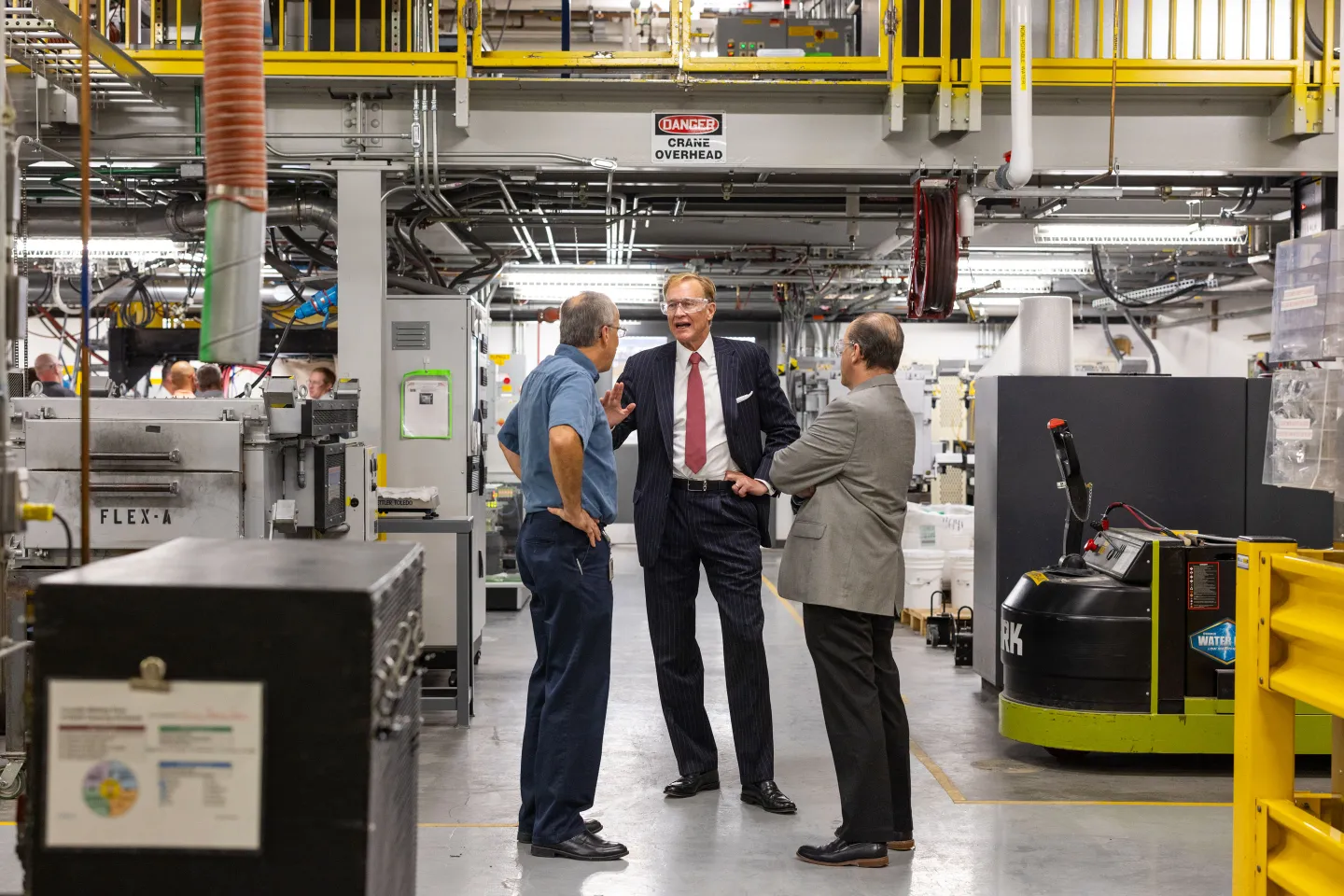
Corning CEO Wendell Weeks is a frequent and regular visitor to the company’s research and development labs, and holds 44 patents himself.

Lauren Petracca for Fortune

After a short detour to Harvard for business school, Weeks came back to Corning in 1987 to develop a strategy for specialty glass and ceramics, studying science textbooks in his off hours to gain the technical knowledge the job required. He was appointed CEO in 2005 and chairman of the board in 2007.

Weeks never received a degree in the sciences, but in his time at Corning, he has earned 44 U.S. patents in his own name. These include patents for Valor Glass Vials–the crack-resistant vials that played a key role in enabling the delivery of COVID vaccines—and for the bendable glass used in interior automotive displays

Weeks’ approach to problem-solving is what sets him apart, says Samsung executive chairman Jay Y. Lee, who developed a close friendship with Weeks thanks to the tech giant’s more than 50-year partnership with Corning, which has made LCD monitors and foldable smartphone glass, among other inventions, for the company.
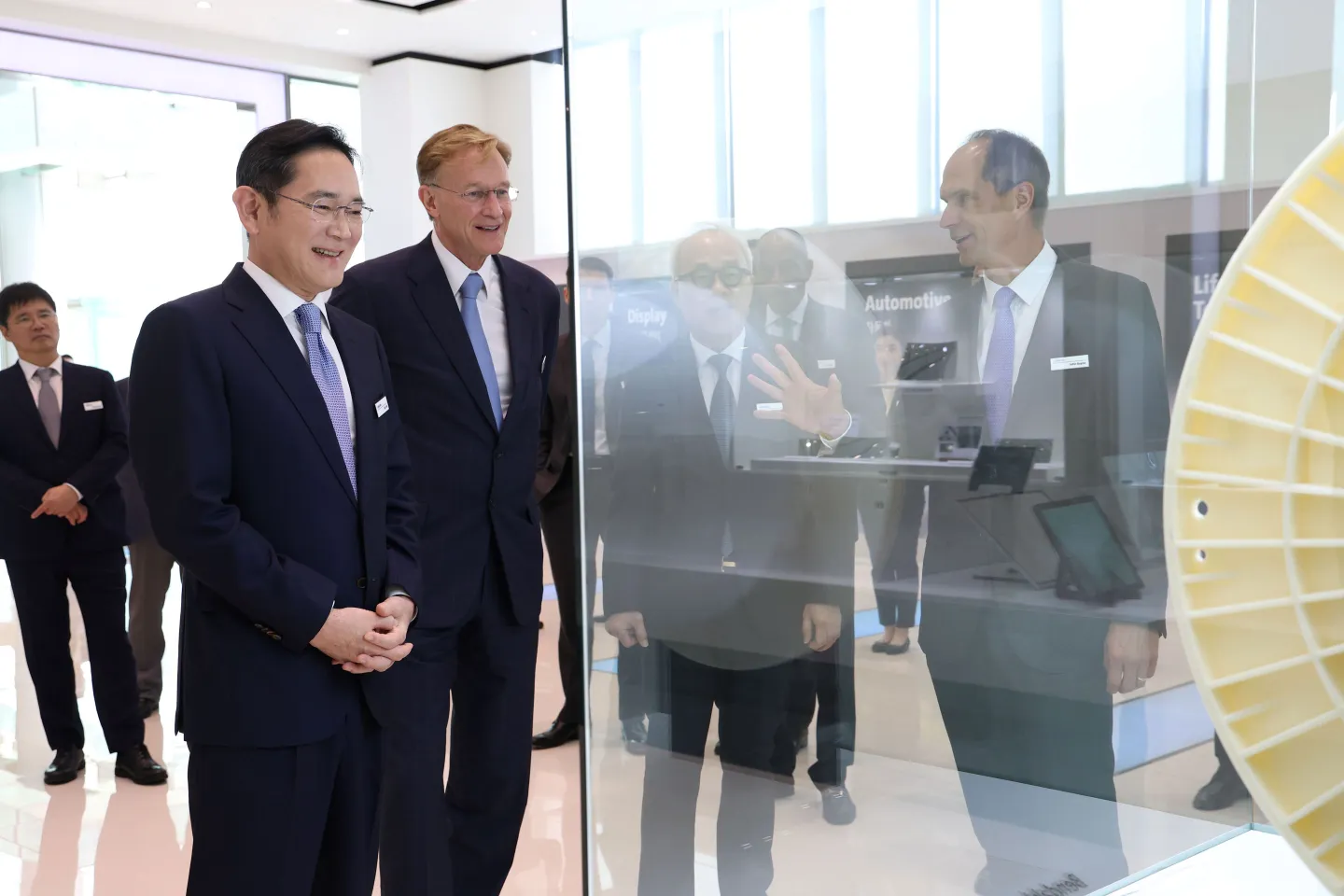
Corning Chairman and CEO Wendell Weeks, and Jay Y. Lee, executive chairman of Samsung Electronics, are shown a bendable glass spool in 2023.

Courtesy of Corning

“He doesn’t hesitate to roll up his sleeves and work alongside his colleagues when there’s a complex problem to solve or a tough issue to be faced,” Lee says via email. “He inspires everyone to bring their best game to the table in the search for the best solutions.”

Amazon CEO Andy Jassy says he relies upon Weeks for directness and fresh perspectives. “He tells it to you straight,” Jassy tells Fortune. “I’ve had many instances over the years where I’ve called Wendell for input and advice, and where I started a conversation was very different from where I ended up.”

Picking up the pieces

Former Corning CFO Jim Flaws, who was by Weeks’s side during the dotcom disaster, sees in Weeks a kind of “you broke it, you fix it” mentality. He tells a story to illustrate: The office dress code was very casual at that time, but to show their dedication to righting the company in the wake of the crash, Flaws and Weeks vowed to wear suits and ties every day until the company was successful again. “We were going to show the seriousness of this,” Flaws said. (Weeks still wears a suit and tie daily, though the company’s dress code has remained more casual.)

That’s one of Bezos’s favorite anecdotes about Weeks too. “It was a very deliberate, internal thing to say, ‘We are going back to the basics. We are going back to the future. We are returning to our roots,’” Bezos says. “We are not a startup in Silicon Valley. We are an important, 100-plus-year-old company. We are innovative, but buttoned-down too.”  

After the massive hit the company took when the dotcom bubble burst, Weeks and Flaws made three big bets in 2002 that are still paying off today: They doubled the amount of money Corning was pouring into research and development. They invested in developing LCD, flat-screen TV displays. And they created new ceramic filters to trap smog and exhaust from trucks.

Five years later, they got their next big break. In 2007, Apple founder Steve Jobs cold-called Weeks after being introduced briefly by a mutual friend. Jobs explained he was creating a new type of cell phone, called the iPhone, where the whole front face would be a display. He was having trouble finding glass to cover it that wouldn’t easily break or scratch. Jobs asked if Corning could make a super-resilient glass–and deliver it in under six months. The Corning board balked, but the CEO pushed ahead anyway—and pulled it off. 

Gorilla Glass, the glass still used on the screen of the iPhone and almost every smartphone in the world, was one of the most consequential inventions in modern history. Without it, the smartphone revolution would not have been possible.

“Back then, we thought in total we’d sell maybe $50 million worth of product to the iPhone,” Weeks says. “Steve didn’t actually think it was going to be that big either.” Since then, Gorilla Glass has generated more than $20 billion in revenue for the company, and is used globally on more than 8 billion devices made by Apple and other companies. 

Colored glass for mobile devices on display at Corning’s R&D labs in Corning, NY.

Lauren Petracca for Fortune

Corning’s next big bet

Now, with its buzziest innovation nearly two decades old, Corning is pivoting yet again, this time to build the “pipes” for the rise of generative AI. 

In 1970, the company created optical fiber, a highly pure optical glass, as thin as a strand of human hair, that could transmit light signals over long distances. Prior to that, copper was the dominant cable material—and it’s still used today to power the internet for many households. Today, if you stream a movie, post to a social network, or pose a question to a generative AI application on your mobile phone, you’re able to do so because of optical fiber connectivity in a data center.

Earlier this year, Corning rolled out its “next-generation optical cable,” and it inked a multimillion-dollar deal with Lumen Technologies to reserve 10% of Corning’s global fiber capacity for each of the next two years to power data centers for customers like Microsoft. 

How are these fibers different from the ones Corning has produced in the past? It all comes down to density. Gen AI requires 10 times the fiber currently used, but needs to fit in the same space, Weeks says. These new, thinner fibers will allow Lumen and other customers to fit two to four times the amount of fiber into their existing ducts. Unlike copper, fiber has virtually limitless data capacity. In one fiber pair (one sending and one receiving), half of the humans on earth could be talking to the other half simultaneously, Weeks says.

But while there’s a whole lot of fiber out there, the market for it is unlikely to die down anytime soon. “Since we invented fiber, there’s now been enough installed in the world to go back and forth to the sun 20 times,” Weeks says. “And still some 50% of Americans aren’t connected directly by fiber… You think of all that copper cabling that you see—all that ultimately will fall to fiber optics for communications. So we’re still at the beginning of this long-term technology curve.” 
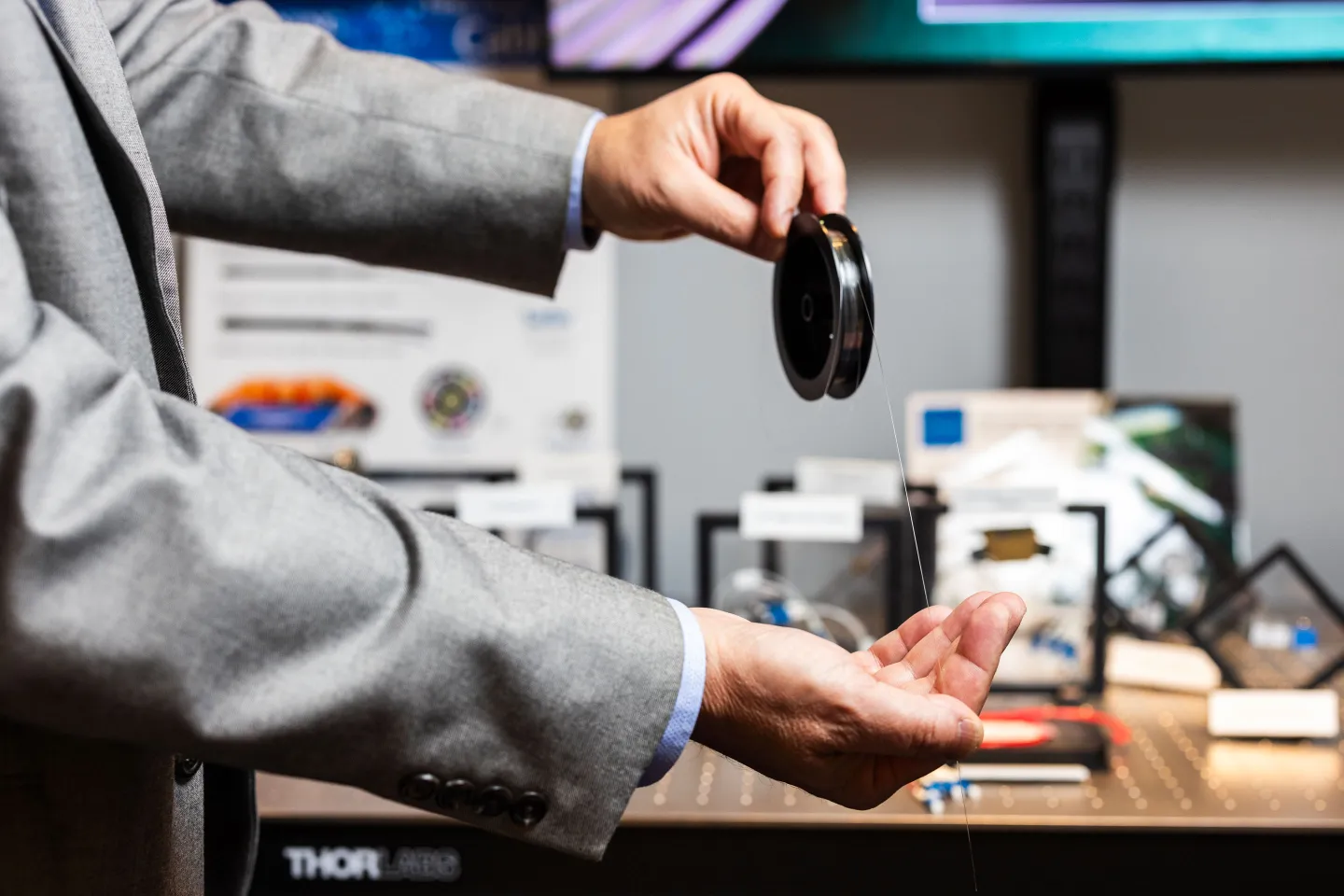
Corning invented optical fiber in 1970. Today the company is the world leader in fiber optic technology.

Lauren Petracca for Fortune

Corning may have invented the stuff, but it’s not the only player in the market for the original optical fiber now: Weeks is keeping his eye on competitors in Asia, including Japan’s Sumitomo Electric and Furukawa Electric Co. Corning’s new fibers and designs for AI applications are still under patent, however.

The situation shows how essential it is that the company keep breaking new ground. Ford CEO Jim Farley says he has learned more from Weeks than any other CEO. (Corning provides much of the exterior and interior glass for Ford’s vehicles.) “He’s in a thermonuclear war of innovation, and we all know that the IP getting created in places like China, Vietnam, and India and around the world is real,” Farley tells Fortune. “He has to stay in front of it, so constantly fueling the innovation, constantly making the right bet on which innovations, that’s a risk for him.” 

William Kerwin, an equity analyst at Morningstar, says the biggest risk he sees ahead for Corning is how capital-intensive its products are to produce—in terms of both manufacturing and research and development. But he thinks Weeks’ three-year, $3 billion sales plan is realistic, thanks to Corning’s diversification.

“It’s a company that is not confined to one product or one market,” Kerwin says. “Glass can sound so boring, but the things they’re able to do with it in terms of durability or the iPhone screens or data-center connectivity with optical fiber is really impressive. They’re really stretching material science to its limits.”

Weeks says he’s betting on gen AI and a trend toward full-screen interior car displays to drive profits going forward. And after decades in the business, he focuses more on finding the right innovation than on predicting the timing of the next blockbuster market for a product. 

“If you understand innovation deeply, you understand that getting the timing right is almost impossible,” Weeks says. “You’ve got to be able to instead go to work on s–t that matters early, and then just scale it fast when all of a sudden it ends up you’ve got to be fast. And that’s what we’re doing now.”