



惯性聚合 高效追踪和阅读你感兴趣的博客、新闻、科技资讯
阅读原文 在惯性聚合中打开

推荐订阅源

A
About on SuperTechFans
D
DataBreaches.Net
K
KPMG report finds enterprise disconnect between AI and its ROI | CIO
V
Visual Studio Blog
奇客Solidot–传递最新科技情报
奇客Solidot–传递最新科技情报
B
Blog RSS Feed
Recent Announcements
The Register - Security
S
Secure Thoughts
Y
Y Combinator Blog
The Last Watchdog
The Last Watchdog
L
LINUX DO - 最新话题
V2EX - 技术
V2EX - 技术
腾讯CDC
GbyAI
GbyAI
G
Google Developers Blog
博客园 - 司徒正美
博客园 - 三生石上(FineUI控件)
T
The Exploit Database - CXSecurity.com
T
Threat Research - Cisco Blogs
P
Proofpoint News Feed
Schneier on Security
Microsoft Security Blog
Jina AI
Jina AI
WordPress大学
WordPress大学
aimingoo的专栏
aimingoo的专栏
MyScale Blog
MyScale Blog
Help Net Security
Help Net Security
K
Kaspersky official blog
P
Privacy & Cybersecurity Law Blog
www.infosecurity-magazine.com
AI
AI
MongoDB | Blog
MongoDB | Blog
Scott Helme
Scott Helme
J
Java Code Geeks
Engineering at Meta
Engineering at Meta
H
Heimdal Security Blog
H
Help Net Security
D
Darknet – Hacking Tools, Hacker News & Cyber Security
云风的 BLOG
云风的 BLOG
Microsoft Azure Blog
S
Security Affairs
TaoSecurity Blog
TaoSecurity Blog
The GitHub Blog
The GitHub Blog
Hacker News: Ask HN
Hacker News: Ask HN
Martin Fowler
Martin Fowler
cs.AI updates on arXiv.org
Project Zero
Project Zero
T
The Blog of Author Tim Ferriss
Last Week in AI
Last Week in AI

Fortune | FORTUNE

One man can kill Bill Ackman’s $64 billion bid for Universal Music Group—and no one knows what he’ll do | Fortune Poppi’s cofounder pitched her startup on Shark Tank while 9 months pregnant and landed a $400,000 deal—now it's worth $2 billion | Fortune Teen boys are choosing AI girlfriends over real ones for 'maximum control, zero rejection'—experts say it could make them unemployable | Fortune A United American merger is by no means impossible given the president 'loves big deals' | Fortune Reed Hastings’s planned exit from $455 billion Netflix ‘had nothing to do with’ the failed deal for Warner Bros., says Ted Sarandos | Fortune Meet Joe McCann: The high-flying crypto trader held in Tanzania after sudden death of his influencer fiancée Ashly Robinson | Fortune Gen Z is carving a different path in the housing market by doing it alone | Fortune U.S. Catholic leaders criticize Trump for ‘disparaging words’ about the pope as Vatican clash risks alienating Catholic voters | Fortune China has ‘nearly erased’ America’s lead in AI—and the flow of tech experts moving to the U.S. is slowing to a trickle, Stanford report says | Fortune Self-made millionaire behind $5 billion Skims Emma Grede says it all began with a cold call to Kris Jenner: Emma Grede—the self-made millionaire behind the $5 billion Skims empire—says it all began with an audacious cold call to Kris Jenner: ‘The difference between me and someone else is, I made it happen’ | Fortune Americans have never been this gloomy about the economy. Wall Street has never cashed in harder | Fortune ‘The college grading system [is] almost meaningless’: People see the Ivy League as an easy A and with flawed admissions standards | Fortune The CEO of $8.5 billion Japanese car giant Nissan plays the drums in a band and hits the tennis courts to destress from the top job | Fortune New York governor's take on a millionaires tax: fancy pied-à-terre second apartments worth over $5 million | Fortune Pope Leo XIV: A ‘handful of tyrants’ are ravaging earth with war and exploitation | Fortune Trump has no plan to cut the $39 trillion national debt, but he does want to cut childcare. His budget director is scrambling to clarify | Fortune China's economy grows 5% in first quarter, surprising economists to the upside | Fortune Everyone was wondering what Trump wanted more: Warsh smoothly seated at the Fed, or for Powell to pay. We have our answer | Fortune Palantir exec: the biggest mistake retailers are making with AI? Trying to do it all with one agent | Fortune American YouTuber who calls himself a 'troll' sentenced to 6 months in Korean prison for literally dancing on wartime graves | Fortune BBC plans to cut up to 2,000 jobs to save 10% of annual budget | Fortune Canva debuts a new suite of agentic tools, as the design app quietly becomes one of the world’s most used AI services | Fortune Moody's CEO: AI has a trust problem – better models won’t fix it | Fortune Top New York surgeon: Americans have better data for choosing restaurants than surgeons. That has to change | Fortune The Iran war’s fertilizer shock is hammering American farmers, and 70% can’t afford what they need for this year’s growing season | Fortune Education experts to Mamdani: Why are you foisting AI on our kids? | Fortune This CEO pirated video games as a teen and became a hacker for the Air Force. Now he’s built a $3 billion cyber firm | Fortune Teacher, blame thyself: Yale report savages Ivy League schools for destroying American trust in higher education | Fortune Fed chair nominee Kevin Warsh is worth more than $100 million and has stakes in SpaceX and Polymarket | Fortune From wool sneakers to GPUs: Allbirds’ desperate AI pivot and 600% stock surge, explained | Fortune The Sam Altman attack is putting two anti-AI groups under scrutiny—but the story is more complicated | Fortune Elizabeth Warren on her proposal to bring back IRS Direct File: ‘For just one day of bombing Iran, we could pay for 20 years’ | Fortune ‘I am certain’: Harvard policy expert warns the true cost of the Iran war to U.S. taxpayers will exceed $1 trillion | Fortune The CEO of a $24 billion Dutch lender has sandwiches once a week with the staff to hear their views and get them on side with cost cuts | Fortune Why insurance giant Travelers' CTO is placing fewer, bigger bets on AI | Fortune Current price of oil as of April 15, 2026 | Fortune The dirty secret behind Big Tech’s AI arms race: Massive hardware investments that are obsolete in 3 years | Fortune Dow’s CEO handoff elevates an insider and seasoned operator | Fortune Anthropic faces user backlash over reported performance issues with its Claude AI chatbot | Fortune Stock futures sink while oil spikes as the U.S. Navy looks to squeeze Iran's economy and break its grip on the Strait of Hormuz | Fortune A major U.S. gasoline production hub is in such a severe drought that its refineries may be hobbled. 'We are actively praying for a hurricane' | Fortune U.K. won’t take part in Trump’s planned blockade of Hormuz strait | Fortune Hungarian voters oust Viktor Orbán, a close ally of Trump and Putin, despite late campaign push from JD Vance | Fortune Blazing hot IPOs, an AI agent craze, and a new word for ‘token’: Here’s what’s happening in the world of Chinese AI | Fortune Iran’s crumbling economy is the regime’s greatest weakness with prices up 40% since the war began while authorities worry about making payroll | Fortune Here’s how a U.S. naval blockade of the Strait of Hormuz could work. ‘This is a big task, and it’s a big gamble’ | Fortune Intuit was an AI pioneer. Why its stock became a SaaSpocalypse casualty | Fortune Artemis III will practice docking Orion with lunar landers in Earth orbit next year while Musk’s Starship and Bezos’ Blue Moon compete for Artemis IV | Fortune Oil tankers U-turn in Hormuz as U.S.-Iran talks break down Saudi Arabia says East-West pipeline restored to full capacity In 2011, Barack Obama said it was time to ‘pivot’ to Asia. But 15 years later, the U.S. is still at war in the Middle East Trump says U.S. Navy to impose Hormuz blockade after Iran ceasefire talks end with no deal. ‘No one who pays an illegal toll will have safe passage’ This TikTok sensation sold her startup for $2 billion. Now Pepsi is letting ‘Poppi be Poppi’ ‘Almost unmanageable’: Raising a child in the U.S. now costs more than $300,000 As Iran peace talks fail, Trump and Joe Rogan watch a hobbled fighter triumph in a brutal cage match Haiti stares down starvation as Iran War drives 200,000 into acute food emergency status ‘I just keep seeing a lot of different aspects of life getting more expensive’: New car prices are up 30% over 6 years America is not ready for its own longevity crisis — and 2026 is the wake-up call | Fortune JD Vance leaves Pakistan after marathon talks with Iran end without a deal as Tehran refuses U.S. demand not to develop nuclear weapons | Fortune Average price of new cars nears $50,000 as automakers focus on big pickups and SUVs while cheaper sedans get phased out | Fortune Navy tests Hormuz blockade as expert says U.S. military prepares for round 2 and could degrade Iran’s hold over the strait to a ‘manageable level’ | Fortune Pakistan sends military force to Saudi Arabia as part of pact | Fortune Three oil supertankers sail through the Strait of Hormuz | Fortune Trump downplays talks for ceasefire deal with Iran, claiming military victory. 'It doesn’t matter. From the standpoint of America, we win' | Fortune Boeing’s moon rocket faces uncertain future under Trump’s NASA | Fortune Appeals court says national security implications of halting White House ballroom construction must be weighed | Fortune Some of cheapest fuel can be found on Native American reservations as tribes are exempt from state gas taxes | Fortune JD Vance begins talks with Iran in Pakistan while Trump claims U.S. has begun 'clearing out' the Strait of Hormuz | Fortune 'This is the last warning.' Iran threatens U.S. warships after they throw down the gauntlet for winner-take-all Strait of Hormuz | Fortune U.S. Navy ships transit Hormuz ahead of mine-clearing mission | Fortune Over a third of Ireland's fuel stations are empty and truck and tractor drivers are protesting nationwide | Fortune Some communities are enduring unprecedented long waits on federal disaster requests, and Democrat-led states say they're being denied | Fortune These niche AI startups are trying to protect the Pentagon’s secrets | Fortune Former Tesla president reveals the ‘single most important thing’ you can do for your career—it’s a habit Elon Musk and Warren Buffett share too | Fortune Ingersoll Rand CEO: here's how employee ownership helped drive more than 8x enterprise value growth | Fortune The petrodollar faces increased risk, but a petroyuan is ‘far-fetched’ as fears of U.S. losing superpower status are overhyped, strategist says | Fortune Palantir CEO says AI ‘will destroy’ humanities jobs, but there will be ‘more than enough jobs’ for people with vocational training | Fortune Warren Buffett says 'accumulating great amounts of money' doesn’t achieve greatness—He still lives in a $31,500 Nebraska home and clipped coupons | Fortune Starbucks' game plan to roll out AI chatbots at cafes could serve as a 'litmus test' for the industry, analyst says | Fortune Data centers and gas demand make boring pipelines great again | Fortune The 'Tuscan Mom' aesthetic is taking over TikTok as Gen Z glamorize McMansions and reject millennial gray | Fortune Man's best friend may soon live a little longer thanks to a new pill promising to extend your pup's lifespan | Fortune Danantara CIO: Indonesia can anchor the AI and energy economy—if governance keeps pace | Fortune OpenAI’s TBPN deal shows how talent, media, and influence are collapsing into one | Fortune AI promises to free workers from grunt work, but psychologists say those mindless tasks are exactly what our brains need to recover | Fortune The 'affordability economy' has created a housing market nobody predicted: Prices collapsing in the Sun Belt, soaring in the Rust Belt | Fortune 'It’s 13 minutes of things that have to go right': Artemis II splashes down despite faulty heat shield | Fortune Fed seeks details on U.S. banks' exposure to private credit firms | Fortune The Navy confirmed an ‘abundant amount’ of Uncrustables when the Artemis II crew lands. Smucker’s just offered them a lifetime supply | Fortune Meet ‘trendslop,’ the new, AI-fueled scourge of workplace consultants everywhere | Fortune Amazon is still paying Jeff Bezos an $80,000 yearly salary—but $1.6 million for travel and security | Fortune Trump-backed World Liberty Financial crypto tokens reach all-time low on reports of insider loans | Fortune Iran is demanding tankers in the Strait of Hormuz pay tolls in crypto: What we know so far | Fortune First they went after medtech, then Kash Patel. Iranian hackers’ next target is likely ‘low-hanging fruit’ in water, energy, and tourism, experts say | Fortune The AI that found 27-year-old vulnerabilities no human ever caught before just forced an emergency meeting with every major Wall Street CEO | Fortune Inflation goes up by a whopping monthly rate of nearly 1%—and it’s hitting you at the grocery store and gas station | Fortune H&R Block is betting it can be more than a tax company | Fortune The real engine of innovation is trust | Fortune Huntington is powering digital growth—by opening a branch almost every 2 weeks, says CFO | Fortune How the 173-year-old glass-maker behind Edison's light bulb and iPhone screens became a Silicon Valley darling | Fortune
The economist who wrote the book on sports finance has a number for FIFA's World Cup haul: $15 billion | Fortune
The Conversation · 2026-05-25 · via Fortune | FORTUNE

At soccer’s World Cup, the top scorer gets the “golden boot,” and the best goalkeeper is handed the “golden gloves.” This year’s tournament will also provide organizer FIFA with a golden opportunity to create billions in additional ticket revenues.

Ticket prices are so high that even President Donald Trump, a billionaire ally of FIFA President Gianni Infantino, said he wouldn’t pay.

The concern is that FIFA is pricing out many of the sport’s most devoted fans. In the 2022 Qatar-hosted World Cup, group-stage Category 1 tickets – the best seats – cost about $220, while Qatari residents could purchase tickets for $11 in some group-stage matches. Category 1 tickets to the final were about $1,600.

For the 2026 World Cup, dynamic pricing, which deliberately makes pricing opaque and subject to real-time changes, is being used for the first time. It means ticket prices may vary dramatically both across games and even for a given game over time.

The initial baseline for Category 1 tickets during World Cup 2026 was about $600 when they first went on sale in the fall of 2025 but now they generally sell for over $1,000 and sometimes much higher. The price for Category 1 tickets for the opening game in Mexico City is currently over $2,500, and even Category 3 tickets, the lowest available tier, are over $1,000. For the final, Category 1 tickets initially cost over $6,000 and had exceeded $32,000 by early May.

As an emeritus professor of finance and author of “Keeping Score: The Economics of Big Time Sports,” I’ve done some number crunching and predict that increased ticket receipts will help FIFA exceed $15 billion in revenue this world cup cycle – which would be a record-breaker for soccer’s governing body and significantly more than its 2022 stated goal of $11 billion.

FIFA’s ticket pricing approach may be a logical way to capture at least some of the revenue that normally goes to ticket scalpers, but it’s also unlikely to find a sympathetic audience among potential ticket buyers. Further, what remains unclear is FIFA’s plan on how to spend the extra billions of revenue, with its stated goal to support positive social change belied by a track record of corruption and lack of transparency.

How FIFA operates

It’s important to put ticket pricing in the context of FIFA’s broader finances and objectives.

FIFA is a nonprofit organization, registered as a charity in Switzerland, with a mandate not only to organize competitions like the World Cup but also to grow the game and expand soccer access globally.

It operates on a four-year budget cycle with most revenues generated by the World Cup in the last year of the cycle.

Historical comparisons help frame the issue. The 1994 World Cup in the United States, widely seen as a major success, generated $700 million in net revenue – or profits – versus a $550 million budget, driven largely by stronger-than-expected ticket sales and sponsorships. Large venues and high attendance also helped advance FIFA’s development goals, including the launch of Major League Soccer.

By 2022, FIFA’s finances had grown dramatically. Revenue for the cycle that included that year’s World Cup was budgeted at $6.44 billion but ended up reaching $7.57 billion — with most growth coming from broadcasting and marketing.

Budgeted ticket revenue appeared modest due to smaller venues in Qatar, but actual ticket revenue significantly exceeded expectations, most likely due to FIFA’s conservative revenue forecast. On the cost side, spending closely matched the budget, with $2.8 billion allocated to development programs in the 2019-2022 cycle. Despite this expense, reserves rose from $2.81 billion to $3.89 billion as a result of the 2022 tournament’s success.

Looking ahead to the 2026 World Cup cycle, FIFA budgeted that revenue would increase by $4.36 billion relative to the 2019-2022 cycle, to $11 billion, driven largely by ticketing — up $2.59 billion — and broadcasting, up $890 million. Costs were expected to rise by $4.57 billion, implying a projected surplus of about $100 million, the same small increase projected in the prior cycle. By 2024, a revised FIFA budget increased the forecasted revenue for the 2023-2026 cycle up to $13 billion.

FIFA’s leverage with ticket demand

FIFA’s track record suggests a pattern: conservative revenue projections, accurate cost control and consistent “surprises” in ticketing and licensing that generate higher than expected revenues and a dramatic increase in ending reserves.

My projections suggest that broadcasting and marketing this year are on track to equal their budgeted values, and historically FIFA’s actual costs closely track budget values. But ticketing remains the key revenue variable – and the central controversy. The expanded 2026 tournament means more teams, more matches, more fans and significantly higher ticket demand.

Even with larger stadiums than any World Cup since 1994, demand has vastly exceeded supply. There were over 500 million ticket requests for the random draw, but roughly 7.1 million available seats.

This imbalance gave FIFA tremendous pricing power. To try to mitigate criticism, FIFA introduced $60 “Supporter Entry Tickets” allocated through national associations. Yet these account for only a small share of tickets, fewer than 600 per match, and have done little to dampen the outrage over prices.

Most tickets have been sold in phases using dynamic pricing, with substantial increases across phases and most sales occurring in the later and more expensive phases. Venue seating charts also indicate most tickets are classified as the highest priced tier. Meanwhile, FIFA will receive ticket revenue from FIFA-controlled resale.

All three factors will likely push ticket revenue well above FIFA’s budget. Based on these dynamics, I project ticketing and hospitality revenue of a minimum of $7.44 billion – more than double FIFA’s budget, but consistent with stadium capacities, pricing across phases, seat allocation by category and ongoing resale activity.

Ticket and hospitality revenue per match in 2022 averaged $14.5 million. FIFA’s $3.1 billion budget for 2026 implies average ticket revenue per match would be about about $30 million. But given the larger stadiums and substantially higher ticket prices, that number appears to grossly understate actual ticket revenues. A final ticketing and hospitality value of close to $9 billion would not be a surprise. My predicted total revenue for FIFA is $14 billion to $19 billion.
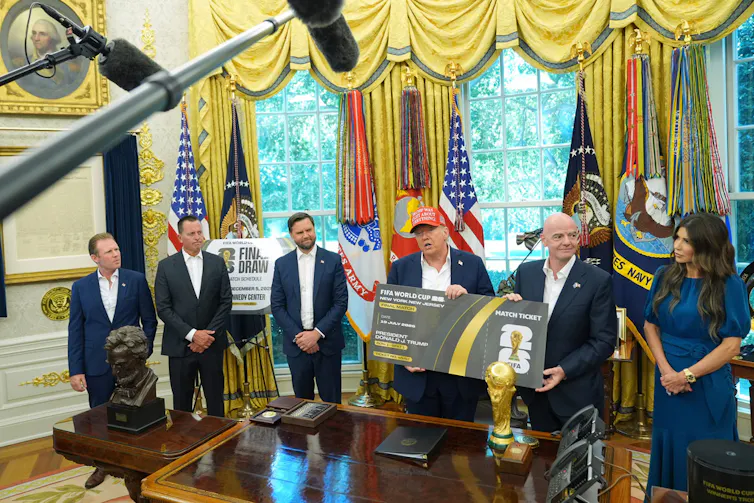
People in business attire stand around a desk during a press conference.
President Donald Trump speaks holding a large ticket representing a ticket for the World Cup final, alongside FIFA President Gianni Infantino on Aug. 22, 2025. AP Photo/Jacquelyn Martin

Following the money

Soccer fans, whether they are ticket buyers or media viewers, generate FIFA’s revenue. In turn, FIFA’s objectives are to use those funds to put on a great World Cup and to grow soccer and make it accessible. As revenues grow, however, it is reasonable to ask why – beyond fairness and ticket accessibility questions – FIFA believes that it needs reserves of over $4 billion – over half of its total costs in the 2019-22 cycle?

Indeed, the numbers suggest the organization has actually decreased some core funding priorities on a relative basis – significantly.

In the 2023-26 cycle, the budget for competitions rose from $2.45 billion to $5.62 billion, about a 130% increase, while the budget for development increased only 44%, and its share of budgeted revenues dropped from 44% to 36%.

FIFA could argue that maximum revenue is needed to cover costs of future events and fund soccer development, but that is not the whole story told by FIFA’s 2027-2030 budget.

Total additional costs are set at around $3 billion, with the main driver being competition and events. Crucially, for the 2019-2022 cycle, development was 44% of the costs; for 2023-2026, it dropped to 36% of the costs; and for the 2027-2030 cycle, it is budgeted to further decrease to 29% of costs. Undoubtedly, these numbers will change, but they currently do not signal that FIFA is going to use its additional ticketing revenue to support broader soccer-related or social change investments.

That is perhaps not surprising, as FIFA has faced governance challenges in the past, including issues of corruption, bribery and fraud, plus accounting practices that critics say lack transparency. Reforms have attempted to mitigate those problems, and FIFA has started programs like the FIFA Foundation, whose stated purpose is to use soccer to improve people’s lives.

Given FIFA’s background, surplus and reserves, however, the biggest question should be whether FIFA’s financial resources are being effectively used to achieve its objectives. FIFA has described its purpose with phrases like “develop the game, touch the world and build a better future.” But to me, its budgets suggest it is focused primarily on the first.

Richard Sheehan, Professor Emeritus of Business and Economics, University of Notre Dame

This article is republished from The Conversation under a Creative Commons license. Read the original article.

The Conversation