








The net number of jobs AI is eliminating each month is shrinking. That sounds like good news. It isn’t — at least not for Gen Z.
Two months ago, Goldman Sachs economists estimated that artificial intelligence was wiping out roughly 16,000 net U.S. jobs per month, with entry-level and young white-collar workers bearing the brunt. Goldman’s latest AI Adoption Tracker, released Friday, puts that net figure at around 11,000 jobs per month. Progress, on paper. But the reason the number improved has almost nothing to do with AI slowing its march through white-collar work. Rather, it has to do with hard hats and conduit wire — and the offset may not be so permanent.
Data center construction — the physical infrastructure required to run the AI systems displacing office workers — has added 212,000 jobs since 2022 and is now generating roughly 9,000 new positions a month, according to Goldman economists Sarah Dong and Joseph Briggs. That looks like electrical contractors, HVAC specialists, and utility and commercial building construction workers.
Experts who study the data center labor market, though, warn that these probably aren’t lasting jobs — once the data center buildout is done, employment shrinks. The American Edge Project estimates the data center boom will generate roughly 4.7 million temporary construction jobs — but only around 697,000 permanent operations positions. Once a facility is running, the ongoing workforce is lean: technicians monitoring servers, facility engineers managing cooling systems, security and maintenance staff.
Strip out construction, and the picture in the industries where AI has actually established itself — marketing, graphic design, customer service, document processing, software — looks worse than the headline suggests. Corporate layoff announcements explicitly attributed to AI resulted in approximately 21,900 employees being laid off in April, the highest single-month figure Goldman has tracked since it began counting in 2023. Total AI-attributed layoffs now stand at 136,000 over three years. And the boardroom conversation is intensifying: 24% of Russell 3000 companies mentioned AI and labor together on Q1 2026 earnings calls, a figure that has risen sharply and shows no sign of plateauing.
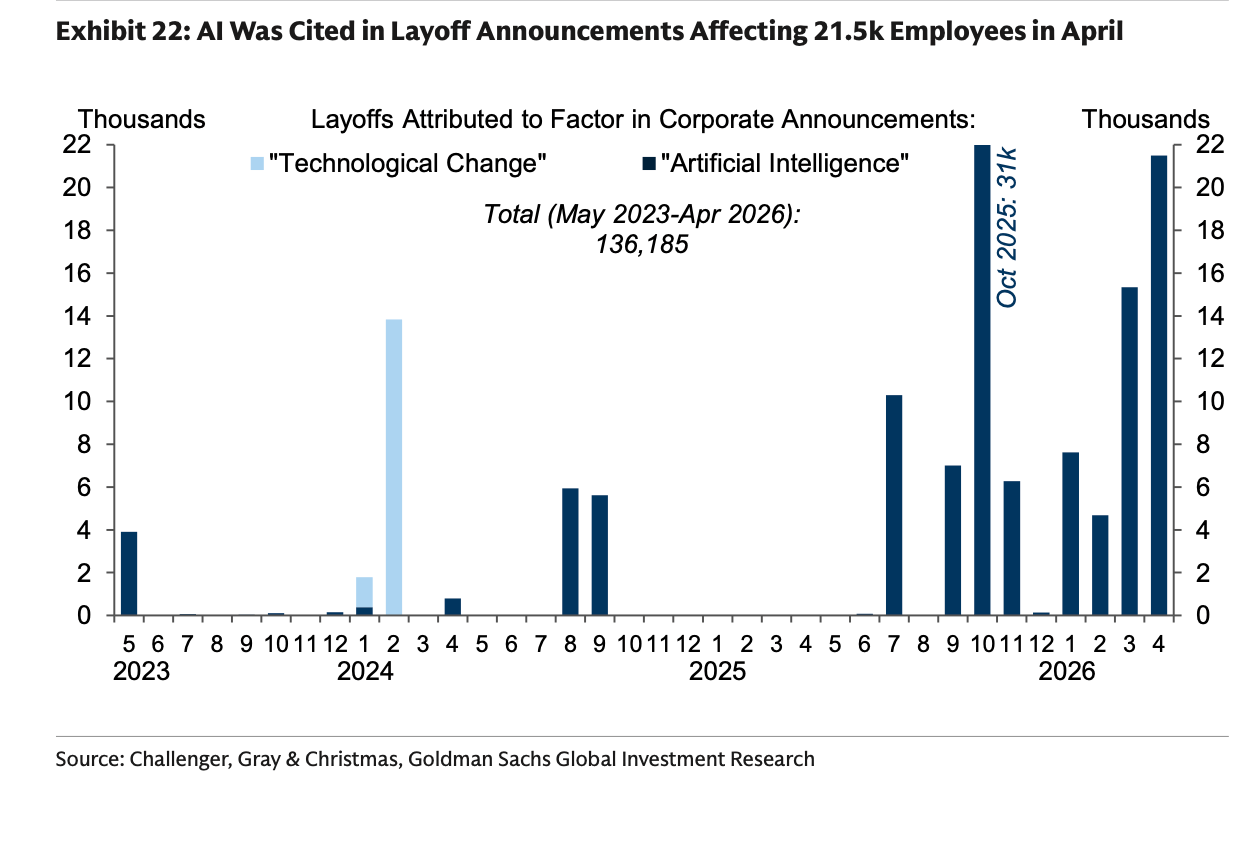
Within that overall picture, Goldman’s tracker is beginning to show a pattern worth watching: a slight positive correlation between AI adoption rates and unemployment among workers under 30, measured across industries. It is not yet a clean structural break — in fact, Goldman’s own data shows young tech workers’ unemployment has recently moved back in line with the broader tech workforce — but the cross-industry signal is consistent enough that Goldman says it will continue to monitor closely.
Academic studies Goldman compiled show generative AI delivers a 23% average productivity uplift — gains that flow disproportionately to workers senior enough to leverage them, not to those whose core value was executing the tasks AI now handles.
At the economy-wide level, the labor market remains resilient. UBS economists, in a note published Thursday, project nonfarm payrolls added around 95,000 jobs in May and the unemployment rate holding near 4.33%. Their conclusion echoes Goldman’s: AI’s broader impact is unlikely to manifest as a simple or persistent rise in unemployment. UBS describes a race between “rising job destruction” and “strong job creation and stable unemployment,” depending on how quickly new roles and industries emerge. The likely outcome, it adds, is “significant occupational churn and periodic dislocation.” For now, the blue-collar gains are compensating for the bleeding in entry-level hiring.
Firm-level AI adoption is puttering along. Census Bureau data compiled by Goldman shows 19.5% of U.S. establishments now use AI in regular business functions, a 0.3 percentage-point drop from the last tracker, with 22.7% expected within six months. Where it is being adopted, though, Goldman cites “academic studies” implying a 23% average productivity uplift, and a 33% boost based off company anecdotes.
Chemical manufacturing and electrical equipment firms report the largest expected increases in adoption ahead — the next frontier of displacement, moving beyond knowledge work into industrial settings.
For now, the race between AI-driven job displacement and job creation is tightening. The workers pulling ahead are the ones pouring concrete for the data centers. The workers falling behind are the ones those data centers were built to replace. And when the concrete is poured, the question will still be: what’s next?
此内容由惯性聚合(RSS阅读器)自动聚合整理,仅供阅读参考。 原文来自 — 版权归原作者所有。