


About a decade ago, Tom Colicchio started writing checks. Not large ones at first, and not on his own thesis—he is the first to say he doesn’t have the wherewithal to evaluate a company. His method was to find people who did, watch what they were putting in, and ride alongside if the conviction looked real.
That is how a friend told him about Bending Spoons.
The Milan-based technology conglomerate closed a $710 million equity round in October 2025 at an $11 billion pre-money valuation, making it one of a handful of European tech decacorns. Colicchio got in early, exited around that round, and walked away with what he says was roughly a 15x return.
“Essentially, Bending Spoons covered everything else that I’ve done, and then some,” he told me, sitting in his office above his flagship restaurant in Manhattan’s Gramercy neighborhood. The company is now reportedly preparing a U.S. listing that could value it at nearly $20 billion.
Bending Spoons is best understood as a software rollup: it acquires underperforming consumer apps—Evernote, WeTransfer, Vimeo, Meetup, Eventbrite, AOL—and aggressively re-monetizes them, typically with deep staff cuts and price increases. It is exactly the kind of efficiency-first operator that, in another setting, Colicchio will tell you has helped hollow out creative industries. He does not pretend the tension isn’t there. He just took the trade.
It is the kind of return that, in a normal year for American fine dining, would be a fun footnote in a chef’s biography. In 2026, for Colicchio, it is the part of the portfolio that is working.
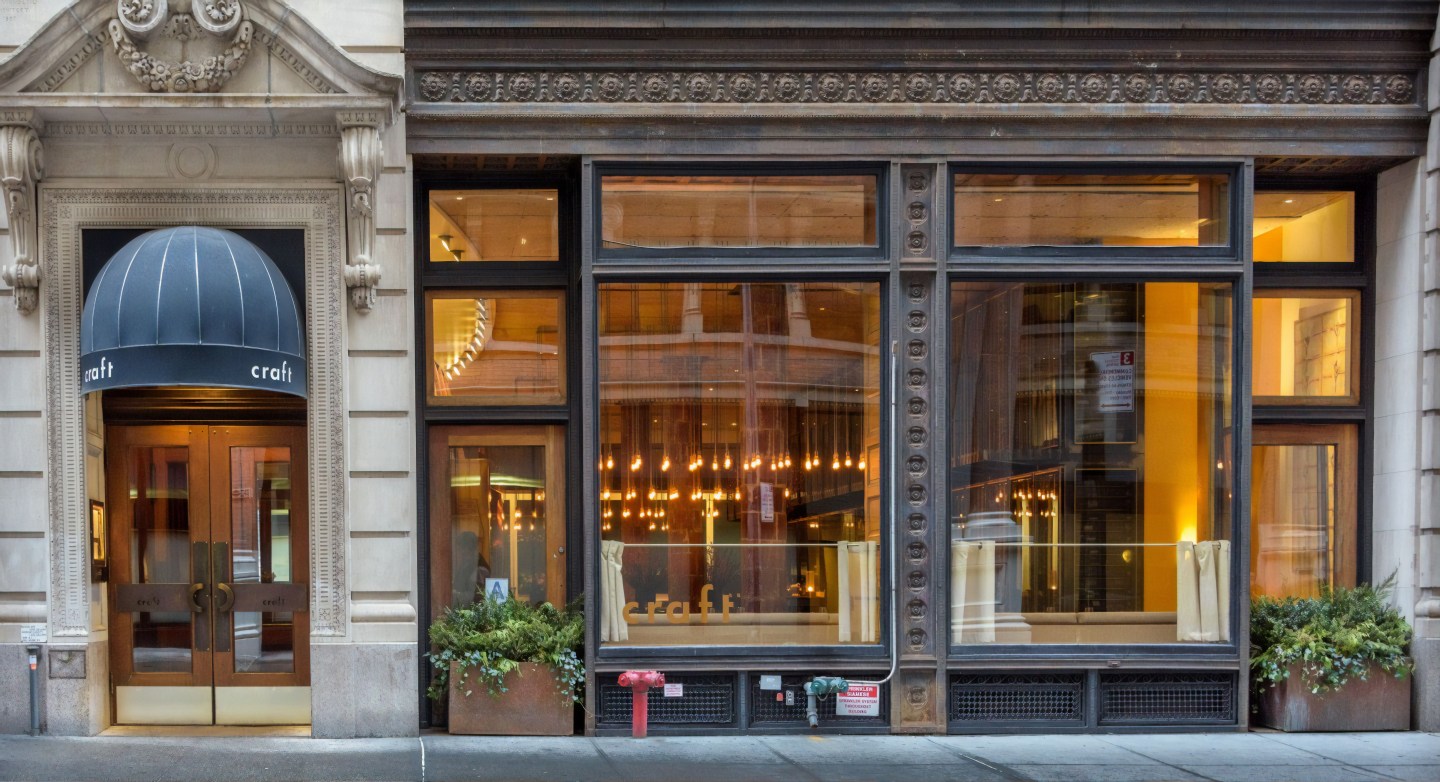
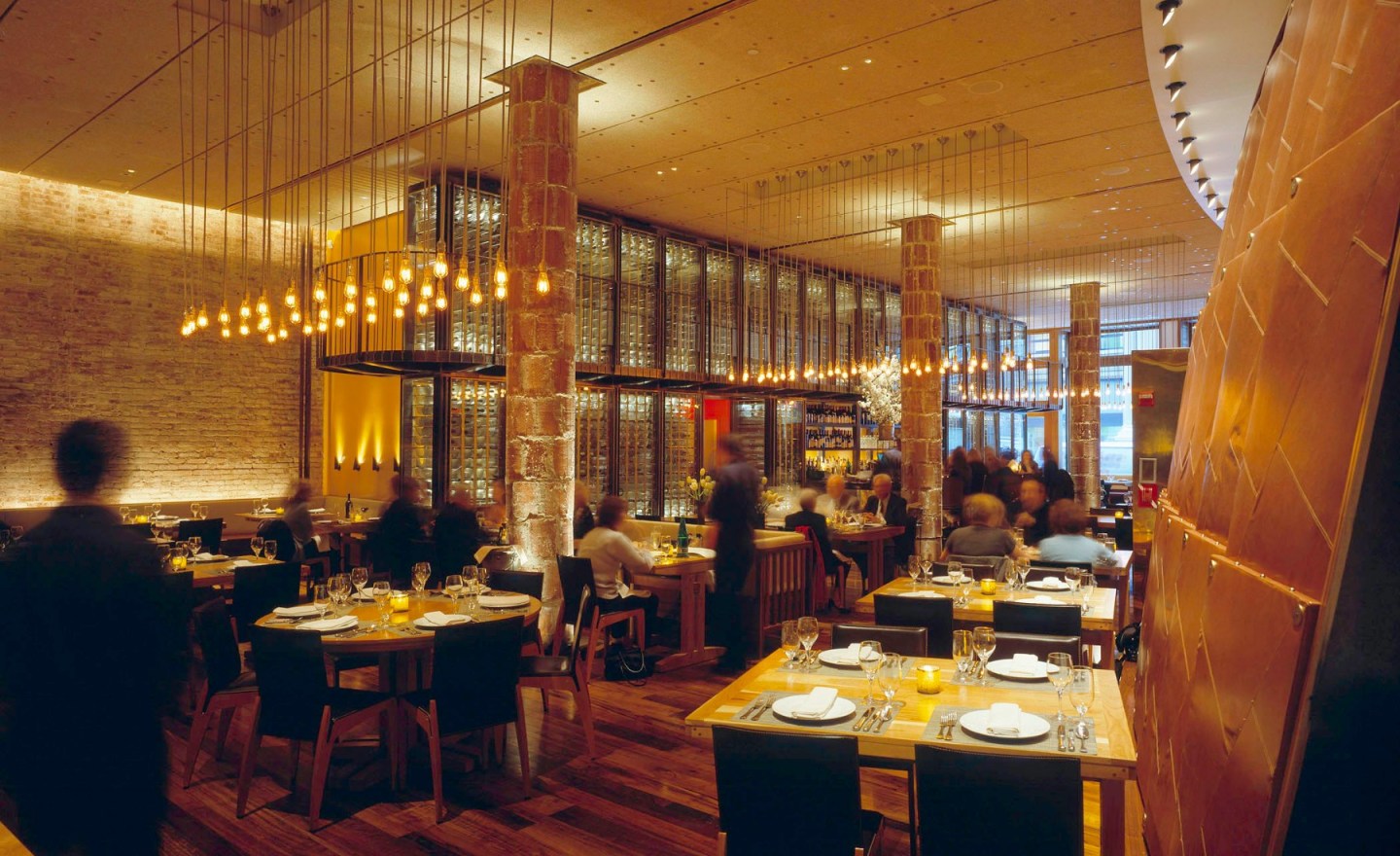
Colicchio is direct about the state of his own industry in a way most operators aren’t. “Craft’s been open for 25 years, and last year was probably our worst year ever,” he said of his Flatiron flagship. “It is what it is. The restaurant business has never been easy, but it used to always be fun. It’s not really fun these days.”
The math, as he described it, is unforgiving. Food costs that ran comfortably at 34% of revenue when he started out now have to be held at 26%. “The only place to get that is to lower your food cost,” he said. “That’s one variable cost you can lower.” Fixed costs, he explained, you really can’t. Beef is up roughly 30% over the past 18 months. Olive oil from Italy has repriced sharply. Spirits and wine have been disrupted by tariff retaliation. “A lot of liquor went up because of tariffs,” he said. “Wine prices have gone up. Certain American liquors are not affected by tariffs. But they’re all affected because a lot of other countries pulled stuff off shelves.”
Bryan Hunt, Craft’s director of culinary operations, said the cost of some luxury ingredients “has just gotten so exorbitant” that the restaurant uses them only for special-occasion menus. “We might have one or two dishes that feature some of those things,” he said. “The stations have gotten a little smaller. I would say some of the dishes are not quite as involved, and there’s not as many touches on the dishes.”
Lunch near the 19th Street flagship has become nearly impossible to fill—a permanent consequence of hybrid work schedules that have thinned Manhattan’s midday office population to a fraction of what it was. Tuesdays are now the best night of the week, Hunt said, because that is when employees are back in the office. Thursday and Friday nights, once reliable, have softened.
The formula has narrowed in ways that go beyond the numbers. “So many restaurants are doing — it’s like the formula,” Colicchio said. “A cup of pasta, a pizza, some salads, and that’s it. Because no one wants to take risks. Taking a risk is expensive.” Diners, he argued, have become as risk-averse as operators. Back in the day, he claimed, he could put anything on the menu, and it would sell: squab, offal, whatever. “I put squab on the menu now, I can’t sell it.” He described a vicious cycle where diners and restaurants alike are less adventurous, and chefs follow suit. “You try to please everyone, and you end up being like the Gap.”
He connected this to a broader cultural compression he sees happening across every creative field at once, against an economy reshaped by AI anxiety and tariff disruption. “What’s interesting to me is that there’s more money sloshing around than ever before,” he said, “and usually you had people who were really wealthy who were the ones financing independent films and financing restaurants. And I just don’t know if that’s still happening.”
Which is, in a roundabout way, how Colicchio ended up an investor in 30 companies. He is too disciplined to call it a hedge against his own industry. But he is also a man who, at every fork in his life, has refused to bet on a single track.
The portfolio, built over roughly the past five to seven years, runs to about 30 companies: a Brown University–affiliated angel group focused largely on medical technology; a corporate food services platform called Hungry; a hot sauce company that sold to McCormick at a modest return; and Bending Spoons, which by his own account paid for everything else.
“It’s interesting,” he said of the founder class he works with now. “Some people, you put some money in, you hear from them, and they’re really good about keeping in touch. And some founders, it’s like you never hear from them again.”
The son of a corrections officer who became a union president, Colicchio came to his skepticism of unearned advantage honestly. Bending Spoons, he said, was a great story to watch as the company went from strength to strength, which isn’t always the case with venture investments.
Everything about how Colicchio operates today—the restlessness, the parallel bets, the refusal to be defined by the institution in front of him—traces back to a kid in Elizabeth, N.J., who could not get through a school day.
“I didn’t go to college because I had undiagnosed ADHD,” he said, with the bluntness familiar to fans of his long-running Bravo show, Top Chef. “So I hated school for that reason.”
Some things came easy. Competitive swimming, for one. “I didn’t lose a race from the age of 9 to 13,” he said—until he started partying, stopped practicing, and the kids he had been beating regularly began finishing ahead of him. “It pissed me off,” he said, flashing the competitive side that has become a Top Chef trademark. He made himself a private promise: if he ever found something else he was good at, he wasn’t going to let that happen again.
Before the swim club snack bar, there was his grandfather. Colicchio grew up in a four-family redbrick apartment building in Elizabeth; his grandfather lived in the apartment behind theirs. On Saturdays, they would fish together—out to Toms River and Barnegat Bay, an hour-and-a-half each way—and the boy’s job on the ride home was to keep his grandfather awake at the wheel. His other job, starting at age seven, was to fillet the catch. Someone, he recalled with a laugh, “thought it was okay to put a knife in a 7-year-old’s hand.”
The catch—crabs, clams, sometimes fish — would come home to a table of 20 or 30 people, extended family gathered for a summer meal. He didn’t understand how much those meals shaped him, he said, until the pandemic, when he was doing Zoom cooking classes and being asked over and over why he cooks. “Food, I think more than anything, has the power to bring people around a table,” he said. “I think that’s why I was attracted to it.”
Then the Gran Centurions swim club in nearby Clark, N.J. — where his parents were members—needed a short-order cook. Colicchio was fast with a knife. The kitchen showed him what the classroom couldn’t.
“The frenetic pace of the kitchen worked for me,” he said. “For some reason, that calmed me down. When it would get busy, I would slow down instead of speeding up. And it just kind of worked.”
He said he thinks he started cooking at exactly the right moment. From the vantage point of 2026, with an economy reshaped by AI anxiety and tariff disruption, it can be hard to remember how peripheral chefs once were. That changed in the 1980s. Nouvelle cuisine in France had begun to liberate chefs from the tightly wound traditions of French cooking. New American cuisine was arriving in New York. The last days of disco were fading, and Andy Warhol and his ilk needed another place to hang out.
“My theory is that once people got a little older and stopped going to clubs, they realized they can’t just live on cocaine,” Colicchio said. “But they still wanted to go out. And so restaurants became a thing.” He was well-positioned, he added, because from age 13 onward, he had been practicing that rarest of things: a true skill.
He picked up knife work at an Italian restaurant that did a lot of butchering. He learned how to make a sauce that would hold together, even going head-to-head with chefs of a certain pedigree. “I worked in another restaurant with two recent culinary grads,” he recalled, almost shaking his head, “and, like, I would have to make the sauce because they would break hollandaise every time.”
He was still thinking of going to culinary school himself when he landed at a New American restaurant called 40 Main Street that wouldn’t seem out of place in today’s listings—redoing its menu every night, doing elevated things. He was promoted to sous chef within four months. “I was like, ‘I’m not going to culinary school now.’”
By 26, he was the chef at the Mondrian in New York and had received a Best New Chef citation from Food & Wine. The people he had admired — Jonathan Waxman, Jean-Jacques Rachou, Danny Meyer — started coming to his restaurant on their nights off. When he told Meyer he was closing Mondrian, the conversation naturally turned to what they might build together.
That became Gramercy Tavern in 1994, one of the most famous restaurants of its era. “Gramercy was a lot of fun. It was a lot of hard work,” he said. “I was usually in that restaurant at 10 in the morning and didn’t leave until 1 most nights.” Craft followed in 2001, earning three stars and building the template for ingredient-driven American cooking that a generation of chefs would imitate.
Today, his Crafted Hospitality group counts three restaurants in New York City, one on Long Island, and one in Las Vegas’ MGM Grand. Top Chef came next, and kept coming, now into its 23rd season. He has won eight James Beard Awards.
From the outside, the arc looks like the inevitable rise of a natural. From the inside, it has been a sustained argument with a world that once declared him unequipped—an argument he has been winning, methodically and without much fanfare, for forty years.
There is a version of nostalgia that is merely self-serving—the successful person who made it in an earlier era romanticizing the conditions that made their success possible. Colicchio is honest enough to walk up to that line and examine it.
New York, he said, really was as good as advertised, or as depicted in series like FX’s Love Story. When he opened Gramercy Tavern in 1994, he was paying $9,000 a month in rent. SoHo was filled with artists living in loft squats who could afford to be in the city, be strange, and take risks.
What he misses most is not the economics but the energy—the sense that every night was an event, that the room had a life of its own, that something might happen. “Every night was like a party,” he said. “Every night was fun to be there. Always cool people around. It seems to have changed.” The people who used to stay until midnight now leave at 7:30. “No one hangs out anymore. You know, come at 8:30, 9:00, you get out of your restaurant, you go home. It used to be, you stay until 10 and then you go meet your friends and go hang out. No one’s doing that anymore.”
He does not have a clean theory for why. “Some people think the algorithm makes us the same as everyone else,” he said. The cost of real estate. The displacement of the creative class that once gave cities their productive friction. “Food was the last one to go,” he said. “After indie movie star died, and the music scene died, food was still going strong until like 10 years ago.” And then it stopped.
Hunt, from his vantage point in the kitchen, agreed. “Everybody was in New York to work at the restaurant, and that’s what your whole life revolved around,” he says. Now people put more energy into life outside work. “I definitely also think sobriety culture has something to do with it. The younger generation, it’s very obvious that they do not drink quite like my peers in the industry when I was their age.”
Hunt said he sees a counter-trend, too. “There’s been a huge shift of people that have kind of been romanticizing the industry and dipping their toes into the water to see if they like it,” he says. In the past two years, he has seen cooks come through with more passion, cooking on their days off, talking about food a lot more. “To see that coming back these past couple of years is reinvigorating.”
When Colicchio thinks of his younger children, in school at 15 and 16, “the idea of AI is stressful. Are there going to be jobs for our kids in 10 years?” He said he watches their schooling with the specific anxiety of someone who knows from the inside what those institutions can miss — and what they can cost a kid who doesn’t fit.
He hopes they find something like he did — something they can actually do, something the market will recognize independently of what any institution says about them. “When I found cooking, I just found this came very easy to me,” he said. “I liked it. And I was good at it.” If he was 20 years older, he added, he’s not sure if cooking would have been the same opportunity. “I got lucky.”
He is not telling his children to skip college. He is telling them, or at least hoping, in the way parents of complicated, bright, restless kids hope, that somewhere along the way they find something like he found the knife: a skill so obviously theirs that no classroom could have found it for them.
Is he worried about AI coming for his job, and theirs? One of his investments, he allows, started as something else and has morphed into robotics.
“But it can’t cook,” he said. “It can’t cook. It’s not going to cook.”
此内容由惯性聚合(RSS阅读器)自动聚合整理,仅供阅读参考。 原文来自 — 版权归原作者所有。