


惯性聚合 高效追踪和阅读你感兴趣的博客、新闻、科技资讯
阅读原文 在惯性聚合中打开

推荐订阅源

Recent Announcements
J
Java Code Geeks
雷峰网
雷峰网
Microsoft Security Blog
博客园 - 【当耐特】
腾讯CDC
博客园 - 司徒正美
B
Blog RSS Feed
博客园 - 三生石上(FineUI控件)
I
InfoQ
N
Netflix TechBlog - Medium
L
LangChain Blog
博客园_首页
Cyber Security Advisories - MS-ISAC
T
Tailwind CSS Blog
MyScale Blog
MyScale Blog
美团技术团队
The Cloudflare Blog
爱范儿
爱范儿
Stack Overflow Blog
Stack Overflow Blog
博客园 - 聂微东
H
Help Net Security
Martin Fowler
Martin Fowler
V
Visual Studio Blog

Fortune | FORTUNE

One man can kill Bill Ackman’s $64 billion bid for Universal Music Group—and no one knows what he’ll do | Fortune Poppi’s cofounder pitched her startup on Shark Tank while 9 months pregnant and landed a $400,000 deal—now it's worth $2 billion | Fortune Teen boys are choosing AI girlfriends over real ones for 'maximum control, zero rejection'—experts say it could make them unemployable | Fortune A United American merger is by no means impossible given the president 'loves big deals' | Fortune Reed Hastings’s planned exit from $455 billion Netflix ‘had nothing to do with’ the failed deal for Warner Bros., says Ted Sarandos | Fortune Meet Joe McCann: The high-flying crypto trader held in Tanzania after sudden death of his influencer fiancée Ashly Robinson | Fortune Gen Z is carving a different path in the housing market by doing it alone | Fortune U.S. Catholic leaders criticize Trump for ‘disparaging words’ about the pope as Vatican clash risks alienating Catholic voters | Fortune China has ‘nearly erased’ America’s lead in AI—and the flow of tech experts moving to the U.S. is slowing to a trickle, Stanford report says | Fortune Self-made millionaire behind $5 billion Skims Emma Grede says it all began with a cold call to Kris Jenner: Emma Grede—the self-made millionaire behind the $5 billion Skims empire—says it all began with an audacious cold call to Kris Jenner: ‘The difference between me and someone else is, I made it happen’ | Fortune Americans have never been this gloomy about the economy. Wall Street has never cashed in harder | Fortune ‘The college grading system [is] almost meaningless’: People see the Ivy League as an easy A and with flawed admissions standards | Fortune The CEO of $8.5 billion Japanese car giant Nissan plays the drums in a band and hits the tennis courts to destress from the top job | Fortune New York governor's take on a millionaires tax: fancy pied-à-terre second apartments worth over $5 million | Fortune Pope Leo XIV: A ‘handful of tyrants’ are ravaging earth with war and exploitation | Fortune Trump has no plan to cut the $39 trillion national debt, but he does want to cut childcare. His budget director is scrambling to clarify | Fortune China's economy grows 5% in first quarter, surprising economists to the upside | Fortune Everyone was wondering what Trump wanted more: Warsh smoothly seated at the Fed, or for Powell to pay. We have our answer | Fortune Palantir exec: the biggest mistake retailers are making with AI? Trying to do it all with one agent | Fortune American YouTuber who calls himself a 'troll' sentenced to 6 months in Korean prison for literally dancing on wartime graves | Fortune BBC plans to cut up to 2,000 jobs to save 10% of annual budget | Fortune Canva debuts a new suite of agentic tools, as the design app quietly becomes one of the world’s most used AI services | Fortune Moody's CEO: AI has a trust problem – better models won’t fix it | Fortune Top New York surgeon: Americans have better data for choosing restaurants than surgeons. That has to change | Fortune The Iran war’s fertilizer shock is hammering American farmers, and 70% can’t afford what they need for this year’s growing season | Fortune Education experts to Mamdani: Why are you foisting AI on our kids? | Fortune This CEO pirated video games as a teen and became a hacker for the Air Force. Now he’s built a $3 billion cyber firm | Fortune Teacher, blame thyself: Yale report savages Ivy League schools for destroying American trust in higher education | Fortune Fed chair nominee Kevin Warsh is worth more than $100 million and has stakes in SpaceX and Polymarket | Fortune From wool sneakers to GPUs: Allbirds’ desperate AI pivot and 600% stock surge, explained | Fortune
Oil markets could be a month away from the moment of trut...
Jason Ma · 2026-05-17 · via Fortune | FORTUNE

Dire warnings about oil supplies are coming from everywhere lately as the Strait of Hormuz remains largely closed while President Donald Trump’s trip to China failed to produce a breakthrough to reopen the critical waterway.

While investors have been trading on hopes that the Iran ceasefire will remain intact, there is little sign that the oil trade will return to normal soon, forcing them to reckon with the reality of worsening shortages and an imminent tipping point ahead.

JPMorgan predicted that commercial oil inventories in the developed world could “approach operational stress levels” by early June. Saudi Aramco said global inventories of gasoline and jet fuel could reach “critically low levels” ahead of the summer.

The International Energy Agency warned the world is drawing down oil inventories at a record pace, with 164 million barrels released by governments and industry as of May 8.

“Rapidly shrinking buffers amid continued disruptions may herald future price spikes ahead,” IEA said in its lately monthly report.

The U.S. and Israel launched their war on Iran two and a half months ago, and analysts expected the Strait of Hormuz to reopen by the end of May or early June.

That’s looking less likely as Iran attacks ships in the Persian Gulf while the U.S. military is still enforcing a blockade on Iranian oil. Meanwhile, the Navy’s efforts to reopen the strait with warships is on hold.
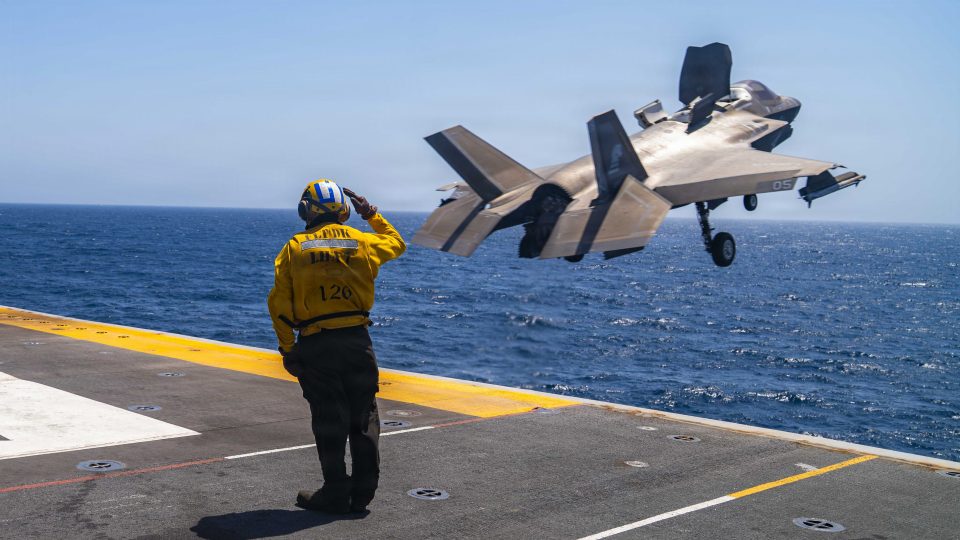
An F-35B Lighting II, attached to Marine Fighter Attack Squadron (VMFA) 121, takes off from the flight deck of America-class amphibious assault ship USS Tripoli (LHA 7), May 13, 2026.

U.S. Navy

“But if the Strait remains effectively closed and commercial oil inventories in the OECD continue to be run down at the same pace as they were in April, oil stocks could reach critically low levels by the end of June,” Hamad Hussain, climate and commodities economist at Capital Economics, said in a note on Wednesday.

“That would be consistent with Brent crude prices reaching an all-time nominal peak, and could require more disorderly and economically damaging cuts to oil demand.”

He estimated oil prices could top $130-$140 a barrel next month if the strait remains closed and inventory depletion rates remain steady.

On Friday, Brent crude futures gained more than 3% to close at $109.26 a barrel as China offered no hints that it would lean on ally Iran to normalize tanker traffic.

For now, oil futures haven’t reached doomsday levels. That’s due to ample supplies at sea when the war started, record releases from strategic oil reserves, and a sharp drop in Chinese oil imports as it draws on its own stockpiles, according to Hussain.

More supplies from oil inventories could be released. But they cannot fall to zero as certain volumes are needed to maintain pressure within storage systems, and the daily flow of releases is limited.

In addition, 1 billion barrels of oil is estimated to have been lost already, dwarfing the IEA’s planned total release of 400 million barrels.
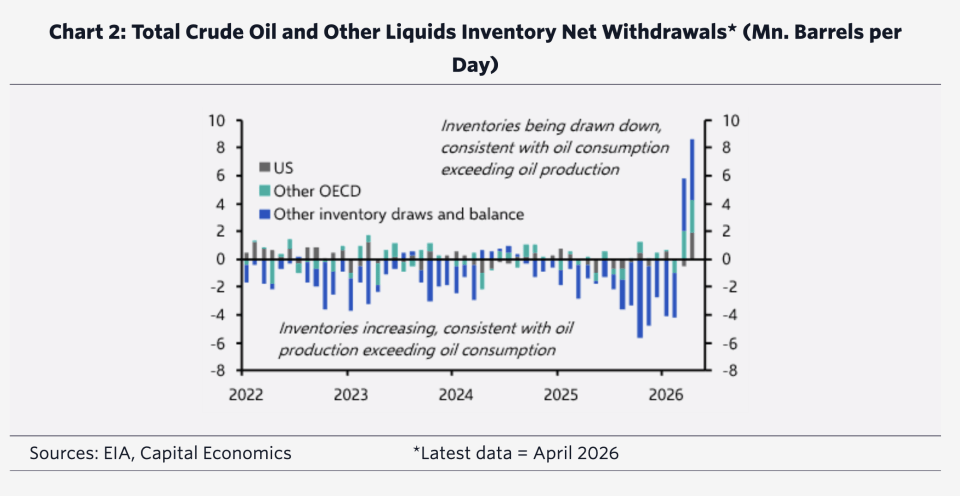
Efforts to clamp down on oil demand could intensify, and some countries in Asia have already imposed rationing measures.

“But given the extent of supply losses from the Middle East, the risk of a ‘non-linear’ adjustment in demand and prices will continue to grow for as long as the Strait of Hormuz remains effectively closed,” Hussain added.

In other words, rather than oil prices following a straight-line trajectory higher, they could instead go parabolic, looking more like the curved end of a hockey stick.

Similarly, analysts at UBS also said oil inventories are approaching record lows, warning that “buffers have now largely been exhausted.”

As stockpiles go even lower, UBS said oil prices could become more volatile and highlighted the “risk of panic buying if physical dislocation intensifies and the Strait of Hormuz remains closed.”