


U.S. debt is expected to continue soaring in the coming decades not because of excesses committed by future lawmakers, although that’s certainly possible, but because interest payments on past borrowing will increasingly dominate spending.
Americans got a reminder of that outlook as the U.S. crossed a grim fiscal threshold this week, when first-quarter data confirmed debt is now bigger than the economy.
As of March 31, debt held by the public stood at $31.27 trillion, while nominal GDP over the prior 12-month period was an estimated $31.22 trillion, pushing the debt-to-GDP ratio to 100.2%
“US sovereign debt has hit levels where interest expense is becoming a primary driver of the deficit. In a ‘Fiscal Dominance’ regime, the Fed’s ability to aggressively hike rates to curb inflation is constrained, as doing so risks a fiscal or financial crisis,” analysts at Deutsche Bank said in a note on Thursday, adding that such an environment often encourages higher-for-longer inflation.
Federal budget deficits are already tracking at more than $2 trillion this fiscal year, adding to the mountain of debt, with interest payments alone headed for $1 trillion.
Interest costs will soar to $2.1 trillion by 2036, when publicly held debt is expected to balloon to 120% of GDP, according to the Congressional Budget Office.
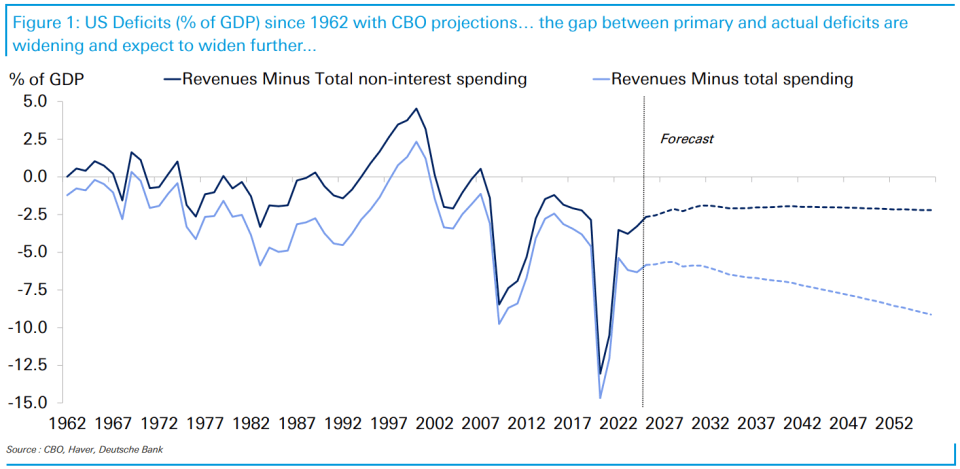
An earlier analysis from Deutsche Bank pointed out that the CBO assumes the primary deficit—the shortfall between revenue and spending excluding interest payments on debt—is expected to remain relatively stable over the next decade and beyond at about 2% of GDP.
That’s the view even as spending on Social Security and Medicare will jump to account for the growing numbers of baby boomers heading into retirement.
But after including interest payments, the total deficit will steadily widen from around 6% of GDP today to nearly 10% by the mid 2050s.
The gap between primary and total deficits has historically been narrow, analysts said in February, but it started growing in the years after COVID, when massive spending blew up the deficit and high inflation forced the Federal Reserve to hike interest rates aggressively.
The CBO’s forecast also assumes interest rates and nominal GDP growth largely remain steady, meaning the future debt surge isn’t due to higher borrowing costs or an economic slowdown.
“Those assumptions could, of course, prove wrong in either direction,” Deutsche Bank said. “But even if they hold, it is clear that the sheer size of the outstanding debt stock is becoming a far more significant driver of deficits than it was even at the start of this decade. As a result, future US administrations may increasingly find that fiscal policy is constrained not by their willingness to run primary deficits, but by the need to manage the debt stock itself in order to meet broader fiscal ambitions.”
Fiscal ambitions have since become more ambitious. The war against Iran has severely depleted inventories of the most expensive munitions in the U.S. arsenal, requiring a costly restocking effort.
The Trump administration also seeks to boost the Pentagon’s budget by nearly half to $1.5 trillion a year as it eyes a transformation of the defense industrial base to produce greater quantitates and more advanced weapons.
But sources told The Washington Post earlier this year that White House budget chief Russell Vought was among the critics of giving the Pentagon an additional $500 billion, warning on its potential impact on the federal deficit.
His aversion to seeing the deficit widen further on the back of a bigger military bill highlights a phenomenon observed by historian Niall Ferguson, who has said any great power that spends more on debt servicing than on defense risks ceasing to be a great power.
“This is because the debt burden draws scarce resources towards itself, reducing the amount available for national security, and leaving the power increasingly vulnerable to military challenge,” he wrote.
In fact, the U.S. hit reached this threshold in 2024 and continues to meet the conditions for “Ferguson’s Law.” Of course, ratcheting up defense outlays to $1.5 trillion would put the Pentagon budget back above debt-servicing costs, but only temporarily. Even without the added military spending, interests costs are expected top $2 trillion next decade.
The CBO’s sobering outlook may even be a bit optimistic. While it sees interest rates and GDP growth largely holding steady over the long term, there are years in the 2030s when borrowing costs will outpace the economy.
“Later in the decade, under CBO’s baseline, the average interest rate on all federal debt will exceed nominal economic growth, which could represent the start of a debt spiral,” the Committee for a Responsible Federal Budget said in February.
此内容由惯性聚合(RSS阅读器)自动聚合整理,仅供阅读参考。 原文来自 — 版权归原作者所有。