





The male labor force participation rate in the U.S. has been falling for generations, perplexing economists who have struggled to come up with an explanation.
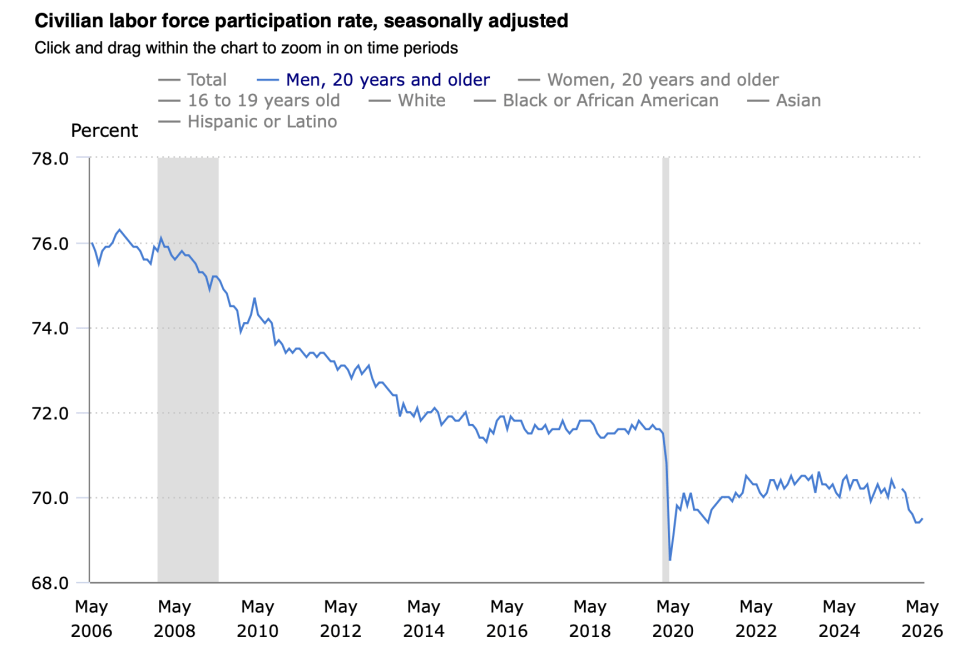
According to the Labor Department’s latest data, the rate for men 20 years and older was 69.5% in May, down from 76% in May 2006. That means fewer men were employed or unemployed but actively looking for a job.
The male participation rate peaked at 86.4% in 1950, but slid to 79.7% in 1970, and 76.4% in 1990. By contrast, female participation rose steadily until the 1990s, peaked in 2000, and has dipped only slightly since then.
Numerous theories have been thrown around to try shedding light on the more recent declines among males. After the housing bubble popped and triggered the Great Recession, for example, the sudden loss of construction jobs was partly blamed for men dropping out of the work force.
The introduction of more advanced video games since the early 2000s has even been cited as a cause for men working fewer hours. Meredith Whitney, the one-time “Oracle of Wall Street” who predicted the Great Financial Crisis, previously told Fortune that young single men living at home and playing video games are behind a “crisis of the American male.”
Last year, the San Francisco Fed took a crack at it, saying men were both pulled out of the labor force because of schooling or caretaking duties and pushed out due to a mismatch in skills or a disability.
Now a new paper from University of Connecticut economists Remy Levin and Daniela Vidart has added to the debate, arguing that men’s beliefs about the benefits of work are shaped by the labor market conditions they observed over their lifetimes, particularly during childhood.
When young males grow up seeing weak wages and high unemployment among the men around them, they form pessimistic expectations about their own prospects later in life, making them less likely to participate in the labor force, the economists explained.
“Our findings suggest that experience effects can turn short-run declines in labor demand into long-run declines in labor supply,” they wrote.
Bureau of Labor Statistics
The phenomenon persisted even after men moved to a different state, and the effects were stronger among men exposed to the experiences of their own racial group.
In addition, the paper said childhood exposure explained nearly all of the labor force participation dynamics and that men’s expectations for their own wages or employment were based on lifetime experiences—and not macroeconomic conditions like national unemployment or inflation.
“It is the labor market environment men grow up in, more than what they observe as adults, that shapes their later participation,” Levin and Vidart concluded. “This points to the formative years as the critical window for belief formation about returns to work, with implications for how policy interventions might most effectively cultivate lasting labor force attachment among men.”
For policymakers, a more effective response to declining male participation may entail managing expectations by cultivating credible, long-run beliefs in the value of work, they said.
Separate research has found that the COVID pandemic may have motivated people to re-evaluate their life priorities, leading them to choose to work fewer hours.
But there was a clear gender divide. Young men with at least a bachelor’s degree spent an average of 14 hours less annually on the job between 2019 and 2022. The decline was far less over the same period for similarly qualified women, who worked three fewer hours.
Yet another study from the Boston Fed in 2022 said that non-college-educated men, between the ages of 25 and 54, left the workforce in higher numbers than other groups in part because of their perceived social status relative to better-educated men of similar age.
Since 1980, men without degrees have seen their weekly earnings decline by 17%, while those of college-educated men rose by 20%, adjusting for inflation.
The Boston Fed study found that the drop in earnings for non-college-educated men over the last four decades has increased their likelihood of leaving the labor force by nearly half a percentage point. That also accounts for 44% of the increase in their exit rate.
“If the increasing wage gap between high and low earners directly or indirectly affects men’s aggregate labor supply, wage inequality might have carried wider implications to the economy than previously believed,” Pinghui Wu, the author of the study, wrote.
此内容由惯性聚合(RSS阅读器)自动聚合整理,仅供阅读参考。 原文来自 — 版权归原作者所有。