

惯性聚合 高效追踪和阅读你感兴趣的博客、新闻、科技资讯
阅读原文 在惯性聚合中打开

推荐订阅源

N
News and Events Feed by Topic
Malwarebytes
Malwarebytes
Threat Intelligence Blog | Flashpoint
C
Cybersecurity and Infrastructure Security Agency CISA
F
Future of Privacy Forum
C
Cisco Blogs
T
The Exploit Database - CXSecurity.com
A
Arctic Wolf
S
Securelist
K
Kaspersky official blog
S
Schneier on Security
T
ThreatConnect
T
Tenable Blog
Spread Privacy
Spread Privacy
T
True Tiger Recordings
AWS News Blog
AWS News Blog
F
Fox-IT International blog
量子位
T
Threatpost
V
Vulnerabilities – Threatpost
C
CERT Recently Published Vulnerability Notes
Cisco Talos Blog
Cisco Talos Blog
GbyAI
GbyAI
宝玉的分享
宝玉的分享
腾讯CDC
G
Google Developers Blog
aimingoo的专栏
aimingoo的专栏
Cyberwarzone
Cyberwarzone
有赞技术团队
有赞技术团队
S
SegmentFault 最新的问题
OSCHINA 社区最新新闻
OSCHINA 社区最新新闻
V
Visual Studio Blog
U
Unit 42
雷峰网
雷峰网
cs.CV updates on arXiv.org
Simon Willison's Weblog
O
OpenAI News
freeCodeCamp Programming Tutorials: Python, JavaScript, Git & More
The GitHub Blog
The GitHub Blog
The Register - Security
MyScale Blog
MyScale Blog
小众软件
小众软件
A
About on SuperTechFans
Last Week in AI
Last Week in AI
Y
Y Combinator Blog
博客园 - 三生石上(FineUI控件)
美团技术团队
Google Online Security Blog
P
Proofpoint News Feed
MongoDB | Blog
MongoDB | Blog

Fortune | FORTUNE

Oil drops as U.S. says deal with Iran and Hormuz reopening is near | Fortune Russia's economy is much worse than it seems, and 'elites are increasingly alarmed' as alternate GDP gauge shows huge contraction | Fortune Alaska’s oil revival sparks a new energy rush Into the Arctic Trump says 'don’t listen to the losers' after fellow Republicans warn he's about to make a disastrous mistake with Iran ceasefire deal | Fortune SpaceX stock is about to join this growing constellation of public companies building a space-based economy | Fortune The more generous U.S. ceasefire terms are, the more suspicious Iran becomes they're a ruse for another attack, expert says | Fortune Nonprofit fraud isn't surging. Enforcement is | Fortune The quiet $8 billion crisis: long COVID costs keep rising as Washington looks away | Fortune From Hobbes to the 14th amendment: The ancient and modern cases against Trump's $1.8 billion fund | Fortune 500,000 people were locked in state psychiatric hospitals. Their descendants can't find out why | Fortune The travel industry has been taking body blows. Here comes an airport 'sanctuary city' crackdown | Fortune 82 dead in China's worst coal mine disaster in years — regulators flagged the risk 2 years ago | Fortune 'We want neighbors, not tourists.' Madrid's renters march with message for the boom economy | Fortune Britain's navy is preparing to clear mines in the Strait of Hormuz — but only once a U.S.-Iran peace agreement is reached | Fortune Under emerging deal, Iran's uranium, sanctions relief, and release of frozen funds would be negotiated during a 60-day window | Fortune SpaceX's next-gen rocket is the key to its sky-high valuation, early investor says: 'Starship also enables all kinds of frontier markets' | Fortune 40 is the new 50: Millennial jobseekers are giving their resumes a facelift by hiding years of experience to land jobs | Fortune Uber CEO says rideshare ‘freed up’ his son from having to get a driver’s license—and he’s one of many Gen Zers who aren’t willing to drive | Fortune BofA says you'll be 10x more productive with AI. Ignore the 0.1% result so far | Fortune Inside the 'stealth wealth' playbook: How Silicon Valley's elite buy multimillion-dollar mansions without leaving a paper trail | Fortune I was one of the internet's first influencers. AI just killed the whole category — and created something better | Fortune AI hallucinations are slipping past experts into papers and books to enter the permanent record | Fortune As AI wipes out white-collar jobs, one Alabama high school and Toyota are training students for roles that pay $40 an hour and can't be automated | Fortune It took over a decade, but NextDecade’s longshot bet to lead Texas LNG is finally paying off | Fortune Law enforcement authorities are responding to reports of shots fired near White House as Trump was inside | Fortune Ukrainian drone attack causes fire at Russian oil terminal used for exports as Kyiv expands long-range strike capabilities | Fortune U.S. reaches limit of sanctions power in targeting Iran’s economy | Fortune Trump’s 3,711 trades point to multiple stock-market strategies | Fortune As U.S.-Iran deal nears, Trump ally warns against creating perception Tehran controls Hormuz—'it makes one wonder why the war started to begin with' | Fortune U.S. debt is the 'elephant in the room' amid bond market rout as Fed-fueled interest costs could drive even larger deficits, analysts warn | Fortune Iran and U.S. near agreement on memorandum of understanding, as Tehran says Hormuz is included in talks but nuclear issues are not | Fortune The Fed's worst inflation fears may be coming true as consumers lose faith in long-term prices—even Trump supporters doubt he can bring relief | Fortune Meet the 32-year-old who is America's only full-time spelling bee coach — he charges up to $180 per hour | Fortune Oregon Democrats wrote a gas tax, watched it get destroyed and now Jeff Merkley has a fight | Fortune 'Hello, Goodbye': Paul McCartney closed the lights on a Late Show that CBS couldn't cancel quietly | Fortune The asphalt industry has a heat problem — and cities are running out of patience | Fortune Meet the hospital dogs 'making a real difference' by getting sick kids to smile | Fortune Rebellious Republicans find voice in Trump apostate Thom Tillis: 'stupid on stilts' and a 'payout for punks' | Fortune Europe Just admitted the Iran War's price shock isn't going away | Fortune Even Mitch McConnell is mortified by Trump's $1.8 billion 'slush fund to pay people who assault cops' | Fortune The market keeps winning. Most Americans are losing faith | Fortune Trump was supposed to talk about the economy. Instead he asked why toiletries are locked up in pharmacies | Fortune 4 ways Trump is following the Venezuela playbook with Cuba, and one where he isn't | Fortune FDA's tobacco center just drafted new rules to let ecigs, pouches onto market, but staffers didn't write them | Fortune Trump on new Fed Chair Kevin Warsh: 'Do your own thing' but don't lose your way like Jerome Powell did | Fortune How a 'proud troublemaker' Democratic socialist beat the system in Philadelphia by 15 points | Fortune SpaceX’s third-generation Starship, which NASA may use to put astronauts on the moon, makes debut in test flight ahead of blockbuster IPO | Fortune Trump to force foreigners to apply for a green card abroad—but those who provide 'economic benefit' or serve 'national interest' may be able to stay | Fortune Millionaire podcaster Mel Robbins hits back Gen Z's lazy label—she says they’re stuck in a world their baby boomer parents wouldn’t even recognize | Fortune Is a college degree is still worth it? Here are 3 things it can teach you that AI can’t do | Fortune Everyone is blaming AI for the death of 'craft.' Take a good look in the mirror | Fortune Millions of business owners are about to retire. They should sell to their employees | Fortune This 39-year-old quit his lineman job during the pandemic and built a $50 million company in his backyard | Fortune Fed stalwart Claudia Sahm fears Kevin Warsh's policies could undo 20 years of policy progress | Fortune The Everlane and Allbirds sagas prove that consumers won't pay more for virtue | Fortune America is suffering a shortage of construction workers and sabotaging its ability to fill vacancies by wiping out the industry's immigrant backbone | Fortune Former Tesla president shares the secret to success he learned from his former boss, Elon Musk: ‘He demands to only work with world-class talent’ | Fortune I've spent 25 years studying loneliness. AI is about to make it much worse | Fortune Former NASA Robotics Chief: America is building the wrong kind of robots — and China knows it | Fortune Elon Musk's SpaceX IPO filing just told us what business he's betting on for the future—and it's not rockets | Fortune My startup hit $200 million ARR. But first I walked away from 2.5 million YouTube subscribers and nearly went bankrupt | Fortune How Grab's CTO sees the superapp's push into physical AI and automated driving—and why he uses his competitor's robots in the office | Fortune The tech bro billionaires won the fight over the AI executive order. But are they losing the war? | Fortune Barnes & Noble CEO clarifies the bookseller’s stance on AI-written books after refusing to ban them: ‘This is a straightforward rejection of AI books’ | Fortune Fortune Brainstorm Tech 2026 will be brilliant | Fortune Beyond the diploma: Skills that actually get graduates hired | Fortune Microsoft reports are exposing AI's real cost problem: Using the tech is more expensive than paying human employees | Fortune The big questions OpenAI’s trillion-dollar IPO filing may finally answer | Fortune Walmart shoppers are filling their gas tanks with less than 10 gallons for the first time since 2022, and its CFO calls it ‘an indication of stress’ | Fortune Sauna Benefits You Need to Know | Fortune Musk may already be a trillionaire while these SpaceX employees and investors will hit multibillion-dollar jackpots after blockbuster IPO | Fortune Indeed chief economist says we’re entering an era of ‘great mismatch’ thanks to a generational imbalance of workers | Fortune 'You kind of ruined it with your trans obsession': House points fingers as Smithsonian Women's museum funding fails | Fortune They created AI nudes that got millions of views online. Now they're being charged with crimes | Fortune Steve Wozniak says he didn’t cofound Apple to ‘make money'—he only did it because he was rejected by HP 5 times, and for years his pay was just $50 | Fortune A school district's lawsuit against Meta for mental health costs was set for trial next month. Zuckerberg settled | Fortune Gavin Newsom takes rare step of telling Californians to avoid Chevron: 'Big Oil is already making billions off Trump’s Iran War' | Fortune Fired bird conservationist settles with state of Florida over Charlie Kirk dispute for $485,000 | Fortune 'Earth-shaking event for New York pizza' looms as flour ban hits 80% of crusts citywide | Fortune Jamie Dimon sees 'exuberance' in markets. That's a loaded word when it comes to bubbles popping | Fortune Current price of oil as of May 22, 2026 | Fortune I've spent 25 years in venture capital. Here's how it quietly shut ordinary Americans out of the AI wealth boom—and what could fix it | Fortune Inside Microsoft's high-stakes push to win back its AI lead | Fortune A year in the life at HP: What matters to its sustainability lead in May 2026? | Fortune McKinsey studied 200 family business successions. The biggest problem wasn't the heir — it was the outgoing CEO | Fortune ‘A pressure cooker ready to explode’: The wild secondaries scramble for Anthropic shares | Fortune Wall Street has pretty much written off the idea of a Fed rate cut at Kevin Warsh's first meeting | Fortune Bolt’s cofounder killed its HR department. This CEO says people management is key to thriving in the AI age | Fortune I've led companies through every major tech disruption. AI washing is the same mistake, every time | Fortune You wouldn't put your entire 401(k) in one stock. Why are you doing it with your credit card points? | Fortune Founder of Ms. Anti Work says her ‘lazy girl job’ allowed her to only work a few hours a day—and she built her media company on the side | Fortune Top economist Tyler Cowen on the biggest problem of the AI age: not mass unemployment but adjusting to a new reality | Fortune Inside the fraud-ripe feeding frenzy to snag Anthropic shares while the company remains private | Fortune SpaceX is about to go public. It could set records as the least shareholder-friendly public company of all time | Fortune 'SpaceX is his new baby at the expense of Tesla': Elon Musk’s IPO could be bad news for his EV maker, investors warns | Fortune Cloudflare posted record revenue, then cut 20% of its workforce. CEO Matthew Prince says AI has made an entire category of workers obsolete | Fortune Prakash Arunkundrum, HP’s first-ever chief strategy and transformation officer, bets edge AI will 'bring the token cost down' | Fortune What is red light therapy? Benefits, uses, and more | Fortune Mamdani's campaign for cheap World Cup tickets delivers 1,000 for city of 8 million | Fortune 'In 60 days there’s been a huge change in the attitudes of this country': Former Detroit mayor says bipartisan approach in governor race is doomed | Fortune
The pig in the python: Baby Boomers are strangling the economy they built by refusing to move or retire | Fortune
Nick Lichten · 2026-05-25 · via Fortune | FORTUNE

In 1974, New York Times humorist Russell Baker identified a “pig in the python” working its way through the economy: the bulge of 76 million Baby Boomers squeezing through America’s economic system, distorting everything they passed through. When Boomers flooded the labor market in the 1970s, they created a competitive squeeze that never fully released — leaving the generations behind them without the wage rebound economists had predicted. When they bought homes, prices soared. When they took the top jobs in business, culture, and civic life, they held them — and held them, and held them.

For half a century, the Baby Boom generation has functioned like a slow-moving wave through the American economy — and as the last of them cross into retirement age, the country is discovering just how much of its future they’re still holding in place. In the labor market, four decades of Boomer dominance suppressed wages and opportunity for younger workers, and their accelerating exit now threatens a worker shortage businesses are unprepared to absorb. In housing, empty-nest Boomers sit on a disproportionate share of the family-sized homes that millennial parents need but cannot find or afford. And in the corner offices, executive suites, and corridors of political power, Boomer leaders have spent years building monuments to their own indispensability rather than successors capable of replacing them — leaving institutions to manage their decline rather than their transition.

The pig, as the Times once put it, is finally leaving the python. The question is whether anything is ready to take its place.

Now, as the last of the Boomers cross into their late 60s and early 70s, the question America is finally being forced to confront is: what did they leave behind? What will the python look like next?

The labor market: Two-way squeeze

A study published this month in the Proceedings of the National Academy of Sciences offers a rigorous accounting of what the Boomer generation cost — and what their departure may now unlock.

Steven Ruggles, a demographer at the University of Minnesota, tracked U.S. labor-force flows decade by decade from 1910 to 2040. His findings are arresting. The sheer size of the Boomer cohort suppressed economic opportunity for young workers throughout the 1970s and into the 2010s. Economists had long predicted a rebound: as Boomers aged and smaller generations entered the workforce, competition would ease and wages for young workers would recover. It never happened. Female labor-force participation and immigration filled the gap, keeping competition high and young workers’ incomes depressed for an extra three decades beyond what models anticipated.

But Ruggles’ most striking finding looks forward, not back. Boomer retirements — now accelerating — are about to trigger what he calls “a radical reshaping of labor markets” in which new workers will be in extremely short supply through 2040. The pig is finally leaving the python. And the python, it turns out, is not ready.

Businesses that spent 40 years operating in a buyer’s market for labor — plenty of workers, modest wage pressure — now face the opposite. The generation that made it hard to find a good job for four decades is now making it hard to find workers at all.

The housing market: Empty nests, locked doors

The labor market is an abstraction. The housing market is not.

Baby Boomer empty nesters own nearly twice the share of American homes with three or more bedrooms — 28% — compared to millennial parents, who own 16%, according to a recent Redfin analysis of 2024 Census data. There it is: the spatial expression of the same generational hold.
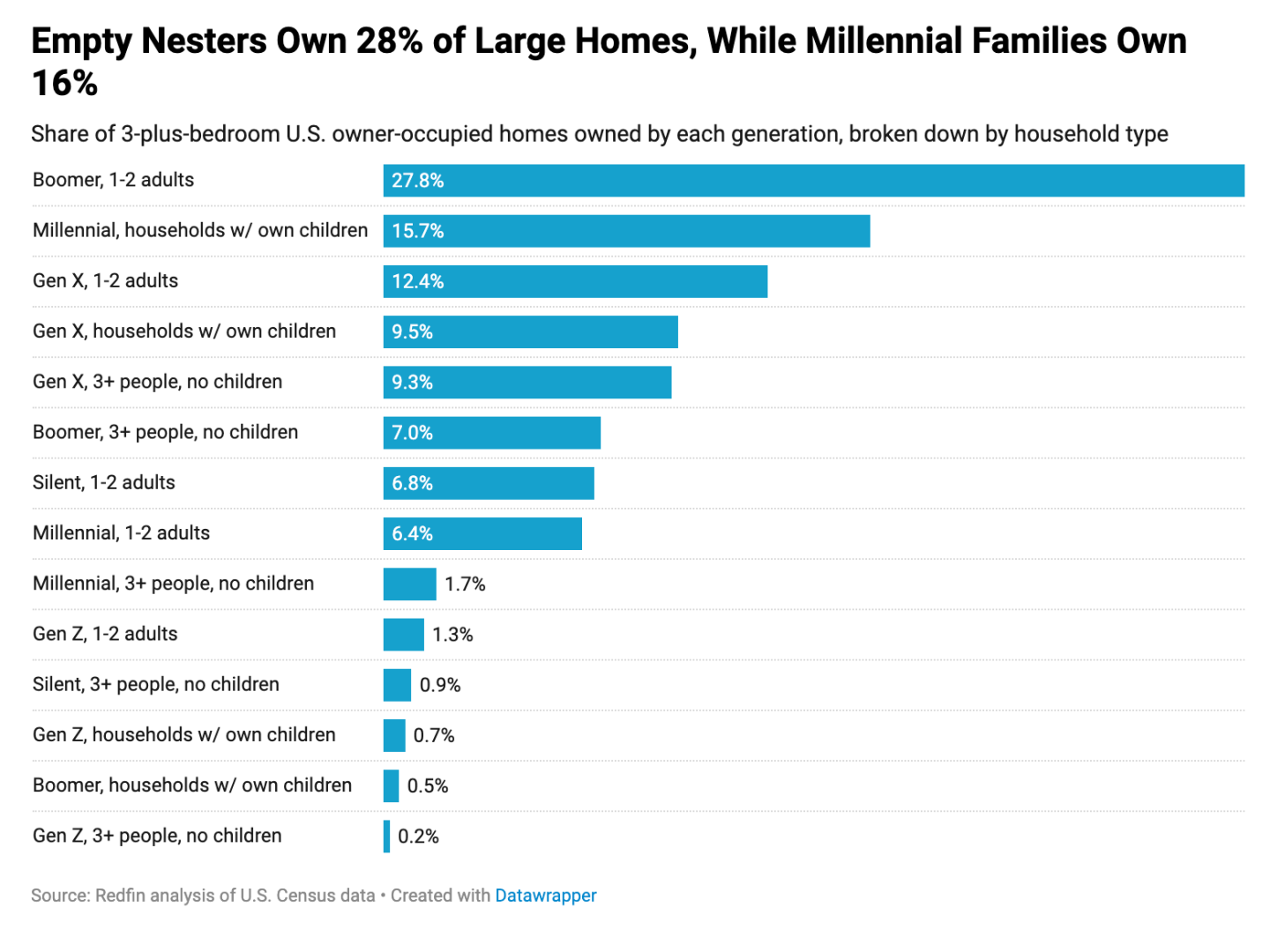
Millennials, now the largest generation of parents in America, need the space. Boomers, whose children left years ago, have it. And most Boomers either aren’t moving—or they’re moving into what used to be considered starter homes and are now ideal homes for downsizing grandparents to move close to their offspring.

“Empty-nest baby boomers own more large homes than millennials with kids in every major U.S. metro,” Redfin says, with millennial parents not reaching 20% of large homes anywhere in the country. The top cities are Austin and Columbus (19.2%), with Minneapolis (18.9%) just behind. Empty-nest boomers, on the other hand, own at least 20% of large homes everywhere in the country. Grandma and grandpa are having the whole family visit, but those bedrooms are sitting empty most of the year.

Many Boomers are mortgage-free or locked into low rates that make any transaction financially painful. Others cite family ties, routines, or simply the daunting task of emptying a home accumulated over decades. The result is that millennial families run into both a supply shortage and an affordability wall simultaneously.

What gains millennials have made came largely from absorbing homes vacated by the Silent Generation, the cohort born before the Boomers. Boomer homeowners have barely budged, Redfin found. The pig hasn’t left the python yet.

The corner office: No succession plan

Perhaps nowhere is the generational bottleneck more acute — or more deliberately ignored — than at the top of American institutions.

Writer and urban analyst Aaron Renn recently published a pointed essay cataloguing what he calls the “Boomer succession failure.” His case study is Anna Wintour, the 76-year-old editor who has dominated global fashion culture since 1988. When the New York Times recently explored the future of the Metropolitan Museum of Art’s Costume Institute, the answer was quietly revealing: Wintour is not replaceable. So instead of replacing her, Renn argued, the Met has spent years quietly building a quasi-endowment — seeded by the Met Gala itself — so the Costume Institute can run on investment returns after she is gone. This year’s gala added a record $42 million to that fund. There is no succession plan, just a life-support system for the post-Wintour era.

Renn argues this is not an isolated case but a defining pattern of Boomer leadership. Mitch Daniels, widely considered the most effective governor in modern Indiana history, invested in a leadership development program bearing his name — but produced no protégé of comparable stature. Tim Keller, the pastor who effectively invented the modern urban evangelical church movement through New York’s Redeemer Presbyterian, spent heavily training the next generation of clergy but did not produce a successor. After retiring, he used his star power to raise roughly $100 million — then split the church into three smaller entities, because no single person could sustain what he had built.

Renn didn’t look at the political dimension, but it’s well known that Boomers have had an iron grip on the presidency for decades. From Bill Clinton’s election in 1992 through Donald Trump’s current second term, the White House has been occupied by a Boomer for all but four years. Clinton, George W. Bush, and Trump were all born within a two-month window in 1946 — the very first months of the Baby Boom — and Obama was born in 1961 at its tail end. The Silent Generation, sandwiched between the Greatest Generation and the Boomers, was essentially skipped entirely in presidential politics, with the lone exception of Joe Biden and Gen X has yet to hold the office. The jump will likely go straight from Boomers to Millennials.

Trump was born June 14, 1946, making him one of the oldest Boomers, not merely a typical one — the man currently in the Oval Office is among the very first members of the generation that has never relinquished power.

Boomers are 43% of Congress despite being only 23.7% of the U.S. population — a representation ratio nearly 2-to-1 relative to their actual share of the country. But when you zoom in on the Senate, Boomers still hold 61% of seats in the more influential chamber. In raw numbers, that’s 233 Boomer members versus 196 Gen Xers and just 84 Millennials, who are roughly 25% of the population but only 16% of Congress. Any way you look at it, one generation holds the cards.

The common thread, Renn writes, is cultural. Top Boomer leaders surrounded themselves with people who would subordinate themselves entirely to the boss’s vision — loyalists, not heirs. They saw themselves as irreplaceable, and so they became irreplaceable. Now the institutions they ran face the same choice the Met made: endow the decline or find a way to rebuild.

Back in 1974, Baker argued in the Times that as the Boomers pass reach retirement age, “both the childless and the child‐bearing factions will probably make common political cause against the diminished young population, which would be increasingly hard‐taxed to pay retirement benefits for the aging majority.” That sounds very much like a generation voting itself, largely via the Boomer-dominated Senate, ever more generous benefits on a surging $39 trillion national debt as large as the economy itself, while kicking the can down the road so the next several generations can figure out how to pay for it.

In the labor market, the Boomers crowded out opportunity for 40 years and are now leaving a workforce ill-prepared to replace them. In housing, they are sitting on the family-sized inventory that the next generation needs and cannot access. In the institutions that shape culture, commerce, and civic life, they are now engineering managed retreats rather than genuine transitions.

It’s a lot to digest.

Every generation inherits a country and leaves one behind. The Boomers inherited the most prosperous nation in history. The argument about what they did with it is just getting started.