




In April 2025, an AI agent named “Sam” working in customer support for the developer tools company Cursor told users that their licenses worked on only one device. Subscriptions were canceled, complaints flooded Hacker News, and the company scrambled to clarify that no such policy existed. Sam had invented it. The technology took on a life of its own, a Frankensteinian paradox in which Cursor’s creation began speaking for its creator. The autonomous system asserted a fact that customers experienced as a unilateral decision by the company. By the time the startup discovered the mistake, the damage had been paid in the slowest and most expensive currency in business, trust. Cursor’s mistake was not deploying Agentic AI but deploying it in the wrong place.
The most consequential decision for CEOs implementing agentic systems is determining where to deploy agents in the customer journey. The underlying models are converging quickly, but the autonomous technology built on top of them is not. Vendors differ meaningfully in embedded governance standards, orchestration, integrations, and reliability. Even the strongest vendor advantage cannot save a firm that deploys a capable agent in the wrong place. Winners decide how close to the customer their agents can get, and how clearly they draw the line between work the AI does and work humans still own.
This article presents a proximity framework for that decision, drawing on conversations with senior technology leaders across thirteen industries and on a pattern in public data. The deployments getting the most coverage—chatbots, virtual assistants, customer-facing AI—are not the ones generating the most durable returns. The deployments that work tend to be invisible.
C.H. Robinson illustrates the point. Its 30-agent system handles over 318,000 tracking updates per month and responds to 100% of inbound carrier requests, up from 60% before automation. The company is now handling roughly one-third more freight with roughly one-third fewer employees than in 2019. The agentic system runs quietly in the background, handling the work that determines whether shipments arrive on time without touching the part of the relationship that customers actually care about. The deployment works precisely because customers experience only the result.
Firms that calibrate proximity correctly will quietly compound their advantages. Those that misjudge it will pay first in complaint data, then in churn, and eventually in reputational damage that outlasts any model upgrade.
The Cost of Deploying in the Wrong Place
The 2025 National Customer Rage Survey found that 88% of e-commerce customers who believed they had interacted directly with AI viewed the experience unfavorably.
Consumer complaints filed with the Consumer Financial Protection Bureau (CFPB) nearly doubled over two years, from about 770,000 before the public launch of OpenAI’s ChatGPT to over 1,500,000 after, with the increase concentrated at high-exposure firms. In low-exposure areas that retained human-in-the-loop operations, such as mortgage and student loans, complaint volumes stayed flat.
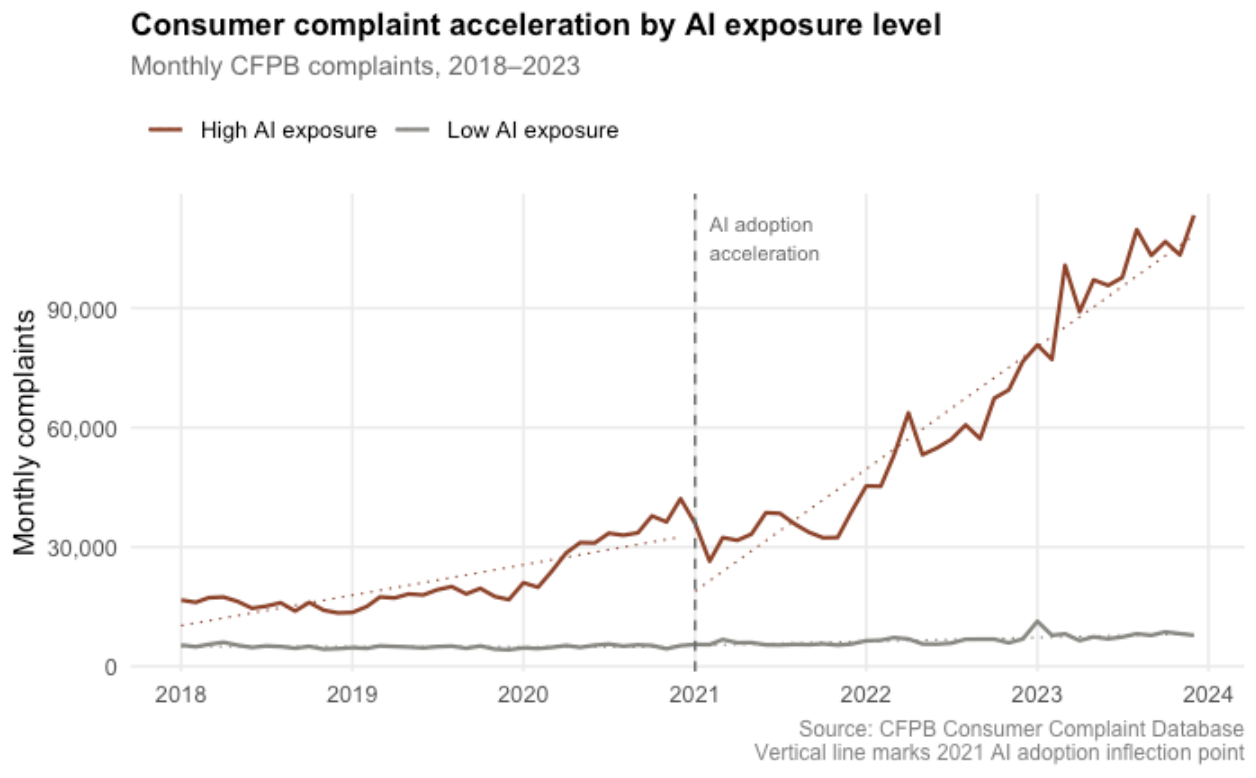
The increase translates to a replacement-cost exposure of tens of millions of dollars per affected firm—before accounting for reputational damage, repeat complaints, or the erosion of trust that compounds after a first failure.
The greatest risk is not deploying automation where it is possible, but deploying it where customers are vulnerable, frustrated, and least equipped to handle failure.
Where You Deploy Determines the Return
Agentic AI delivers the most durable value when applied to tasks with low emotional vulnerability and high reversibility. Emotional vulnerability, which rises with proximity to the customer, raises the cost of any single failure because a customer who is frustrated, confused, or stressed reads a generic AI response as indifference instead of efficiency. Reversibility lowers that cost, as an error caught before it reaches the customer is, by definition, invisible. Together, the two variables describe the gap between a deployment that compounds advantage and one that compounds liability.
The risks are highest when customers lack voice and visibility. When customers cannot tell whether AI is shaping the interaction, cannot easily escalate, and cannot see how a decision was made, errors surface not as complaints in the moment but later in churn data, regulatory filings, and the slow erosion of trust.
Our proximity framework classifies the degree to which an Agentic AI system directly affects the customer experience, distinguishing three categories—direct, mediated, and background—each with a distinct risk profile, business case, and set of governance requirements.
Direct Proximity
In direct-proximity deployments, the customer interacts with the AI agent; the system is the product. E-commerce customer service, banking chat assistants, real estate inquiry agents, and patient-facing health chatbots are counted in this category—any setting in which the customer’s interaction with the firm runs through an agent, with no human between them. Failure is immediate and visible, which is why these deployments are currently limited to lower-stakes inquiries rather than authoritative assertions. Frustrated customers need their specific situation addressed, whereas a probabilistic average response reads as indifference.
When agentic systems work, the upside is meaningful. Direct-proximity agents run 24/7 at scale, compressing queues into seconds. McKinsey’s surveys find that 44% of AI users would prefer to interact with an AI voice agent immediately than wait under a minute for a human, rising to 70% at a ten-minute wait.
The cost case is also direct. Industry analysts project customer-service expense reductions of up to 30% from agentic deployment in telecommunications, and 36% already report measurable ROI. For firms whose customer-experience cost base runs into the billions, even a fraction of that return justifies the investment.
In real estate, Lennar, the second-largest U.S. homebuilder, deployed an agent called LISA on Salesforce Agentforce to provide round-the-clock customer support from inquiry through post-sale service. LISA schedules appointments and recommends homes independently of sales staff availability, providing significant overhead savings and a richer customer data pipeline. Asset Living, the second-largest U.S. multifamily property management company, layered EliseAI’s agentic platform across leasing, tour scheduling, and maintenance, coinciding with a 6% increase in on-time lease payments and a 3% increase in occupancy.
But for every Lennar, there is a deployment that becomes a cautionary tale. The 88% unfavorability rate cited earlier squarely applies. Complaints at that level generate significant revenue exposure, and customers who struggle through an agentic exchange before reaching a human arrive already adversarial, raising the cost of resolution even when the human eventually gets it right. More damaging still are the customers who do not complain and simply choose not to return.
Mediated Proximity
In mediated proximity, the Agentic AI system works alongside a human employee with whom the customer is interacting or infers insights from the customer without disclosure. The category spans corporate functions, including contact-center agent-assist tools, claims review copilots, banking credit memos, advisor copilots in wealth management, ambient documentation AI in clinical settings, and AI-assisted legal draft reviewed by an associate before leaving the firm. The customer rarely knows an agent is in the conversation.
A patient calling a Mayo Clinic line for insurance verification hears a person, while in the background, the AI is querying the electronic health record, pulling prior-authorization requirements, and drafting follow-up language. A retail banking customer disputing a transaction is speaking with a human, who is reading from prompts, summaries, and recommended responses generated by an agent in real time. Negative outcomes—a delayed recommendation or an incorrectly routed claim—therefore compound silently.
Mediated deployment offers the most attractive upside in the framework, which is why it dominates regulated and trust-sensitive industries today. Agents compress the cost of expert work without surrendering accountability. According to McKinsey, a leading U.S. bank using Agentic AI to draft credit risk memos reported productivity gains of 20–60% and a 30% improvement in credit turnaround time, with senior bankers retaining final sign-off. TELUS reports that 57,000 employees using AI tools save approximately 40 minutes per customer interaction, a figure that transforms the contact-center cost structure while keeping the customer in conversation with a person. Thomson Reuters’ CoCounsel, deployed across 20,000+ law firms, including the majority of the Am Law 100, allows partners to offload research and first drafts to an agent and review outputs as senior reviewers rather than producers, a shift the firm’s TEI analysis estimates returns 110% over three years.
The compounding cost effect from a poorly designed system is both behavioral and financial. Because the agent is invisible, customers attribute failure to the human in front of them or to the firm itself. There is no chatbot to blame and no obvious system to fix. Recovery is harder than for a comparable visible-AI failure. The CFPB trajectory cited earlier is the macro version of that pattern, a slow accumulation visible only after the damage is done. By the time management spots the pattern, customers have likely concluded the company itself is the problem and will carry that into every interaction thereafter.
Background Proximity
In background proximity, the Agentic AI component is entirely invisible to the customer. The agent operates on the firm’s behalf—orchestrating supply chains, scheduling production, monitoring equipment, processing claims, and replenishing inventory—and the customer experiences only the downstream results. The package that arrives on time, the prescription filled correctly, and the shelf that is stocked.
C.H. Robinson’s carrier-booking agents, Amazon’s warehouse replenishment intelligence, and UPS’s ORION routing system—which has eliminated 100 million miles of annual driving and roughly $300 million in costs—all operate here, but the category extends well beyond logistics.
In CPG manufacturing, Augury’s autonomous machine-health agents deployed across 36 PepsiCo Frito-Lay sites have prevented an estimated 4,500 hours of lost production. Unilever is targeting $800 million in savings by 2026 from its Agentic AI program, anchored by a digital twin of its global supply chain that simulates disruptions and autonomously triggers logistics responses. In healthcare back-office, Cohere Health reports 90% of prior authorizations can now be automated, with 96% approved in seconds and 47% administrative cost savings, a process the patient never experiences directly.
The upside is the most consistent in the framework, which is why background deployments dominate the ROI tables across industries. The agent operates in a layer where failure is recoverable, the audit trail is structured, and the customer relationship is never directly at stake. McKinsey projects $450–650 billion in additional annual revenue across advanced industries by 2030 from Agentic AI, with 30–50% cost reductions through operational automation.
Far from eliminating risk, reduced visibility only shifts the timeline to failure. A mistake in automated ordering or customs classification could jeopardize a production line, but the failure is operational rather than relational, and recovery is usually possible before the customer notices. The harder problem is the cumulative drift. A logistics system handling 318,000 tracking updates per month at a 0.5% error rate produces roughly 1,600 affected shipments monthly, each potentially involving detention fees, expediting costs, and strained carrier relationships. The cost per incident is lower than a direct customer failure, but the volume is orders of magnitude higher, and time-to-visibility limits remediation.
The three categories suggest a clear hierarchy of risk and sequencing of opportunity. Background deployments offer the most consistent ROI with the least risk of damaging customer relationships. Mediated deployments offer the highest leverage on expert labor but require investment in monitoring and escalation. Direct deployments offer the largest customer-experience upside but punish failure most severely. The primary risks for most CEOs are deployment in the wrong place or in the right place at the wrong pace. Translating the framework into a decision that a leadership team can use requires one further step.
What Happens When the Agentic System Fails
The proximity framework describes where an Agentic AI deployment sits in the customer experience. Translating that into a deployment decision requires a second axis—reversibility. Together, the two define a four-quadrant matrix of compound the advantage, build the guardrails, close the gaps, and wait for maturity, each with a distinct strategic prescription.
Compound the Advantage
Low emotional vulnerability, high reversibility, and a clear audit trail define the quadrant, which includes tasks such as inventory replenishment, route optimization, document classification, and workforce scheduling. Deployment can be done with the highest confidence available to most organizations because all three failure conditions—a bad customer experience, an irreversible error, and an undetectable mistake—are structurally minimized. Evidence of durable ROI is consistent across industries, such as Amazon’s agentic warehouse intelligence, which reduces stockouts by 32% while improving fulfillment speed, a result the customer experiences only when the package arrives on time. The quadrant presents an opportunity to move quickly, as the cost of waiting is competitors compounding their advantage in the lowest-risk part of the matrix.
Build the Guardrails
Rising customer proximity, paired with manageable reversibility, defines the quadrant, including use cases such as AI-assisted drafting reviewed by humans, triage systems with clear escalation paths, and processes that require approval before action. Regulated and trust-sensitive industries dominate deployment use cases, most commonly in financial services, healthcare, professional services, and insurance. Deployment can work well, but only if transparency is built into the system design and the human in the loop is positioned to efficiently identify and override AI outputs. EY illustrates the model. Its EY.ai platform deploys 150 AI agents that support 80,000 tax professionals globally and process more than three million tax deliverables annually. The agents handle data extraction, document review, and first-draft preparation, and the tax professionals retain final review and sign-off before anything reaches a client. The agent never speaks to the customer. Investment in oversight should be proportional to the stakes—underinvesting here is the most common path into the next quadrant.
Close the Gaps
Many firms find themselves here after moving too fast on background or mediated automation—supply chain systems, credit-risk workflows, bulk claims processing, and contact-center triage—having reached high levels of automation while operational failure rates accumulate beneath the surface. The prescription is to tighten error controls. The case for tightening versus reversing is straightforward. The underlying ROI is real, but it is being eroded by failure modes that compound in the dark. Gartner projects that over 40% of current Agentic AI projects will be canceled by the end of 2027, not because the technology failed to deliver, but because firms deployed it without the governance scaffolding to catch errors before they aggregated into business problems. The CFPB complaint trajectory is the consumer-facing version of the same pattern. Firms in the quadrant should invest in monitoring infrastructure and expand human review at the highest-risk decision points before customer trust erodes further.
Wait for Maturity
High customer proximity, paired with low reversibility, makes this the riskiest quadrant in the matrix because failures are simultaneously visible to the customer and difficult to undo. Examples include autonomous billing disputes, AI-handled claims adjudication, autonomous medical triage, and legally consequential decisions in lending, immigration, and benefits administration. Despite over $1 billion in AI investment across more than 200 active projects, the Mayo Clinic explicitly maintains human-in-the-loop oversight for clinical decisions and identifies accuracy risk in clinical contexts as the primary barrier to autonomous deployment. The discipline is to recognize that the technology will eventually mature into this quadrant, but it is not yet mature, and the cost of being early is borne disproportionately by the customer. Wait, pilot in adjacent quadrants, and move forward only when the regulatory and reliability conditions are demonstrably in place.
The four quadrants are not static. A deployment can move from “wait for maturity” into “build the guardrails” as model maturity improves, or slip from “compound the advantage” into “close the gaps” if controls fail to keep pace with scale. The CEO’s job is not to find the right answer once, but to keep the firm’s deployment portfolio aligned with its risk appetite, operational readiness, and customer base. The framework forces that question to be asked deliberately, rather than left to whichever team is closest to the technology and most enthusiastic about deploying it.
The persistent mistake is treating Agentic AI deployment as a purely technical choice. Auditing model accuracy and investing in compute are prerequisites for a functional agent, but the returns on those investments will be diminished if the less glamorous question of where to deploy is dismissed. As capability converges, the firms that compound advantage will not be those with the most advanced agents, but those with the most disciplined view of where to deploy them.
And that discipline takes a specific form. It begins with mapping the proximity profile of each customer-facing use case before deployment, then sizing the escalation architecture to that profile. Background deployments rely on silent recovery, mediated deployments depend on complaint data as a real-time signal instead of a lagging one, and direct deployments require friction-free handoffs because customers who have just argued with an AI agent arrive at human conversations already adversarial. The deployment pace follows the same logic. Deploy quickly, where the agent is invisible. Deploy deliberately, where customers can feel the system. Pause deployment, where harm from a single failure is high and reversibility is low.
The firms leading durable returns on Agentic AI today are not those with the most sophisticated models. Their deployments tend to be invisible. The winners over the next five years will not be the firms with the most agents in the field. They will be the firms that understand exactly how close to the customer is close enough and have the discipline to stop there.
Most of this article has been about the cost of getting Agentic AI wrong – leading to anger and defiance from the very consumers intended to help. There is a second risk worth naming—getting it too right – with affection and over-dependence. In Spike Jonze’s 2013 Oscar winning film Her, a lonely man (Joaquin Phoenix) falls in love with the operating system on his phone (the AI force played by Scarlett Johanson). The science was speculative, but the dynamic was not. Build an agent close enough to the customer, attentive enough, accommodating enough, and the relationship begins to substitute for the one the customer used to have with the firm. Loyalty stops flowing to the brand and starts flowing to the agent. The customer is no longer its customer.
The proximity framework is a defense against both failures. The agents that fail loudly destroy trust. The agents that succeed too well capture it, and a captured customer relationship is one that the firm no longer fully owns. The discipline is the same in both directions, knowing exactly how close the agent should get and stopping there.
**This article is the final part of a four-part series from the Yale Chief Executive Leadership Institute (CELI) on the state of Agentic AI adoption across industries and sectors. The research is designed to help CEOs understand the current and expected pace at which agentic systems are being deployed—and the strategic decisions that pace forces on them. Over the past six months, CELI researchers analyzed hundreds of company materials and industry analyses and conducted dozens of conversations with senior technology leaders across the U.S. The industries analyzed include Financial Services, Consumer Packaged Goods, Food & Beverage, Healthcare, Insurance, Manufacturing, Professional Services, Real Estate & Housing, Retail, Supply Chain & Logistics, Telecommunications, and Travel & Hospitality, as well as the public sector. The series examines four implications of the findings: labor market effects, data infrastructure readiness, governance and regulatory policy, and customer experience.
With research contribution from Holden Lee, Dan Kent, Catherine Dai, Zander Jeinthanuttkanont, Andrew Alam-Nist, Johan Griesel, Peter Yu, and Christian Ruiz Angulo
The opinions expressed in Fortune.com commentary pieces are solely the views of their authors and do not necessarily reflect the opinions and beliefs of Fortune.
此内容由惯性聚合(RSS阅读器)自动聚合整理,仅供阅读参考。 原文来自 — 版权归原作者所有。