


Hello and welcome to Eye on AI. In this edition…Anthropic scrambles to try to reverse U.S. export controls on its Fable and Mythos models…the U.S. government decision on Anthropic’s models causes panic in Europe over AI sovereignty and delight among China’s open source AI developers…OpenAI’s finances revealed…a new benchmark shows AI agents may not be as capable as you think…and courts are turning to AI for transcripts but the reasons may not be what you think.
This week’s biggest news is obviously the U.S. government’s decision to impose export controls on Anthropic’s newest and most powerful AI models, Fable and Mythos, after researchers at Amazon found a way to jailbreak some of Fable’s cybersecurity guardrails. The decision forced Anthropic to disable the two AI models for all users, since American “deemed export” rules mean that allowing any foreign national, including those who work for Anthropic, to access the models would violate the law. Anthropic has been scrambling to try to get the export controls rescinded, sending a delegation of high level executives to Washington earlier this week to try to hash out a compromise with the government. But so far, no deal has been reached.
The government decision has wide ranging implications and sparked all kinds of reactions. Those who think Anthropic uses “fear-based marketing”—hyping the dangerous potential of its models as a kind of psychologically-crafty way of touting its models as the most capable on the market—reacted with schadenfreude, declaring that Anthropic was only reaping what it sowed. (AI “godfather” Yann LeCun, who has been dismissive of AI’s existential risks, was among those endorsing this view.) Others, who think Anthropic is sincere in its communication about its models’ dangers, were more divided on the decision. Some were willing to give the government some benefit of the doubt and think Anthropic may have been reckless in releasing Fable, which was supposed to offer many of the benefits of Mythos without the cyber security and bio weapons risks, but which may not, in fact, have had robust enough guardrails.
Many cyber security experts, however, say the Fable jailbreak Amazon discovered did not unlock potential offensive cyber abilities that are not also currently available from other AI models, including OpenAI’s GPT-5.5, which are not being subjected to export controls. More than 100 cyber and tech policy experts signed an open letter stating that Fable and Mythos, were essential tools for cyber defenders to find and patch vulnerabilities in their own systems and that these benefits outstripped the risk attackers might jailbreak Fable.
Clearly Amazon must have thought the jailbreak was a serious concern—its CEO Andy Jassy personally made a call to the White House about the issue. But there is still much we don’t know about exactly what the internal debate was within Amazon. The e-commerce and cloud giant has invested $13 billion into Anthropic, and committed to investing up to $20 billion more in the coming years, and it remains unclear exactly how Amazon weighed the risks to its investment in the AI startup against the national security concerns it raised with the U.S. government, and how exactly Jassy characterized the risks from Anthropic’s models compared to others on the market. While some conspiracy-minded analysts have suggested Amazon may have had commercial reasons to torpedo Anthropic’s models, those theories make little sense to me, and I think we still need to hear from Amazon more about exactly why it took the steps it did and exactly what Jassy said in his calls with the administration.
What is clear, however, is that the U.S. government now has a mandatory licensing regime for frontier AI. It is just not a transparent, de jure one. Instead, it is ad hoc and opaque. Jonathan Iwry, a fellow at the Wharton Accountable AI Lab, told my colleague Beatrice Nolan, “we see the government repurposing existing legal authorities into what is effectively a backdoor licensing regime.” Dean Ball, the libertarian AI policy thinker who briefly helped the Trump administration shape its AI policy last year but who has now emerged as a fierce critic of the government’s recent AI decisions, put it this way:
AI is licensed now, but the requirements change constantly and are always a secret, even to the administration itself, which will discover the rules spontaneously in real time as it reacts to events. This means also that the rules are in practice stricter and more roughly enforced for organizations the administration does not like.
Ball says the situation is made worse by the administration’s “insistence that it is Not Regulating AI. This has become an excuse for vagueness and evasiveness in rule-drafting…and this in turn makes the lawlessness worse.” He says the government “has discovered that ‘not regulating AI’ is in fact a great excuse for refusing to support laws that could constrain the admin’s power.”
As was the case with the administration’s earlier—and also unprecedented—decision to label Anthropic a “supply chain risk” for refusing to agree to the Pentagon’s preferred contract terms, the arbitrary and capricious use of government power to punish, and perhaps even destroy, a company that has not violated any law ought to be concerning to every American business.
Some have said it is ironic that Anthropic, whose CEO Dario Amodei has called for an FDA-like agency to regulate AI and license frontier AI models, is now complaining about being regulated. But I have a great deal of sympathy for Anthropic’s statement that it wants “a statutory process that is transparent, fair, clear, and grounded in technical facts.” We should all want that. And this is the opposite.
Even if we do move towards a statutory process, there are tough decisions ahead about exactly how that process should work and what the thresholds for blocking deployment of an AI model should be. Frontier AI models are inherently dual use, and they do possess significant cyber security risks. If the history of U.S. export controls is any guide, the road ahead for U.S. frontier model companies is going to be rocky unless they start training models without any significant coding and biological knowledge. Of course, that obviates many of these models’ best use cases. Still it might allow AI companies to continue to sell models that are useful in many business contexts. Those who argue that the export control ruling is good news for VCs who have been backing startups working on narrow AI applications in specific professional verticals are probably not wrong. Those narrow AI models are much less likely to run afoul of U.S. export licensing.
On the other hand, the same logic that led the administration to block Fable and Mythos leads, perhaps inevitably, to the nationalization of frontier AI. (AGI is, after all, perhaps the most potent dual use technology there is. It’s not clear how the U.S. could ever allow it to be exported.) I don’t buy conspiracy theories currently circulating on social media that Amazon, Microsoft, and Google have somehow colluded to position themselves as the only government-approved gatekeepers to frontier AI models, arguing they are best positioned to exercise strict know-your-customer rules, but I do think it is possible we will end up in exactly that scenario.
What do you think? Let me know and I will try to publish some of your views in next week’s newsletter.
In the meantime, here’s more AI news.
Jeremy Kahn
jeremy.kahn@fortune.com
@jeremyakahn
The following newsletter sections were compiled this week with help from Lulu Nairn.
The shutdown of Anthropic’s Mythos model sparks a global scramble for sovereign AI—by Beatrice Nolan
Anthropic’s Fable fiasco leaves the door open for open-source AI, particularly cheaper models from China—by Nicholas Gordon
Anthropic’s IPO pitch has a new problem: the government can shut it down—by Eva Roytburg
The $1 billion game that says AI can’t replace human creativity—by Kamal Ahmad
Exclusive: Voice AI startup Bland raises $50 million after being rejected by 180 investors—by Lily Mae Lazarus
Exclusive: How college photo-sharing app Swsh became an AI-powered fan data business backed by Scooter Braun—by Lily Mae Lazarus
OpenAI spent $34 billion in 2025 while bringing in about $13 billion in revenue. That’s according to financial figures the company shared with investors and which tech blogger and perpetual AI skeptic Ed Zitron obtained. The figures were then confirmed by the Financial Times. The company spent about $19 billion on research and development and nearly $6 billion on sales and marketing. Having generated $13 billion in revenue for the full year (and reaching $2 billion in monthly revenue by the end of the year), the company reported a net loss of around $39 billion, though roughly $30 billion of that stemmed from a one-time accounting charge related to its former corporate structure rather than operating performance. Excluding that charge and other non-cash expenses, OpenAI’s underlying losses were about $8 billion, highlighting the enormous costs of competing in the AI market. The company has been buoyed by investor enthusiasm, raising fresh capital at a valuation of about $730 billion and confidentially filing for an IPO, with some investors and executives expecting a public listing as early as this autumn.
KPMG withdraws report on AI because it contained AI hallucinations. KPMG has withdrawn an AI adoption report after it was found to contain multiple fabricated case studies that appear to have been generated by AI hallucinations, including false claims about AI deployments at UBS, the U.K.’s National Health Service, Transport for London, and Swiss Federal Railways. The errors were identified by AI-detection company GPTZero and confirmed by the Financial Times, prompting several organizations cited in the report to publicly deny the claims and request corrections. The incident follows a similar recent retraction by consulting and accounting firm EY and shows that even the consulting firms helping clients adopt AI have not quite nailed how to develop workflows that protect against AI-derived errors. Read more from the Financial Times here.
Meta’s internal AI efforts face internal turmoil, low morale. That’s according to a story in Wired that cites unnamed employees complaining that work in the company’s newly-created Applied AI unit is “soul-crushing” and comparing the team to a “gulag.” The discontent spilled into public view when an employee disrupted a company-wide AI presentation with an expletive-laden rant, reflecting broader frustration over layoffs, forced transfers into AI-related roles, and increased employee monitoring. In internal meetings and a company memo, CEO Mark Zuckerberg and Chief Product Officer Chris Cox acknowledged low morale and organizational strain, while defending the company's AI push as essential to building future products and competing in the race toward advanced AI systems. Despite promises of greater stability and no further mass layoffs this year, many engineers reportedly feel they have been reassigned from creative product development to repetitive data-generation tasks designed to train and evaluate AI models in support of Meta’s separate Superintelligence team, which sits under the control of executive Alexandr Wang.
U.K. unveils new AI infrastructure push. The British government unveiled a broad AI strategy centered on a £1.1 billion ($1.47 billion) investment in AI hardware, skills programs, defense applications, and incentives for businesses to adopt AI, while also touting major private-sector investments from companies including chipmaker AMD and neo-cloud company Nebius. However, analysts questioned whether the hardware funding is sufficient to create meaningful U.K. AI sovereignty given the industry's dependence on overseas chipmakers and cloud providers, and noted that some of the announced spending had already been pledged previously. Read more from the Guardian here.
British police officer under criminal investigation for using AI to fabricate evidence. An officer in England who works for the Derbyshire Constabulary is under criminal investigation and has been removed from frontline duties over allegations that he used AI to manufacture or doctor evidence in multiple cases. The case is believed to be the first known U.K. criminal investigation into police misuse of AI-generated evidence and comes amid growing concerns about the reliability of AI tools in criminal proceedings. The investigation follows warnings from the National Police Chiefs' Council's PoliceAI unit, which has advised some forces to stop using AI to draft witness statements and other court documents because of accuracy concerns. Read more from the Financial Times here.
How good are AI agents? Maybe not yet as good as some claim. That’s the conclusions from a new benchmark test for AI agents created by a team that consisted of contributors from 88 different academic institutions and companies, and led by the University of California at Berkeley. The researchers created a benchmark consisting of complex, long-horizon professional workflows across 55 different professions drawn from 13 different industries, from engineering and architecture to business and finance to medicine. The workflows, some of which involve using a standard graphical user interface for a computer and others a command line interface that computer programmers use, are ones that would take a human hours to weeks to complete, which is much longer than the tasks used for many other AI benchmarks. The researchers found that even the most advanced AI models—and they tested Anthropic’s Fable as well as OpenAI’s GPT-5.5 Codex and Cursor’s Composer 2.5—can complete only 25% of the tasks successfully (that score was achieved by GPT-5.5 Codex). On the most difficult tasks, the agents’ success rate was no better than 10%. You can read more about the benchmark and view the leaderboard of agents here. You can read the research paper here.
June 17-20: VivaTech, Paris.
July 6-11: International Conference on Machine Learning (ICML), Seoul, South Korea.
July 7-10: AI for Good Summit, Geneva, Switzerland.
Aug. 4-6: Ai4 2026, Las Vegas.
AI was supposed to kill off court reporters. Instead, they are in more demand than ever. And the reason may hold a message for other professions in the age of AI. That’s according to a story in the Wall Street Journal. Courts have been turning to AI due to a lack of human court reporters, and in some cases, because of costs as a result of budget cuts in certain state judiciaries. The profession has seen a big decline: the total number of court reporters in the U.S. has fallen 21% to just 23,000 individuals over the past decade, according to a 2025 report from the Council for the Advancement of Professionals, Technology and Unbiased Reporting. In California, about 72% of cases heard between April 2023 and June 2025 had no verbatim record, with the expense and limited number of court reporters being one reason. California’s Supreme Court heard arguments this month about whether to allow electronic recording and AI transcriptions in civil cases, where such recoding is currently prohibited.
But, it turns out, many legal professionals say AI isn’t actually up to the task. Human stenographers are often required to achieve 95% accuracy at typing speeds of up to 225 words per minute for five minutes, figures many current AI systems can’t match. The AI systems often make mistakes, and can erroneously transcribe courtroom noise not related to a case, according to the National Court Reporters Association. AI transcripts based on audio recordings also can’t pick up non-verbal cues that many human stenographers are trained to include in official records. Some court systems are exploring the use of human “audio recorders” who don’t have the same stenography skills as trained court reporters but use AI to assist them in the compilation of an official record. This might be a good example of using AI to upskill people and move more of them into jobs, rather than replacing human labor. — Lulu Nairn
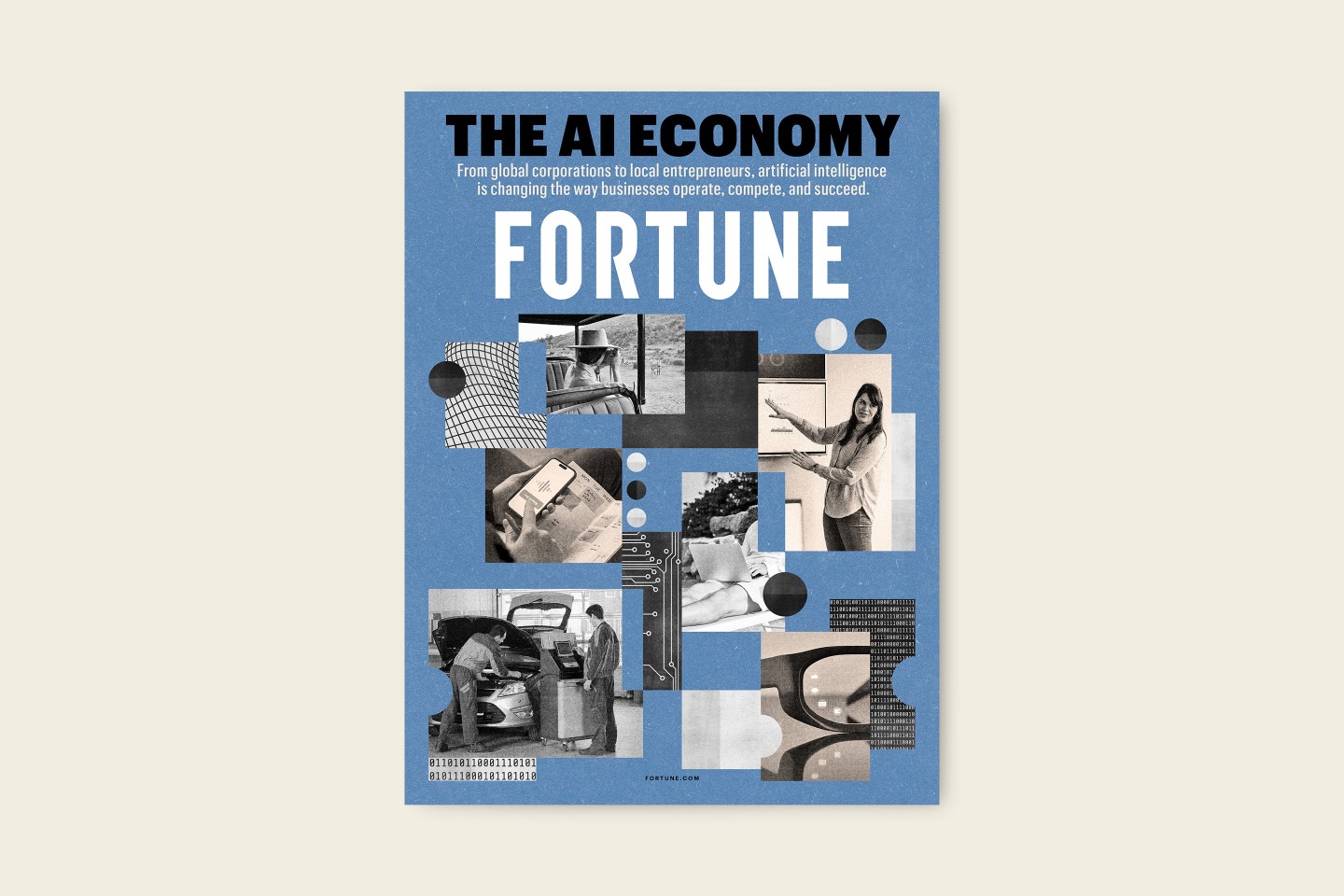
From global corporations to local entrepreneurs, artificial intelligence is changing the way businesses operate, compete, and succeed. Explore all of Fortune AIQ, and read the latest collection of stories below:
–After AI stole his clients, one Big Tech ghostwriter is using AI to get them back
–Outnumbered: At $4 billion ClickUp, a 3:1 agent-to-human ratio is rewiring work itself
–How a mom-and-pop car wash chain went from sticky notes to AI-powered operations that are upleveling every part of the company
–Solo founders are using AI to do the work of entire teams—but going it alone has limits
–How EarthRanger uses AI to help protect endangered species—and boost the wildlife tourism industry
–The smartphone’s days are numbered. Meet the device that could come next
此内容由惯性聚合(RSS阅读器)自动聚合整理,仅供阅读参考。 原文来自 — 版权归原作者所有。