


惯性聚合 高效追踪和阅读你感兴趣的博客、新闻、科技资讯
阅读原文 在惯性聚合中打开

推荐订阅源

N
Netflix TechBlog - Medium
G
Google Developers Blog
H
Hackread – Cybersecurity News, Data Breaches, AI and More
T
The Blog of Author Tim Ferriss
Microsoft Azure Blog
GbyAI
GbyAI
L
LangChain Blog
云风的 BLOG
云风的 BLOG
OSCHINA 社区最新新闻
OSCHINA 社区最新新闻
aimingoo的专栏
aimingoo的专栏
P
Proofpoint News Feed
Cyber Security Advisories - MS-ISAC
小众软件
小众软件
WordPress大学
WordPress大学
A
About on SuperTechFans
大猫的无限游戏
大猫的无限游戏
C
Check Point Blog
月光博客
月光博客
Stack Overflow Blog
Stack Overflow Blog
美团技术团队
Jina AI
Jina AI
T
Tailwind CSS Blog
Google DeepMind News
D
Docker

Fortune | FORTUNE

One man can kill Bill Ackman’s $64 billion bid for Universal Music Group—and no one knows what he’ll do | Fortune Poppi’s cofounder pitched her startup on Shark Tank while 9 months pregnant and landed a $400,000 deal—now it's worth $2 billion | Fortune Teen boys are choosing AI girlfriends over real ones for 'maximum control, zero rejection'—experts say it could make them unemployable | Fortune A United American merger is by no means impossible given the president 'loves big deals' | Fortune Reed Hastings’s planned exit from $455 billion Netflix ‘had nothing to do with’ the failed deal for Warner Bros., says Ted Sarandos | Fortune Meet Joe McCann: The high-flying crypto trader held in Tanzania after sudden death of his influencer fiancée Ashly Robinson | Fortune Gen Z is carving a different path in the housing market by doing it alone | Fortune U.S. Catholic leaders criticize Trump for ‘disparaging words’ about the pope as Vatican clash risks alienating Catholic voters | Fortune China has ‘nearly erased’ America’s lead in AI—and the flow of tech experts moving to the U.S. is slowing to a trickle, Stanford report says | Fortune Self-made millionaire behind $5 billion Skims Emma Grede says it all began with a cold call to Kris Jenner: Emma Grede—the self-made millionaire behind the $5 billion Skims empire—says it all began with an audacious cold call to Kris Jenner: ‘The difference between me and someone else is, I made it happen’ | Fortune Americans have never been this gloomy about the economy. Wall Street has never cashed in harder | Fortune ‘The college grading system [is] almost meaningless’: People see the Ivy League as an easy A and with flawed admissions standards | Fortune The CEO of $8.5 billion Japanese car giant Nissan plays the drums in a band and hits the tennis courts to destress from the top job | Fortune New York governor's take on a millionaires tax: fancy pied-à-terre second apartments worth over $5 million | Fortune Pope Leo XIV: A ‘handful of tyrants’ are ravaging earth with war and exploitation | Fortune Trump has no plan to cut the $39 trillion national debt, but he does want to cut childcare. His budget director is scrambling to clarify | Fortune China's economy grows 5% in first quarter, surprising economists to the upside | Fortune Everyone was wondering what Trump wanted more: Warsh smoothly seated at the Fed, or for Powell to pay. We have our answer | Fortune Palantir exec: the biggest mistake retailers are making with AI? Trying to do it all with one agent | Fortune American YouTuber who calls himself a 'troll' sentenced to 6 months in Korean prison for literally dancing on wartime graves | Fortune BBC plans to cut up to 2,000 jobs to save 10% of annual budget | Fortune Canva debuts a new suite of agentic tools, as the design app quietly becomes one of the world’s most used AI services | Fortune Moody's CEO: AI has a trust problem – better models won’t fix it | Fortune Top New York surgeon: Americans have better data for choosing restaurants than surgeons. That has to change | Fortune The Iran war’s fertilizer shock is hammering American farmers, and 70% can’t afford what they need for this year’s growing season | Fortune Education experts to Mamdani: Why are you foisting AI on our kids? | Fortune This CEO pirated video games as a teen and became a hacker for the Air Force. Now he’s built a $3 billion cyber firm | Fortune Teacher, blame thyself: Yale report savages Ivy League schools for destroying American trust in higher education | Fortune Fed chair nominee Kevin Warsh is worth more than $100 million and has stakes in SpaceX and Polymarket | Fortune From wool sneakers to GPUs: Allbirds’ desperate AI pivot and 600% stock surge, explained | Fortune
You had a miserable 2025 because of tariff inflation. The...
Jake Angelo · 2026-05-06 · via Fortune | FORTUNE

“This will be indeed the golden age of America,” President Donald Trump proclaimed on April 2, 2025, better known as Liberation Day. On that day, the president lauded tariffs as a way to “make America wealthy again.” Americans invested in the market lost about 10% of their wealth as the market reeled with one of the worst short-term crashes in recent memory, with the Dow shedding nearly 4,600 points as it tumbled 11% over four days. The tariff regime was rolled back, then reinstated bit by bit, then ruled illegal, but tariffs fueled inflation all the while.

That was just the appetizer, according to Mark Zandi. “The higher energy and other commodity prices caused by the war threaten to do even more economic damage than the tariffs, further undermining growth and pushing inflation higher,” the Moody’s Analytics chief economist said in a post on X.

Americans are facing a barrage of economic headwinds. Many employers have paused hiring, adopting a wait-and-see approach thanks to Trump’s tariffs. A growing number of tech firms have cut workers in the wake of AI adoption. Inflation also remains hard to tame, down from a high of 9.1% in July 2022, though stubbornly above pre-pandemic levels. But while many economists predicted at the beginning of 2026, the tariff-related headwinds would begin to relent, the Iran war threw a wrench in those plans. Inflation is now trending upward as a result of the energy shock stemming from the war. And Zandi predicts job growth will stagnate, developing a noxious combination of higher inflation and slow growth.

That combination has some economists whispering the dreaded S-word: stagflation, economists’ favorite portmanteau for a brutal combination of stagnating growth and persistent inflation. That’s as the Strait of Hormuz remains under a double blockade and a resolution to the conflict seems further and further down the line as hostilities briefly resumed Monday.
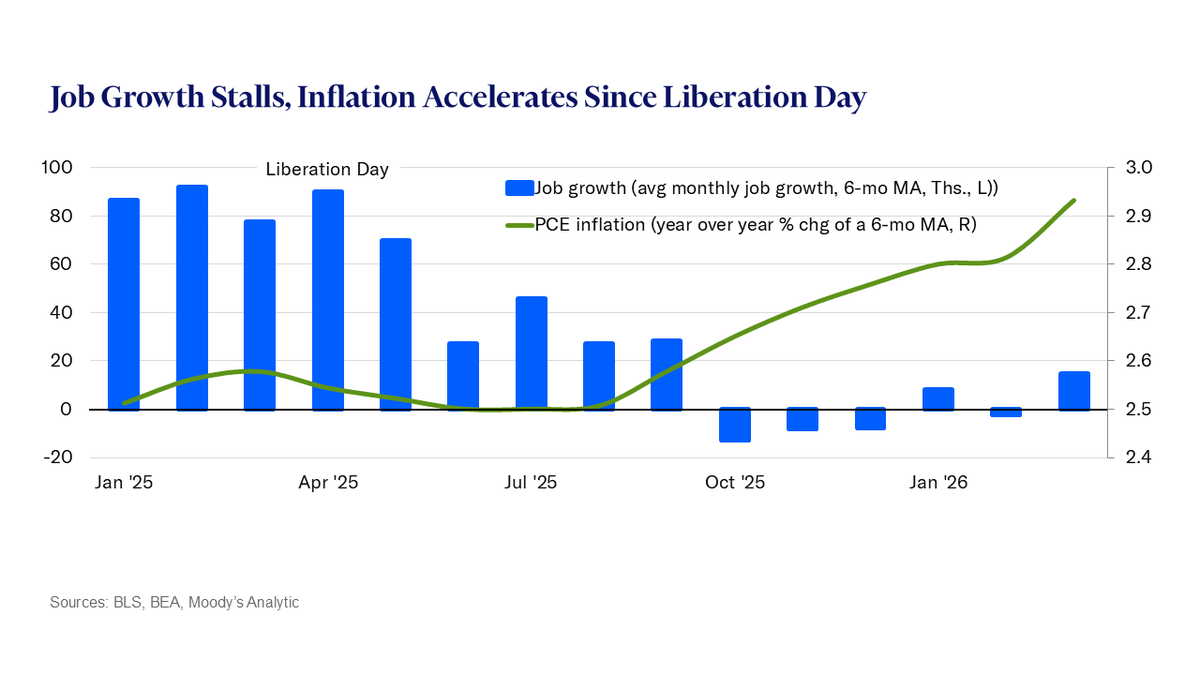
How Moody’s predicts the war will impact the U.S.

While the Supreme Court overturned Trump’s tariffs issued under the International Emergency Economic Powers Act, the president reimposed tariffs under Section 232, levies that aim to protect U.S. national security. A March report from the nonpartisan Tax Foundation found that these tariffs, though smaller in scale than those imposed under IEEPA, will shrink long-run GDP by 0.2%, and lead to 154,000 lost jobs.

Zandi—who has warned since the war’s outbreak of the recessionary implications the conflict could have on the U.S.—doubled down on his warning. In a recent post on LinkedIn, the Moody’s economist said that while the U.S. should avoid a recession, he expects the economy to further diminish even if the war concludes in the next few weeks. 

“The economy should avoid a recession, but growth will fall well short of potential, jobs will remain largely flat, and unemployment will drift higher,” he said.

Higher fuel prices will spread out across the economy, according to Zandi. Higher energy costs are set to drive up delivery packages, airfares, and food prices in the coming months. What’s more, a recent Goldman Sachs note gives it to July until the U.S. starts to run out of jet fuel, meaning airlines would likely dramatically cut back on flights, as some European airlines have already done.

Although Zandi said in his note that he expects the economy to avoid a recession, Moody’s recession odds hit 49% in March. Similarly, Goldman Sachs forecasts a 30% risk of recession and EY-Parthenon has the odds at 40%.

And while Zandi claims the war will hamstring the labor market, it’s not so clear if it will hit hiring. Bloomberg reported that forecasters expect the April jobs report on Friday to show an estimated 62,000 jobs added, with private-sector hiring expected to be even stronger, according to a survey of economists conducted by Bloomberg. That’s riding off the momentum of a better-than-expected March jobs report where employers added 178,000 jobs and the unemployment rate ticked down to 4.3%.

Still, Zandi is skeptical about whether the U.S. economy can withstand the economic blows reverberating from the Strait of Hormuz. 

“The U.S. economy is resilient,” he said, “but just how resilient is set to be tested.”