
惯性聚合 高效追踪和阅读你感兴趣的博客、新闻、科技资讯
阅读原文 在惯性聚合中打开

推荐订阅源

F
Full Disclosure
博客园 - 三生石上(FineUI控件)
MyScale Blog
MyScale Blog
Apple Machine Learning Research
L
LINUX DO - 最新话题
T
The Blog of Author Tim Ferriss
P
Proofpoint News Feed
宝玉的分享
宝玉的分享
小众软件
小众软件
Hugging Face - Blog
Hugging Face - Blog
GbyAI
GbyAI
Cyber Security Advisories - MS-ISAC
V
Visual Studio Blog
爱范儿
爱范儿
freeCodeCamp Programming Tutorials: Python, JavaScript, Git & More
博客园_首页
CTFtime.org: upcoming CTF events
月光博客
月光博客
博客园 - 叶小钗
D
Docker
H
Hackread – Cybersecurity News, Data Breaches, AI and More
T
Tailwind CSS Blog
D
DataBreaches.Net
酷 壳 – CoolShell
酷 壳 – CoolShell
B
Blog RSS Feed
量子位
美团技术团队
Vercel News
Vercel News
Y
Y Combinator Blog
IT之家
IT之家
Martin Fowler
Martin Fowler
OSCHINA 社区最新新闻
OSCHINA 社区最新新闻
S
SegmentFault 最新的问题
腾讯CDC
Recent Announcements
Google DeepMind News
罗磊的独立博客
让小产品的独立变现更简单 - ezindie.com
G
Google Developers Blog
Microsoft Azure Blog
The Register - Security
博客园 - 司徒正美
N
Netflix TechBlog - Medium
S
Schneier on Security
博客园 - 聂微东
U
Unit 42
D
Darknet – Hacking Tools, Hacker News & Cyber Security
Threat Intelligence Blog | Flashpoint
雷峰网
雷峰网
Latest news
Latest news

Fortune | FORTUNE

One man can kill Bill Ackman’s $64 billion bid for Universal Music Group—and no one knows what he’ll do | Fortune Poppi’s cofounder pitched her startup on Shark Tank while 9 months pregnant and landed a $400,000 deal—now it's worth $2 billion | Fortune Teen boys are choosing AI girlfriends over real ones for 'maximum control, zero rejection'—experts say it could make them unemployable | Fortune A United American merger is by no means impossible given the president 'loves big deals' | Fortune Reed Hastings’s planned exit from $455 billion Netflix ‘had nothing to do with’ the failed deal for Warner Bros., says Ted Sarandos | Fortune Meet Joe McCann: The high-flying crypto trader held in Tanzania after sudden death of his influencer fiancée Ashly Robinson | Fortune Gen Z is carving a different path in the housing market by doing it alone | Fortune U.S. Catholic leaders criticize Trump for ‘disparaging words’ about the pope as Vatican clash risks alienating Catholic voters | Fortune China has ‘nearly erased’ America’s lead in AI—and the flow of tech experts moving to the U.S. is slowing to a trickle, Stanford report says | Fortune Self-made millionaire behind $5 billion Skims Emma Grede says it all began with a cold call to Kris Jenner: Emma Grede—the self-made millionaire behind the $5 billion Skims empire—says it all began with an audacious cold call to Kris Jenner: ‘The difference between me and someone else is, I made it happen’ | Fortune Americans have never been this gloomy about the economy. Wall Street has never cashed in harder | Fortune ‘The college grading system [is] almost meaningless’: People see the Ivy League as an easy A and with flawed admissions standards | Fortune The CEO of $8.5 billion Japanese car giant Nissan plays the drums in a band and hits the tennis courts to destress from the top job | Fortune New York governor's take on a millionaires tax: fancy pied-à-terre second apartments worth over $5 million | Fortune Pope Leo XIV: A ‘handful of tyrants’ are ravaging earth with war and exploitation | Fortune Trump has no plan to cut the $39 trillion national debt, but he does want to cut childcare. His budget director is scrambling to clarify | Fortune China's economy grows 5% in first quarter, surprising economists to the upside | Fortune Everyone was wondering what Trump wanted more: Warsh smoothly seated at the Fed, or for Powell to pay. We have our answer | Fortune Palantir exec: the biggest mistake retailers are making with AI? Trying to do it all with one agent | Fortune American YouTuber who calls himself a 'troll' sentenced to 6 months in Korean prison for literally dancing on wartime graves | Fortune BBC plans to cut up to 2,000 jobs to save 10% of annual budget | Fortune Canva debuts a new suite of agentic tools, as the design app quietly becomes one of the world’s most used AI services | Fortune Moody's CEO: AI has a trust problem – better models won’t fix it | Fortune Top New York surgeon: Americans have better data for choosing restaurants than surgeons. That has to change | Fortune The Iran war’s fertilizer shock is hammering American farmers, and 70% can’t afford what they need for this year’s growing season | Fortune Education experts to Mamdani: Why are you foisting AI on our kids? | Fortune This CEO pirated video games as a teen and became a hacker for the Air Force. Now he’s built a $3 billion cyber firm | Fortune Teacher, blame thyself: Yale report savages Ivy League schools for destroying American trust in higher education | Fortune Fed chair nominee Kevin Warsh is worth more than $100 million and has stakes in SpaceX and Polymarket | Fortune From wool sneakers to GPUs: Allbirds’ desperate AI pivot and 600% stock surge, explained | Fortune The Sam Altman attack is putting two anti-AI groups under scrutiny—but the story is more complicated | Fortune Elizabeth Warren on her proposal to bring back IRS Direct File: ‘For just one day of bombing Iran, we could pay for 20 years’ | Fortune ‘I am certain’: Harvard policy expert warns the true cost of the Iran war to U.S. taxpayers will exceed $1 trillion | Fortune The CEO of a $24 billion Dutch lender has sandwiches once a week with the staff to hear their views and get them on side with cost cuts | Fortune Why insurance giant Travelers' CTO is placing fewer, bigger bets on AI | Fortune Current price of oil as of April 15, 2026 | Fortune The dirty secret behind Big Tech’s AI arms race: Massive hardware investments that are obsolete in 3 years | Fortune Dow’s CEO handoff elevates an insider and seasoned operator | Fortune Anthropic faces user backlash over reported performance issues with its Claude AI chatbot | Fortune Stock futures sink while oil spikes as the U.S. Navy looks to squeeze Iran's economy and break its grip on the Strait of Hormuz | Fortune A major U.S. gasoline production hub is in such a severe drought that its refineries may be hobbled. 'We are actively praying for a hurricane' | Fortune U.K. won’t take part in Trump’s planned blockade of Hormuz strait | Fortune Hungarian voters oust Viktor Orbán, a close ally of Trump and Putin, despite late campaign push from JD Vance | Fortune Blazing hot IPOs, an AI agent craze, and a new word for ‘token’: Here’s what’s happening in the world of Chinese AI | Fortune Iran’s crumbling economy is the regime’s greatest weakness with prices up 40% since the war began while authorities worry about making payroll | Fortune Here’s how a U.S. naval blockade of the Strait of Hormuz could work. ‘This is a big task, and it’s a big gamble’ | Fortune Intuit was an AI pioneer. Why its stock became a SaaSpocalypse casualty | Fortune Artemis III will practice docking Orion with lunar landers in Earth orbit next year while Musk’s Starship and Bezos’ Blue Moon compete for Artemis IV | Fortune Oil tankers U-turn in Hormuz as U.S.-Iran talks break down Saudi Arabia says East-West pipeline restored to full capacity In 2011, Barack Obama said it was time to ‘pivot’ to Asia. But 15 years later, the U.S. is still at war in the Middle East Trump says U.S. Navy to impose Hormuz blockade after Iran ceasefire talks end with no deal. ‘No one who pays an illegal toll will have safe passage’ This TikTok sensation sold her startup for $2 billion. Now Pepsi is letting ‘Poppi be Poppi’ ‘Almost unmanageable’: Raising a child in the U.S. now costs more than $300,000 As Iran peace talks fail, Trump and Joe Rogan watch a hobbled fighter triumph in a brutal cage match Haiti stares down starvation as Iran War drives 200,000 into acute food emergency status ‘I just keep seeing a lot of different aspects of life getting more expensive’: New car prices are up 30% over 6 years America is not ready for its own longevity crisis — and 2026 is the wake-up call | Fortune JD Vance leaves Pakistan after marathon talks with Iran end without a deal as Tehran refuses U.S. demand not to develop nuclear weapons | Fortune Average price of new cars nears $50,000 as automakers focus on big pickups and SUVs while cheaper sedans get phased out | Fortune Navy tests Hormuz blockade as expert says U.S. military prepares for round 2 and could degrade Iran’s hold over the strait to a ‘manageable level’ | Fortune Pakistan sends military force to Saudi Arabia as part of pact | Fortune Three oil supertankers sail through the Strait of Hormuz | Fortune Trump downplays talks for ceasefire deal with Iran, claiming military victory. 'It doesn’t matter. From the standpoint of America, we win' | Fortune Boeing’s moon rocket faces uncertain future under Trump’s NASA | Fortune Appeals court says national security implications of halting White House ballroom construction must be weighed | Fortune Some of cheapest fuel can be found on Native American reservations as tribes are exempt from state gas taxes | Fortune JD Vance begins talks with Iran in Pakistan while Trump claims U.S. has begun 'clearing out' the Strait of Hormuz | Fortune 'This is the last warning.' Iran threatens U.S. warships after they throw down the gauntlet for winner-take-all Strait of Hormuz | Fortune U.S. Navy ships transit Hormuz ahead of mine-clearing mission | Fortune Over a third of Ireland's fuel stations are empty and truck and tractor drivers are protesting nationwide | Fortune Some communities are enduring unprecedented long waits on federal disaster requests, and Democrat-led states say they're being denied | Fortune These niche AI startups are trying to protect the Pentagon’s secrets | Fortune Former Tesla president reveals the ‘single most important thing’ you can do for your career—it’s a habit Elon Musk and Warren Buffett share too | Fortune Ingersoll Rand CEO: here's how employee ownership helped drive more than 8x enterprise value growth | Fortune The petrodollar faces increased risk, but a petroyuan is ‘far-fetched’ as fears of U.S. losing superpower status are overhyped, strategist says | Fortune Palantir CEO says AI ‘will destroy’ humanities jobs, but there will be ‘more than enough jobs’ for people with vocational training | Fortune Warren Buffett says 'accumulating great amounts of money' doesn’t achieve greatness—He still lives in a $31,500 Nebraska home and clipped coupons | Fortune Starbucks' game plan to roll out AI chatbots at cafes could serve as a 'litmus test' for the industry, analyst says | Fortune Data centers and gas demand make boring pipelines great again | Fortune The 'Tuscan Mom' aesthetic is taking over TikTok as Gen Z glamorize McMansions and reject millennial gray | Fortune Man's best friend may soon live a little longer thanks to a new pill promising to extend your pup's lifespan | Fortune Danantara CIO: Indonesia can anchor the AI and energy economy—if governance keeps pace | Fortune OpenAI’s TBPN deal shows how talent, media, and influence are collapsing into one | Fortune AI promises to free workers from grunt work, but psychologists say those mindless tasks are exactly what our brains need to recover | Fortune The 'affordability economy' has created a housing market nobody predicted: Prices collapsing in the Sun Belt, soaring in the Rust Belt | Fortune 'It’s 13 minutes of things that have to go right': Artemis II splashes down despite faulty heat shield | Fortune Fed seeks details on U.S. banks' exposure to private credit firms | Fortune The Navy confirmed an ‘abundant amount’ of Uncrustables when the Artemis II crew lands. Smucker’s just offered them a lifetime supply | Fortune Meet ‘trendslop,’ the new, AI-fueled scourge of workplace consultants everywhere | Fortune Amazon is still paying Jeff Bezos an $80,000 yearly salary—but $1.6 million for travel and security | Fortune Trump-backed World Liberty Financial crypto tokens reach all-time low on reports of insider loans | Fortune Iran is demanding tankers in the Strait of Hormuz pay tolls in crypto: What we know so far | Fortune First they went after medtech, then Kash Patel. Iranian hackers’ next target is likely ‘low-hanging fruit’ in water, energy, and tourism, experts say | Fortune The AI that found 27-year-old vulnerabilities no human ever caught before just forced an emergency meeting with every major Wall Street CEO | Fortune Inflation goes up by a whopping monthly rate of nearly 1%—and it’s hitting you at the grocery store and gas station | Fortune H&R Block is betting it can be more than a tax company | Fortune The real engine of innovation is trust | Fortune Huntington is powering digital growth—by opening a branch almost every 2 weeks, says CFO | Fortune How the 173-year-old glass-maker behind Edison's light bulb and iPhone screens became a Silicon Valley darling | Fortune
'FOMO has proven a stronger incentive than poor stock performance': Goldman Sachs just issued a brutal verdict on the AI boom | Fortune
Nick Lichten · 2026-05-07 · via Fortune | FORTUNE

The numbers coming out of Wall Street’s most influential research shop tell a story that Silicon Valley would rather not hear.

In two separate reports published last month, Goldman Sachs analysts examined the great AI infrastructure build-out from opposite ends of the telescope — one team studying how much the machine will cost to build, another studying whether the machine is actually working — and arrived at a rare institutional moment: two wings of a single firm arguing, simultaneously, that the machine costs more than anyone knows and produces less than anyone admits.

Notably, it is not the first time Goldman has said something like this. James Covello, the firm’s head of global equity research, has been one of Wall Street’s most prominent and consistent AI skeptics since he co-authored the original “Too Much Spend, Too Little Benefit?” report in June 2024 — a piece that landed like a thunderclap precisely because it came from inside one of the institutions most deeply enmeshed in financing the boom it was questioning. Goldman advises hyperscalers, underwrites chip company offerings, and sits at the table with the companies building the very infrastructure Covello was interrogating.

Two years later, Covello is back with an update. He was wrong about some things, he acknowledges. But on the central question — whether the spending is producing commensurate returns — he has only gotten more convinced.

Trillion-dollar bill

Start with the cost. The Goldman Sachs Global Institute, in a report titled “Tracking Trillions,” projects roughly $7.6 trillion in cumulative AI capital expenditure between 2026 and 2031 — covering chips, data centers, and power infrastructure. Annual spending is expected to more than double over that period, from $765 billion this year to $1.6 trillion by 2031.

Those figures, the report is careful to note, are not forecasts. They are baseline estimates — and extremely sensitive ones at that. Change a single assumption about how quickly AI chips become obsolete, and cumulative spending swings by hundreds of billions of dollars. Build the next generation of data centers at $19 million per megawatt instead of $15 million, and total data center costs balloon by more than $500 billion over the projection period. The report’s central message is blunt: the $4 trillion to $8 trillion figures that have “featured prominently in recent market commentary” are “far more conditional than they appear.”
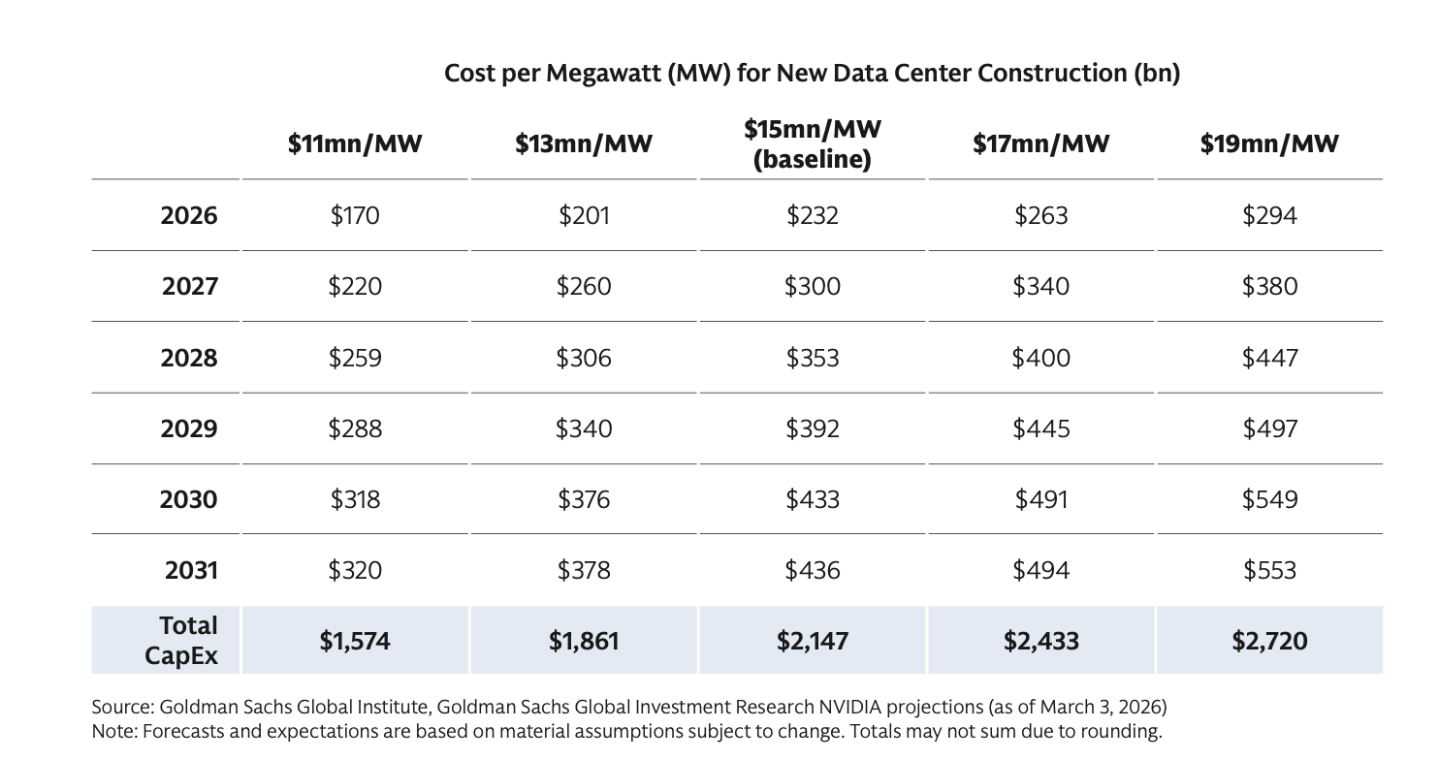
The physical reality underlying those numbers is staggering in its own right. Today’s leading AI systems pack 72 processors into a single rack, connected by hundreds of thousands of kilometers of cabling. The facilities housing them require industrial-scale liquid cooling, dedicated power delivery, and redundancy systems that didn’t exist in conventional data center design a decade ago. A standard cloud data center from the 2010s might have been built at $10 million per megawatt. The next generation of AI-optimized facilities costs $15 million to $20 million, and some facilities built just two years ago are already considered insufficiently equipped for the chips being manufactured today.

What is the return on investment?

Then there’s Covello’s perspective.

Covello writes that he spent two years tracking what all that investment is actually producing for the companies deploying it. His findings do not make for comfortable reading in the boardrooms of companies that have staked their technology roadmaps on artificial intelligence.

Despite $30 billion to $40 billion in enterprise investment in generative AI, Covello cited the influential MIT Labs report, as reported by Fortune, which found that 95% of organizations were getting zero return on their AI pilots. A 2025 EY survey found that 99% of companies in its sample reported financial losses due to AI-related risks, with an average loss of $4.4 million per company. A Wall Street Journal survey found a yawning gap between what C-suites say AI is doing for productivity and what workers on the ground actually report. One AI hiring startup tested frontier AI agents on 480 workplace tasks commonly performed by bankers, consultants, and lawyers. Every agent failed to complete most of its duties.

“56% of Americans say they use AI,” the report quotes one research firm saying, “yet 85% of the workforce does not have a value-driving AI use case.”

IT budgets, rather than shrinking as executives promised shareholders, are growing. Gartner projects global IT spending to rise from $5 trillion in 2024 to $6.15 trillion in 2026. The cost savings have not materialized. Harvard Business Review research cited in the report found that AI-generated errors — what researchers are calling “workslop” — cost a 10,000-person organization more than $9 million annually in lost productivity. Far from efficiencies, AI appears to be generating new headaches and expenses in many cases.

Nvidia: the AI economy’s big winner

Somewhere between the two reports lies what may be the defining structural problem of the AI era: almost none of the money flowing into the AI ecosystem is being captured by the companies deploying it. Nearly all of it is flowing to Nvidia.

“Tracking Trillions” anchors its entire baseline model to Nvidia’s forward revenue estimates, noting that the chip giant accounts for roughly 75% of total compute spend — at gross margins of approximately 75%, far above any competitor, essentially acknowledging that the AI economy as currently constructed is a revenue model for one company.

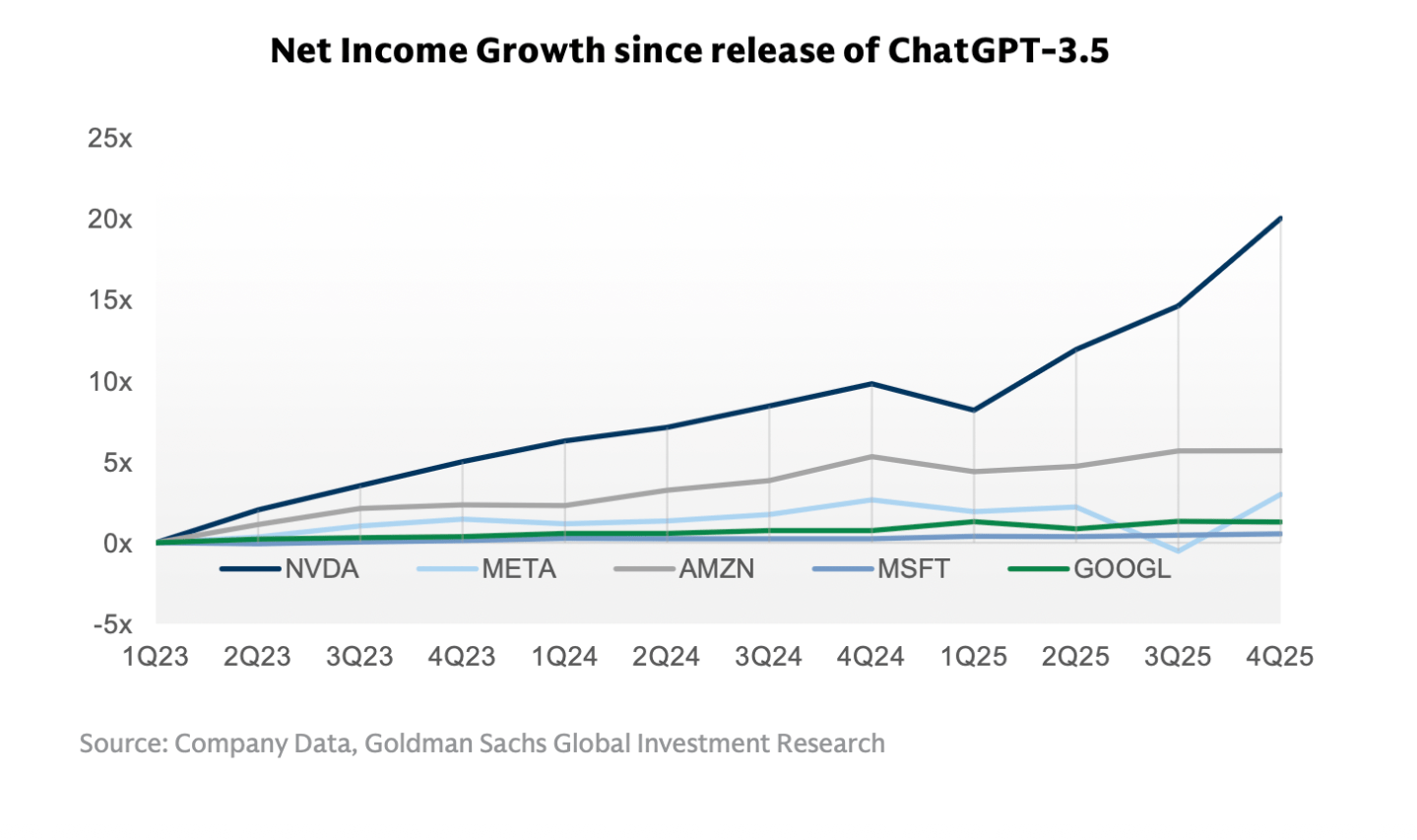
Covello is less diplomatic about what this means. Semiconductor companies, he writes, “are supposed to thrive when their customers thrive [but] in this cycle, the chip companies are thriving at the expense of everyone above them in the chain.” Since the launch of ChatGPT, Nvidia’s net income has grown roughly 20x. The hyperscalers — Microsoft, Amazon, Google, Meta — have seen far more modest gains and enterprises and model companies have been losing money. “Something has to change with this dynamic,” Covello writes, “either the companies higher in the chain need to start earning a return on investment or they will eventually need to spend less on the chips that are powering this build.”
FOMO is the motivator

And yet the spending continues. Which brings us to perhaps the most remarkable finding from Goldman: the engine driving the fifth industrial revolution does not appear to be a rational capital allocation process. It is insecurity, if not outright fear.

Covello had explicitly predicted in its original 2024 report that if hyperscaler stocks underperformed the market for a sustained period, those companies would cut their AI capital expenditure. The opposite has happened. Microsoft, Amazon, Google, and Meta have dramatically increased their spending on AI infrastructure even as their stocks have lagged the S&P 500. Hyperscalers have burned through all their free cash flow from operations and are now issuing debt to fund the build-out. Data center debt issuance doubled to $182 billion in 2025 alone.

Covello’s diagnosis: “FOMO has proven a stronger incentive than poor stock performance as hyperscalers have prioritized being involved in the AI arms race over their current shareholders.”

The word “arms race” is doing a lot of work in that sentence. Arms races, by definition, are not about winning — they are about not losing. No hyperscaler CEO is racing to build data centers because the ROI spreadsheet demands it. They are racing because the cost of being wrong about AI — of sitting it out and watching a competitor transform the industry — feels existentially higher than the cost of burning through cash on infrastructure that may never fully pay for itself. It is a very human insecurity driving what may be the largest coordinated capital deployment in corporate history.

The “Tracking Trillions” report captures the supply-side version of the same dynamic. When physical bottlenecks — power interconnection queues, transformer shortages, specialized labor constraints — slow data center deployment, companies don’t scale back their ambitions. They work around the constraints, building behind-the-meter power generation, duplicating capacity, absorbing inefficiency rather than reconsidering the underlying bet. “Elongation,” the report calls it: the buildout stretches, costs rise, and the gap between capital committed and capacity online widens — but the commitment itself holds, because no one wants to be the company that blinked.

The big risk in an elongation scenario, the institute argues, is if bottlenecks prove severe or persistent enough to shift the buildout narrative. When projects fail simultaneously, the focus suddenly shifts to whether they can actually succeed within the timeline. “At that point, elongation begins to function as a feedback loop, one in which supply-side friction introduces demand-side doubt, potentially leading to deferred or downsized investment plans.” That being said, the institute finds the current environment closer to the base case than the stress case, “though the buffer is not wide.”

It hardly needs to be said that insecurity and fear are the stuff that bubbles are built on, and the jitters over an AI bubble in 2025 appeared to deflate with the successful release of Google’s new Gemini model and the growing influence of Anthropic’s Claude. We still aren’t out of the woods yet, Goldman is pointing out.

The jobs didn’t disappear

One area where Goldman explicitly revises its prior pessimism is jobs — though not in the direction AI boosters would prefer.

The firm’s macro team found that while AI has measurably reduced hiring in substitution-heavy occupations — telephone operators, insurance claims clerks, billing processors — it has modestly increased employment in augmentation-heavy fields like engineering and operations management. The net drag: roughly 16,000 jobs per month, and a 0.1 percentage point bump to the unemployment rate. Goldman’s baseline projects that AI could ultimately displace 6% to 7% of jobs as adoption broadens over the next decade — meaningful, but nowhere near the “AI will replace 50% of jobs” headlines that have dominated public discourse.

Those headlines “will most likely persist,” Covello notes drily, “as that drives clicks and views.”

The job finding is, in its own way, a symptom of the same broader problem: AI has been most effective at the margins, augmenting what workers already do rather than replacing them wholesale or generating the sweeping productivity gains that would justify the spending. Consumer adoption has been spectacular — Goldman acknowledges it was too conservative on this front, noting that generative AI reached roughly 53% adoption within three years, faster than the personal computer or the internet at comparable stages. But 95% of those users are on free tiers. The consumer enthusiasm has not translated into enterprise economics.

Something has to give

Goldman’s investment conclusion is a quiet repudiation of the trade that has defined markets for the last two years: go long hyperscalers, underweight semis. The picks-and-shovels play, in other words, may be over. He echoed Fortune contributor Jeffrey Sonnenfeld, Lester Crown Professor of Leadership Practice at the Yale School of Management and founder of the Yale Chief Executive Leadership Institute, who recently argued that “data infrastructure” is the key differentiator for AI scale going forward.

What actually needs to happen, per Covello, is more mundane than most AI coverage would suggest. Data needs to be structured properly — many AI agents today are being built on top of siloed, misaligned databases that make good outputs impossible. Workloads need to be orchestrated so that expensive frontier models aren’t being deployed to answer questions a cheaper model could handle. Small language models, fine-tuned on domain-specific data, need to keep displacing the large general-purpose models that dominate headlines but often underperform in practice.

The logic is asymmetric. If enterprise ROI eventually materializes, hyperscaler stocks — currently priced with deep skepticism baked in — have significant room to run. If ROI continues to disappoint, hyperscalers will cut capex and see a cash-flow-relief rally regardless. The semiconductors, by contrast, are priced for a world in which the arms race never ends, and the returns never arrive — a world that, per Goldman’s own analysis, cannot persist indefinitely.