
惯性聚合 高效追踪和阅读你感兴趣的博客、新闻、科技资讯
阅读原文 在惯性聚合中打开

推荐订阅源

雷峰网
雷峰网
奇客Solidot–传递最新科技情报
奇客Solidot–传递最新科技情报
大猫的无限游戏
大猫的无限游戏
Google DeepMind News
V
V2EX
T
The Blog of Author Tim Ferriss
H
Hackread – Cybersecurity News, Data Breaches, AI and More
Hugging Face - Blog
Hugging Face - Blog
Stack Overflow Blog
Stack Overflow Blog
I
InfoQ
博客园_首页
钛媒体:引领未来商业与生活新知
钛媒体:引领未来商业与生活新知
Last Week in AI
Last Week in AI
Recent Announcements
Vercel News
Vercel News
freeCodeCamp Programming Tutorials: Python, JavaScript, Git & More
T
Tailwind CSS Blog
美团技术团队
Martin Fowler
Martin Fowler
宝玉的分享
宝玉的分享
Blog — PlanetScale
Blog — PlanetScale
GbyAI
GbyAI
OSCHINA 社区最新新闻
OSCHINA 社区最新新闻
J
Java Code Geeks

Fortune | FORTUNE

One man can kill Bill Ackman’s $64 billion bid for Universal Music Group—and no one knows what he’ll do | Fortune Poppi’s cofounder pitched her startup on Shark Tank while 9 months pregnant and landed a $400,000 deal—now it's worth $2 billion | Fortune Teen boys are choosing AI girlfriends over real ones for 'maximum control, zero rejection'—experts say it could make them unemployable | Fortune A United American merger is by no means impossible given the president 'loves big deals' | Fortune Reed Hastings’s planned exit from $455 billion Netflix ‘had nothing to do with’ the failed deal for Warner Bros., says Ted Sarandos | Fortune Meet Joe McCann: The high-flying crypto trader held in Tanzania after sudden death of his influencer fiancée Ashly Robinson | Fortune Gen Z is carving a different path in the housing market by doing it alone | Fortune U.S. Catholic leaders criticize Trump for ‘disparaging words’ about the pope as Vatican clash risks alienating Catholic voters | Fortune China has ‘nearly erased’ America’s lead in AI—and the flow of tech experts moving to the U.S. is slowing to a trickle, Stanford report says | Fortune Self-made millionaire behind $5 billion Skims Emma Grede says it all began with a cold call to Kris Jenner: Emma Grede—the self-made millionaire behind the $5 billion Skims empire—says it all began with an audacious cold call to Kris Jenner: ‘The difference between me and someone else is, I made it happen’ | Fortune Americans have never been this gloomy about the economy. Wall Street has never cashed in harder | Fortune ‘The college grading system [is] almost meaningless’: People see the Ivy League as an easy A and with flawed admissions standards | Fortune The CEO of $8.5 billion Japanese car giant Nissan plays the drums in a band and hits the tennis courts to destress from the top job | Fortune New York governor's take on a millionaires tax: fancy pied-à-terre second apartments worth over $5 million | Fortune Pope Leo XIV: A ‘handful of tyrants’ are ravaging earth with war and exploitation | Fortune Trump has no plan to cut the $39 trillion national debt, but he does want to cut childcare. His budget director is scrambling to clarify | Fortune China's economy grows 5% in first quarter, surprising economists to the upside | Fortune Everyone was wondering what Trump wanted more: Warsh smoothly seated at the Fed, or for Powell to pay. We have our answer | Fortune Palantir exec: the biggest mistake retailers are making with AI? Trying to do it all with one agent | Fortune American YouTuber who calls himself a 'troll' sentenced to 6 months in Korean prison for literally dancing on wartime graves | Fortune BBC plans to cut up to 2,000 jobs to save 10% of annual budget | Fortune Canva debuts a new suite of agentic tools, as the design app quietly becomes one of the world’s most used AI services | Fortune Moody's CEO: AI has a trust problem – better models won’t fix it | Fortune Top New York surgeon: Americans have better data for choosing restaurants than surgeons. That has to change | Fortune The Iran war’s fertilizer shock is hammering American farmers, and 70% can’t afford what they need for this year’s growing season | Fortune Education experts to Mamdani: Why are you foisting AI on our kids? | Fortune This CEO pirated video games as a teen and became a hacker for the Air Force. Now he’s built a $3 billion cyber firm | Fortune Teacher, blame thyself: Yale report savages Ivy League schools for destroying American trust in higher education | Fortune Fed chair nominee Kevin Warsh is worth more than $100 million and has stakes in SpaceX and Polymarket | Fortune From wool sneakers to GPUs: Allbirds’ desperate AI pivot and 600% stock surge, explained | Fortune
Crypto's most controversial governance idea is making a c...
Ben Weiss · 2026-06-22 · via Fortune | FORTUNE

Hi, Ben Weiss here! I’m filling in for Jeff for the next three weeks while he’s on vacation.

Last week, crypto investors debated one of the wonkier terms in blockchain. In a discussion on X, Ali Yahya, general partner at Andreessen Horowitz’s crypto arm, mused about how previous iterations of DAOs, or decentralized autonomous organizations, didn’t work. “We spent the last 10 years rediscovering the hard way that direct democracy is a bad idea,” he wrote

Crypto loves decentralization. Founders have created decentralized versions of social media sites, wireless networks, and even apps that pay you to, um, sweat? To manage these decentralized platforms, many founders created DAOs.

Most DAOs are akin to public companies. Like shareholders, members can vote on proposals, and their sway is determined by the proportion of cryptocurrency they own. But instead of one party counting each participant’s vote, DAOs use blockchains to coordinate. 

In theory, stripped of the humans underlying the decision-making, the idea works like an algorithm: log votes onto a blockchain, calculate a winning proposal, and execute the proposal with code. But, in practice, DAOs, like any human organization, become messy. If someone owns the majority of tokens, is there actually real democracy, or is it just theater? That criticism, which has since been called “decentralization theater,” is a repeat accusation in crypto. 

For example, industry watchers have criticized the prediction market Polymarket, which says it’s decentralized, for how it resolves disputes on whether an event has happened. Polymarket punts those disagreements to a network called UMA protocol, where tokenholders vote on whether, say, the crypto-hoarding company Strategy sold Bitcoin in May. While anyone can vote, in reality, a small group of “whales” often determine the results, the Wall Street Journal recently reported.

Add in how messy DAOs can get (try wrangling a bunch of pseudonymous degens across the internet) and it’s no wonder that investors as well as founders have soured on the concept. “From half a decade of experiments, governance proved to be almost everywhere else but the [block]chain,” wrote Jake Brukhman, founder and CEO of the crypto VC CoinFund, in a reply to Yahya, the investor at Andreessen Horowitz.

Still, Yahya is optimistic that new crypto founders can reinvent the concept. “The future does not always look like the past,” he wrote.

And so is Simon Hudson, whose project, Botto, I reported on three years ago. Hudson and his cohort are part of a DAO that manages an “autonomous AI artist” that’s made millions in selling its art as NFTs. “Are they dead? Certainly not,” Hudson told me in a phone call, referring to DAOs. “Have a lot of people been burned by them? Oh yeah.”

I remain skeptical. Humans are messy, and no amount of tech can fix that—but maybe the next iteration of DAOs can do better.

Ben Weiss
benjamin.weiss@fortune.com
@bdanweiss

DECENTRALIZED NEWS

Polymarket paid content creators to publish videos of themselves winning big. An investigation found that those trades never happened. (WSJ

Theodore, the son of pro-crypto Sen. Kirsten Gillibrand (D-N.Y.), raised $30 million at a $300 million valuation from Lux Capital to launch a perpetual futures exchange. (Fortune)

The prediction market Kalshi has passed $2 billion in annualized revenue as it has informal talks with banks about a potential IPO. (The Information)

Derivatives exchange CME sued the CFTC after the regulator let the prediction market Kalshi and crypto exchange Coinbase offer perpetual futures. (FT)

Sens. Cynthia Lummis (R-Wyo.) and Ruben Gallego (D-Ariz.) issued a formal resolution urging the executive branch not to pardon Sam Bankman-Fried. (Fortune)
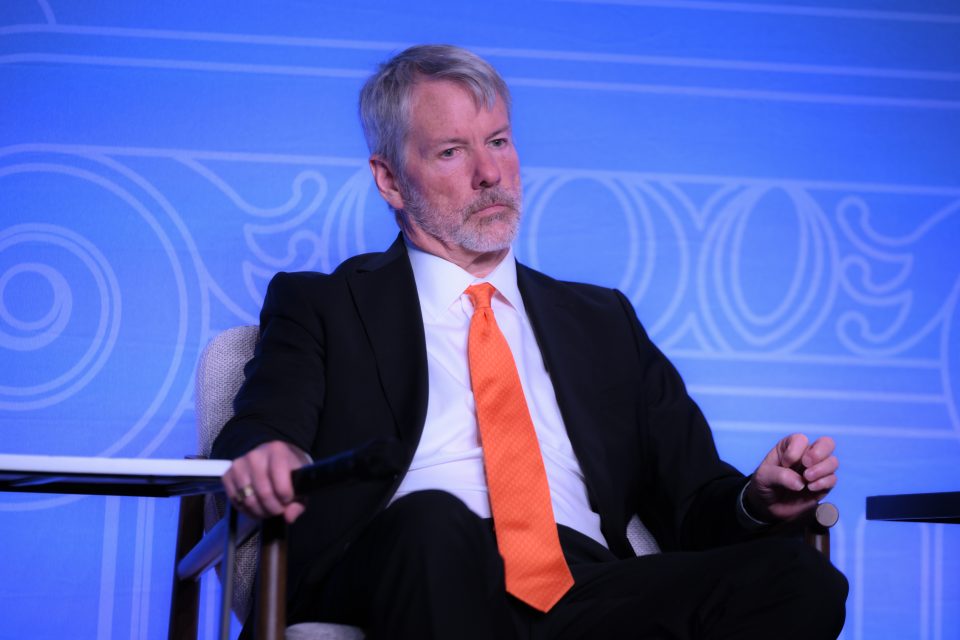
MAIN CHARACTER OF THE WEEK

Strategy executive chairman Michael Saylor.

Tayfun Coskun—Anadolu/Getty Images

Bitcoin bull and Strategy chairman Michael Saylor said in an interview with CoinDesk that he designed a preferred shares offering with AI. That offering is now trading below the $100 par value, effectively pushing Strategy to raise capital at a loss. 

MEME O' THE MOMENT

AI isn't infallible.

@boldleonidas

The Crypto Twitterati couldn’t help but pile on.