











The global economy entered 2026 on firmer footing than most forecasters had predicted, buoyed by a surge in AI-related investment, easing trade tensions and supportive financial conditions. Then the Middle East conflict changed everything.
In its June 2026 Economic Outlook, the OECD sharply downgraded its global growth projections and warned that a prolonged energy crisis stemming from the conflict could leave “scarring effects on potential output” across the world economy — with some countries tipped into or close to recession. The report, titled Under Pressure, represents the organization’s starkest assessment of the global economy since the pandemic.
“The conflict in the Middle East has become the dominant force shaping the global economic outlook,” wrote Chief Economist Stefano Scarpetta in the report’s editorial.
The OECD framed its projections around two scenarios, both shaped by how long disruptions to the Strait of Hormuz and Gulf energy infrastructure persist.
In the more optimistic “time-limited disruption” scenario — which assumes energy prices gradually ease from mid-2026, in line with futures markets — global GDP growth slows from 3.4% in 2025 to 2.8% this year, then recovers to 3.1% in 2027. G20 inflation rises to 4.0% in 2026, then fades to 3.1% in 2027.
The second path is considerably darker. Should disruptions persist well into 2027, global growth could crater to just 2.1% this year and 1.8% in 2027 — levels the OECD noted would push several economies “into or close to recession.” Under this prolonged scenario, global inflation would jump an additional 1.3 percentage points in 2027, unemployment would rise, and investment would weaken significantly. The report warned the consequences “could prove especially severe for developing economies with limited energy reserves” and constrained fiscal capacity.
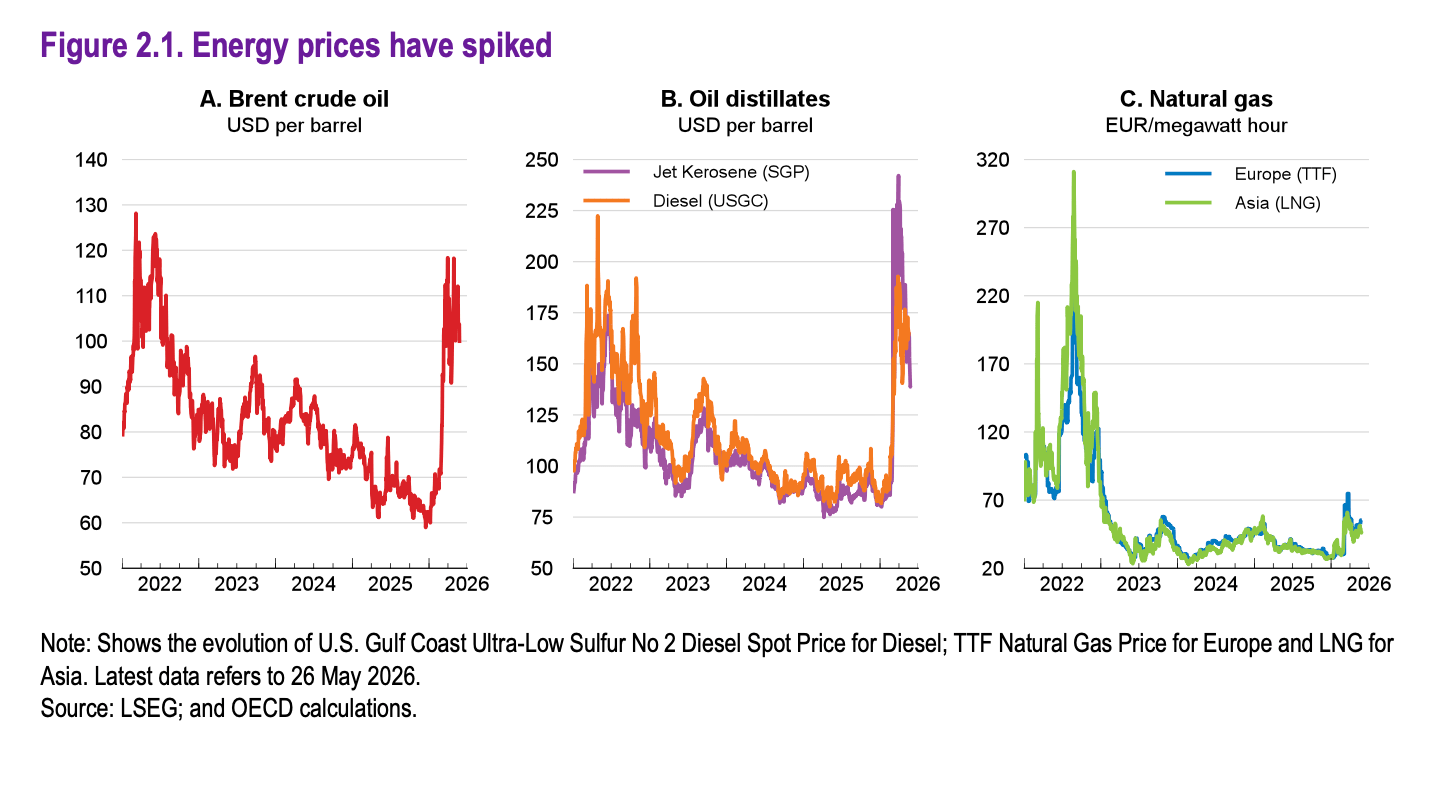
The energy shock is already biting. Global oil supply fell 13.5% between February and April 2026, with production from Gulf economies down 45% in April. Global gas supply is expected to run roughly 15% below prior projections. The supply crunch has sent prices sharply higher across the board — crude oil, natural gas, sulfur, and fertilizers such as urea have all surged since late February, with the increases hitting Asian markets hardest given their heavy reliance on Gulf imports. Ocean freight rates have surged around 45% above pre-conflict levels; air freight, nearly 30%.
The fiscal picture compounds the alarm. Government debt ratios are projected to increase further in many countries, with fiscal space already constrained by elevated public debt and new spending demands from energy relief, defense, and aging populations. The bind echoes the IMF’s warning in April that the Middle East conflict had arrived at precisely the wrong moment — hitting a world already carrying record debt loads with little room to absorb new shocks. The situation has only worsened since.
Amid the macro turbulence, the report surfaced a finding likely to reframe one of the most heated debates in economics: so far, AI is not killing jobs.
“There are no signs of widespread labour displacement due to business adoption of AI technologies at the industry level,” the report states. In fact, job vacancies in the industries most exposed to AI have increased more than in other sectors across most economies over the year to April 2026.
The bottleneck, the OECD found, runs in the opposite direction. Rather than workers being displaced by AI, businesses are struggling to find enough workers capable of using it. “A lack of workers with digital skills is emerging as a barrier to the adoption of AI technologies,” the report says.
The finding offers a data-backed rebuttal to a wave of alarm that gripped markets earlier this year — including predictions of a “human intelligence spiral” and an Anthropic report in March warning of a potential “Great Recession for white-collar workers.” But the OECD’s aggregate finding doesn’t fully resolve the picture: Unemployment among 20- to 30-year-olds in AI-exposed roles had already jumped by roughly 3 percentage points in 2025.
That caveat aside, the OECD finding carries a second wrinkle: the same conflict squeezing household energy bills could slow the buildout of AI infrastructure. Data centers and semiconductor supply chains both rely on inputs from Gulf economies, meaning prolonged disruption could directly threaten AI investment — complicating the IMF’s April thesis that AI may be the only rescue from the world’s deepening debt spiral.
The OECD urged central banks to “remain vigilant” but said the current supply-driven energy price spike can be “looked through” as long as inflation expectations stay anchored. If the prolonged disruption scenario materializes, however, the report said the burden of stabilizing activity would fall largely on fiscal policy — with monetary policy offering limited room to maneuver.
On energy, the report was direct: government relief measures should be targeted, include “automatic sunset clauses,” and preserve incentives to reduce consumption. Broad-based subsidies and price caps, it warned, are “particularly costly” if the disruption proves long-lasting.
And in a message that applies well beyond the current crisis, Scarpetta concluded: “The vulnerability of our economies to one single chokepoint demonstrates the need for intensifying efforts to strengthen the resilience of supply chains.”
For this story, Fortune journalists used generative AI as a research tool. An editor verified the accuracy of the information before publishing.
此内容由惯性聚合(RSS阅读器)自动聚合整理,仅供阅读参考。 原文来自 — 版权归原作者所有。