





For decades, the Sunshine State has been seen as, well, sunny and bright. Florida has no income tax, and many metros had a cost of living that allowed for the working class, like teachers, nurses, and hospitality workers, to build a comfortable, middle-class lifestyle.
But times are changing.
The pandemic ushered in a massive wave of wealthy transplants, forcing home prices higher and making the Sunshine State one of the biggest losers in today’s housing market.
Florida gained more wealth from high-earning transplants than any other state in 2023, according to Internal Revenue Service data. The Sunshine State gained $20.65 billion in annual adjusted gross income from tax filers who moved there from another U.S. state, a Realtor.com analysis published March 27 shows. The average income of people who moved to Florida from another state was $122,530, the highest among all U.S. states, according to Gay Cororaton, chief economist for the Miami Realtors.
“This wealth migration has been the primary factor driving up prices, with prices continuing to climb due to strong demand, even when mortgage rates started to hit over 5% in 2022 and as rates have remained elevated to over 6.5% to date,” Cororaton told Fortune.
So as wealth comes in, other income groups are getting pushed out. Now the people who staff the restaurants, hospitals, and classrooms are leaving, and the middle class is dissolving.
“What we’re seeing isn’t just a housing shift: It’s a reshaping of who can realistically afford to live in these markets,” Tara Benson, a Douglas Elliman real estate agent who works both in Florida and New York City, told Fortune. “When buyers coming in have significantly more purchasing power than local residents, it doesn’t just push prices up. It pushes entire income groups out.”
Between 2019 and 2023, Florida absorbed a net $137 billion in income from other states, according to Miami Realtors’ analysis of IRS migration data. Over the same period, California lost $91 billion, and New York lost $76 billion. Many of those wealthy transplants chased a limited supply of Florida homes, ultimately driving up home prices—and making affordability more challenging for other income groups.
In Miami-Dade, the median annual single-family prices spiked 10.1% in 2020, surged 23% in 2021—an all-time high pace—and rose another 11.1% in 2022, Cororaton said. Meanwhile, the share of million-dollar homes in Miami-Dade surged from 8% in 2019 to 28% in Q1 2026. In Palm Beach County, nearly one-third of homes are valued at least $1 million, according to data from Cororaton.
“Low rates lit the match, tight supply fed it, investors added heat, and wealthy newcomers poured gasoline on it,” Arman Javaherian, CEO of the homebuying platform Homa and a former Zillow executive, told Fortune.
Another factor middle-income Floridians can’t compete with is cash.
About 39% of Miami home purchases and 48% of West Palm Beach purchases were all-cash in recent years, Javaherian said. And for luxury homes, the shares are even higher: 82% of Miami condo sales above $1 million in 2025, Cororaton added.
“Many buyers here are operating on liquidity, not debt,” she said.
That type of competition is a huge handicap for local, financed buyers. Michael Merrill, who leads The Exclusive Group at Douglas Elliman across Miami Beach, Palm Beach, Boca Raton, and Vero Beach, said cash offers now routinely close deals at just a 5% to 10% premium over financed bids.
“The certainty of a clean, fast deal often wins over financed offers,” Merrill said. “That dynamic continues to put local buyers at a disadvantage.”
To be sure, all-cash offers aren’t just coming from out-of-state buyers. David Druey, Florida regional president at Centennial Bank, told Fortune some are coming from within.
“There are plenty of in-state Florida buyers making cash offers as well,” he said. This includes existing homeowners trading up on appreciated equity, which compounds the pressure on first-time and middle-income buyers.
Housing economists typically flag a household as “cost-burdened” or “house poor” when shelter costs exceed 30% of income. Florida has blown past that threshold.
Statewide, the median single-family home price is roughly $420,000, according to Florida Realtors, and the median household income is about $77,000, Census data shows. That means the price-to-income ratio is over 5.4.
“Above 5x price-to-income, strain becomes obvious,” Javaherian said.
And on top of high home prices and wages that don’t match, insurance is a massive obstacle for Florida residents. The state’s average annual home insurance premium is $8,292, or 181% above the national average, according to Insurify. Once premiums consume 5% or more of household income, “buyers start walking away,” Javaherian said.
Druey, whose bank finances Florida homes every day, said the insurance bar is now parcel-specific. Homes built to modern Miami-Dade hurricane code have lower premiums, but older homes without updated roofs and windows are more expensive.
“That becomes the tipping point for many buyers,” he said. “It’s less about middle-class households being pushed out of the market entirely, and more about whether a specific home is financially feasible once insurance is factored in.”
Take Joan Keenan, a retired Illinois teacher who moved to Florida with her husband, who retired from fire service, to live their “retirement dream,” who told Newsweek in 2023, “the insurance in Florida is a nightmare.”
Benson said the squeeze is tightest for households earning $75,000 to $125,000 because they make too much to qualify for subsidies but not enough to afford the full monthly housing cost.
“However, this is increasingly becoming a broader middle-class issue rather than being confined to a narrow income range,” she said.
The result of high home prices, insurance, and competition from wealthy transplants is that Floridians are moving elsewhere. Druey calls it “South Florida fatigue.”
Working families and retirees are feeling the overall pressure of living in South Florida, so they’re getting out.
“We’re seeing people sell and move to more affordable areas within the state, like from Fort Lauderdale up to Stuart, or Fort Myers to Lakeland,” he said. “Others are even considering moving back to places they lived 15 to 20 years ago, where costs are lower.”
And some are moving out-of-state to Georgia, the Carolinas, Tennessee, and Texas. Atlas Van Lines’ 2025 Migration Patterns Study, released in December, ranked North Carolina, Tennessee, and Alabama among the top inbound states, and named affordability the single top factor influencing interstate moves in 2025. Their study shows that Florida had a “balanced” migration status, with inbound and outbound moves roughly equal. This was a “significant shift” after years of high inbound migration, according to Atlas Van Lines.
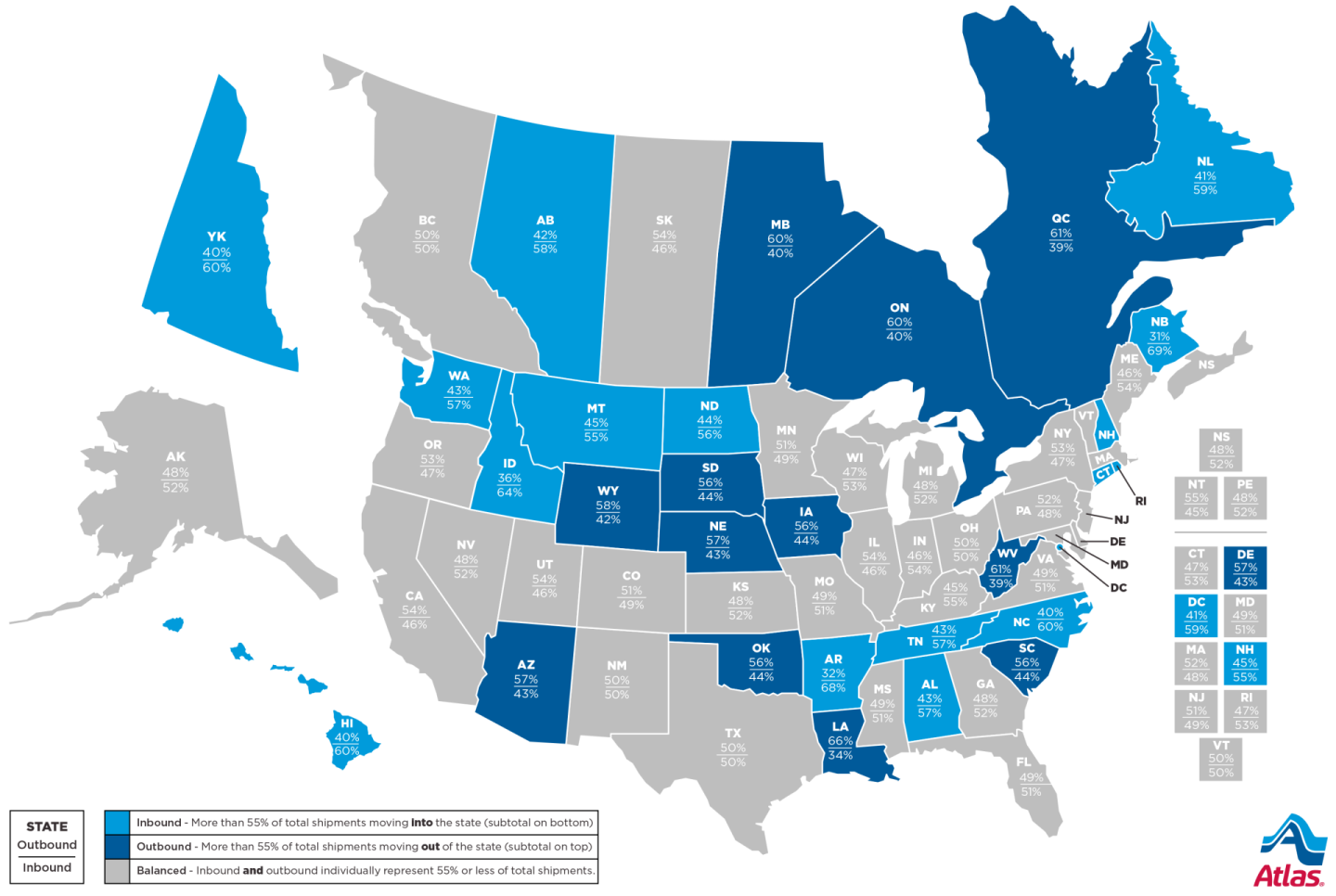
Map courtesy Atlas Van Lines
To be sure, that means other housing markets could become more squeezed as more people ditch Florida.
“In that sense, the issue isn’t being solved,” Benson said. “It’s being redistributed.
The migration data points to a structural problem for Florida.
In the Miami metro area, about 10,000 retail trade workers left in 2024 alone, Cororaton said. Retail and hospitality—the industries Florida’s tourism and service economy depends on—are losing workers fastest.
As the Wall Street Journal reported this month, Orlando, Miami, and Tampa rank among the bottom five of the 25 largest U.S. metros in median household income, according to the U.S. Census Bureau. Florida lacks the concentration of high-wage industries that might otherwise absorb the shock.
Nearly half of Floridians surveyed in a November 2025 Florida Atlantic University poll said they have considered leaving the state because of the cost of living. Ninety percent said they were concerned about inflation; 80% about housing.
“For most Floridians, financial security feels one expense away from collapse,” Monica Escaleras, chair of FAU’s department of economics and director of its Business and Economic Polling Initiative, said in a statement. “The Florida promise of sun, growth, and upward mobility remains alive, but it is getting expensive to hold on to.”
此内容由惯性聚合(RSS阅读器)自动聚合整理,仅供阅读参考。 原文来自 — 版权归原作者所有。