







Given its length, the encyclical says a lot of things. The Pope uses the Tower of Babel as a metaphor for technological hubris and contrasts that with the story of Nehemiah, who rebuilt the walls of Jerusalem after the Babylonian exile. Nehemiah did not rebuild the walls only according to his own vision, but instead fasted, prayed, and meditated in silence before then convening all of the families of the city, assigning them each a section of the wall to repair, and adjudicating any conflicts between them. The Pope uses this as a metaphor for a more inclusive, collaborative building of technology.
Some key provisions the encyclical include: calling for increased government regulation of the private companies driving AI development; calling for accountability for the companies building AI models and for the companies deploying that technology; and calling for transparency around algorithmic tools, particularly those used in government decision-making, and says that these tools should be verifiable, something that many modern LLM-based AI systems are not.
Seeing work as fundamental to human dignity, the encyclical asks for measures to protect jobs and retrain workers displaced by AI. It calls for measures to protect children from harmful AI-generated content and supports governments that are imposing age limits on the use of digital technology. It sees education as playing a critical role in teaching the next generation how to think critically and use digital tools in ways that enhance their human agency, not detract from it. It says that communities around the world should have a right to shape the ethical and moral guidelines that govern what AI models do, so that this power is not just left in the hands of a tiny handful of companies and a few countries. As the Pope writes:
“A more moral AI is not enough if that morality is determined by a few. What is needed is a more active political involvement that is capable of slowing things down when everything is accelerating, and of protecting the opportunities for communities still to be able to participate and ask questions.”
It also says that AI should not be used for the development of lethal autonomous weapons. As the Pope writes, “moral judgment cannot be reduced to calculation, for it involves conscience, personal responsibility and the recognition of the other as a person. Therefore, it is not permissible to entrust lethal or otherwise irreversible decisions to artificial systems.”
As many of the things Pope Leo says in the encyclical echo central themes of my own book, Mastering AI: A Survival Guide to Our Superpowered Future, there isn’t too much in the encyclical that I would quibble with. That said, much of what the Pope is calling for is easy to say but difficult to implement, and, as always, the devil (or God in this case) is in the details.
It is doubtful the encyclical will have much real impact on how companies develop AI or how countries regulate it. Noreen Herzfeld, director of a program on technology and ethics at St. John’s School of Theology and Seminary in Collegeville, Minn., told the New York Times: “I don’t think the ‘tech bros’ in Silicon Valley will listen that much. But I think within the church, it will be there as a reference for priests and bishops and particularly for those of us who are educating seminarians or young people.”
While I didn’t find all that much to fault in the Pope’s encyclical, others on both the left and the right of AI policy did. Timnit Gebru, the well-known researcher in responsible AI and AI ethics, attacked the Vatican for its decision to invite a representative from Anthropic to sit alongside Pope Leo at the presentation of the encyclical on Monday. That representative was Chris Olah, an Anthropic co-founder and a pioneer in “mechanistic interpretation,” a leading technique for probing the inner workings of large neural networks to try to discover how they arrive at their outputs. According to a post on a website for “sentientism,” or the belief that all sentient creatures should have moral rights, Olah is described as “an atheist and vegan.” And, of course, Anthropic has staked out a position as highly concerned with AI safety, including the existential risks of AI (a position that critics like Gebru see as mere marketing, with no real difference between Anthropic, OpenAI, Google DeepMind and others).
Writing on LinkedIn, Gebru lashed out at the Vatican for “jump[ing] on the bandwagon of the dudes who are about to make billions with their IPOs.” She also said it was evidence that “leaders of corporations, foundations, governments, entrenched religious institutions…They’re all in the same echo chamber.” She faulted the Vatican for not criticizing Anthropic for “stealing data, exploiting labor, killing the environment, deceiving us with anthropomorphic designs and lying about product ‘capabilities.’” She compared the Vatican partnering with Anthropic to discuss the potential ethical and moral risks of AI to “partnering with the Sackler family to discuss the harms of oxy.” She said the Vatican could have chosen to partner with exploited data workers or those fighting against data centers, instead of platforming a powerful technology company.
Meanwhile, Dean Ball, the libertarian AI policy thinker who briefly served as an AI policy advisor to the Trump administration, lamented that many fellow conservatives seemed enthusiastic about all the calls for government intervention in the encyclical and attacked the Vatican for being too small-minded in its approach to AI. He said it was functioning too much like a typical European technocrat, calling for this or that regulation, while denying that AI presented a fundamental challenge to the supremacy of human intelligence.
In a post on X, Dean pointed out that Olah, in his remarks at the encyclical presentation, directly contradicted a portion of the papal document. Olah said that his own research into AI models keeps “finding things that are mysterious, even unsettling. We find structures that mirror results from human neuroscience. We find evidence of introspection. We find internal states that (functionally) mirror joy, satisfaction, fear, grief, and unease. I don’t know what that means, but I think it warrants ongoing discernment.” Meanwhile the encyclical says plainly that we must avoid equating AI with human intelligence—that the systems “merely imitate certain functions of human intelligence” but cannot actually have any subjective experiences or feelings.
Leaving sentience and consciousness aside, Ball also wrote on X:
Humanity is building machines that will be smarter than we are at things we care about, things in which take individual and collective pride, domains of thought we originally invented and discovered. This will enable incredible things, but no honest person can deny that this will be a kind of grand humbling for humanity. No honest person can deny that there is at least some melancholy in contemplating it all, some change to the centrality we have ascribed to our own minds in the order of the world.
My primary disappointment in the encyclical is that it fundamentally denies that grand humbling. It sidesteps the humbling altogether, saying that AI cannot “really” this and that. Instead, it puts the Church into the awkward role of the European technocratic regulatory advocate, which, love those regulations or hate them, is probably not what the world really needs from the Catholic Church at this moment.
Sometimes, when people are criticized from both the left and right, it is a sign they struck exactly the right position. In this case, however, that might not be the case. Perhaps in all those words, Pope Leo still somehow managed to say not enough.
With that, here’s more AI news.
Jeremy Kahn
jeremy.kahn@fortune.com
@jeremyakahn
Ok, before we get to the news: Join us on Thursday, May 28, for Fortune 500 Europe: In Conversation with Tech Leaders, a candid virtual exchange with senior technology leaders from Fortune 500 Europe companies, including Mars Pet Nutrition, Orange, Reckitt, and Saint-Gobain. The discussion will explore one of the most pressing questions organizations face today: how to turn AI investment into sustainable business value. Register your interest to attend and receive Fortune’s editorial takeaways.
Tech billionaires convinced Trump to back off an AI executive order. But much of MAGA favors AI regulation—by Jeremy Kahn
The big questions looming over OpenAI’s trillion-dollar IPO—by Beatrice Nolan
Microsoft lost its way in the AI race. Can Copilot get it back on course?—by Jeremy Kahn
Microsoft moves to cut off Databricks in sign ‘toll gate’ tactics becoming more prevalent. Microsoft blocked partners like Databricks from connecting their tools to its widely used Power BI product, a move many see as an attempt to protect its own data platform, Fabric, from increased competition in the world of AI agents, the Information reported. (Microsoft has said its move was driven by reliability concerns, not a desire to stifle competition.) The dispute highlights the growing battle over ‘semantic layers’—tools that standardize business data definitions—which are critical for improving the accuracy and cost efficiency of AI agents. A number of large enterprise software companies, including Workday, ServiceNow, and Hubspot have started to erect “toll gates” to make it more difficult for third-party AI agents or systems to connect to their ecosystem without paying additional fees, as a way to potentially lock customers in or capture more of the value of AI-driven actions that might otherwise flow to another platform.
Waymo suspends service in five U.S. cities after car drives into flood waters. Waymo has paused its robotaxi service in five U.S. cities after two incidents in which its cars drove into flood waters and were trapped or swept away (both cars were empty at the time). The company said a software issue was to blame and that it was recalling 3,800 cars that use the most recent versions of its self-driving software while the company works on additional safe guards. The company also suspended freeway operations in several cities as it works to improve performance in hazardous conditions like flooding and construction zones. You can read more from the BBC here.
Mistral moves into the legal sector with Harvey partnership. Paris-based AI company Mistral is expanding into the legal sector through a partnership with popular AI legal tool Harvey, bringing its models to a platform used by more than 1,500 law firms and legal teams worldwide. The move positions Mistral against rivals like Anthropic in a fast-growing market where AI can automate document-heavy tasks such as contract analysis and compliance. Mistral is betting its models can win customers that value privacy, customization and jurisdictional accuracy while Harvey, which already offers models from Anthropic, OpenAI, and Google, is hoping that offering another major model provider will boost its market position, especially outside the U.S. Read more from the Wall Street Journal here.
OpenAI’s model solves an Erdös problem—for real this time. An unreleased “general purpose reasoning model” from OpenAI has solved a so-called Erdös problem, one of hundreds of unsolved conjectures and problems formulated by mathematician Paul Erdös during his lifetime. OpenAI previously claimed its GPT-5 model had autonomously solved 10 Erdös problems, only to have that claim debunked when it was discovered that those particular problems had, in fact, been solved previously and their solutions were discoverable on obscure websites which GPT-5 most likely ingested during its training. This time, however, the OpenAI model’s work has been independently verified by professional mathematicians who also worked with the model to further refine the proof.
The problem the OpenAI model cracked is called “the planar unit distance problem.” In essence, this problem involves figuring out how many pairs of points in a plane can be the same distance apart. Erdös conjectured that the number of equidistant pairs would rise only slightly faster than the number of points in the plane and for years people showed this was likely the case through gridlike constructions. But OpenAI’s model proved the conjecture is incorrect and came up with a whole new set of shapes that show the number of equidistant pairs can grow much faster than the number of points. The model did this by relying, in part, on ideas from algebraic number theory, which is a completely different area of mathematics than discrete geometry, the area from which the problem is drawn.
OpenAI says the result shows how advanced reasoning models might be able to solve many other types of problems, in part by bringing in non-obvious insights from other domains or fields that human researchers might overlook or not even be aware of. You can read more about the breakthrough on OpenAI’s blog here.
June 8-10: Fortune Brainstorm Tech, Aspen, Colo. Apply to attend here.
June 17-20: VivaTech, Paris.
July 6-11: International Conference on Machine Learning (ICML), Seoul, South Korea.
July 7-10: AI for Good Summit, Geneva, Switzerland.
Aug. 4-6: Ai4 2026, Las Vegas.
One effect that the Pope’s AI encyclical will likely have. While many doubt Pope Leo’s AI encyclical will have much impact on the technology’s development, one concrete effect may be to produce increasing levels of cognitive dissonance for U.S. Vice President JD Vance. Vance is a religious Catholic who finds himself increasingly at odds with the Pope, on the U.S. war in Iran, and now also on the regulation of AI. The vice president has tried to have it both ways on AI, arguing against regulation of the technology but also saying that American AI will somehow be inherently “pro-worker.” When the Trump administration last week was on the brink of signing an executive order that would have created some kind of licensing or at least review framework for the most powerful AI models, Vance was apparently among those working to convince the President to back off signing the order. The encyclical may make Vance’s role in arguing against AI regulation increasingly uncomfortable. In advance of the encyclical being published, Vance told Catholic News service OSV News that he was sure the encylical would “contain lots of insights, some of which I’ll probably agree with, some of which I may not, but I think it’s going to be a very, very important document.” Wonder what he’s saying now?
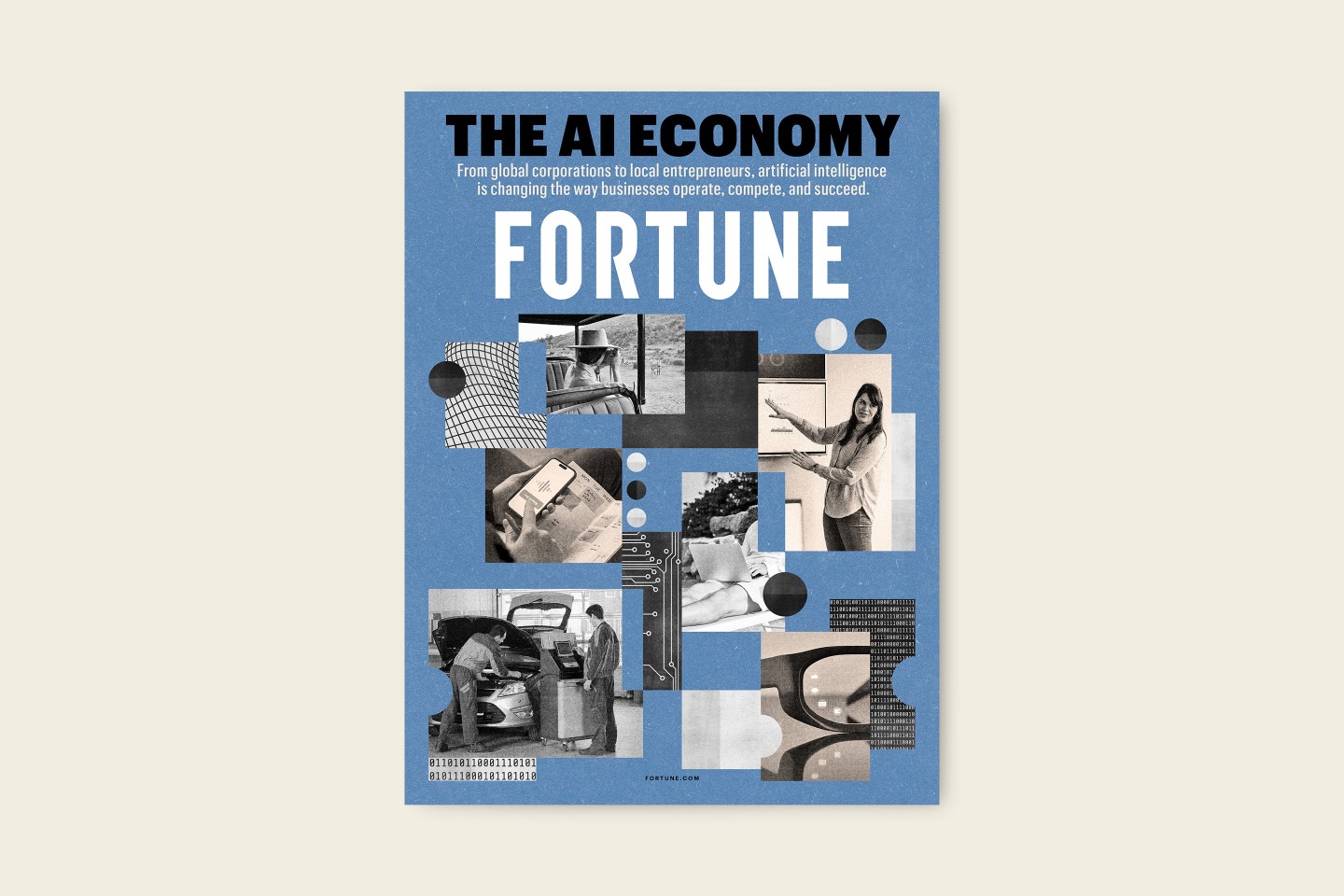
From global corporations to local entrepreneurs, artificial intelligence is changing the way businesses operate, compete, and succeed. Explore all of Fortune AIQ, and read the latest collection of stories below:
–After AI stole his clients, one Big Tech ghostwriter is using AI to get them back
–Outnumbered: At $4 billion ClickUp, a 3:1 agent-to-human ratio is rewiring work itself
–How a mom-and-pop car wash chain went from sticky notes to AI-powered operations that are upleveling every part of the company
–Solo founders are using AI to do the work of entire teams—but going it alone has limits
–How EarthRanger uses AI to help protect endangered species—and boost the wildlife tourism industry
–The smartphone’s days are numbered. Meet the device that could come next
此内容由惯性聚合(RSS阅读器)自动聚合整理,仅供阅读参考。 原文来自 — 版权归原作者所有。