




Officials overseeing the S&P 500 have decided NOT to fast-track the inclusion of SpaceX, Anthropic, and other “megacap” IPOs in its blue-chip index of stocks, according to a statement from S&P Dow Jones Indices.
S&PDJI had considered waiving its standard rules around ownership, profitability, and trading history in order to include the companies. Those rules seek to guarantee that only high-quality companies are included in the S&P, based on their track record of profits and the wide availability of their shares.
But it has held firm. That means it will be a year or more before SpaceX et al are eligible for inclusion in the index that is often favored by people with 401(k)s or other standard retirement saving plans.
But, as the FT points out, Russell, Morningstar and Nasdaq have all changed their rules to include the megacaps. Retail investors seeking to exclude these companies from their portfolios will have to avoid all those indexes and stick with S&P, in other words. While there is a lot of excitement around the SpaceX and Anthropic IPOs, many investors are wary that they are asking for valuations that are far in excess of their underlying businesses (not to mention that SpaceX isn’t profitable).
In addition, SpaceX will set aside up to 30% of its share offering for retail investors. Typically, companies going public limit their retail offering to between 5% and 10%. The implication is that Elon Musk is hoping his vast army of fans will buy in, regardless of the quality of his financial statements.
Nonfarm payrolls: The U.S. Bureau of Labor Statistics will release a new jobs number for May at 8.30 a.m. this morning. The Dow Jones survey expectation is for 80,000. However, the range of estimates is very wide: Goldman Sachs is forecasting 60,000 and Vanguard expects only 20,000. A high number could pressure the Fed into raising interest rates this year. Expect volatility in U.S. stocks regardless of the number.
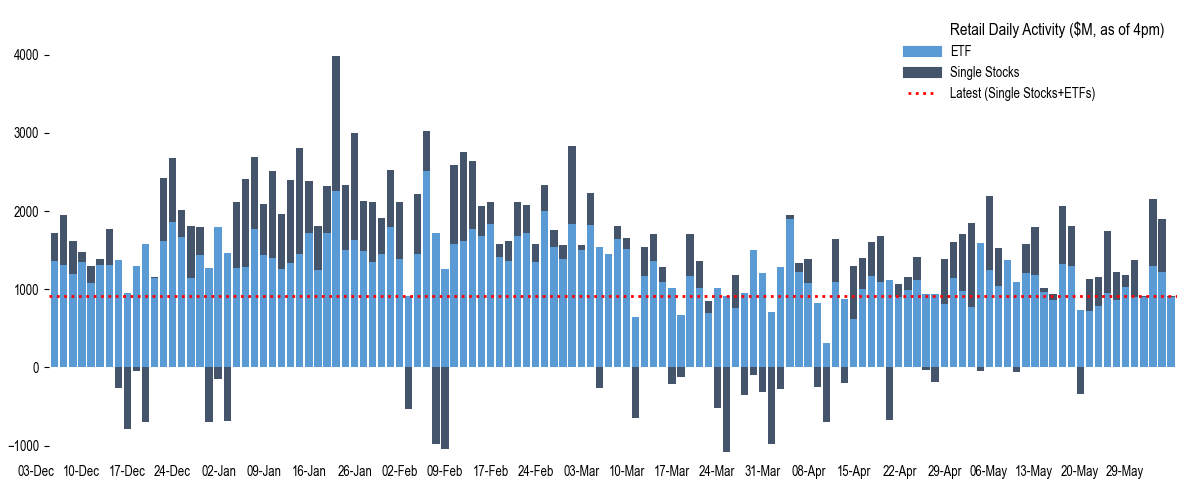
Why are stocks generally going up despite the war and rising inflation? One reason, according to Arun Jain and his colleagues at J.P. Morgan, is that retail investors poured a net $7.3 billion into stocks in the most recent week, mostly favoring exchange-traded funds. On average, mom-and-pop investors net add $6.7 billion to their stock holdings on a weekly basis—again, mostly in the form of ETFs. This chart shows the result: Sometimes retail traders net sell individual stocks but even in their worst weeks they’re almost always net buyers of ETFs. If you think stocks are due for a fall, this is the tide you’re swimming against:
This chart shows the difference between the 100 most volatile stocks and the 100 least volatile stocks, according to Adam Turnquist, chief technical strategist for LPL Financial. “A rising ratio indicates high-beta [volatility] stocks are outperforming their low-beta counterparts, while a falling ratio signals the opposite,” he said in an email to Fortune. Clearly, traders love risk right now:
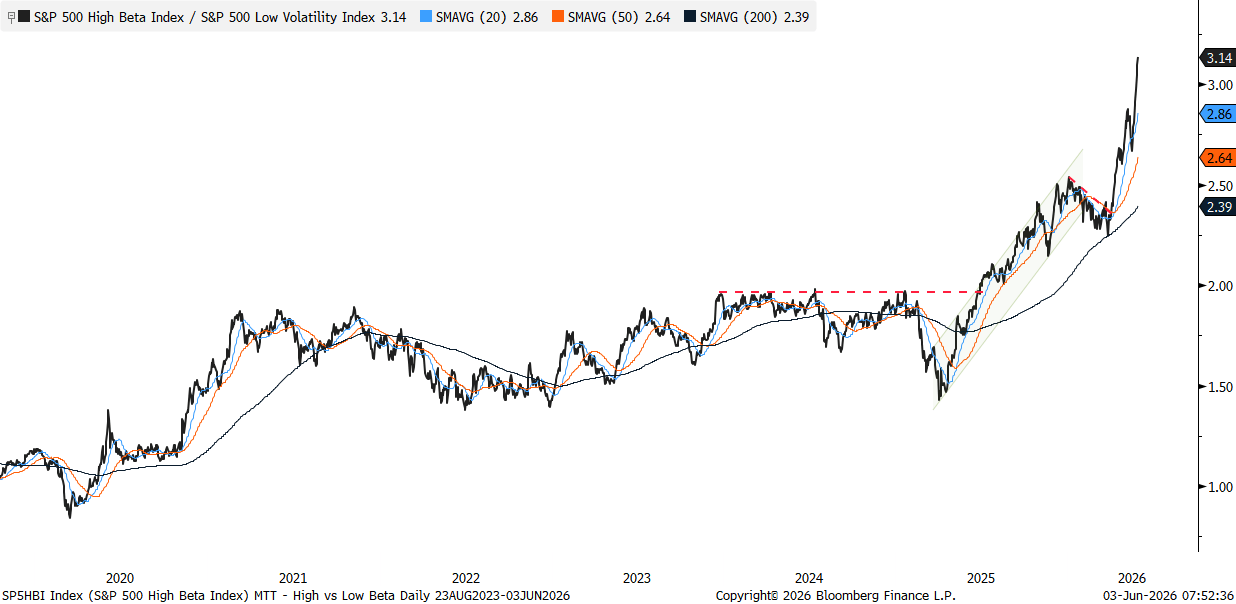
While this is a symptom of confidence in the markets, it also signals potential fragility. Highly volatile stocks can rise or crash equally fast. “The magnitude and speed of the recent outperformance raise questions about how sustainable the trend may be in the near term,” he says.
Following the U.S. Supreme Court’s decision that most of President Trump’s “Liberation Day” tariffs were illegal, he used a different legal instrument—known as “Section 301”—which purports to allow the U.S. to impose tariffs on nations using “forced labor.” Not everyone on Wall Street is convinced this will survive a legal challenge.
Conveniently, the White House’s investigators discovered that 100% of the U.S.’s main trade allies still use slavery, apparently.
“Of the 60 economies investigated for allowing imports of goods produced with forced labor, the administration found that all 60 of them are guilty,” Piper Sandler’s Andy Laperriere said in a note seen by Fortune. “The legal case against this dubious use of the 301 authority is not as clear cut as the IEEPA case, but the administration has plenty of legal vulnerability on this one, too. Tariffs are likely to remain high, vulnerable to litigation, and subject to change at any time for the rest of Trump’s presidency.”
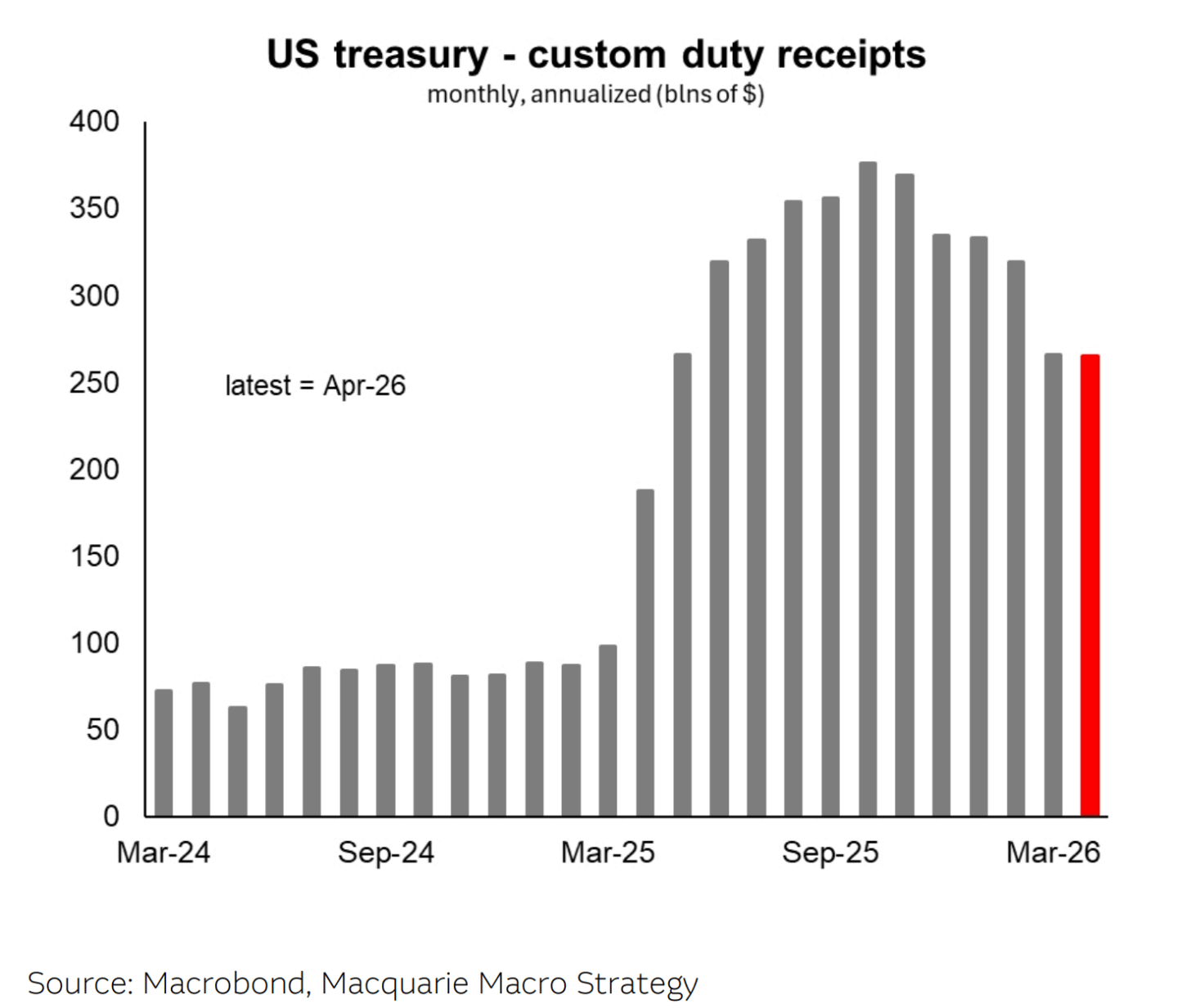
Over at Macquarie, David Doyle and Chinara Azizova have a little more faith. “The usage of Section 301 has been consistently held up by U.S. courts over time. This means there is a higher probability that these tariffs would hold up to legal scrutiny should they be put into place. Despite this, it remains possible that courts may narrow the usage of them or require stronger justification than has been thus far provided,” they advised. They produced this chart of declining tariff revenue, which illustrates the problem that Trump’s newfound interest in workers’ rights is trying to solve:
Hezbollah, Iran‘s proxy terror group in Lebanon, said it would not follow the ceasefire agreement between Israel and Lebanon. Israel continued to strike Hezbollah positions in southern Lebanon and the latter responded with its own attacks on Israeli positions.
President Trump remained hopeful and said he had spoken to Hezbollah and Israeli Prime Minister Benjamin Netanyahu, according to the BBC. "It would be really nice if Lebanon could have some peace. Lebanon's been under attack for so many years and always like an underdog, and it would be really nice if it could end," he said.
Social Security faces a 24% cut in 2032—that’s a $345 billion hit to retirees nationwide, watchdog says - Nick Lichtenberg
10,000 Boomers a day, $39 trillion in debt, and no benefit cuts: Bessent stakes Social Security on the Trump economy - Nick Lichtenberg
World’s largest sovereign wealth fund backs push for Google oversight on government use of its AI and cloud technology - Beatrice Nolan
Taylor Swift, the economics of hype, and what the World Cup gets wrong - Nick Lichtenberg
MacKenzie Scott’s approach to her $26 billion giving spree was inspired by a book she read in college about writing - Sydney Lake
Miami is the World Cup’s best-performing host city — and 45% of its hotels are still projecting a miss - Hunter Kim and John Nauright
Dropbox called hybrid work ‘the worst of both worlds.’ New research suggests it’s down to ‘paradox management fatigue’ - Radostina Purvanova and Alanah Mitchell
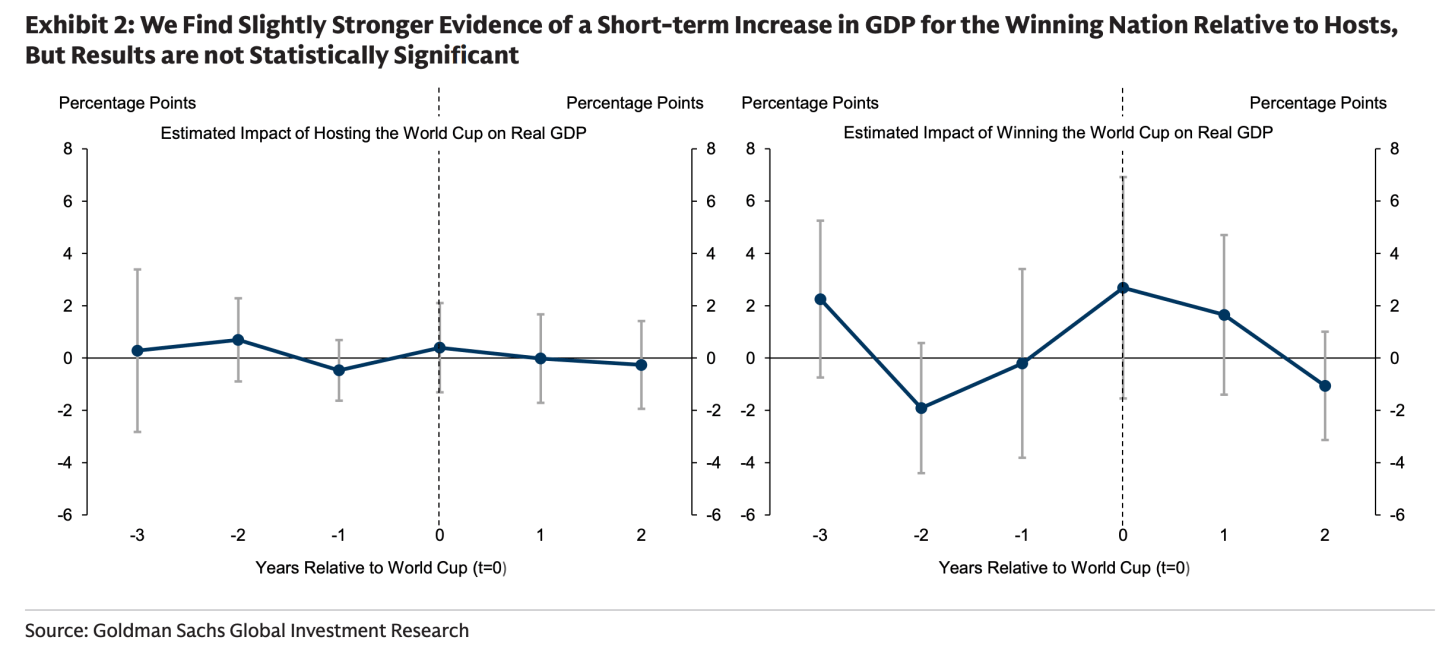
If you have any important transactions to conduct with Goldman Sachs you might want to get them done before the World Cup starts, because judging by the volume of their research into soccer the bank’s staff will be somewhat distracted for about a month starting on June 11. (They won’t be alone—1.5 billion people watched the final of the last cup.)
“Using data from the 1982 World Cup onwards … we find that there is a marginally positive but not statistically significant effect on the real GDP of the host nation during the year the World Cup takes place and the long-run effect is effectively zero,” analysts Kevin Daly and Mambuna Njie told clients. There’s a slight bump if you win the trophy “but the longer-term effect remains minimal,” they say.
The decline in disposable income (after tax and inflation) that Americans experienced in April, according to Pimco economist Tiffany Wilding. “That’s a pace not usually seen outside of recession,” she says.
While the economy is technically resilient—unemployment is low, GDP is growing, the stock markets are on the rise—households are still being battered by rising oil prices, slowing wage growth, and a sticky, sluggish job market. “Economic resilience has limits,” Wilding says. “The deeper risk is that households will start to believe that the forces currently squeezing real income are more persistent than transitory.”
Inside the CBS mutiny against Bari Weiss and David Ellison - FT
Tracking website, food watch: South Korea is obsessing over Nvidia CEO Jensen Huang’s visit - CNBC
Anthropic warns AI could soon help build its own successors - Axios
Real-Time Satellite Intelligence Is Making Ukraine’s Drone Strikes Deadlier Than Ever - WSJ
Ukraine’s Zelensky Proposes Peace Talks in Letter to Putin - Bloomberg
John Bolton Reaches Deal to Plead Guilty Over Classified Information - NYT
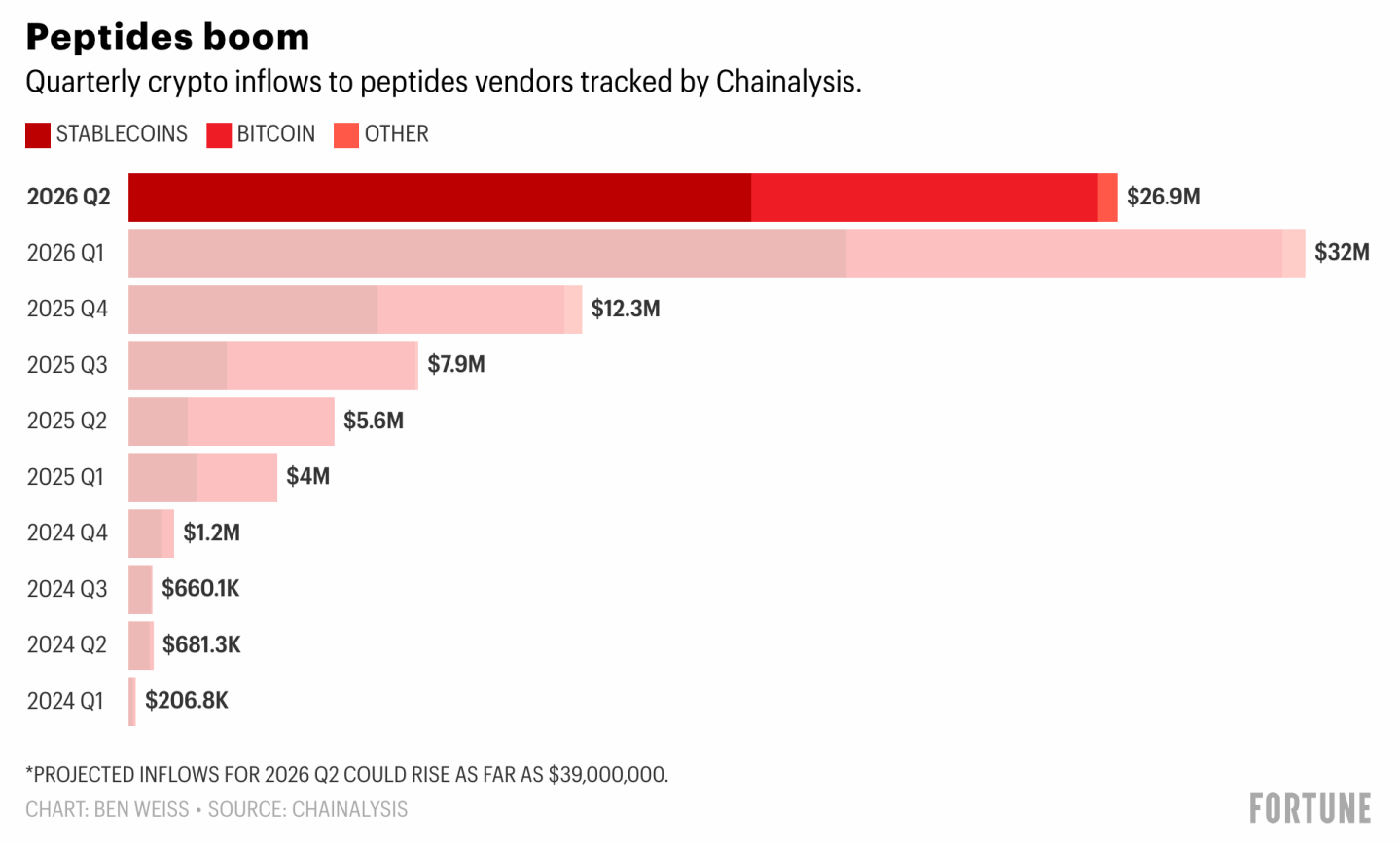
Fortune’s Ben Weiss has discovered that there’s a $32 million-per-quarter business in selling sketchy drugs for crypto over the internet—and it’s growing. To prove it exists, he sent $109 in USDC (a stablecoin) to “Louise”—who has a British phone number but prefers to be paid via China’s Alipay app—and two days later a package with 10 vials of bright-orange peptides arrived from New Hampshire. (Peptides allegedly enhance athletic performance.)
We know this trade exists and is growing because payments to crypto wallets associated with online supplement dealers can be tracked on-chain, as the chart below indicates.
“If this end[s] with you under investigation by a federal agency,” Ben’s editor told him, “I will swear it was in the name of journalism.”
此内容由惯性聚合(RSS阅读器)自动聚合整理,仅供阅读参考。 原文来自 — 版权归原作者所有。