



惯性聚合 高效追踪和阅读你感兴趣的博客、新闻、科技资讯
阅读原文 在惯性聚合中打开

推荐订阅源

Microsoft Azure Blog
有赞技术团队
有赞技术团队
Threat Intelligence Blog | Flashpoint
cs.CV updates on arXiv.org
F
Fox-IT International blog
Recorded Future
Recorded Future
T
ThreatConnect
T
The Exploit Database - CXSecurity.com
SecWiki News
SecWiki News
奇客Solidot–传递最新科技情报
奇客Solidot–传递最新科技情报
人人都是产品经理
人人都是产品经理
T
Tenable Blog
L
LINUX DO - 最新话题
博客园_首页
Hugging Face - Blog
Hugging Face - Blog
罗磊的独立博客
博客园 - 司徒正美
The Hacker News
The Hacker News
博客园 - 聂微东
CTFtime.org: upcoming CTF events
Scott Helme
Scott Helme
博客园 - 【当耐特】
O
OpenAI News
Schneier on Security
Latest news
Latest news
S
Security @ Cisco Blogs
S
Secure Thoughts
F
Full Disclosure
L
Lohrmann on Cybersecurity
S
SegmentFault 最新的问题
T
Tor Project blog
OSCHINA 社区最新新闻
OSCHINA 社区最新新闻
量子位
小众软件
小众软件
T
Threat Research - Cisco Blogs
Simon Willison's Weblog
IT之家
IT之家
大猫的无限游戏
大猫的无限游戏
N
News and Events Feed by Topic
E
Exploit-DB.com RSS Feed
J
Java Code Geeks
Last Week in AI
Last Week in AI
酷 壳 – CoolShell
酷 壳 – CoolShell
Application and Cybersecurity Blog
S
Schneier on Security
Cisco Talos Blog
Cisco Talos Blog
freeCodeCamp Programming Tutorials: Python, JavaScript, Git & More
P
Proofpoint News Feed
Recent Commits to openclaw:main
雷峰网
雷峰网

404 Media

Here's the Bodycam Footage of the Cybertruck That Drove Into a Lake Behind the Blog: The Attention Wars How Deepfakes Tore a High School Apart This Archivist Has Saved 175,000 Articles from 30 Years of Writing about Magic: The Gathering The Oldest Evidence of Animal Sex Has Been Found, and It’s Mind-Boggling Township Leader Resigns in Tears Over OpenAI Data Center Death Threats After Town Bans Flock, Councilmember Crashes Out, Proposes Internet and Phone Ban Podcast: Elites Just Don't Get AI Streamer Realtime Deepfakes Himself into Mr. Beast, Says He Loves 'Touching Little Boys' Lawyer for Guy Who Sued Women Who Called Him ‘Psycho’ Caught Using AI The FBI Wants to Buy Nationwide Access to License Plate Readers Researchers Wanted Preschool Teachers to Wear Cameras to Train AI Podcast: The Physical Politics of the Internet with Britt Paris Scientists Discover Strange New Crystal Formed by Nuclear Blast Tech Companies to Discuss Iran's Future During 'Private Conference' at Uber HQ ArXiv to Ban Researchers for a Year if They Submit AI Slop Behind the Blog: New Music and a Crash Out Mayo Clinic is Using AI to Listen to Emergency Room Visits DOGE Cuts Unleashed a Deadly Wave of Violence Across Africa, Study Finds Internet of Shit: AI Poop Analysis App Offered to Sell Me Database of Its Users' Poops At Least We Know the Washington Post Isn't Buying Views War and Data Centers Are Driving Up the Cost of Fiber-Optic Cable Software Developers Say AI Is Rotting Their Brains Podcast: The Chinese Deepfake Software Powering Scams ICE Agents Have List of 20 Million People on Their iPhones Thanks to Palantir How the World Became a Casino Your AI Use Is Breaking My Brain Students Boo Commencement Speaker After She Calls AI the ‘Next Industrial Revolution’ Scientists Studied 906 Mafia Marriages and Found Something Surprising University Claims Withholding Water From Nuclear Weapons Data Center Is 'Unlawfully Discriminatory' to Data Centers Behind the Blog: Storage Woes and RSS 'The Biggest Student Data Privacy Disaster in History': Canvas Hack Shows the Danger of Centralized EdTech ICE Plans to Develop Own Smart Glasses to ‘Supplement’ Its Facial Recognition App ‘HELLO BOSS’: Inside the Chinese Realtime Deepfake Software Powering Scams Around the World Scientists Gave ‘Aggressive’ Fish Psychedelic Drugs. A Breakthrough Came Next Podcast: Flock Used Cameras at a Children’s Gymnastics Center for a Sales Pitch Man Finds $1 Million Worth of Yu-Gi-Oh Cards in a Dumpster UK iPhone and iPad Users Can Watch Porn Again The AI Hard Drive Shortage Is Making It More Expensive and Harder to Archive the Internet 'Nature' Retracts Paper on the Benefits of ChatGPT in Education OpenAI, Google, and Microsoft Back Bill to Fund ‘AI Literacy’ in Schools How a University’s Censorship Conference Got Censored This Personality Trait Makes Dreams More Bizarre, Scientists Discover China Pressure Canceled World’s Largest Digital Human Rights Conference Behind the Blog: Big Questions of Consciousness Japan Is Building Cardboard Suicide Drones People Are Selling Kills of Marathon’s Hardest Boss on eBay City Learns Flock Accessed Cameras in Children's Gymnastics Room as a Sales Pitch Demo, Renews Contract Anyway World’s Largest Digital Human Rights Conference Suddenly 'Postponed' DHS Plans to Buy More Predator-Style Drones Apple Fixes Bug That Let FBI Extract Deleted Signal Messages After 404 Media Coverage Podcast: How This Trippy Image Started A Massive Conspiracy Theory Scientists Investigated a Frequency Linked to ‘Paranormal’ Encounters. The Results Were Unsettling. SXSW Used AI-Powered Trademark Tool To Censor Dissent on Instagram University Professors Disturbed to Find Their Lectures Chopped Up and Turned Into AI Slop People Using AI to Represent Themselves in Court Are Clogging the System Did a Time Traveling Superintelligent AI Try to Warn About White House Correspondents Dinner Shooting? An Investigation Study Finds A Third of New Websites are AI-Generated Government Hacking Tools Are Now in Criminals' Hands (with Lorenzo Franceschi-Bicchierai) Google DeepMind Paper Argues LLMs Will Never Be Conscious A Mysterious Golden Orb Was Discovered Under the Sea. We Finally Know What It Is. Behind the Blog: Waiting in the Apple Store The AI Compute Crunch Is Here (and It's Affecting the Entire Economy) Community Votes to Deny Water to Nuclear Weapons Data Center Researchers Simulated a Delusional User to Test Chatbot Safety Trump Wants to Double Production of New Nuclear Weapon Cores Startups Brag They Spend More Money on AI Than Human Employees Podcast: How Algorithms Make Us Feel Bad and Weird EMERGENCY BREAKING NEWS PODCAST: Tim, Cooked This AI Tool Rips Off Open Source Software Without Violating Copyright Scientists Gave a Bunch of Salmon Cocaine. This Is What Happened Next Forbes Prediction Market Gamifies Story About Mass Shooting of 8 Children Why Journalists Are Going Indie (with Maddy Myers) Babies Born from Dead Parents Will Increase with New Tech. Are We Ready? FAA Scraps Civil and Criminal Penalties for Flying Drones Near ICE Vehicles The Destroyed Remnants of a Lost World Are Falling to Earth, Scientists Discover Behind the Blog: Jazz and Journalism App Stores Push Users Toward Nudify Apps, New Research Shows I Almost Lost My Mind in the Bridal Algorithm Thomson Reuters Shareholders Demand Investigation into ICE Contracts Ukraine Says Russians are Surrendering to Robots Emails Reveal Space Force’s Hardest Mission Is Writing a Song Podcast: How the FBI Extracted Deleted Signal Messages Thomson Reuters Fired Worker For Speaking Out About ICE, Former Employee Says Airbnb Hosts Don't Want to Talk to Guests Anymore, Are Outsourcing Messages to AI Google, Microsoft, Meta All Tracking You Even When You Opt Out, According to an Independent Audit Hacker Compromises a16z-Backed Phone Farm, Tries to Post Memes Calling a16z the ‘Antichrist’ How the Internet Became Hell (with Whitney Phillips) WebinarTV Secretly Scraped Zoom Meetings of Anonymous Recovery Programs The Oldest Octopus Fossil Ever Isn’t An Octopus At All, Scientists Discover Behind the Blog: Smoking the Whole Carton World’s Largest Group of Chimps Waging Deadly ‘Civil War,’ Scientists Discover Farmer Arrested for Speaking Too Long at Datacenter Town Hall Vows to Fight FBI Extracts Suspect’s Deleted Signal Messages Saved in iPhone Notification Database Podcast: Wildlife Cops Are Searching AI Cameras for ICE A 'Self-Doxing' Rave Helps Trans People Stay Safe Online I Wish I Didn’t Care About 'Marathon' Player Numbers, But I Do Microsoft Abruptly Terminates VeraCrypt Account, Halting Windows Updates Maine Is Close to Passing a Moratorium on New Datacenters Data Center Tech Lobbyists Fearmonger in Attempt to Retroactively Roll Back Right to Repair Law
‘Corpse Point’ In the Arctic Is Melting, Disturbing Centuries-Old Bodies
Becky Ferrei · 2026-05-23 · via 404 Media

Welcome back to the Abstract! Here are the studies this week that felt the heat, left their mark, survived a cataclysm, and watched cows watch TV.

First, the bones of long-dead whalers are spilling out their Arctic graves due to human-driven climate change. Then: a trip to “where the snakes lost life,” an ur-moon in the ashes, and the facial recognition abilities of cows.

As always, for more of my work, check out my book First Contact: The Story of Our Obsession with Aliens or subscribe to my personal newsletter the BeX Files.

The thaw at “Corpse Point”

Loktu, Lise, and Brødholt, Elin Therese. “Skeletons in the permafrost: Exploring climate-driven heritage loss and occupational health at the early modern whaling burial site of Likneset, Svalbard.” PLOS One.

The battered bones of beleaguered whalers buried centuries ago in the Arctic are melting out of their permafrost graves due to human-driven climate change, according to a new study. The remains of these men, who lived in the 17th and 18th centuries, reveal the physical toll of whaling on sailors, and highlight the urgent need to preserve cultural heritage as global temperatures rise.

Climate change is an obvious danger to future generations, but it also threatens our link to the past by accelerating the erosion and degradation of its material remains. This problem affects all kinds of different archaeological sites, from ancient artifacts preserved in vanishing Mongolian glaciers to the oldest rock art on record in Indonesia, which is rapidly decaying in the heat 45,000 years after it was painted.

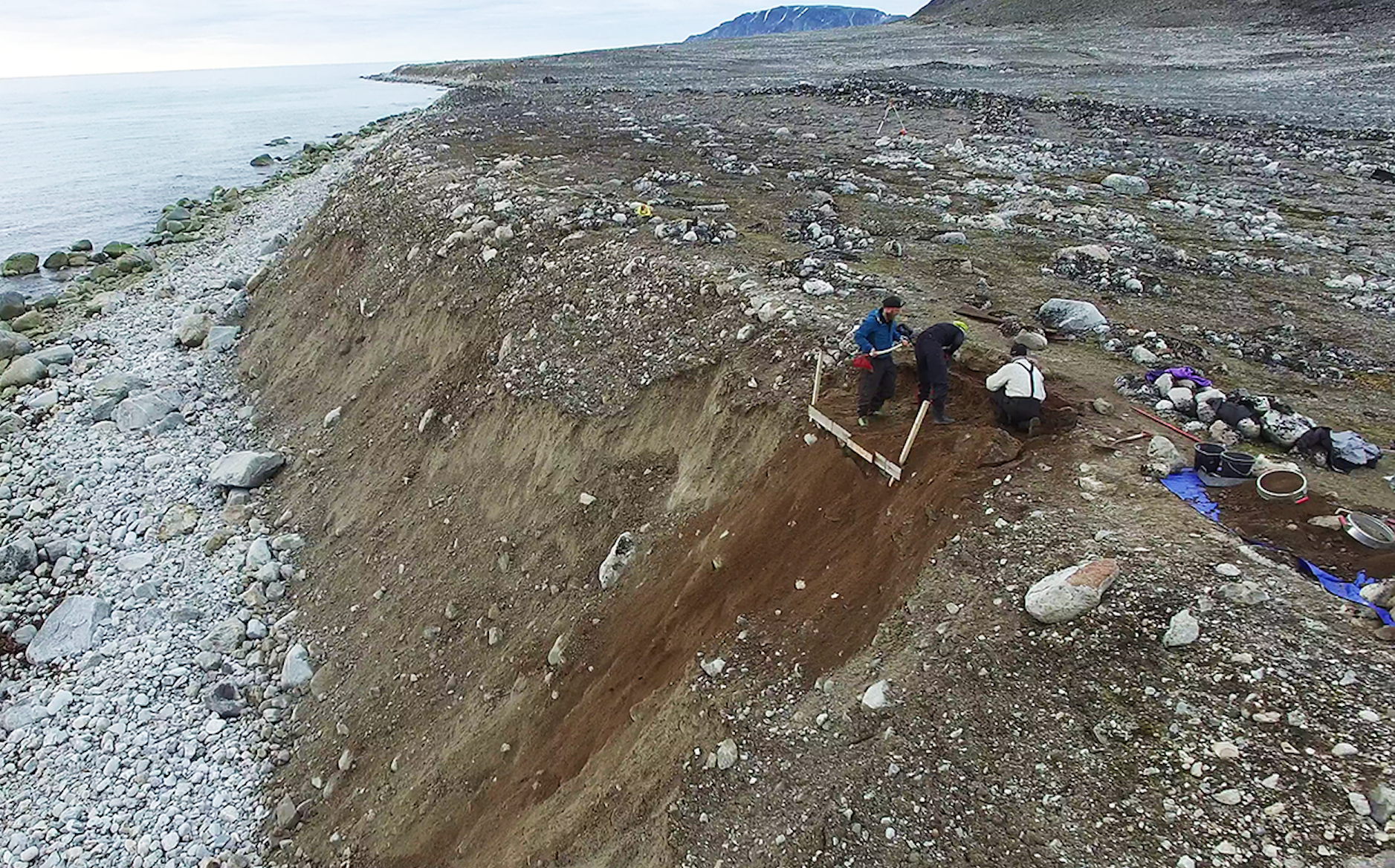
Graves at “Corpse Point” showing some of the textiles have eroded in recent decades. Image: Loktu, Lise, and Brødholt, Elin Therese

Nowhere is more affected by warming trends than the Arctic, where temperatures are rising nearly four times faster than the global average. Now, a pair of researchers has examined the remains of European whalers at the Likneset whaling burial site on Norway’s Svalbard archipelago, also known as “Corpse Point.” The team discovered significant degradation of many burials since they were first documented in the 1970s, a loss that has been sped up by climate change. 

“The site has been excavated repeatedly over more than three decades, providing a rare opportunity to examine both preservation change and human skeletal evidence through time and across contrasting burial environments within a single site,” said authors Lise Loktu of the Norwegian Institute for Cultural Heritage Research and Elin Therese Brødholt of Oslo University Hospital.

“In several cases, coffin lids had collapsed and sideboards were displaced, resulting in partial disturbance of skeletal remains and textiles,” the team said. “One grave (Grave 214) is classified as completely destroyed, with coffin elements and skeletal remains dispersed downslope.” 

Textiles were in a better state of preservation in less exposed graves. Image: Loktu, Lise, and Brødholt, Elin Therese

These whalers just can’t get any peace, even in death. Their lives were short and filled with physical hardships, according to the team’s re-examination of the bones. Many individuals endured physical trauma due to chronic strain, and 18 out of 19 of the studied sailors suffered from scurvy. Most of the bones belong to men who died in their 20s or early 30s.

“The predominance of healed injuries indicates survival after traumatic events and suggests that mortality within the assemblage was more closely related to cumulative physiological stress than to acute fatal trauma,” according to the study. 

“The results from Likneset…call into question the long-term viability of in situ preservation and managed decay under warming permafrost conditions,” the team concluded. Future work to address this problem “should be guided by clearly defined knowledge priorities: which information must be documented and analysed before it is irretrievably lost?”

In other news…

The mystery of Ndalambiri

Mesfin, Isis et al. "A new archaeological chrono-cultural sequence for the rock art site of Ndalambiri, Cuanza Sul, Angola" Journal of Archaeological Science: Reports.

For at least 45,000 years, humans have gathered at Ndalambiri, a rockshelter in Angola thought to be named for an Umbundu phrase that means, “This is where snakes lost life.” Its interior wall is adorned with an immense fresco of roughly 1,200 figures painted in white, red, and black, including many anthropomorphic and geometric designs left over the past 2,000 years. 

Now, researchers report the first comprehensive excavation of the site in partnership with local communities, an effort that unearthed thousands of artifacts, such as pottery shards, tools, and botanical and faunal remains.

Excavations under the fresco at Ndalambiri. Image: Mesfin, Isis et al. 

“The archaeological content of this central rock art and heritage site in Angola has remained poorly documented until now,” said researchers led by Isis Mesfin of the French Museum of Natural History in Paris. “The diversity of archaeological materials discovered at the Ndalambiri shelter makes it a strategic site for raising awareness about heritage preservation and field archaeology training.”

The team discovered the earliest evidence of iron production in Angola in the layers, dating back to the 5th century CE, and speculated that Ndalambiri was often a crossroads of diverse cultural interactions. But despite the wealth of new finds from the excavation, the study noted that “the identity of Ndalambiri’s occupants and painters remains uncertain.” 

Though it’s not clear yet who adorned its walls or sought refuge in its space, the rockshelter was clearly a storied gathering place that preserves eerie remnants of untold generations.

Last moon standing 

Belyakov, Matthew et al. “Nereid as a regular satellite of Neptune.” Science Advances.

Let’s dispense with human timescales and wind the clock way back to the early solar system, some four billion years ago. There was Neptune, minding its own business, when a pair of Pluto-sized dwarf planets suddenly barged into its way, causing complete orbital chaos. 

Neptune gravitationally captured one of the interlopers, which became the moon Triton. But in the fallout of the encounter, Neptune’s original moons were catapulted into deep space or torn into pieces and left to coalesce into a new set of irregular objects.

All, that is, except Nereid. Scientists have discovered that this Neptunian moon, which is about 200 miles in diameter, is likely the sole survivor of this ancient collision of worlds. Using observations from the James Webb Space Telescope, a team found that Nereid doesn’t spectrally match the rest of Neptune’s moons.

“Our proposed regular satellite genesis story for the moon leaves Nereid as the singular intact original satellite of Neptune—Neptune’s innermost moons, such as Proteus, are reaccreted pieces of satellites destroyed by Triton’s capture,” said researchers led by Matthew Belyakov at Caltech. “Future spacecraft exploration of the Neptunian system should search for signs of an early geologic history on Nereid consistent with formation as a regular satellite.”

Talk about a lunar loner. Nereid may offer a rare glimpse of a fleeting era before Triton came crashing into its captured orbit, upending the Neptunian moon system forever.

Cows can tell people apart 

Amichaud, Océane et al. “Cows visually discriminate and cross-modally recognise familiar and unfamiliar human faces in videos.” PLOS One.

We’ll end, as all things should, with cows watching TV. To determine whether these animals can recognize human faces, or match voices to faces, scientists played a series of videos for 32 Prim’Holstein cows. 

In one experiment, the cows watched a series of muted videos of familiar and unfamiliar male faces. In a second session, the cows watched videos of familiar caretakers speaking in their own voice, or a dubbed version with a different voice. The heart rates of the cows were monitored throughout both experiments.

Cows visually discriminate and cross-modally recognise familiar and unfamiliar human faces in videos
A graphic demonstrating the experimental setup. Image: Amichaud et al.

The results revealed that “cows looked significantly longer at the unfamiliar person, suggesting that they are able to discriminate between familiar and unfamiliar individuals using only a video of their faces as a cue,” said researchers led by Océane Amichaud of the National Research Institute for Agriculture, Food and Environment in France. “Cows looked significantly longer at the face that matched the voice, indicating that they are able to associate familiar and unfamiliar voices with the corresponding face.”

While the cows were able to distinguish between individuals, there was no difference in their heart rates when presented with familiar caretakers and strangers. The researchers suggested that future work should explore whether any other bovine behaviors are dependent on their human companions. This has been “cows watching TV” news. 

Thanks for reading! See you next week.