

惯性聚合 高效追踪和阅读你感兴趣的博客、新闻、科技资讯
阅读原文 在惯性聚合中打开

推荐订阅源

AI
AI
OSCHINA 社区最新新闻
OSCHINA 社区最新新闻
D
Docker
Last Week in AI
Last Week in AI
Apple Machine Learning Research
WordPress大学
WordPress大学
F
Full Disclosure
博客园 - 【当耐特】
博客园 - 司徒正美
V
Visual Studio Blog
F
Fortinet All Blogs
T
Tor Project blog
T
Threatpost
Blog — PlanetScale
Blog — PlanetScale
月光博客
月光博客
C
Cyber Attacks, Cyber Crime and Cyber Security
阮一峰的网络日志
阮一峰的网络日志
GbyAI
GbyAI
cs.CL updates on arXiv.org
T
Tenable Blog
M
MIT News - Artificial intelligence
L
Lohrmann on Cybersecurity
P
Palo Alto Networks Blog
I
Intezer
Stack Overflow Blog
Stack Overflow Blog
The Register - Security
The Last Watchdog
The Last Watchdog
S
Securelist
T
Tailwind CSS Blog
V
Vulnerabilities – Threatpost
U
Unit 42
博客园 - 叶小钗
P
Proofpoint News Feed
C
Cybersecurity and Infrastructure Security Agency CISA
H
Help Net Security
Cyber Security Advisories - MS-ISAC
酷 壳 – CoolShell
酷 壳 – CoolShell
Hacker News - Newest:
Hacker News - Newest: "LLM"
NISL@THU
NISL@THU
J
Java Code Geeks
H
Hackread – Cybersecurity News, Data Breaches, AI and More
SecWiki News
SecWiki News
www.infosecurity-magazine.com
Project Zero
Project Zero
T
The Exploit Database - CXSecurity.com
TaoSecurity Blog
TaoSecurity Blog
A
Arctic Wolf
Martin Fowler
Martin Fowler
T
Threat Research - Cisco Blogs
N
News | PayPal Newsroom

蛮荆

如何获取更多的免费服务器 Kubernetes 调度器队列 - 设计与实现 Kubernetes 调度器 - 核心流程 Kubernetes Networking Model & CNI Kubernetes 控制器管理总结 Kubernetes CronJob 设计与实现 Kubernetes Job 设计与实现 Kubernetes HPA 设计与实现 Kubernetes Deployment 滚动更新实现原理 Kubernetes GC 设计与实现 Kubernetes Pod 驱逐 - 设计与实现 Kubernetes Daemonset 设计与实现 Kubernetes ReplicaSet 设计与实现 Kubernetes EndPoint 设计与实现 Kubernetes Informer 设计与实现 降本增效之应用优化 (三) 日志存储与检索 Kubernetes Pod 设计与实现 - 创建流程 Kubernetes 探针设计与实现 Unix 编程艺术名句摘录 Kubernetes - CRI 概述 Golang 编译速度为什么这么快? Kubernetes Pod 设计与实现 - Pause 容器 Kubernetes - kube-proxy 代理模式工程优化 Kubernetes 应用最佳实践 - 优雅关闭长连接 Kubernetes Service 类型和会话亲和性 Kubernetes 为什么需要 Ingress Kubernetes 架构 - 控制平面和数据平面 降本增效之应用优化 (二) 大报表 Go 语言如何获取 CPU 利用率 降本增效之应用优化 (一) Redis 业务规则引擎演变过程简述 微服务中的熔断算法 漏桶算法和令牌桶算法 jsonparser 为什么比标准库的 encoding/json 快 10 倍 ? zap 高性能设计与实现 HTTP Router 算法演进 fastcache 高性能设计与实现 Web 常见的三个安全问题 ants Code Reading Go 线程安全 map 方案选型 布隆过滤器 死锁、活锁、饥饿、自旋锁 sync.Pool Code Reading Go 内存管理概述 Go netpoll Code Reading goroutine 泄漏与检测 time/Timer Code Reading GMP Scheduler Code Reading Go channel 的 15 条规则和底层实现 为什么 Linux “一切皆文件” context.Context Code Reading runtime/HACKING.md Goland 最佳实践 互联网开发与金庸武学 为什么 Redis 6.0 引入多线程模型? Kubernetes 应用最佳实践 - 金丝雀发布 容器中如何正确配置 GOMAXPROCS ? singleflight Code Reading sync.Map Code Reading sync.Cond Code Reading sync.WaitGroup Code Reading sync.RWMutex Code Reading sync.Mutex Code Reading sync.Once Code Reading Go 无锁编程 sync/atomic Code Reading goroutine 交替打印奇偶数 GODEBUG Go 并发模式 Go 汇编 UUID 通用技术选型 Kubernetes 应用最佳实践 - 水平自动伸缩 Go 高性能 Tips fasthttp 为什么比标准库 net/http 快 10 倍 ? 技术文章配图指南 ChatGPT 初体验 Docker 网络原理概览 iptables 的五表五链 Kubernetes 应用最佳实践 - 亲和性和污点容忍度 Go 的反射与三大定律 Docker 官方提供的最佳实践 Go 语言内置的设计模式 HTTP1 到 HTTP3 的工程优化 Kubernetes 应用最佳实践 - Sidecar 模式 Kubernetes 应用最佳实践 - init 容器和钩子函数 为什么 recover 必须在 defer 中调用? 为什么 defer 的执行顺序和注册顺序不同? Go map 设计与实现 Go 切片扩容底层实现 Go 语言中的零拷贝 Go Delve 云原生和边缘计算简介 Kubernetes Pod 服务质量等级 Kubernetes 应用最佳实践 - 探针 Kubernetes 应用最佳实践 - 资源请求和限制 CDN 原理 Kubernetes 应用最佳实践 - 开篇 缓存策略和模式 Go 内存模型 Kubernetes 核心概念
System Design Principles
2018-02-16 · via 蛮荆

蛮荆

2018-02-16 System Design

SOLID Design Principles

SOLID is an acronym of design principles that help software engineers write solid code within a project.

  1. S - Single Responsibility Principle. A module should be responsible to one, and only one, actor. a module is just a cohesive set of functions and data structures.
  2. O - Open/Closed Principle. A software artifact should be open for extension but closed for modification.
  3. L - Liskov’s Substitution Principle. Simplify code with interface and implementation, generics, sub-classing, and duck-typing for inheritance.
  4. I - Interface Segregation Principle. Segregate the monolithic interface into smaller ones to decouple modules.
  5. D - Dependency Inversion Principle. The source code dependencies are inverted against the flow of control. most visible organizing principle in our architecture diagrams.
    1. Things should be stable concrete, Or stale abstract, not concrete and volatile.
    2. So use to create volatile concrete objects (manage undesirable dependency.)
    3. DIP violations cannot be entirely removed. Most systems will contain at least one such concrete component — this component is often called main.

Concurrency Models
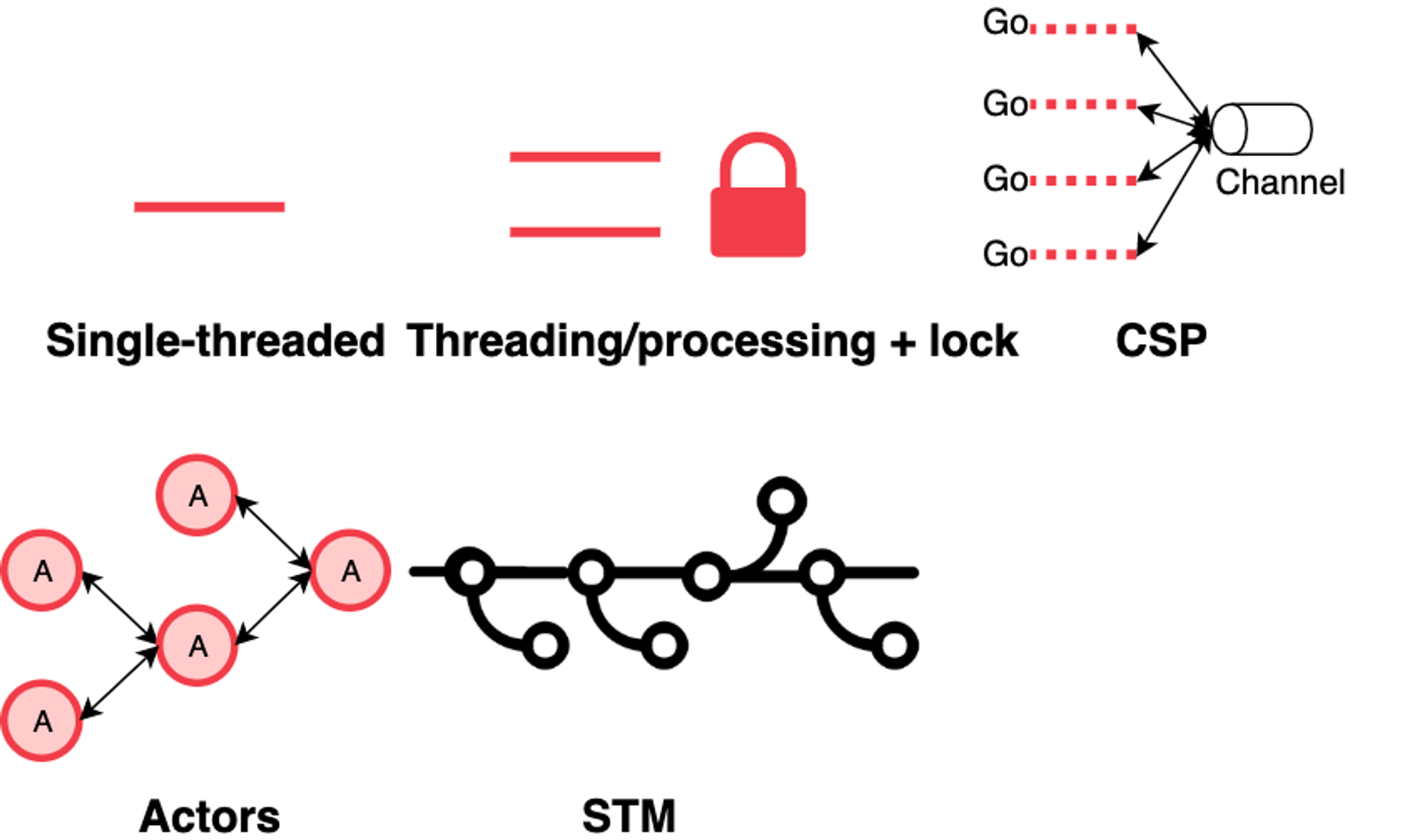
  • Single-threaded - Callbacks, Promises, Observables and async/await: vanilla JS
  • threading/multiprocessing, lock-based concurrency
    • protecting critical section vs. performance
  • Communicating Sequential Processes (CSP)
    • Golang or Clojure’s core.async.
    • process/thread passes data through channels.
  • Actor Model (AM): Elixir, Erlang, Scala
    • asynchronous by nature, and have location transparency that spans runtimes and machines - if you have a reference (Akka) or PID (Erlang) of an actor, you can message it via mailboxes.
    • powerful fault tolerance by organizing actors into a supervision hierarchy, and you can handle failures at its exact level of hierarchy.
  • Software Transactional Memory (STM): Clojure, Haskell
    • like MVCC or pure functions: commit / abort / retry

AKF Scale Cube

  1. Horizontal Duplication and Cloning (X-Axis). Having a farm of identical and preferably stateless instances behind a load balancer or reverse proxy. Therefore, every request can be served by any of those hosts and there will be no single point of failure.
  2. Functional Decomposition and Segmentation - Microservices (Y-Axis). e.g. auth service, user profile service, photo service, etc
  3. Horizontal Data Partitioning - Shards (Z-Axis). Replicate the whole stack to different “pods”. Each pod can target a specific large group of users. For example, Uber had China and US data centers. Each datacenter might have different “pods” for different regions.

转载申请

本作品采用 知识共享署名 4.0 国际许可协议 进行许可,转载时请注明原文链接,图片在使用时请保留全部内容,商业转载请联系作者获得授权。