








Imagine, for a moment, a more limited social media. No endlessly-scrolling feed, no clickbait, no auto-playing videos. Just posts from your friends, pictures and posts you’ve been tagged in, then back to real life.
I’d bet it’d still be addictive, as long as it included mentions and notifications.
It’s fun to be talked about (in a good way, that is), nice to know that people liked what you’ve shared. Thus the dopamine hit whenever someone shares your work and tags you in the post.
That has to be at least part of the reason why social media took over blog posts and RSS feeds. The feedback loops are shorter; it’s more instantly gratifying when folks click Like, than waiting for the long tail of the web to catch up with you.
Not that they have to be. For over two decades, blogs have been able to notify each other of new posts, with Webmentions (and Trackback, Pingbacks, and other types of Linkbacks). They’re tiny steps towards decentralized networks—and bring a bit of the warm fuzzy feelings of mentions to indie publication.
A Webmention is...
...an “@ mention that works across websites.” That’s how Roney Ngala described Webmentions in 2017, five years after the first specification was written.
The idea was simple: A modernized version of TrackBacks, PingBacks, and all the other linkbacks that’d been invented in the first two or so decades of the internet. Original TrackBacks were essentially automated comments. When someone mentioned your blog post in their article, their server would comment on your post with a link to their post.
But the modern web had likes, comments, reposts, and more, and Webmentions set out to implement them all, to “enable cross-site conversations” as IndieWeb described their purpose. And so started a fork of PingBacks, designed to modernize how blogs talk to each other—and, perhaps, decentralize social networking and bring a bit of energy back to blogging.
“If you use Twitter, your friend Alice only uses Facebook, your friend Bob only uses his blog on WordPress, and your pal Chuck is over on Medium, it’s impossible for any one of you to @mention another,” wrote Chris Aldrich in A List Apart, building the case for Webmentions. What if, instead, you had an “@mention that works from one website to another,” went the proposal. It’s a dream that the earliest bloggers shared, back before WordPress had been invented.
Back to the TrackBack
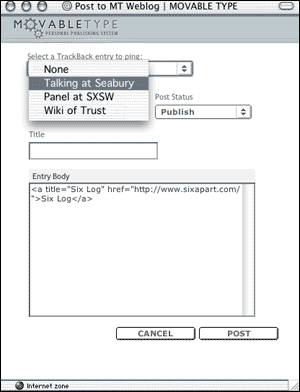
The original MovableType TrackBack
It all started back in June 2002, four years after Larry Page and Sergey Brin’s Googlebot started scouring the internet for backlinks to find the best parts of the internet, with nascent blogging platform MovableType. The idea was simple: What if you were notified every time someone referenced something you wrote? It’d be backlinks that’d come to you.
TrackBacks started life with a bookmarklet. When you read something interesting, you’d click the bookmarklet for your blog and if that blog supported TrackBacks, it’d copy the link and give you a space to start blogging. And when you clicked Post, your new blog post would be published and your site would notify the original site about the post. A bit manual—but not much more than quoting a Tweet and adding additional commentary today.
“We've already thought of some examples where TrackBack can be used, the MovableType team dreamed. Build a decentralized commenting system, where the space under your article was filled with links to others’ takes on your idea. Create a guest blog section on your site, with a list of articles others wrote that referenced your product. Run surveys, with everyone’s picks published on their site for a shot at vitality. All that, a year before the BlackBerry got push notifications for email.
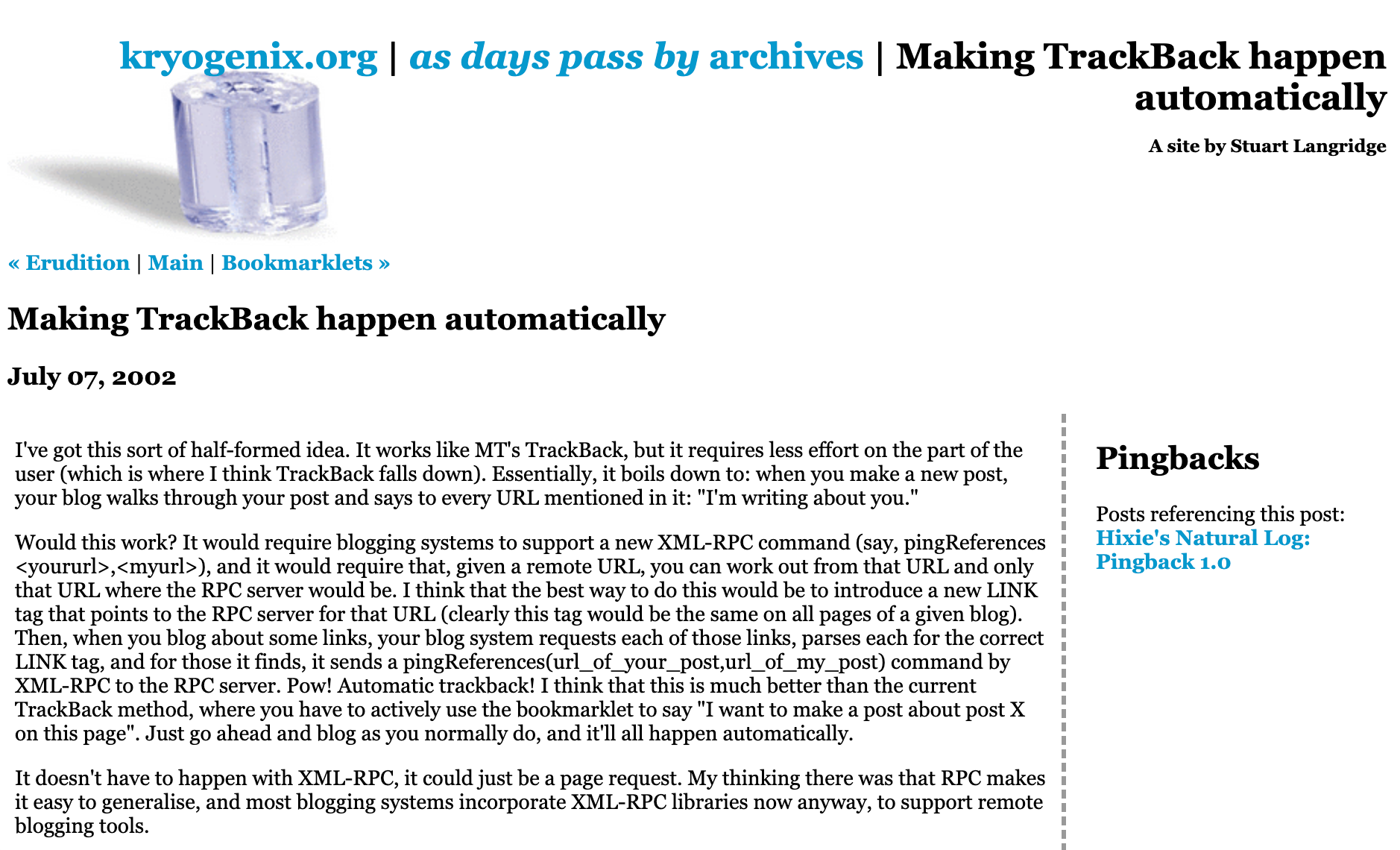
Possibly the world’s first Pingback, on the original Pingback blog post
A month after TrackBacks launched, Stuart Langridge had a better idea. What if the servers just automatically notified each other? “When you make a new post, your blog walks through your post and says to every URL mentioned in it: ‘I’m writing about you,’” suggested Langridge, using XML-RPC commands to ping the server. By September, an official spec was born, christened Pingback. If your site supported Pingbacks, you’d included a <link rel="pingback" href="https://domain"> in the head. Whenever a blog post mentioned you, its software would scan the header, find the Pingback link, and ping it with details about the new post.
TrackBacks might have encouraged you to write a blog post right when you were reading a site—but they were also prone to spam, with no confirmation that your blog post was actually published. Plus, anything that adds an extra step makes it harder to keep going over time.
PingBacks, by being automatic and requiring both servers to support PingBacks, simplified the blogging process and cut down spam (a bit, anyhow). That was enough to make it the de facto standard, baked into WordPress—and by extension, a growing proportion of the web—since 2005. And then it was everywhere, spammers discovered how easy it was to get a backlink just by sending a TrackBack to a popular site, and that, as Stack Overflow creator Jeff Atwood said in 2006, is what killed Trackbacks (and, for the most part, comments on much of the web).
Then creators moved on to social media, blogging went corporate, and the whole thing was ripe for reinvention.
Building a better PingBack
Don’t reinvent the wheel, though, and so “the Webmention spec began as a simplified version of the Pingback spec,” says the W3C Webmention guide. From Sandeep Shetty’s first iteration in October 2012, Webmentions replaced XML-RPC with a simpler HTTP form POST, making it easier to develop and less susceptible to hacks.
POST /webmention-endpoint HTTP/1.1
Host: bobs.host
Content-Type: application/x-www-url-form-encoded

source=http://alices.host/alice/post/42&\
target=http://bobs.host/bob/post/2
Then trust, but verify, and so when your site receives that HTTP POST with a Webmention, it’ll first check to ensure that link really exists, and only then save the mention for reference. Your server could even periodically check to ensure the mention is still there, if you want to keep your Webmentions up-to-date.
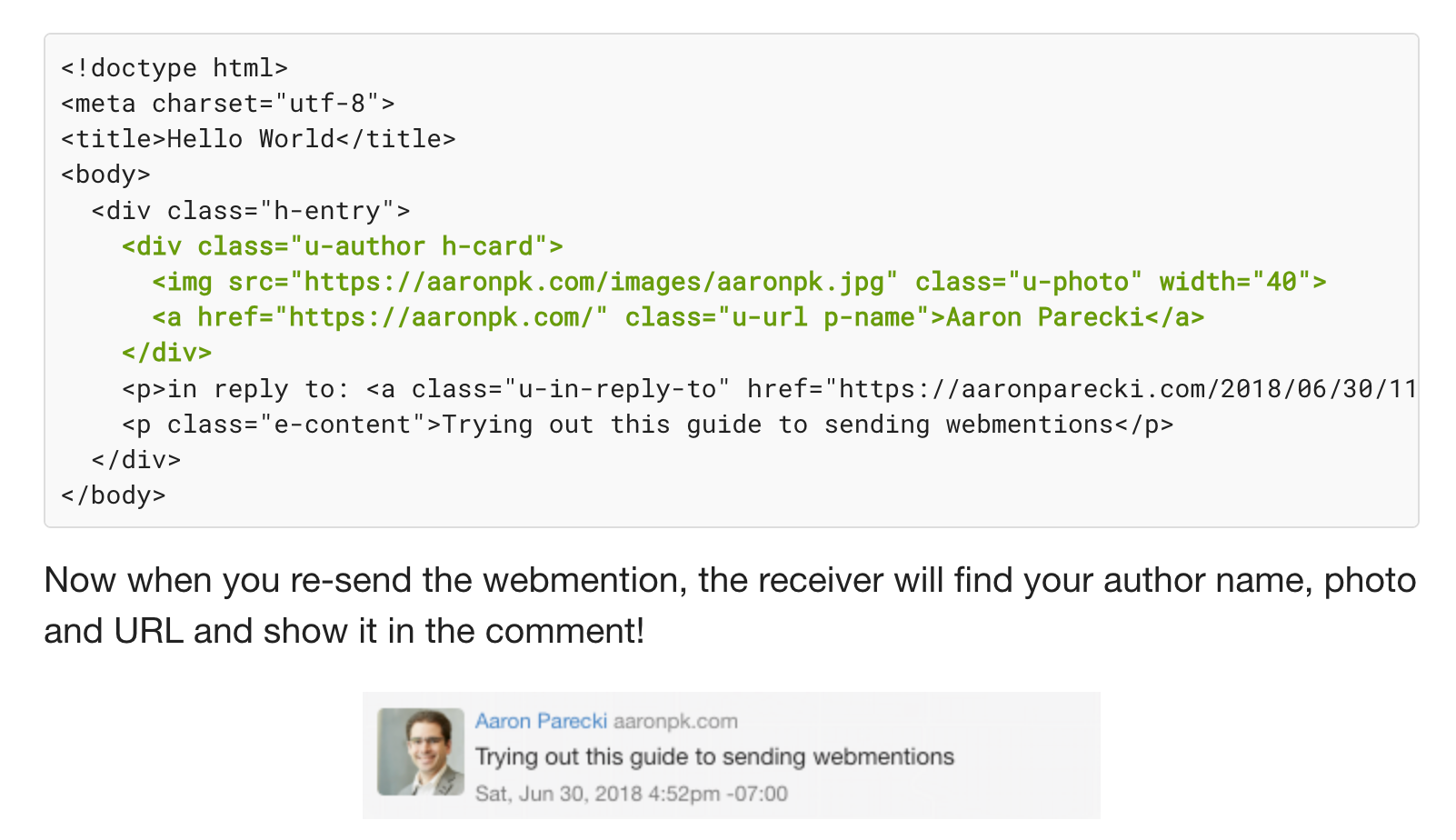
Example via Aaron Parecki’s guide to Webmentions
Links on their own don’t tell you all that much, so Webmentions expanded what could be included. You could include microformats like h-entry and u-author in your Webmention copy, to perhaps share a like or dislike, include the ID of a specific comment you’re replying to, include your name and avatar, and more. And you could include URL fragments to link directly to a specific part of a page, for Medium-style inline comments.
In the spirit of PingBacks and TrackBacks before, folks dreamed of everything. You could have comments across blogs, back and forth, with Webmentions copying the comments between sites, imagined A List Apart. “A response can be an RSVP to an event, an indication that someone "likes" another post, a "bookmark" of another post, and many others,” imagined the W3C’s spec.
And along came the software. Webmention.io can receive Webmentions on behalf of your site, without needing to add anything beyond an HTML tag to your site. Bridgy can find mentions of your site on social media, and push them via a Webmention to your site. And your favorite newsletter tool, Buttondown, supports Webmentions, so whenever you mention a blog post in your newsletter, their server will get pinged with the new mention.
Webmentions aren’t perfect. Dr. Wouter Groeneveld, an early adopter, turned off his Webmention server in 2023 thanks to the same problem that took down TrackBacks: Spam. And the non-spammy comments weren’t all that interesting, either; “about 75% of the mentions I do receive are completely useless ‘like’ messages,” Groeneveld wrote.
Yet the dream lives on. You could gather Webmentions with Webmention.io, just as a way to know who mentioned you but without sharing every mention on your site. You could perhaps build a whitelist to show your friends’ Webmentions, for a new take on a web ring (remember those?). You could take the idea and run with it, tackling spam and building something more fun in the process, as Matthias argued on Own Your Web: “This tinkering is worth the effort: seeing the replies of others appear on your site is just magical.”
Or, perhaps, you might prefer the oldest Webmention of them all: Email. “If I have to choose between spending time coding in yet another edge case or just writing and replying to a lovely email from a reader, I’d prefer the latter,” concluded Groeneveld, and we concur.
We’re proud that you can have both in Buttondown, and always thought there was something to the idea in the TrackBacks and Pingbacks of old. And just maybe, as Bluesky and Mastodon and a thousand networks bloom, we’ll eventually land on a universal way to @mention each other on the web.
Spam, though? Might have to wait for the heat death of the universe to cure that one.