Tell me a bit about yourself and your background.
I’m a data journalist based in New York City. Until early 2022, I worked in newsrooms, using data analysis and computer programming to guide and support investigative reporting, most recently as the data editor at BuzzFeed News for 7+ years. I left that job to go freelance and to start the Data Liberation Project — an initiative to identify, obtain, reformat, clean, document, publish, and disseminate government datasets of public interest.
And, last but not least, I keep writing the newsletter because I genuinely enjoy the process.
Tell me a little bit about Data is Plural! What do you write about, and how did you get started?
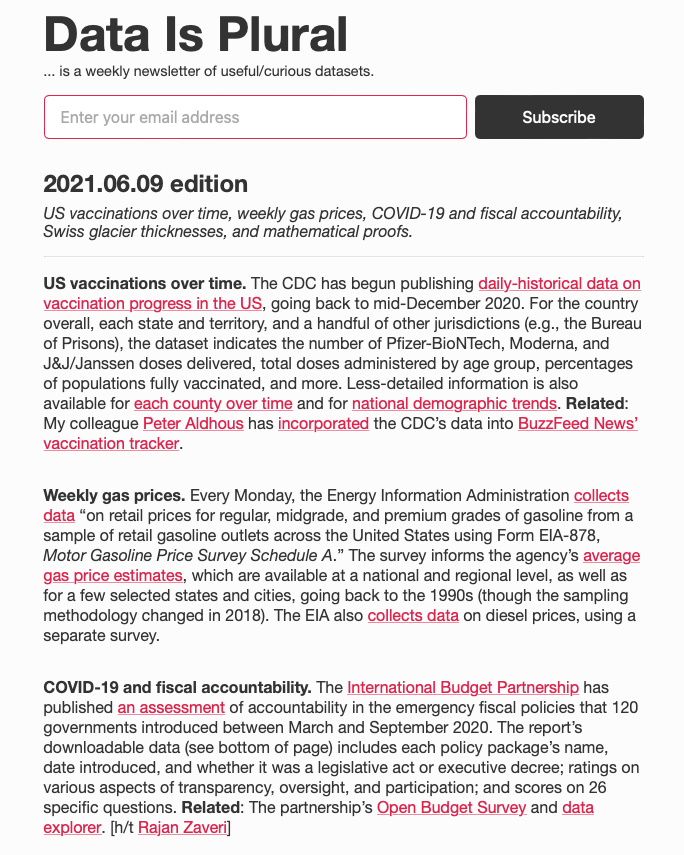
I started writing Data Is Plural in late 2015, to scratch a proverbial itch. At the time, it seemed there wasn’t a great way to learn about public datasets. There were giant data portals, but they felt overwhelming and often lacked key context. There were also smaller, more niche data portals, but spread all across the web. And there were one-off blog posts here and there, highlighting a few gems.
What I was hoping for — but couldn’t find — was what Data Is Plural became: A steady, concise feed describing a handful of datasets each week. DIP’s format has remained the same pretty much since launching: Five datasets per weekly edition, one paragraph of description each. So have the criteria: The datasets should be freely, publicly available and downloadable in bulk or via API; bonus points for originality, good documentation, open data formats, temporal freshness, and detail.
DIP has been around for nearly a decade, which is no mean feat. What inspires you to keep going?
When I started writing Data Is Plural, I didn’t know what to expect ... but the thought of still writing it more than eight years later never crossed my mind. A few motivations have propelled DIP’s longevity. There’s the joy of hearing from readers who find the newsletter helpful. There’s the satisfaction of watching the archive grow into a resource of its own. Also, as someone who’s mostly inactive on social media, the newsletter has also been a helpful way to convey occasional updates about my work. And, last but not least, I keep writing the newsletter because I genuinely enjoy the process: looking for datasets, exploring them, and trying to understand them well enough to summarize.
Justin won me over with his responsiveness, straightforward business plan, and general human-ness.
Where did you first learn of Buttondown, and what made you decide to give it a try?
In early 2021, I started hitting the quotas of DIP’s initial newsletter platform, TinyLetter. Knowing I would need to migrate to another service, I did some research on other options. I had a few basic criteria, and Buttondown seemed to meet them while seeming reasonably priced.
I forget how exactly I came across the service, but on Feb. 18, 2021 I sent Justin an email with the subject line “Hello from a prospective newsletter-service switcher”. I recall being somewhat wary of entrusting my newsletter’s delivery to (what was then) a one-person company. Justin won me over, however, with his responsiveness, straightforward business plan, and general human-ness. I also liked Buttondown’s API, its option to remove link-tracking, and its customizability. Nearly three years later, I’m still happy with that choice.
What are some ways Buttondown has helped you run/manage DIP?
Buttondown allowed me to remove link-tracking from the newsletter, an option very few platforms offered (at least at the time I was looking). In addition to preserving readers’ privacy, it also means they can hover their cursor over the links and see the real URLs, not the obfuscated ones that link-tracking requires.
I’ve also appreciated Buttondown’s broken-link checker, which gives me some pre-send peace of mind. And the fact that Buttondown accepts Markdown is wonderful; I write the newsletter in Markdown, so that saves me the step of converting drafts to HTML myself.
More generally, Buttondown’s customer service is (literally) the best I’ve encountered online. On the rare occasions where there’s a hiccup, Justin’s been responsive, forthright, and helpful.
What are some things you’d be excited to see Buttondown build in the next few months?
Buttondown has added a slew of new features since I started using it, so I should probably try some of those — the surveys seem fun — before proposing new ones.
But since you asked ... I'd be excited to be able to preview the newsletters as they would appear in various email clients, such as Gmail, Apple Mail, Outlook, et cetera.
What advice would you give to someone starting their own newsletter?
Before committing to the newsletter you have in mind, try writing a few editions just for yourself. Without the promise (or fear) of public attention, or the distractions of infrastructure, is it fun to write? (This is what I did with DIP before announcing or publishing it.) It’s also a good opportunity to fiddle with the style and format.