
惯性聚合 高效追踪和阅读你感兴趣的博客、新闻、科技资讯
阅读原文 在惯性聚合中打开

推荐订阅源

宝玉的分享
宝玉的分享
酷 壳 – CoolShell
酷 壳 – CoolShell
让小产品的独立变现更简单 - ezindie.com
S
Security @ Cisco Blogs
小众软件
小众软件
D
Docker
博客园_首页
A
About on SuperTechFans
P
Privacy International News Feed
freeCodeCamp Programming Tutorials: Python, JavaScript, Git & More
A
Arctic Wolf
Spread Privacy
Spread Privacy
有赞技术团队
有赞技术团队
T
Tailwind CSS Blog
Latest news
Latest news
WordPress大学
WordPress大学
CTFtime.org: upcoming CTF events
T
The Exploit Database - CXSecurity.com
C
Cybersecurity and Infrastructure Security Agency CISA
大猫的无限游戏
大猫的无限游戏
cs.CV updates on arXiv.org
OSCHINA 社区最新新闻
OSCHINA 社区最新新闻
K
Kaspersky official blog
V2EX - 技术
V2EX - 技术
SecWiki News
SecWiki News
U
Unit 42
GbyAI
GbyAI
H
Hackread – Cybersecurity News, Data Breaches, AI and More
L
LINUX DO - 热门话题
S
Security Affairs
Y
Y Combinator Blog
aimingoo的专栏
aimingoo的专栏
Blog — PlanetScale
Blog — PlanetScale
MongoDB | Blog
MongoDB | Blog
博客园 - 【当耐特】
The GitHub Blog
The GitHub Blog
T
Tenable Blog
W
WeLiveSecurity
Cloudbric
Cloudbric
Cyber Security Advisories - MS-ISAC
G
Google Developers Blog
Application and Cybersecurity Blog
N
Netflix TechBlog - Medium
F
Full Disclosure
N
News and Events Feed by Topic
D
DataBreaches.Net
P
Proofpoint News Feed
B
Blog RSS Feed
B
Blog
cs.CL updates on arXiv.org

Buttondown's blog

Email could have been X.400 times better The physicists who convinced Fermilab to send Brazil's emails Better in-app previews Analytics 3.0 Subscriber ID variables Comments! Send latest premium action Automation filtering Free API subscribers Surveys in automations Reply to replies Labels for RSS feeds How Jeremy Singer-Vine curates curious datasets for readers 2023 (and what's next) Email vs web content Sort by engagement Better gift subscriptions How Andy Dehnart built a career reviewing television New email template Email-based automations Opt-in reply tracking Automatic alt text More social network integrations Sort by metadata Overlarge image warnings Automation tag actions Pause emails mid-flight Search tags and automations Gift via automations Subscriber-driving emails Programmatic webhooks Email page views Tag statistics Discord webhook formatting Automatic subscriber cleanup RSS subscriber count Weekly subscriber reports More list columns Customizable list views How Max Voltar turned a side gig into a trusted keyboard resource How Nick Disabato runs two newsletters from one design consultancy Made-for-you share images Automation improvements End-of-email surveys Filter by date Survey-triggered automations More automation functionality New webhooks How France Insider built a news service with paid subscribers Email as primary key How John Willshire unites two businesses in one newsletter Confirmation reminders Email churned subscribers Email-to-draft Subscriber metadata columns ChatGPT integration Faster web archives Referral program Better search results TikTok embeds Subscriber timeline Spotify embeds Improved RSS-to-email Subscribe page OG image New analytics page Google Tag Manager Even more subscriber types Integrating Duda with Buttondown Linktree integration guide Advanced and enterprise plans Framer integration guide API requests page Team collaboration In-email surveys Better CSS settings Better RSS automation fetching! Editor toolbar improvements Smart filters Faster emails page RSS automations Faster email analytics Zapier error codes Image accessibility checks Tags vs newsletters OG image picker Image editor improvements API bulk actions Improved OpenAPI spec Mastodon support Better subscriber filtering Better subscriber validation Hotkey support! Programmatic access to analytics Stronger bulk actions Faster archive page Custom canonical URLs Email slug and metadata Improved writing interface Generating a Typescript router in Django Filter emails by source
What it costs to run a software business in 2023
Justin Duke · 2023-02-09 · via Buttondown's blog

I am a sucker for a good list of running costs, dating back to seeing Cushion's, back in 2015. I think it lends an earnest and unglamorous look as to what it really takes to a business in the way that "hustle porn"-type essays rarely do.

I've done a poor job of keeping my own such running cost document (though I'd like to do a better job!), but in lieu of a beautiful chart like Cushion's I'll try and offer something sloppier: a screenshot of my finances table!
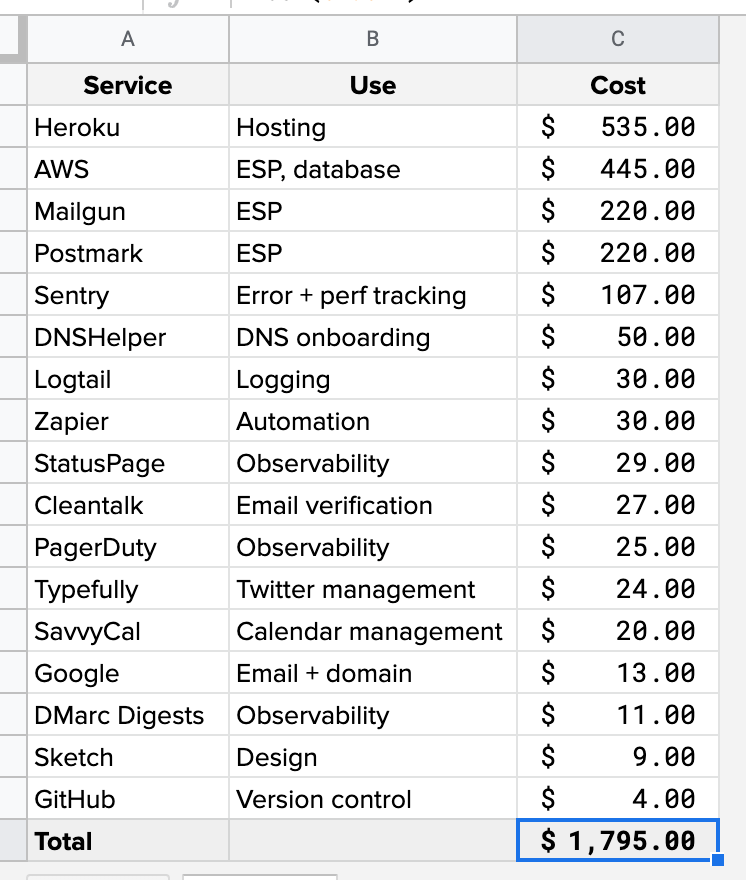
All the costs.

(As context, Buttondown posts around low five figures of monthly revenue, so this is a pretty healthy margin.)

Some notes on these numbers:

  • My Stripe fees are a goose-egg thanks to Stripe offering a huge amount of free credits to alumni. This would otherwise be one of my largest costs.
  • Instead, my largest cost is Heroku, which is coincidentally the cost I'm least happy with. Buttondown does not serve enough traffic to warrant five hundred dollars a month; in fact, the lion's share of that money goes towards a Redis cluster and auto-scaling asynchronous queues. A goal of mine for later this quarter is to migrate onto a more modern, cheaper solution like Render — which I've napkin math'd out to be closer to $150/month.
  • Of the things I pay for that I'm least satisfied with regardless of cost, PagerDuty and StatusPage share the award. Neither of these are good products for my use case, and I deeply wish to migrate to Better Uptime. But the trap that you quickly run into is that $60/month is simply not an urgent enough level of cost to prioritize migration, and so I toil away using these subpar tools. (I'll switch off of them probably when I also switch off of Heroku.)
  • I spend a lot on sending emails. Sending emails is not free! I have three active ESPs — Postmark, Mailgun, and AWS — for various use cases, as well as a dormant ESP (Sendgrid) for failover's sake (it's currently on the free tier, as I only send through enough traffic to make sure the plumbing doesn't explode).

Beyond that, nothing much to report. There's a slew of things that cost somewhere between $5—$30/month for which I use the following heuristic: does this provide at least fifteen minutes' worth of value? If so, great. That's perhaps a low bar, but it's certainly a higher one than at big technical companies (where the bar might be "has someone used this tool in the past year? okay, we won't churn from our four-digit plan".)