


“Email has largely stayed the same,” wrote Gmail product manager Aakash Shaney in 2019, while the web rapidly evolved around it.
No more. Google’s AMP for email meant “your emails can stay up to date” and “you can easily take action directly from the message itself.”
Four years earlier, the search giant had come for the mobile web with AMP—accreted mobile pages. Devs would code mobile versions of their site using AMP libraries, host them in Google’s CDN, and reap the benefits of near-instant load times and preferential placement in Google search results.
And now they were coming for your emails, dangling the benefits of a modernized messaging experience where you could book flights and hotels, respond to meeting invites and Google Docs comments, all from the comfort of your inbox.
“Who would ever want this?” asked @waste_monk on Hacker News. “We are living in hell.”
Dante's inbox
Yet the road to hell is paved with good intentions, as they say. That, and more than a little hubris.
On the web, AMP had gained grudging adoption through carrots and sticks. Build an AMP site, and you’d get preferential placement in search results, a grey lightning bolt near your site’s name in search results, and a near-zero latency page load from Google’s CDN—all carrots. “We are here to make the web great again,” said Google’s vice president of news, Richard Gingras in 2015, only months after Donald Trump brought that phrase into the vernacular. Google assumed publishers the world over would happily rewrite their mobile sites to the search giant’s whims.
The implicit stick, though, was that without an AMP page, your site wouldn’t rank as highly as it may have previously. And with over 89% of global search volume, when Google asks web publishers to jump, they say how high.
There were always issues with AMP. It brought back the dynamics of the mobile versus the desktop web, for one. Instead of the same web for everyone, you now had one page on mobile, another page on desktop—exactly what responsive web design had been fighting against ever since the iPhone brought a desktop-class browser to mobile. And, more critically, it lessened your control over your site.
AMP required allowing any AMP CDN to cache your pages. Visitors might be served your page from a Google domain instead of your own, or the ad tech and other scripts on your site might be incapable of running on your AMP site (handily, it seemed, for Google, who might prefer you to use their ad tech instead).
It was all enough that, over the coming years, Google would come under two antitrust lawsuits that referenced AMP as part of what the US Justice Department saw as Google’s attempt to monopolize online advertising and the web in general.
AMP libraries themselves were open-source. And you could offer a competing AMP CDN; Microsoft’s Bing did, for one. But web developers viewed AMP with suspicion from the onset, as much due to the coercion as anything. “It’s a threat to the open web,” as @ImprobableValue summed up the prevailing opinion on Reddit.
And then Google brought AMP to email.
What if email was interactive?
Emails has always moved at its own, slower pace. The first email was sent twenty years before the first web page was published, and to this day, plain text emails without HTML are still considered compliant internet messages.
As Ray Tomlinson, who implemented and sent the first email from ARPANET in 1971 said about adding formatting to email: “That’s too complicated: we just want to send messages to people.”
That, for better or worse, has been the ethos of email. It’s why every email message, today, should include both an HTML and plain text version, why you can email anyone and trust that they can read your message. It’s one of the remaining decentralized parts of modern communications, one where Gmail supports only 152 of the 301 email HTML and CSS features yet your messages still typically look fine.
Email’s great because “No company owns it. It works reliably and as intended on every platform, every operating system, every device. That’s a rarity today and a hell of a valuable one, ” said TechCrunch’s Devin Coldewey.
And here came Google, recommending everyone change how they write emails.
AMP email used the same frameworks as AMP on the web, with a scaled-down set of components. Some new stuff: AMP-form to gather info, AMP-autocomplete to suggest search and filter results, AMP-carousel to showcase said results. Some older stuff, rewritten: AMP-image to “replace the HTML5 img tag” and lazy-load images, AMP-anim to “manage an animated image, typically a gif,” and AMP-timeago for fuzzy timestamps.
It all worked, in Gmail, Yahoo! Mail, and (inexplicably) Mail.ru. Launch partner OYO Rooms let you browse hotel listings and reviews from emails. Booking.com let you flip through room photos—and change your email preferences from daily to weekly from an interactive form in emails. Pinterest emails let you flip through recipes and save them to your boards. And Google Docs, most notably, let you reply to and close comments from your inbox.
“It’s the biggest thing happening to email since the creation of email,” Booking.com’s Antony Malone said to the AMP team.
AMPing up your emails
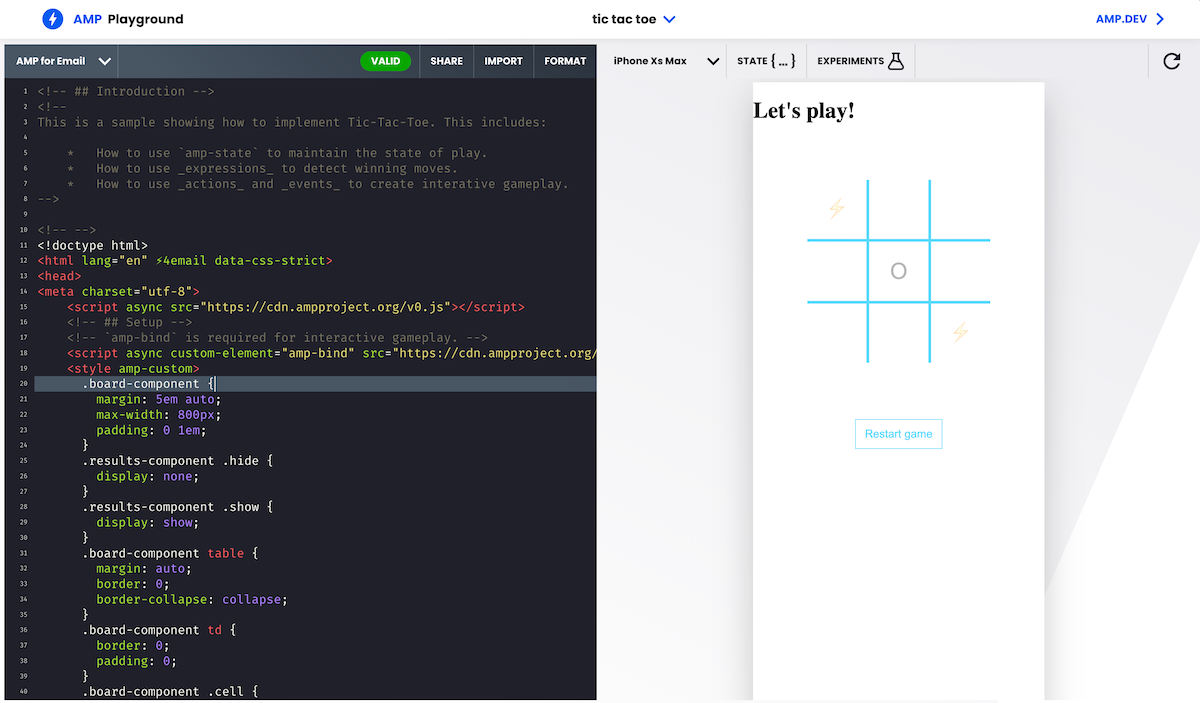
You, too, could code an AMP email, as long as you were willing to now write AMP, HTML, and plain text versions of every email. The AMP version was familiar enough, HTML if you squint. You’d open with an <html ⚡4email lang="en" data-css-strict> or <html amp4email> tag, then add standard HTML components alongside <amp-img> or <amp-carousel> or other elements as needed. You could build an interactive tick-tack-toe game, if you were so inclined.
Then, just as today you write HTML and plain text versions of your emails, you’d need to code AMP and HTML versions of each message. You’d need alternatives for core features. Google Docs, for instance, let you reply to a Google Doc comment directly from an email in Gmail. On other email apps without AMP support, the reply button would instead open a New Email window complete with a custom @docs.google.com address where you could email in a reply. That requires a magnitude more effort to build and support, for a simulacrum of interactivity.
And, even after all of that work, you couldn’t just send your email. You’d need to authenticate your domain with DKIM, DMARC, and SPF—good ideas, regardless. You’d also need to send a sample email to both Google and Yahoo!, and register your domain with each of them. Then, if you were lucky, within 5 days you’d be approved to start sending AMP emails.
All of that, for emails that would only work in a handful of email apps.
AMP emails, today, still aren’t supported by Gmail or any other service in Microsoft Edge (or Internet Explorer, but that’s more understandable). Yahoo! only added AMP support to mobile in 2022, two years after the initial launch. Microsoft added “preview” support for AMP to Outlook.com in 2019, only to turn it off a year later in favor of their Exchange-only, JSON-powered “Actionable Messages.”
The writing seemed on the wall from the beginning. It was all too much effort, for too little, in a developer environment primed to distrust anything new from Google.
“It’s okay,” declared @_ofdw on Hacker News, 3 months after AMP for Email’s initial release. “Google will kill AMP in a year or two, just like they kill everything else.”
AMP, expunged
666 days later (seriously!), Google blinked. “We will no longer show the AMP badge icon to indicate AMP content,” announced the Google Search Central Blog in April 2021, and “using the AMP format is no longer required” to be featured in Google News’ Top Stories carousel.
AMP for Email went more quietly into that dark night. No announcements that AMP for Email was over, no disabling of AMP features in Gmail. It didn’t join the 296 other projects that have been killed by Google, from AngularJS to Zeitgeist (and Google Reader, Google Wave, and so many more).
Google itself still uses AMP for email, branded as Dynamic Email. You can still reply to Google Docs comments and accept Google Calendar events without leaving Gmail thanks to AMP for email.
But AMP the project has been left to die. The AMP by Example site, linked to in all of the announcements, is dead. AMP’s Email spec hasn’t been updated since a few typos were fixed in 2023, while the wg-amp4email working group hasn’t seen an update since 2021. Google’s own AMP Playground site is stuck in the past, featuring the iPhone XS and Pixel 2 phones.
AMP “got as far as Google could prop it up and as soon as Google gave up on that everyone promptly ditched it,” remarked Rarst on a Reddit r/webdev thread about AMP.
Interactivity in email didn’t die with AMP. You don’t need anything beyond good ol’ HTML. HTML buttons and forms are supported by Gmail and almost every app other than Outlook for Windows or Yahoo! Mail for iOS. The HTML5 <video> element works in Apple Mail, Thunderbird, and Outlook on Mac (as well as, strangely, Outlook 2003 for Windows but no other versions)—just not in Gmail. You can make polls and surveys in email with HTML links and buttons, as we do at Buttondown—enough to RSVP to events, even if not enough to dynamically view hotel prices, say.
AMP, though, wasn’t just interactive. It made emails impermanent. The email you receive today with a comment may not look the same tomorrow after someone edits their comment or adds a new reply. The price on a home listing or plane ticket might dynamically update, gaslighting you about what you know you saw in your inbox yesterday. Email’s the last bastion of permanency on the internet, one place where at least you have a record of what went down. That’s worth preserving. Fuzzy timestamps are the last thing email needed.
Email’s lasted for 54 years. Over the next 54 years, expect email to change, slowly. Expect plain text email to stick around forever. Expect people to continue to predict the death of email. And, expect the death of everything that says it’ll usurp email.
You can’t kill—or change, really—something that’s lasted that long.
Image Credits: Animated demos of AMP emails from Google’s launch posts.