


惯性聚合 高效追踪和阅读你感兴趣的博客、新闻、科技资讯
阅读原文 在惯性聚合中打开

推荐订阅源

让小产品的独立变现更简单 - ezindie.com
人人都是产品经理
人人都是产品经理
Cisco Talos Blog
Cisco Talos Blog
钛媒体:引领未来商业与生活新知
钛媒体:引领未来商业与生活新知
V
V2EX
博客园 - 三生石上(FineUI控件)
Martin Fowler
Martin Fowler
WordPress大学
WordPress大学
D
Docker
S
SegmentFault 最新的问题
博客园 - 聂微东
美团技术团队
Apple Machine Learning Research
月光博客
月光博客
奇客Solidot–传递最新科技情报
奇客Solidot–传递最新科技情报
Last Week in AI
Last Week in AI
M
MIT News - Artificial intelligence
F
Fortinet All Blogs
freeCodeCamp Programming Tutorials: Python, JavaScript, Git & More
The GitHub Blog
The GitHub Blog
GbyAI
GbyAI
L
LangChain Blog
Vercel News
Vercel News
博客园 - 叶小钗
MongoDB | Blog
MongoDB | Blog
Stack Overflow Blog
Stack Overflow Blog
H
Help Net Security
OSCHINA 社区最新新闻
OSCHINA 社区最新新闻
The Cloudflare Blog
Engineering at Meta
Engineering at Meta
T
Threat Research - Cisco Blogs
T
Threatpost
Scott Helme
Scott Helme
T
Tailwind CSS Blog
Latest news
Latest news
Stack Overflow Blog
Stack Overflow Blog
Blog — PlanetScale
Blog — PlanetScale
The Register - Security
罗磊的独立博客
P
Proofpoint News Feed
腾讯CDC
S
Schneier on Security
雷峰网
雷峰网
A
About on SuperTechFans
T
Tenable Blog
F
Full Disclosure
Cyberwarzone
Cyberwarzone
博客园_首页
有赞技术团队
有赞技术团队
K
Kaspersky official blog

文章列表

Compulsive curiosity, or, how I built an infinite idea machine Gift details on the subscriber portal Portal link in the archive nav The physicists who convinced Fermilab to send Brazil's emails First, add no friction: How micropayments lost and subscriptions won Filter subscribers and automations by source Automations, rebuilt What email will look like in the future Filter subscribers by bounce date and reason Email could have been X.400 times better Three features are moving behind the paywall Firewall changes and improvements Put your name and voice into your company newsletter Simplified email address settings Subscription wall Inboxes were overwhelming before we'd even named them The US government tried really hard to screw up email Public postmortem: database connection exhaustion Ask a nerd: what is the best way to unsubscribe from newsletters? Bookshop.org embeds Email was into agents before they were cool Passwordless login Rename metadata keys in bulk A spring cleaning for our legal docs Ask a nerd: what happens when you click the spam button? Passkey support for two-factor authentication How Buttondown's API versioning works How to send email to space Safer defaults for the email creation API How we enabled Content Security Policy for everyone Recovery codes for two-factor authentication Filter sent emails by engagement rate How we migrated to TypeIDs without breaking clients How we check every link in your email Use newsletter metadata in your emails Should we bring back email exploders? Sort and filter by open and click rates Custom click tracking domains More newsletter settings in the API Revamped replies Custom email templates for everyone Simplified cancellation Ask a Nerd: Does email length affect deliverability? The changelog, reborn Swedish localization Forwarding an email is not always straightforward Public descriptions for tags OpenAPI spec for archives How Rodrigo brings a humanistic view to consumer technology How Brandon Lucas Green shares his music and supports artists Subscribers can come from anywhere. Even another newsletter platform's form. Your newsletter's archives are more valuable than your list Survey responses on the web Better tag self-management Smarter automation filters Granular API keys Ask A Nerd: How does newsletter cadence affect deliverability? New design settings pages Snippets Starred views More ways to customize your archives Inbox filtering Mastodon follower analytics Ask a Nerd: What are good open, click, and response rates for an email newsletter? How we migrated our database to PlanetScale Two new archive themes Ask a Nerd: Does attaching files to your newsletter hurt deliverability? Custom buttons now work in Markdown mode Seline and Tinylytics support Unban subscribers Announcement bars for your archives Public postmortem: archive downtime Bang paths, source routing, and how email trips were planned 2025 disposables.app Russian localization Ask a Nerd: Can you improve email deliverability with a personal domain? More locale options How we interview customers at Buttondown Bluesky analytics Minimum viable complexity Reply to conversations How Jeffery Hicks goes behind-the-scenes in his newsletter Changes to our stack in 2025 2026: Emails TK reminders in the editor What the hell is a UTM? Randomize survey answer order Why we insourced analytics Scroll sync in the editor How Kelly Jensen uses Buttondown to discuss key library issues How Jamie Thingelstad uses Buttondown to explore tech topics 2026: Archives Improved filters Keeping feature creep at bay Content Security Policy in archives Open source Sniperl.ink Auto-activating RSS reader subscriptions What the hell is ActivityPub? Gift subscriptions
Pricing page driven development
Justin Duke · 2023-03-28 · via

You are perhaps familiar with the concept of Readme Driven Development: writing your Readme first and using it to backtest the interface for your CLI.

I'd like to propose a similar mental exercise for thinking about your pricing model: pricing page driven development. As in: when thinking about your monetization strategy, write a pricing page first and work your way backwards into something that makes sense.

Some context about Buttondown

Buttondown is API-first software for sending emails and managing subscriptions. (Think Mailchimp, except for people who don't want to spend all day inside Mailchimp.) Sending emails cost money; running servers costs money; paying a mortgage costs money. So I charge for the service, albeit with a free tier.

Some context about pricing strategy

What makes a good pricing model? More than anything else, you want to think about two numbers:

  1. Conversion rate — how many prospective users become paying customers?
  2. Lifetime value — how much does each customer pay you over their lifetime? (You can think about this separately as ARPU and churn, but the two tend to have a tight relationship.)

Buttondown's old pricing model (2020)

Conversion rate: 5% · LTV: $455

When we launched in 2018, Buttondown had a hybrid model: you pay ~at-cost for the amount of emails you send, and then you also pay an additional $29/mo for additional functionality such as custom domains or whitelabeling. I considered this a very clever approach to align incentives — I "give away" the rails for free and then charge for the fancy stuff!
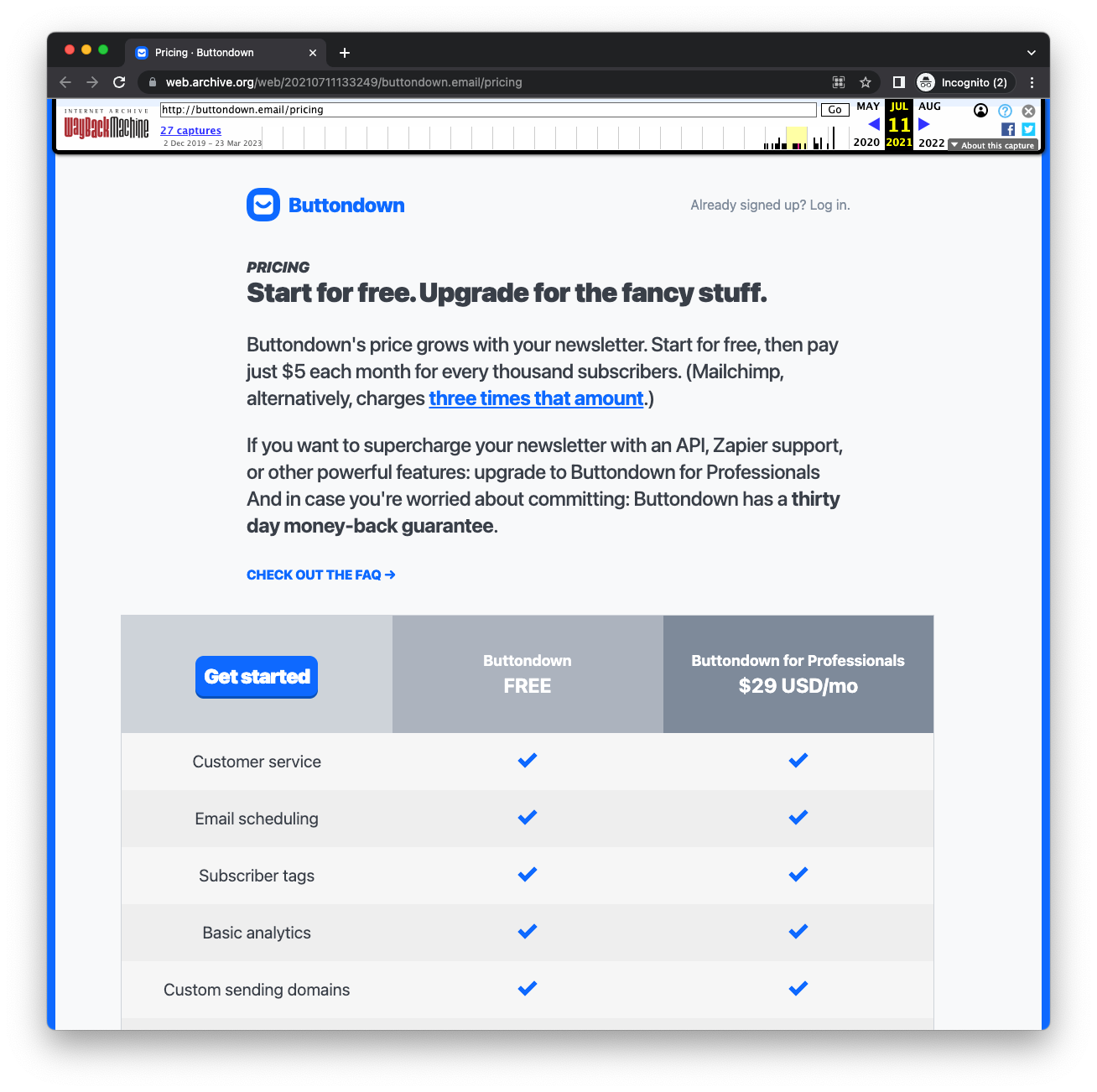
Buttondown's pricing page circa 2020

The problem here was in communication. The vast majority of new customers would have to begin their journey by emailing me some variation of "wait, so how much do I need to pay?" — rarely a good sign.

Buttondown's new pricing model (2022)

Conversion rate: 8.5% · LTV: $397

Last year, I did what many founders do — admit defeat and swear newfound fealty to the almighty three-column SaaS grid. Out goes the clever combination of usage-and-feature-based pricing, in comes the cascading waterfall of checkboxes and the various price tiers:
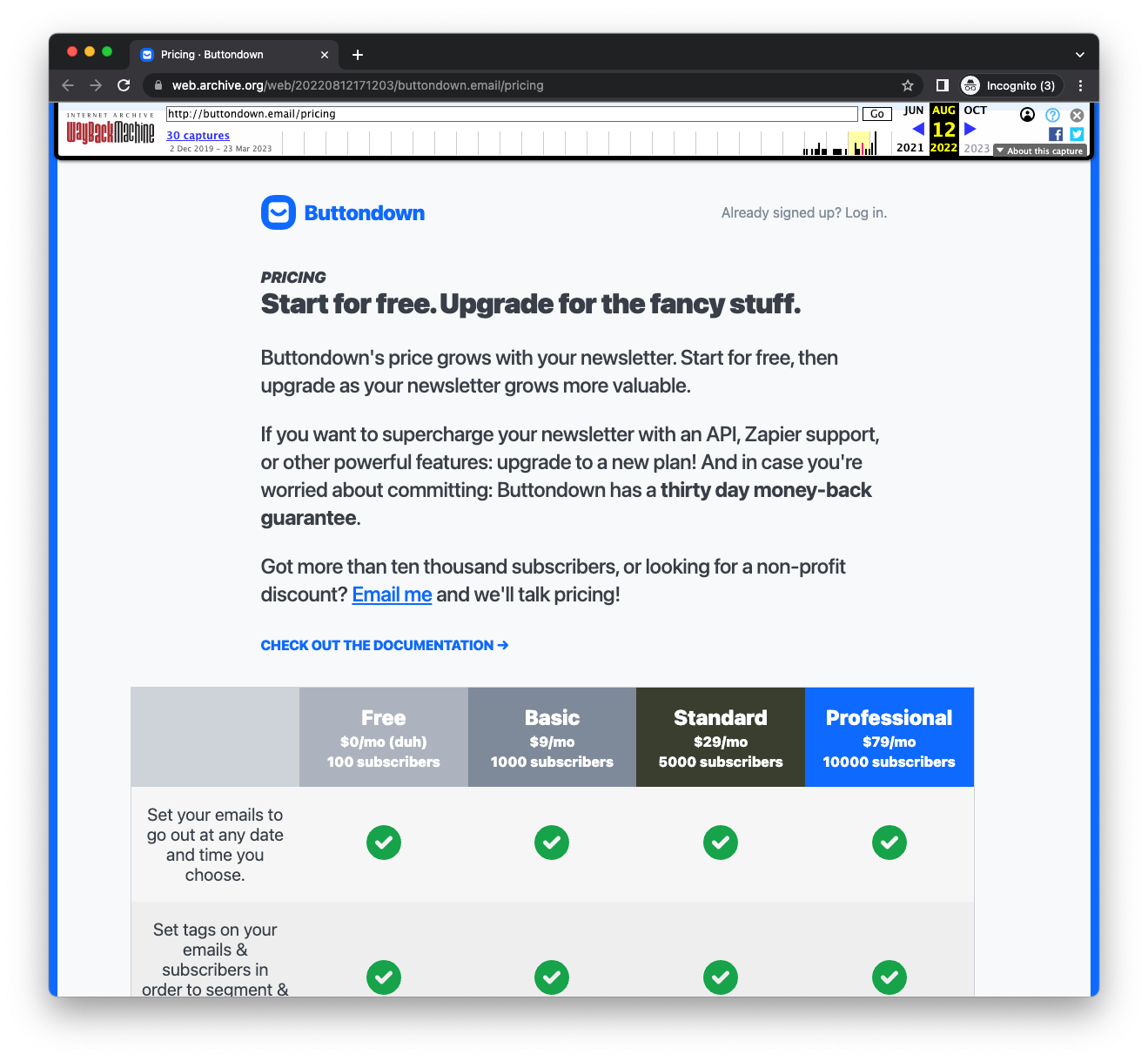
Buttondown's pricing page circa 2022

The combination of both a usage cliff (you have too many subscribers, time to upgrade!) and a feature cliff (you want to use Zapier, time to upgrade!) proved efficacious: ARPU and expansion revenue steadily rose as new customers coalesced around the $29/mo plan.

While the bones of the new pricing model were solid, I found myself running into two core issues:

  1. Expansion revenue from the $29/mo tier into the $79/mo tier was tiny: businesses with hundreds of thousands of dollars of MRR were happily sitting in the $29/mo tier and I didn't have an obvious lever to incentivize them.
  2. Enterprise/volume-based revenue was the wild west: larger customers were put off by the fact that there weren't any obvious tiers for them, and I had to YOLO answers for their costs each time they reached out.

Once again, the pricing page presaged the outcome: of course folks weren't voluntarily expanding because they had no reason to! of course enterprise customers were harder to convert because the messaging for them was terrible!

Expanding Buttondown's pricing model (2023)

Conversion rate: 9.2% · LTV: $511

Earlier this year, I shipped two changes to address both problems:

First, I added and shift functionality to incentivize moving towards Professional — gating whitelabeling behind a higher tier and adding support for teams + dedicated IPs, two long-standing asks:
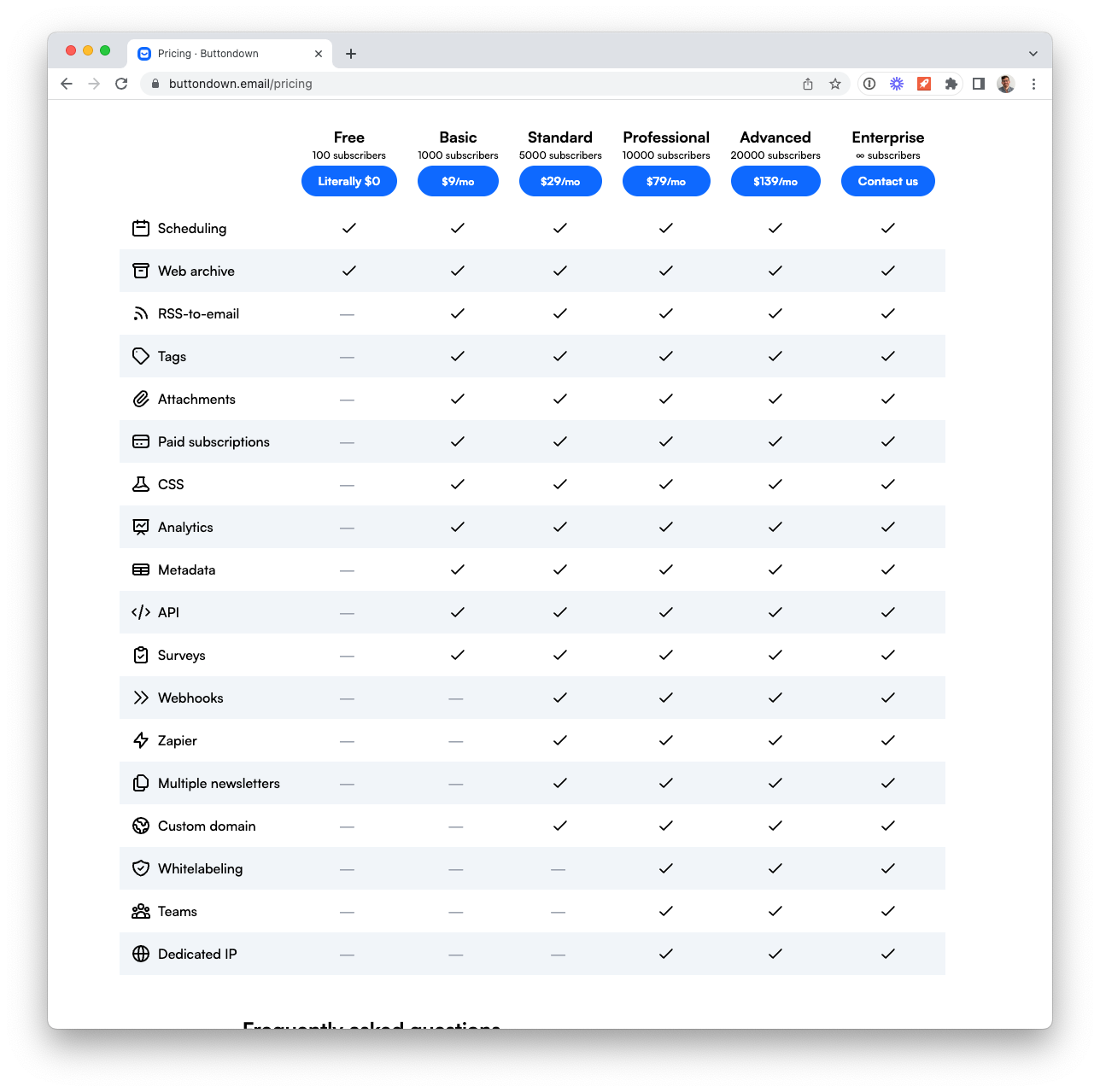
Buttondown's pricing page circa 2023

Second, I added obvious enterprise pricing based on the same value metric that the existing prices were on:
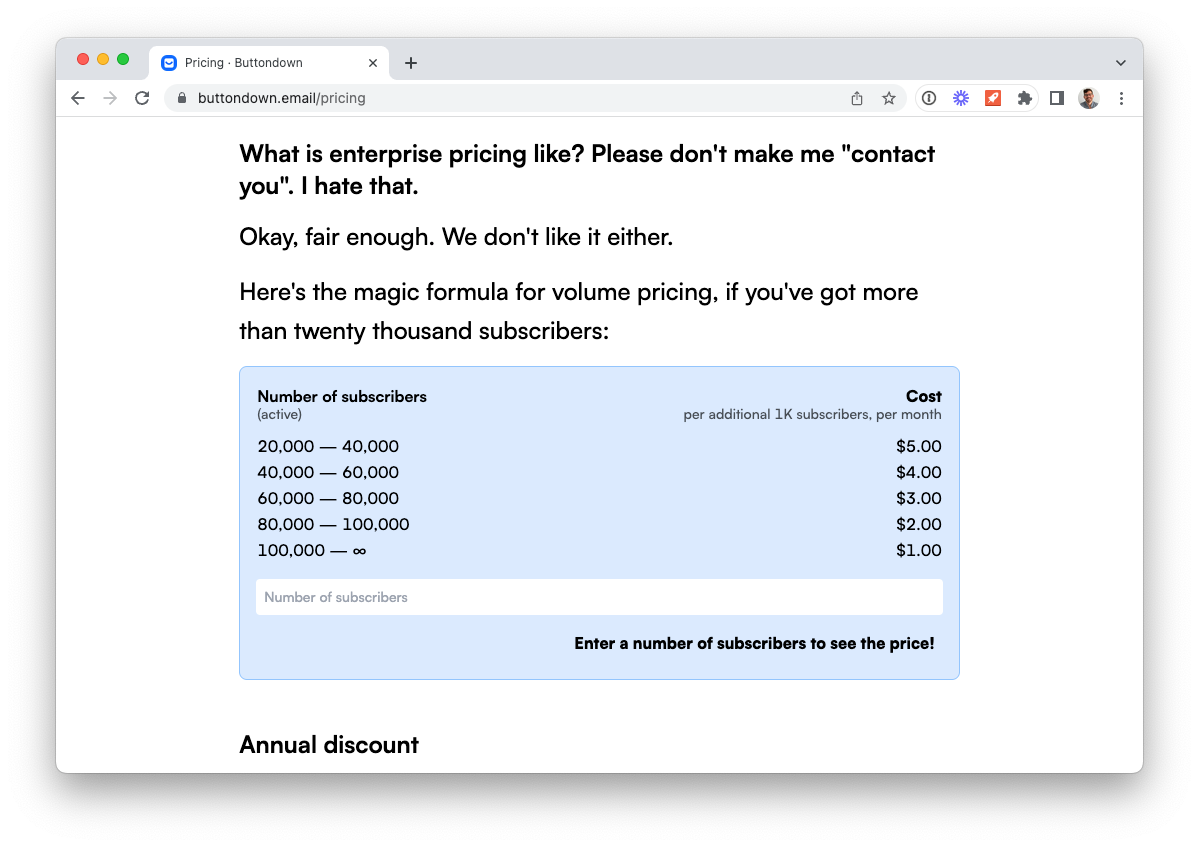
Buttondown's pricing page circa 2023

(I dithered between having the public-facing enterprise pricing be based on "emails sent", which is more common in the industry, vs. "number of subscribers" — ultimately landing on the latter because it feels more cohesive with the other prices.)

Buttondown's pricing isn't perfect — for instance, now I need to think about levers to incentivize upselling into the $139/mo plan — but it's much better than it was 24 months ago. (Much better being defined as ARPU is up and conversion rate is up and churn is down.)

(This pricing page is live, btw!)

All of this is to say

An underrated part of pricing is "does this make sense to users?" Users think about your pricing primarily through your pricing page (and secondarily through your competitor's pricing page.) If rationale or price can't be concisely explained on a page devoted to the subject, then something is probably wrong.