


The Democratic Republic of the Congo is one of Africa’s wealthiest countries even as its people are some of the world’s poorest. It is rich in cobalt, lithium and copper, key materials for the energy transition. Copper is used in electrical wires, and cobalt and lithium are key components in the batteries that keep electric vehicles and cell phones powered. China controls most of the mines and most of the processing factories for these critical minerals, but a big question was how to get the minerals out.
Beijing’s dominance was a fact that weighed heavily on the Biden administration: U.S. envoys had long spoken about investment in Africa, but little had come. And what little U.S. investment there was barely seemed serious. In 2021, The New York Times ran a piece titled “Who Are Congo’s Cobalt Entrepreneurs?,” naming figures such as Akon, the Senegalese-American R&B singer; Jide Zeitlin, a disgraced fashion-industry CEO; and Dikembe Mutombo, a Congolese American basketball player. Of them, only Erik Prince, the mercenary CEO of Blackwater, appears to have built anything that appears to be a sustainable business in Congo — a program to train guards at Chinese mines and support the government in its fight against a rebellion in the country’s restive East.
Biden’s energy czar, Amos Hochstein, began a scramble to figure out how to secure these materials. He came up with a plan that had lain dormant for decades. Beijing had successfully acquired most of the mines in Congo, but most of Congo’s copper and cobalt was exported by road, via Zambia and ports in South Africa. The Americans decided they would try to use Angola’s Benguela Railway to ship Congolese ore across a tract of central Angola and western Congo that it was calling the “Lobito Corridor.”
The corridor stretched over 1,300 kilometers of savannah and scrub to the port of Benguela. The railway had originally been built by British, Portuguese and Belgian colonists in 1903, and had been closed after rebels bombed it in 1975. But the problem was that the Chinese had rebuilt it from 2006 to 2014. More than 20 Chinese workers died during its construction, and the Angolans were broadly grateful to them.
Another problem came from entrenched local interests. The export of copper and cobalt had been an improvised measure, devised in the 1970s, to get around the problems in Angola. However, politicians and powerful local interests in Congo had come to control trucking routes.
The Lobito Atlantic Railway had the potential to “counter Chinese involvement in the African Copperbelt.”
In 2023, the U.S., Angolan, and Congolese governments signed a seven-way memorandum of understanding “to accelerate growth in domestic and cross-border trade along the Lobito Corridor.” They would do this by reopening the Benguela Railway.
The Lobito Atlantic Railway was the Biden administration’s attempt to get serious on critical metals. The development had the potential, as a report by the Cobalt Institute put it, to “counter Chinese involvement in the African Copperbelt.” It was popular in Washington. But it ignored one key detail: It was China, not the U.S., that had spent $1.83 billion rebuilding the railway in Angola. The first shipment of copper and cobalt had taken place under Chinese auspices. By 2024, Angola was the second-largest country for Chinese overseas investment, and Chinese firms were discussing investing in its huge offshore oil reserves.
The railway would certainly be a good thing for Congolese people who lived on the Cobalt Highway out of the country, where dirty trucks caused long traffic jams and polluted nearby homes. The road is also dangerous. Trucks careen off it and kill people with alarming frequency.
One evening in 2022, a truck smashed into the side of my vehicle at a checkpoint outside Likasi, about midway between Kolwezi and Lubumbashi. The driver of the truck, which was laden with sacks of cobalt hydroxide from a Chinese-owned mine near Mutanda, was stoned. After the crash, he stumbled out. I pointed to the mangled fender and door of my rental car. Slurring his words, he asked if I wanted to go and smoke a joint.
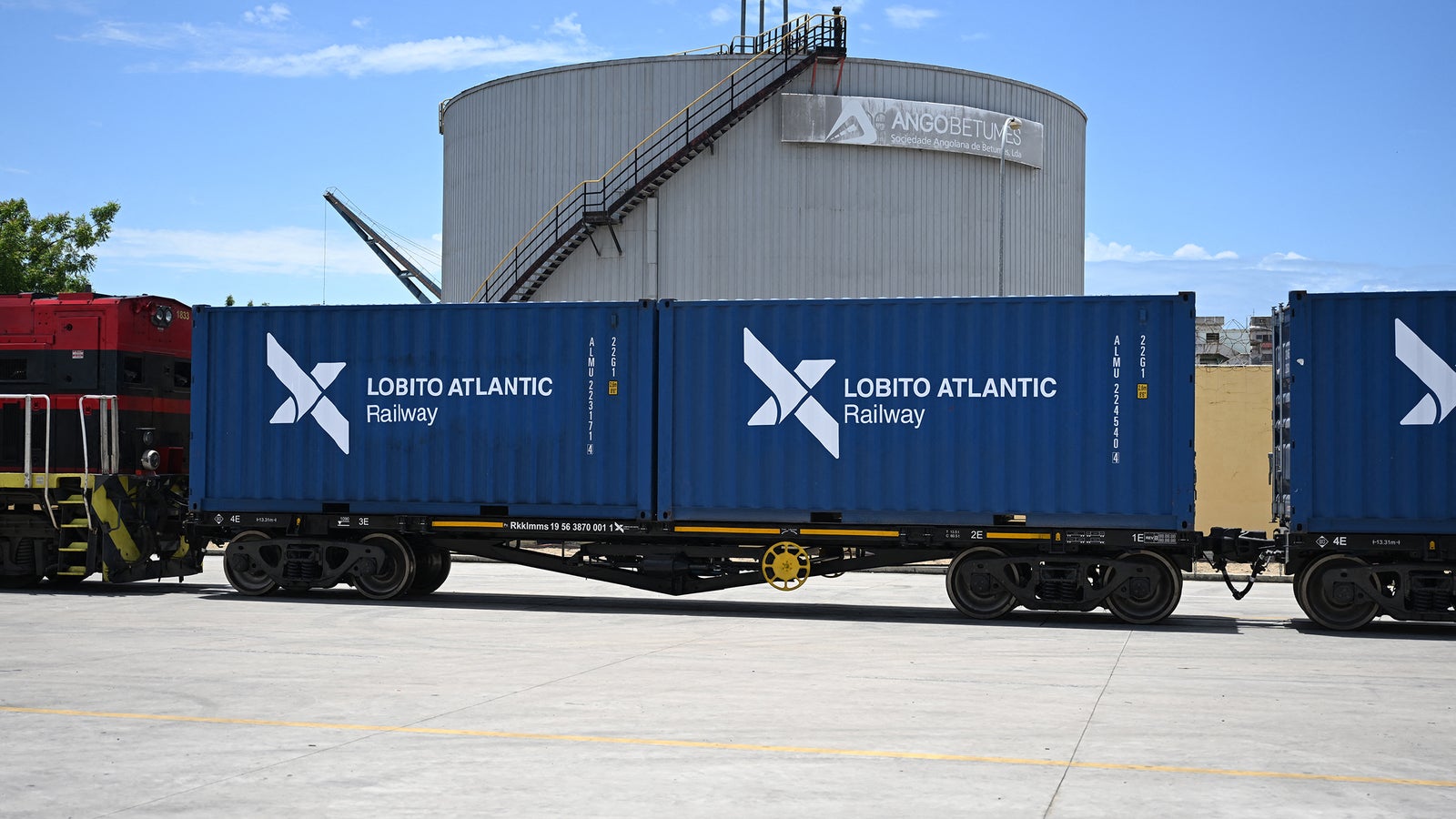
Would the Lobito Corridor end up like so many other well-intentioned plans for Congo and Central Africa, confined to memory and a series of documents gathering dust in an archive? Minerals started to trickle out in 2023, when a test shipment of copper made its way to the coast. In 2024, the Financial Times heralded the project as a soft power blow against China, calling it “the U.S. railway that could set off a copper war.” Later that year, President Biden visited Benguela, the terminus of the corridor, with Angola’s president and Congo’s president, Félix Antoine Tshisekedi Tshilombo.
“Critical minerals our world needs for electric vehicles and semiconductors can be found here,” Biden said in December 2024, on the only trip to Africa of his presidency. “Clean energy we need to power artificial-intelligence data centers and economic growth can be built here.” He continued: “Nations across the Lobito Corridor have solutions to some of the world’s toughest problems.” Tshisekedi hailed the project as “a driving force for economic and social transformation for millions of our people.”
Angolans were sceptical. “The Lobito Corridor is not a contest between the U.S. and China. It is a mirror exposing a harsher truth: the West claims what it did not build; China maintains long-term leverage through the debt and infrastructure it controls; and Angola, constrained by its own machinery of state capture, watches development fall out of reach,” the journalist Rafael Marques de Morais wrote in 2025. “The question is not who laid the tracks or who runs the trains. It is who benefits — and at what cost to the people along the railway, from Lobito to Kolwezi to the war-scarred heart of the DR Congo. Until these questions are answered with integrity, the corridor remains just another extractive route.”
Despite all the investment and guarantees from Washington, comparatively little copper and cobalt has left Congo and passed through Angola by rail on its way to the U.S.
When Trump took office for the second time in 2025, the Lobito Corridor had already handled about 125,000 tonnes of cargo, including around 40,000 tonnes of copper ore from the DRC moving out via Lobito. Trump, however, wanted to control the extraction of critical minerals, not simply their means of export. He was also agitating for them in Ukraine and Greenland. Massad Boulos, the father-in-law of Trump’s daughter Tiffany, was appointed senior adviser for Africa. In his first trip to Kinshasa in his new role in April 2025, Boulos said he envisioned “fostering U.S. private sector investment in the DRC, particularly in the mining sector.” The railroad wasn’t mentioned.
In April last year, James Story, the U.S. ambassador to Angola, told Reuters that the Trump administration was still committed to developing the Lobito railroad. Though the U.S. government was cutting spending elsewhere, it was continuing with the $550 million loan it had pledged to the project, he said.
In mid-2025, Bloomberg reported that a U.S. consortium that included several former intelligence and special forces officials was looking at buying Chemaf, a debt-laden firm that owned several mining permits in Congo and three projects with processing plants. When a Chinese company had tried to buy Chemaf earlier, the Congolese government had held back necessary approvals for the deal, presumably in a show of good faith toward the China-phobic Trump administration. In March this year, Virtus, the intelligence and special forces officials’ new mining company, announced that it had bought Chemaf and would begin working on its assets.
As minerals trickle out of Lobito, State Department officials have told me that the project is one of the key pillars of U.S. strategy in the region. When KoBold, a U.S. mining firm backed by Bill Gates and Jeff Bezos, began looking at developing a lithium mine in the Congolese town of Manono, officials there imagined the means of egress for the lithium ore would include an extension of the Lobito Corridor, but when I asked planners how they would get the minerals to the railway, they admitted that the easiest way would be building a road with China Railway Seventh Group (CREC-7), a Chinese state-owned enterprise.
Still, despite all the investment and guarantees from Washington, comparatively little copper and cobalt has left Congo and passed through Angola by rail on its way to the U.S. For the moment, road transportation still rules, and China looks like it might benefit yet again from U.S. policy in Africa.
此内容由惯性聚合(RSS阅读器)自动聚合整理,仅供阅读参考。 原文来自 — 版权归原作者所有。