







AJ Pics/Alamy
This article first appeared in the Planet Money newsletter. You can sign up here.
OK, hear me out. I'm about to get into a new book with a provocative argument about why income inequality has exploded in America and how to fight it.
But at the center of this very serious economic book is a concept that has me thinking a lot about … the labor economics of the movie Alien. You know, the classic sci-fi horror movie starring Sigourney Weaver, with that diabolical alien — the "Xenomorph" — which has inspired like a dozen other movies and TV shows in the years since. It provides a sort of extreme example of an economic phenomenon that this book and an increasing number of economists suggest is a lurking monster in the labor market that needs to be confronted.
A central storyline in Alien franchise goes something like this:
In 2099, a British company and a Japanese company merged to create the all-powerful Weyland-Yutani Corporation, a multi-planetary conglomerate with tentacles in artificial intelligence, robotics, terraforming, mining, space transportation, and weapons development. It operates in the far-flung reaches of space, apparently beyond any meaningful regulations or oversight.
The Weyland-Yutani Corporation is a terrible employer. Take the original Alien movie. Ripley (played by Sigourney Weaver) and the rest of her crew on the USCSS Nostromo spaceship are essentially space truckers, hauling mineral ore across the galaxy for the company. The distance is so far they have to go into cryogenic sleep for the journey. But, on their way home to Earth, the company reroutes them. The ship's computer awakens the crew after picking up a mysterious signal on the moon of a distant planet, and the company puts in motion a plot to get them to go to it.
The workers complain. One says he wants to go home, and they deserve a bonus if they have to do work beyond what they signed up for. But another crewmember — who is secretly an android doing the company's bidding — tells them that their contract's fine print says any signal like this must be investigated, or else their contract is void and they have to forfeit their salaries. The company has all the leverage. With no bargaining power, the workers comply without getting extra pay for overtime work.
The company's manipulation kicks off a journey toward disaster. The crew lands on this distant world, where they discover a cluster of alien eggs on a crashed spaceship. One opens. A crab-like creature pops out, clamps onto a crewmember's face, and puts him into a coma — while implanting an embryo inside him without anyone realizing. Rejecting Ripley's insistence they follow standard quarantine protocols, the company's android lackey compels them to bring their unconscious co-worker back aboard the ship. The afflicted worker then wakes up and — in one of the most iconic and horrifying scenes in movie history — an alien bursts from his chest, and it spends the rest of the movie terrorizing and killing the crew. Talk about a workers' comp issue.
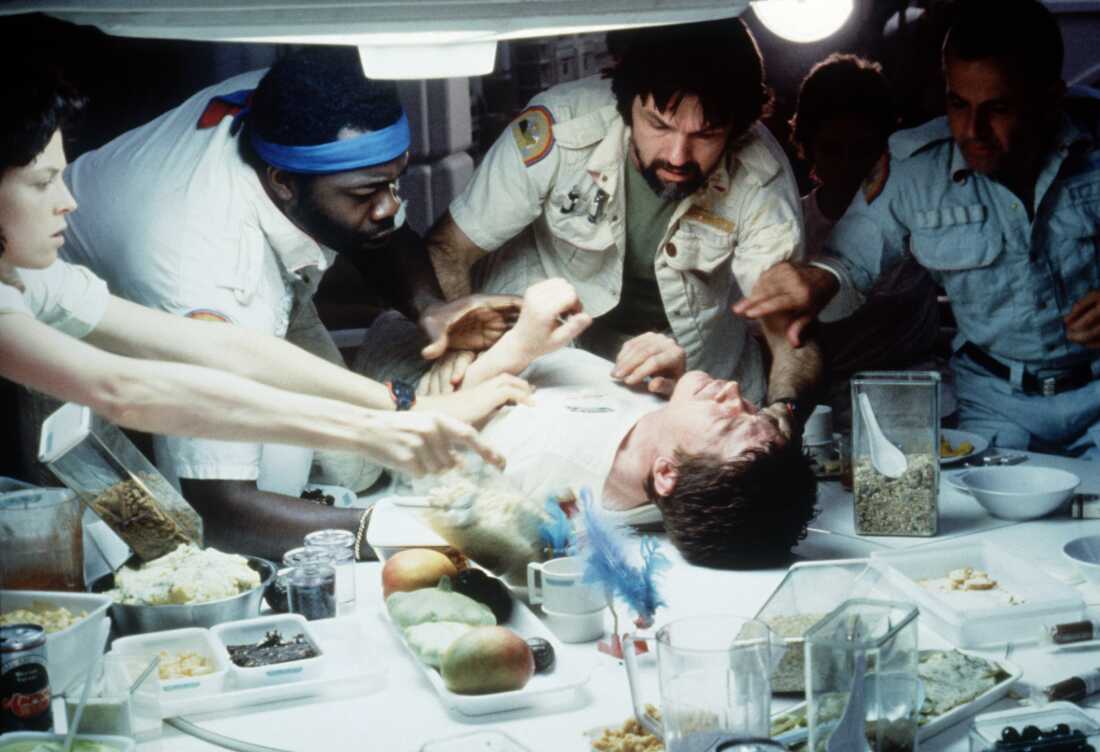
Ripley searches the ship's digital log and discovers that the Weyland-Yutani Corporation had secretly instructed the ship's computer to reroute the ship and implemented a plan to coerce the crew into obtaining an alien "specimen." The company wants to obtain and study this acid-blooded alien for its weapons division. "All other considerations second," the directive says. "Crew expendable."
Sure, Alien is about an alien. But, on a deeper level, it's the story about the horrors of a cartoonishly evil company with unchecked power. The Weyland-Yutani Corporation is an extreme form of what's known in economics as a monopsony.
A monopsony is like the inverse of a monopoly. Whereas a monopoly means one seller, a monopsony means one buyer. It's a concept relevant to the labor market because employers buy our labor.
When there's only a single employer somewhere — like the vacuum of space — and they don't face competition, that can give the company extra power over workers. Without outside job options, workers have a harder time quitting a crappy job and working somewhere else. They're basically trapped. That can give an employer the power to underpay them… or, you know, pressure them into cohabitating on a small spaceship with a killer alien.
For a long time, most economists believed the labor market was mostly competitive and treated monopsonies as like footnotes in history. Economic textbooks commonly cite mining companies in remote locations — kind of like Weyland-Yutani! — as classic examples of monopsonies.
But in a new book, The Wage Standard: What's Wrong in the Labor Market and How to Fix It, economist Arindrajit Dube articulates an increasingly popular theory, based on a growing amount of peer-reviewed economic research, that monopsony power is much more pervasive in the economy than previously imagined, even in places where there are seemingly many employers competing for labor.
We're not talking about literal, pure monopsonies here. Nothing like the power of Weyland-Yutani in deep space. Really, when Dube and other economists talk about "monopsony power," they're talking more generally about employers that face weak competition in hiring and retaining workers, which gives them some ability to underpay or mistreat them. The idea is that companies don't necessarily have to be the only employer in town in order to exercise significant power over workers.
In a way, it's a theory that a lot of companies out there have a mini (probably less nefarious) Weyland-Yutani inside of them, and that we, as a society, have to do work to make sure they don't become too powerful and sinister and stomp on worker rights.
In this conception of the labor market, which rejects the free-market orthodoxy of old-school economics, society needs counterweights to employer power — like a minimum wage, antitrust regulations, public pressure campaigns, business norms about fairness, and labor unions — in order for many companies to pay workers a decent wage and treat them fairly. It's a theory that suggests the crewmembers of the USCSS Nostromo would have fared much better had they been in a union, had a better contract, or had some sort of government-enforced protections.
The story of exploding income inequality in the United States, in Dube's telling, is inextricably linked to a concerted assault on the counterweights to monopsony power since the early 1980s. Think like the erosion of the federal minimum wage, the decline of unions, and a vibe shift in corporate boardrooms away from concerns about fairness.
But Dube also has a surprisingly optimistic take on the direction our society has been moving. He argues that, at least until recently, we've been seeing the resurrection of institutions, policies, and vibes that could help restore greater equality in the labor market.
Stay tuned for next week's Planet Money newsletter, where we'll dive deeper into The Wage Standard, the intellectual history of monopsony, and why Dube believes monopsony power is more pervasive than previously thought.
If you're not subscribed, sign up here.
此内容由惯性聚合(RSS阅读器)自动聚合整理,仅供阅读参考。 原文来自 — 版权归原作者所有。