







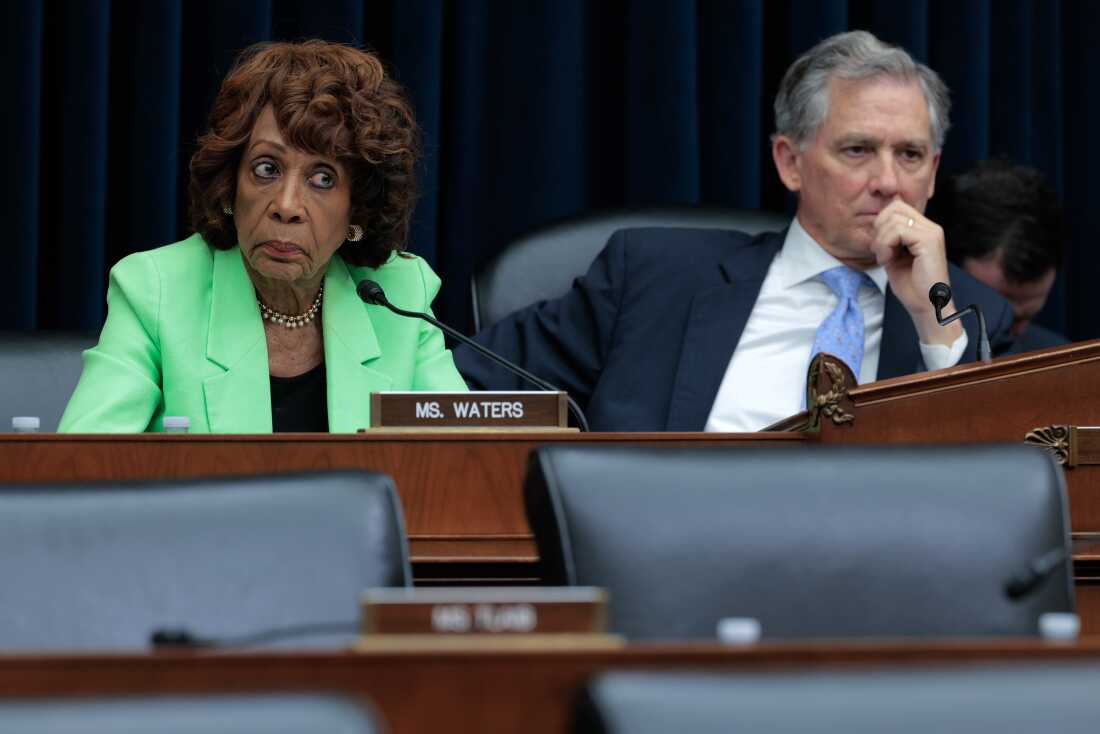
House Financial Services Committee ranking member Rep. Maxine Waters, D-CA., and Chair French Hill, R-AR., listen to a hearing on Capitol Hill on June 24, 2025. Chip Somodevilla/Getty Images hide caption
toggle caption
Chip Somodevilla/Getty Images
Stay up to date with our Up First newsletter sent every weekday morning.
Republicans and Democrats in the House voted Wednesday to pass a bill to address the nation's housing affordability crisis. It encourages homebuilding across the country and would ban corporate landlords from buying up more than 350 houses.
The bill passed 396 to 13, and is an amended version of one passed by the Senate two months earlier. The two chambers still have to agree on a single version before they can send it to the president for his signature.
Both parties are eager to show they are taking legislative action ahead of the midterms to deal with the country's housing crisis. A shortage of homes has driven up prices to an average of $400,000, well outside the range of what many Americans can afford. Just getting more homes into the market faster would help ease the shortage, with Realtor.com estimating there's a 4 million unit gap between available housing and the demand.
If passed, this would be the largest piece of housing legislation in decades.
The House's version of the bill says any group that owns more than 350 houses would not be allowed to buy more single-family homes. These corporate landlords have become a sort of bipartisan boogeyman, with legislators expressing concern that they are buying up homes to rent, outbidding American families who can't compete with well-financed investors who can pay all cash.
Research shows that what this does to home prices is mixed: In some cases it can raise the selling price of homes, but it can also lower the cost to rent by increasing the available supply. Nationally, these investors make up only about 3% of the single-family rental market, though their share is much higher in the Sun Belt and some specific cities like Indianapolis and Seattle.
This small footprint has not stopped politicians on each side of the aisle from lining up to oppose corporate homeownership. President Donald Trump signed an executive order in January ordering federal agencies to not support large institutional investors in purchasing single-family homes. Sen. Raphael Warnock, D-GA, pushed for a ban on these corporations buying houses — and that made it into the Senate bill.
The Senate version did provide one path for investors to own swaths of homes: They could build them.
"Build-to-rent" homes have gone from a niche corner of the housing market to making up 7% of all single-family home construction over the last decade. As the name implies, these standalone houses are built specifically for renters. The phenomenon has plenty of think tank and housing industry supporters who argue it helps lower housing costs by bringing more units onto the market.
But the Senate version of the bill also required those large-scale landlords to sell off their build-to-rent homes to families after seven years.
That provision saw a wave of pushback from the homebuilding industry. An open letter representing 79 industry groups said while they support other parts of the Senate bill, it would "effectively eliminate the production of Build-to-Rent housing."
The House version gets rid of this limit on build-to-rent homes.
At one point, it also included several pages of exceptions to its large-scale investor ban. Investors would have been able to buy homes owned for less than a year along with ones that had only ever been rentals. Land trust and nonprofits would have also been excluded from the ban. But those loopholes were removed from the bill the day before the House voted.
A "meatball" approach to addressing the housing dilemma
While the ban on corporate homebuying might be the most politically potent part of the bill, the legislation doesn't revolve around a central fix for the country's housing crisis.
Instead, it is a policy "meatball," as the Senate version's co-sponsor Elizabeth Warren, D-Mass. called it in March, filled with provisions championed by Republicans and Democrats in both chambers. "It's got a lot of different ingredients in it, but it's the fact that it's all there together is what makes it so delicious," Warren told NPR.
A main theme of the bill's ingredients is deregulation. Factory-built homes will no longer be required to have a permanent chassis — a steel frame that allows the home to be transported, even though many manufactured homes are never moved. The bill would streamline the environmental review process for homes built in the gaps between existing buildings.
A grant program would let communities develop "pattern books" of preapproved housing designs, which would require fewer approvals. Cities that have already tried such ready-to-go designs saw quicker construction, which lowered the cost to build and made the homes more affordable, according to The Pew Charitable Trusts.
President Trump recently called on House Republicans to vote in favor of the unamended Senate version, but he has not commented on the altered bill.
The bill will now go back to the Senate to be considered for final passage.
此内容由惯性聚合(RSS阅读器)自动聚合整理,仅供阅读参考。 原文来自 — 版权归原作者所有。