


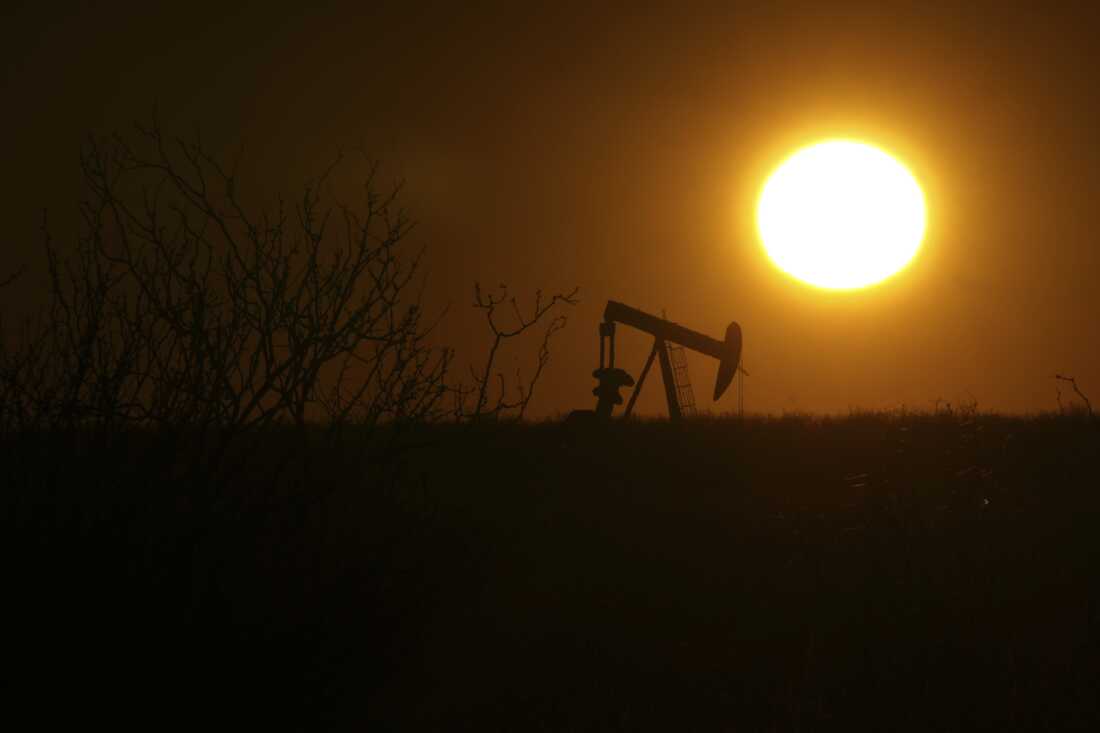
A pumping jack is visible at sunrise on Feb. 24, 2025, in Hobbs, New Mexico. Julio Cortez/AP hide caption
toggle caption
Julio Cortez/AP
Higher prices are good news for the oil industry — to a point. But they can bite, too.
Crude oil prices were around $70 a barrel before the war in Iran. After the U.S. and Israel attacked, they started swinging wildly, shooting up to nearly $120; with the current ceasefire, prices are between $90 and $100. Some disruptions to supply could take months to unwind even if the ceasefire holds, which has some analysts predicting a prolonged period of higher prices.
A clip from the TV show Landman recently went viral; in it, Billy Bob Thornton, as Texas oilman Tommy Norris, explains that the industry wants crude prices to live somewhere between $60 and $90 a barrel.
"Don't get me wrong — we're still printing money at $90," he says. "But gas gets up over $3.50 a gallon, it starts to pinch."
NPR doesn't usually turn to TV dramas for economic analysis. But Ed Crooks, the vice chair for the Americas at the energy and natural resources research group Wood MacKenzie, says that clip "is exactly right."
"There is a kind of a sweet spot for the oil price, a nice range for it to be in" from the industry's perspective, Crooks says. The war in Iran pushed the market well outside that range.
As a result, the current crisis isn't just a cash bonanza for the oil industry. It's also a cause for industry concern.
We'll have a better sense of exactly how much money oil producers may be printing when the publicly traded companies start to report quarterly earnings in the next few weeks. ExxonMobil, which reports earnings May 1, just told investors that it estimates higher prices have boosted its revenues by more than $2 billion.
For now, the stock performance of the energy sector is a pretty good indicator that the industry is thriving with these prices. Since the start of the year, energy stocks have risen some 25%, while the S&P 500 has dropped slightly. That's factoring in a drop in oil stock prices when a two-week ceasefire between the U.S. and Iran was announced on Tuesday.
And the U.S., as the world's largest oil producer, reaps a disproportionate benefit from high prices. While producers like Saudi Arabia have had their exports stymied by the near halt of traffic through the Strait of Hormuz, U.S. production is unaffected. American oil companies can sell as much as ever, now at an inflated price.
President Trump has pointed to this, posting, "when oil prices go up, we make a lot of money." And that's true, for some definitions of "we."
Isabella Weber, a professor of economics at UMass Amherst, worked on a paper that found that in 2022, after Russia launched its full-scale invasion of Ukraine, the global oil industry brought in some $916 billion in profits. The U.S. was the chief beneficiary, raking in $301 billion, some seven times the pre-COVID average annual profits for U.S.-headquartered oil and gas companies.
Weber says this money, through shareholder payouts, disproportionately flowed to the very wealthy. "We find that 50% of the profits in the oil and gas industry went to the top 1% richest Americans, whereas only 1% of those profits went to the bottom 50%," she says.
Meanwhile, when fuel is expensive, everyone who drives or buys goods pays more. The costs of high oil prices are widely distributed, while the benefits are concentrated among a few.
In fact, you can think of high oil prices as a redistributor of wealth, away from the American consumer and toward people who work for, and invest in, the oil industry. This could be a political problem for the current administration, says Crooks, because "a lot more people are affected by the downside of high gas prices than benefit from the upside."
While soaring prices mean more cash flows to the oil industry, the conflict hasn't been all good news for producers. Some of the biggest companies are directly hurt by the conflict, because they have invested in facilities in the Middle East that have been under attack or they have oil and natural gas that can't reach markets due to the reduced traffic through the Strait of Hormuz. ExxonMobil, for instance, estimates that lower production in the Middle East and other disruptions tied to the war are costing it between $1 billion and $1.6 billion this quarter, offsetting much of that $2 billion-plus boost from higher prices.
And even companies that operate only in the U.S. might not benefit as much as you might think.
One reason: hedging. That's when a company locks in a price for its oil months in advance of actually selling it. Hedging provides some certainty in an uncertain market, letting both oil producers and consumers plan their budgets in advance.
Some companies locked down relatively low prices before the war began, back when the global oil market was oversupplied and producers were worried about prices dropping even further. Now they can't take advantage of those prices rapidly shooting up instead.
Based on an analysis of public reports, Jai Singh, head of North America oil and gas research at the consultancy Rystad, estimates that companies that primarily make oil "have hedged at an average floor price of $57 [a barrel], and they've hedged about a third of their production coming into this year."
As a result, he says, "There were some limits to how much of this windfall they could enjoy."
Another reason companies may not be reaping the biggest-possible profits: limitations on how much they can boost production. Producing more oil would seem like an obvious way to rake in more cash, now that prices have spiked. But drilling new wells takes time. The number of partially completed wells that can come online quickly is relatively low right now.
And there are some serious physical constraints to ramping up production. In the Permian Basin in Texas, the most prolific oil basin in the U.S., a single well will often produce both oil and natural gas. You need pipelines to get that natural gas from the field to the market, and those pipelines are pretty much full right now. Producers might want to drill a new well for the oil, but they can't if they don't have any way to move the natural gas that comes with it. There are other constraints too, including staffing shortages and geological considerations.
There's also intense pressure from investors to make sure any new wells will be profitable in the long term. If companies are going to spend cash on drilling instead of paying it out as dividends to shareholders, investors want to be confident that it will pay off down the line — and if the price of oil collapses, it might not.
After all, Crooks points out, investors have been burned before. For the first 15 years of the shale boom, the U.S. shale industry lost enormous amounts of money by drilling lots of wells that turned out to be less profitable than they'd hoped. "People dug big holes in the ground, poured bucketloads of dollars into those holes and then set fire to them," Crooks says. Investors aren't tolerating that anymore.
So, will drilling a new well today make money for investors? It depends on what the price of oil is like months from now.
And nobody knows what the price of oil will be tomorrow, let alone next year.
That brings up the third challenge: volatility. Prices have been on a roller coaster since the war began.
Several oil producers declined to comment for this story, but Dustin Meyer speaks for the industry as the head of policy and economics for the American Petroleum Institute trade group.
"This amount of volatility that we're seeing in the marketplace is not good for anyone," he says. "Our industry is fundamentally predicated on making long-term investments, and it's very hard to do that when market prices are so volatile and so unstable."
Well, it's good for a very short list of people, perhaps. Bob McNally, the founder of Rapidan Energy Group, is the author of the book Crude Volatility. He says traders can benefit from volatility — if they ride the roller coaster right, buying low and selling high.
So can storage owners that charge fees for keeping oil in tanks; all that oil being traded in a wildly swinging market has to be stashed somewhere while the deals are struck. And analysts who are kept busy writing about the market gyrations. "And lawyers, because lawyers always seem to do well no matter what happens," he says. "Everybody else is harmed."
But what if prices stop swinging and just stay high for a long time?
That, too, could be bad for oil producers, depending on exactly how high. In the Landman clip, that's what Tommy Norris means when he talks about prices starting to "pinch."
When oil prices stay consistently above that $90 mark, "the economy suffers and inflation rises," Crooks, of research group Wood MacKenzie, says. "Growth falls. Interest rates may go up. People in the wider economy lose their jobs."
Oil demand is typically quite resilient; people need gasoline to go to work and get their kids to school, even if prices make them wince. But a global economic slowdown or even a recession could bring demand sharply down.
Meanwhile, high prices also increase interest in alternatives to oil, Crooks says. That's good news for electric car makers and the environment, but not for oil companies.
A recession and a boom in alternatives to oil are both examples of what the industry calls "demand destruction," meaning long-term reductions in how much oil the world wants to buy.
If global oil prices are high enough for long enough and demand drops substantially, that "puts the oil industry on a weaker footing looking years and decades into the future," Crooks says.
此内容由惯性聚合(RSS阅读器)自动聚合整理,仅供阅读参考。 原文来自 — 版权归原作者所有。