



惯性聚合 高效追踪和阅读你感兴趣的博客、新闻、科技资讯
阅读原文 在惯性聚合中打开

推荐订阅源

T
Threatpost
aimingoo的专栏
aimingoo的专栏
OSCHINA 社区最新新闻
OSCHINA 社区最新新闻
T
Tailwind CSS Blog
J
Java Code Geeks
博客园_首页
Google Online Security Blog
Hugging Face - Blog
Hugging Face - Blog
C
CXSECURITY Database RSS Feed - CXSecurity.com
I
Intezer
P
Palo Alto Networks Blog
V
Vulnerabilities – Threatpost
雷峰网
雷峰网
O
OpenAI News
SecWiki News
SecWiki News
小众软件
小众软件
酷 壳 – CoolShell
酷 壳 – CoolShell
美团技术团队
N
News | PayPal Newsroom
Project Zero
Project Zero
Forbes - Security
Forbes - Security
IT之家
IT之家
A
Arctic Wolf
WordPress大学
WordPress大学
Jina AI
Jina AI
T
Tor Project blog
博客园 - 三生石上(FineUI控件)
S
Secure Thoughts
Google DeepMind News
Attack and Defense Labs
博客园 - 聂微东
Exploit-DB.com RSS Feed
P
Privacy International News Feed
Cloudbric
Cloudbric
G
GRAHAM CLULEY
博客园 - 叶小钗
H
Hacker News: Front Page
腾讯CDC
量子位
Help Net Security
Help Net Security
人人都是产品经理
人人都是产品经理
C
Cyber Attacks, Cyber Crime and Cyber Security
月光博客
月光博客
奇客Solidot–传递最新科技情报
奇客Solidot–传递最新科技情报
宝玉的分享
宝玉的分享
爱范儿
爱范儿
L
Lohrmann on Cybersecurity
Hacker News - Newest:
Hacker News - Newest: "LLM"
Recorded Future
Recorded Future
C
CERT Recently Published Vulnerability Notes

NPR Topics: Business

Budget-conscious shoppers are feeding a boom in discount groceries Florida farmers struggle to adapt as disease and climate take toll on citrus industry Looking back at Jerome Powell's 8-year term as Federal Reserve Chair They graduate to six figure salaries, and grueling work ABC argues Trump administration is trying to chill free speech Prices are up, but Mother's Day still means brunch With Spirit in liquidation, here's what happens next to its planes Trade court strikes down a second round of Trump tariffs She helps families in need. As gas and grocery prices rise, she needs help, too Gas prices keep rising, but do big oil companies plan to drill more? Not so far Campaign staffers tell NPR they make 'thousands' betting on their own candidates How the petrodollar regime came to be, and what losing it would mean for the U.S. CNN Anchor Christiane Amanpour remembers Ted Turner How Silicon Valley's new tech right has profited by aligning with MAGA 'A trailblazer, a rabble-rouser, a do-gooder': CNN founder Ted Turner dies at 87 Have you lost or are worried about losing SNAP benefits? NPR wants to hear your story A trip to Europe? In this economy? Expensive flights keep vacations closer to home NPR went looking for Polymarket's Panama headquarters. It's elusive The Iran war sent jet fuel prices sky-high. Here's what air travelers should know If you are struggling to make ends meet, NPR wants to hear from you GameStop makes unsolicited bid to acquire online auction giant eBay for $56B Hotels have a big World Cup problem: Bookings are running far below projections Spirit Airlines shutters after federal bailout falls through Gas prices went up more than 30 cents a gallon last week. How high could they go? He recorded his quest for tariff refunds. It shows why billions may never get repaid How algorithms wreaked havoc with these workers' schedules and cut their pay Oil and gas companies making hay by making plastic? An inevitable rise in Chinese-made EVs in America? Spirit Airlines ceases operations after escalating financial struggles Iran war shakes Global economy as energy costs surge and recession fears grow How well can EVs handle the heat — and the cold? AAA put them to the test Trump gives the go-ahead for a major new Canada-U.S. oil pipeline The economy is growing – but soaring energy prices could put a damper on that How Spirit Airlines grew so fast — and why it's experiencing so much turbulence now These fans are boycotting the World Cup. Will they make it a bust? The U.S. economy shows resilience despite the war with Iran Musk continued his testimony from yesterday in lawsuit against OpenAI In court, Elon Musk accuses OpenAI of trying to 'have your cake and eat it, too' As Supreme Court weighs Trump's immigration policy, senior citizens join the fight Spirit Airlines tried to be the Dollar General of the skies. Then the big airlines beat it at its own game It's set to be Jerome Powell's last meeting as Fed chair -- as a big change looms Why Sen. Warren voted no for Kevin Warsh as Fed chairman FCC orders early license renewal for ABC stations following Kimmel's first lady joke As trial against OpenAI begins, Elon Musk seeks Sam Altman's ouster The United Arab Emirates is quitting OPEC oil cartel after nearly 60 years Millions of homes in the U.S. are uninsured. NPR wants to hear your story Lawsuits accuse State Farm of secretly working to cut insurance payouts China's supply chains hit by Iran war Melania Trump wants ABC to 'take a stand' against Jimmy Kimmel after 'hateful' joke Ingenious? Orwellian? Or both? Supreme Court considers constitutionality of 'geofence' warrants Musk vs. Altman: Tech CEOs head to court Monday over fate of OpenAI Climate disaster victims are rebuilding using prefab homes from boxy to bespoke How the Iran war is impacting the airline industry Diary of a business owner trying to get a tariff refund from the U.S. government U.S. looks into regulating prediction market sites like Kalshi and Polymarket Airlines face headwinds as Iran war leads to rising fuel costs Justice Department drops inquiry into Fed Chair Jerome Powell French police probe suspected weather device tampering after odd Polymarket bet Warner Bros. Discover approves $110B Paramount–Skydance merger; regulators up next Meta will lay off 10% of its staff Warner Bros. Discovery shareholders approve $110B merger with Paramount Skydance Tesla's profits beat expectations, but Elon Musk says big costs are ahead The tariff refund process has begun for businesses. What about customers? How the airline industry could be impacted if Spirit Airlines is liquidated The hidden power keeping wages low She raised concerns about her company's contracts with ICE. Then she lost her job Here are 3 takeaways as Trump's pick to lead the Fed faces a confirmation fight Tim Cook to step down as Apple CEO The Onion has agreed to a new deal to take over Infowars Trump's labor secretary resigns amid investigation into misconduct In the American Heartland, farmers are literally betting the farm to stay in business How Saudi Arabia's entertainment investments are playing out at home and abroad Small business owners queue up for tariff refunds This tariff-refund portal is about to be America's hottest website Photos: How overfishing in Southeast Asia is an ecological and human crisis Tired of waiting for your EV to charge up? One Chinese company has a novel solution Judge halts local TV giant Nexstar's takeover of rival Tegna until trial Gasoline could drop below $4 in coming days NPR receives $113 million in charitable gifts A Polymarket trader made $300,000 betting on Biden's pardons, a new analysis shows Jet fuel prices double, leading airlines to increase baggage fees, raise fares Jet fuel supplies are sharply affected by the near-closure of the Strait of Hormuz Visionary NPR leader Kevin Klose, who led network to new heights, has died Once again, Trump threatens to fire Fed Chair Jerome Powell Tax season was supposed to bring big refunds. So far they're less than expected Hollywood heavyweights oppose Paramount deal Fuel protests have Ireland's government facing possible no-confidence vote The labor economics of 'Alien' — and its lessons for inequality on Earth 2 local TV giants merged. Then a court stepped in Families across the U.S. are getting college acceptance letters — and tuition bills Inflation surges to highest level in nearly 2 years as energy costs spike Women are getting most of the new jobs. What's going on with men? How governments have tried to hide information about the Iran war online Inflation climbs to highest level in nearly 2 years Well-timed bets on Polymarket tied to the Iran war draw calls for investigations from lawmakers How an ancient resin traded for centuries got snarled up by the Iran war How a cheese sandwich at the Masters is still $1.50 in an era of price hikes Why high oil prices are good for oil companies — until they aren't Why OpenAI bought 'SportsCenter for Silicon Valley' Oil prices plunge and stocks soar after U.S. and Iran agree on a ceasefire
Short flights are popular. Will they last?
Bill Chappel · 2026-05-13 · via NPR Topics: Business
Short regional flights are the lifeblood of U.S aviation — but they were in decline even before jet fuel concerns struck. Here, a file photo shows a Delta Air Lines Connection regional jet operated by GoJet Airlines taking off from Logan International Airport in Boston.

Short regional flights are the lifeblood of U.S aviation — but they were in decline even before jet fuel concerns struck. Here, a file photo shows a Delta Air Lines Connection regional jet operated by GoJet Airlines taking off from Logan International Airport in Boston. Charles Krupa/AP hide caption

toggle caption

Charles Krupa/AP

U.S. domestic air travel has boomed in recent years, except for one segment. Short flights of a few hundred miles decreased over the past decade, while longer flights became more popular, according to data gathered by the aviation analytics firm OAG for NPR.

Nearly 4 million short flights are scheduled for this year. But as of mid-April, the number of flights spanning less than 250 nautical miles had declined by 11% from 2016 to 2026 — the biggest drop of any route length. The decline comes as no surprise to John Grant, a senior analyst at OAG.

"That is an awful distance to be operating," he says, because short flights are more expensive for airlines than flights with a longer cruise time.

In contrast, every domestic flight category of more than 500 miles saw notable gains over the same 10-year span. The numbers depict the U.S. hub-and-spoke aviation system moving toward longer "spokes" for some routes.

The trend was well established even before rising fuel prices from the Iran war rattled U.S. aviation. It could now accelerate, as airlines raise prices and trim less-profitable flights due to jet fuel supply constraints.

Domestic jet fuel costs have roughly doubled since early February, before the U.S. and Israel attacked Iran. U.S. airlines spent more than $5 billion on jet fuel in March, a 56% increase from February, according to the Bureau of Transportation Statistics. Spirit Airlines blamed the soaring fuel costs when it announced it would shut down last weekend. Prices are even higher for Asia and other markets that rely more heavily on supplies transiting the Strait of Hormuz.

"Any time there is pressure like that, particularly a cost pressure, but also a resource pressure, airlines are going to concentrate flying where they can move the most passengers with the fewest pilots," says Faye Malarkey Black, CEO of the Regional Airline Association.

Short-hop flights are the most frequent, and least efficient

Every day, thousands of U.S. airline passengers step off planes without needing to check the local time and weather, because they've traveled less than 100 miles, on flights lasting less than an hour.

For example, there are dozens of flights between Milwaukee and Chicago each week, even though they're separated by less than 80 miles and have been connected by rail lines for more than a century. But there's a key snag for travelers in the Milwaukee area who might want to take the train to O'Hare International, says Joshua Schank, an urban planning professor at UCLA who's also a partner with the consulting firm Infra Strategies.

"Remember, that rail is going between the [cities'] two downtowns, and it's not between the airports," he says. "And that's the key distinction," he adds, noting that a majority of the route's passengers are likely connecting to other destinations beyond Chicago.

For routes like that to make economic sense, they require enough people willing to pay, says Black, of the airline association.

"It's not the distance, it's the density," she says. "If you have a short flight that has a lot of density because it's between two urban centers and it's a viable option, then people will take that option."

It's one of the shorter spokes in the U.S. hub-and-spoke system that helps airlines concentrate their traffic. That's why the sub-250-mile distance remains the second most popular domestic route, even with its double-digit decline. The most popular flight category over the past 10 years isn't much longer, with the 251 to 500 nautical mile distance scheduled 2.1 million times in 2026, despite a roughly 4% dip.

But all those repeated shorter flights come at a cost.

"A lot of the fuel is used in the takeoff and landing processes," Grant says. And every landing, he notes, adds wear and tear on the planes' equipment.

To hit the sweet spot of revenue versus cost, Grant says, "airlines typically try to be in that two-hour block time" – a category that includes flights over 500 miles, such as Washington, D.C., to Atlanta.

At airports, short flights also add to the workload for understaffed air traffic control systems and congested gates. A small regional jet carrying 50 people, for instance, is just as important to a controller as a wide-body airliner. And it takes up gate space repeatedly, as it shuttles passengers back and forth to a hub airport. As Black notes, the impact of all those short flights adds up.

"Regional airlines have always been the backbone of air service to smaller communities," she says. "In the early 2000s, they were the only source of scheduled air service for roughly three-quarters of U.S. airports. Today, that figure is closer to two-thirds."
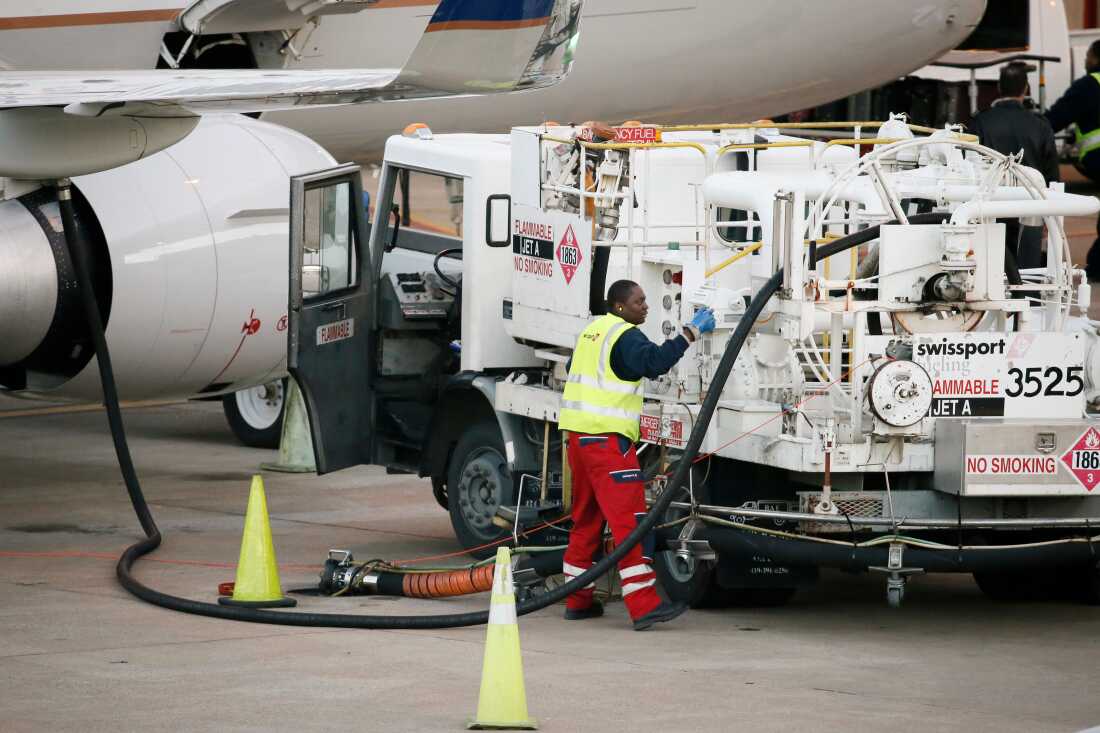
Prices for U.S. jet fuel have nearly doubled since before the Iran war began, shaking up the aviation industry. This file photo shows a worker preparing to fuel a United Express jet at Dallas-Fort Worth International Airport, in Grapevine, Texas.

Prices for U.S. jet fuel have nearly doubled since before the Iran war began, shaking up the aviation industry. This file photo shows a worker preparing to fuel a United Express jet at Dallas-Fort Worth International Airport, in Grapevine, Texas. Tony Gutierrez/AP hide caption

toggle caption

Tony Gutierrez/AP

Where are we heading? 

Despite their recent decline, short-hop flights are integral to the hub-and-spoke network, taking people from Colorado Springs to Denver, for instance, or from Birmingham to Atlanta.

But airlines have shifted more toward longer flights over the past decade, thanks largely to a new generation of narrow-body aircraft that are more efficient, making them an enticing option for longer-range routes. That's why the trendline favors routes such as the 501 to 750-mile category (e.g. Portland to Las Vegas, or Houston to Tampa), which grew by 11% to nearly 1.7 million scheduled flights in 2026. Flights of more than 750 and 1,000 miles each saw double-digit percentage gains, as well.

"Unfortunately for short-haul routes, the economics are not in their favor," says Ahmed Abdelghani, professor of operations management at Embry-Riddle Aeronautical University in Florida. He notes that a smaller jet's higher costs must be borne by fewer passengers than a larger plane, prompting higher fares.

"Those new generation narrowbody aircraft will have much better economics than the smaller 50-seater, 70-seater aircraft," Abdelghani says, citing the newer jets' ability to spread costs over more than 160 seats, depending on how they're configured.

The newer planes align with airlines that prioritize route profitability, Abdelghani says. But he and Black both say that larger narrow-body planes aren't a good fit for every market – and as a result, smaller communities could see fewer flights and connectivity.

"The airports with the sharpest service losses tend to be small hub and non-hub airports," Black says, "and those markets are often built around shorter-distance flying." She notes that other problems, such as pilot shortages, are also affecting small markets. "As pilot availability tightened, airlines had to make decisions about where limited flying could be sustained," Black says.

As Abdelghani puts it, "The airline decides, OK, since now I'm going to fly only efficient aircraft, I'm going to sacrifice the routes that this aircraft doesn't fit."