








TBPN/Screenshot by NPR
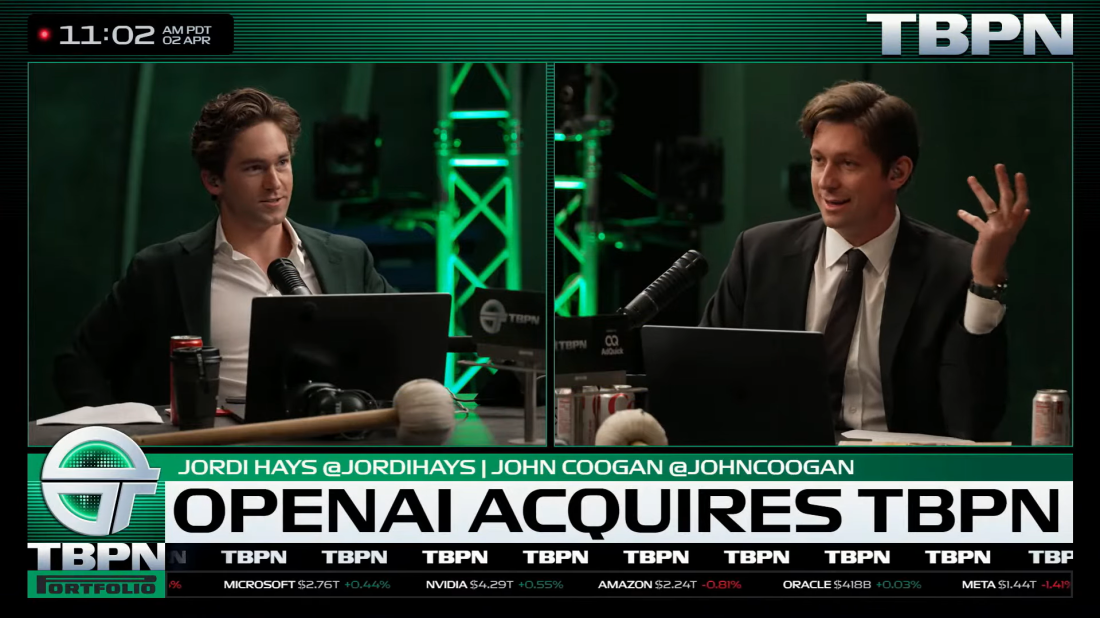
When news broke last week that OpenAI was buying the Technology Business Programming Network, a streaming talk show popular with a small but influential Silicon Valley fanbase, some thought it was a belated April Fools' Day joke.
TBPN co-host Jordi Hays winked at the idea on last Thursday's livestream.
"It is 364 days until April Fool's," Hays interjected as co-founder and co-host John Coogan introduced the show.
"We have some huge news," Coogan chimed in. "This is from the OpenAI blog: 'OpenAI acquires TBPN, accelerating the global conversation about AI.'" He reassured viewers: "This is real."
OpenAI's foray into media comes just a few weeks after executives told staff to cut back on "side quests" and focus on artificial intelligence offerings for businesses. It shut down its AI video app Sora and paused plans to release an erotic chatbot.
While snapping up a talk show may seem tangential to OpenAI's stated mission to "ensure that artificial general intelligence benefits all of humanity," the purchase also aims to shape the company's public narrative amid growing scrutiny from the public — and from the tight-knit tech community that TBPN reaches.
"This particular move by OpenAI does seem like, 'We're buying a niche publication in part because we like it and we can,'" said Margaret O'Mara, a University of Washington professor who studies the history of technology and politics. "It's trying to control the conversation within the industry, within this very highly competitive space of tech insiders."
TBPN has been described as SportsCenter for Silicon Valley. After launching in October 2024 as the Technology Brothers Podcast, Hays and Coogan rebranded the show to TBPN in March 2025 and began livestreaming for three hours every weekday. Coogan introduces the show with the tagline "live from the TBPN ultradome, the temple of technology, the fortress of finance, the capital of capital."
Coogan and Hays come from the world of tech start-ups, not journalism. Their show is a high-energy mix of friendly interviews with tech titans, industry gossip, and celebrations of funding rounds and other successes that involve banging a giant gong.
TBPN is decidedly not a household name. It counts around 345,000 followers on X and 74,000 YouTube subscribers. But its audience is a devoted one, from start-up founders to wealthy investors to executives.
Among them is OpenAI CEO Sam Altman, who says it's his "favorite tech show." He's been friendly with Coogan for more than a decade, since Altman invested in Coogan's first company, the meal replacement brand Soylent.

OpenAI CEO Sam Altman speaks at an event in Washington, DC last month. The company's purchase of TBPN comes at a time of growing anxiety in the tech industry over the public perception of artificial intelligence. Anna Moneymaker/Getty Images hide caption
toggle caption
Anna Moneymaker/Getty Images
Altman has made multiple appearances on TBPN, most recently in February. Other big names have stopped by (or Zoomed in), from Meta CEO Mark Zuckerberg to Microsoft chief Satya Nadella to Mark Cuban, the billionaire investor and entrepreneur.
TBPN's defining trait is techno-optimism, which explains its popularity among tech enthusiasts and industry power players alike.
"They generally believe that most of what's happening in Silicon Valley is a good thing for society, it's a good thing for innovation. And you can sort of see that in the way that their viewpoint comes across in the coverage," said Elizabeth Spiers, a columnist and media strategist who co-founded the website Gawker.
In OpenAI's blog post announcing the deal, executive Fidji Simo said the company wants to foster a "constructive conversation" about AI with the people building and using the technology. She promised the show would remain editorially independent, while also describing the purchase as part of its communications strategy.
"I can't wait to leverage their talent outside of the show to innovate on how we bring AI to the world in a way that helps people understand the full impact of this technology on their daily lives," Simo wrote.
The purchase comes at a time of growing anxiety in the tech industry over the public perception of artificial intelligence.
"To me this reads as AI and tech has a larger narrative change problem," said tech scholar and critic Sara M. Watson. "Popular opinion has shifted to say, 'We're actually quite skeptical of your claims.'"
An NBC News poll in March found a majority of American voters think the risks of AI outweigh its benefits. There are growing concerns about the environmental and energy impacts of data centers and the specter of AI-driven job losses.
Altman himself recently said he miscalibrated the level of distrust towards AI, amid rival Anthropic's fight with the Pentagon over military use of the technology.
Those worries also exist within the workforces of big AI companies. Watson points to staffers who have recently quit OpenAI and other firms. That includes a safety researcher at Anthropic who said he was abandoning the field altogether to study poetry.
"There's enough people who are leaving these companies to become poets that there is a need for supporting the optimistic viewpoint," Watson said.
That's a change for the tech industry, which enjoyed largely positive coverage for decades. Now, many tech giants are running a familiar playbook: buying or creating media in the hopes it will reflect positively on their brands.
In the 1950s, General Electric sponsored General Electric Theater on radio and TV, presented by Ronald Reagan and starring fellow Hollywood actors. In 1996, Microsoft partnered with NBC News to launch MSNBC.
Today, companies from JPMorganChase to Trader Joe's have their own podcasts, while tech moguls Jeff Bezos and Marc Benioff own the Washington Post and Time magazine, respectively.
O'Mara, the historian, said OpenAI's acquisition fits the mold of tech companies and investors launching their own media channels — like Future, a short-lived website rolled out by venture capital firm Andreessen Horowitz in 2021.
"These are vehicles that are advancing the goals of their owners and sponsors," O'Mara said.
But she says there's a risk that TBPN could appear too controlled, despite OpenAI's assurances of independence.
"It's a double edged sword," O'Mara said. "If a journalistic outlet is seen as just being a company organ [or] kind of a PR vehicle, then perhaps its audience is not going to take its messaging quite as seriously."
此内容由惯性聚合(RSS阅读器)自动聚合整理,仅供阅读参考。 原文来自 — 版权归原作者所有。