








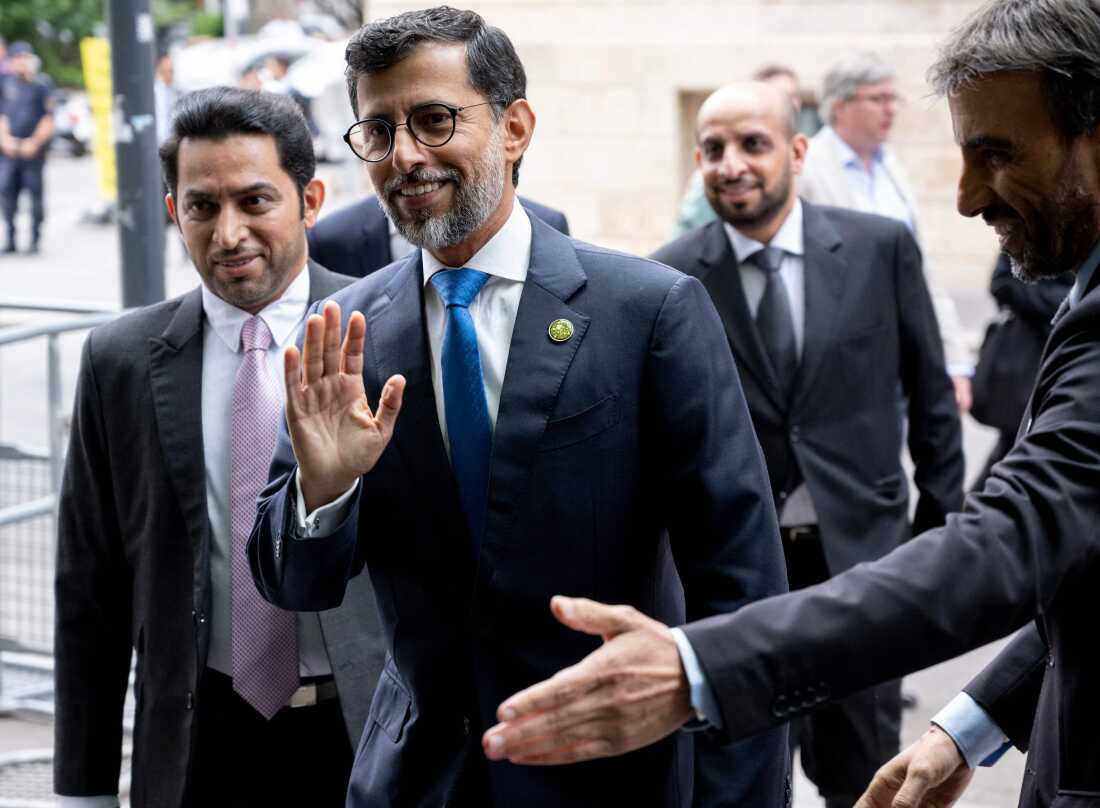
UAE's Minister of Energy and Industry Suhail al-Mazrouei is shown arriving for an OPEC meeting in Vienna, Austria, on June 4, 2023. Joe Klamar/AFP via Getty Images hide caption
toggle caption
Joe Klamar/AFP via Getty Images
The United Arab Emirates has announced that it's leaving OPEC, the cartel representing major state-owned oil producers, on May 1.
In an announcement posted on state-owned media, the UAE wrote that the decision "reflects the UAE's long-term strategic and economic vision and evolving energy profile, including accelerated investment in domestic energy production, and reinforces its commitment to a responsible, reliable, and forward-looking role in global energy markets."
OPEC includes major state-owned oil producers like Saudi Arabia, Kuwait and Iran; the UAE joined the group nearly 60 years ago, just a few years after the cartel was established. As a group, OPEC members set their oil production levels in an attempt to balance oil markets and maintain oil prices high enough to support their national budgetary needs. (If every country produced as much oil as they possibly could, the rules of supply and demand would send crude oil prices down sharply and reduce their incomes.)
In more recent years, through the broader OPEC+ alliance, countries like Mexico and Russia have also agreed to negotiate with OPEC on production levels. The United States, which does not have a state-owned oil producer, does not officially participate in OPEC talks, although some presidents have made requests of OPEC, and some U.S. oil executives have been accused of collusion with the cartel.
The UAE's departure from the group comes after years of friction. The UAE has chafed at its production caps, pushing to raise quotas and produce more oil, while Saudi Arabia, OPEC's largest producer and its dominant force, pushed back. The dispute sometimes prolonged or delayed OPEC meetings.
Meanwhile, political relations between Saudi Arabia and the UAE — once close allies — have grown sour for reasons beyond oil. The two countries have backed opposing forces in Yemen and are competing economically.
A former UAE government official, Tareq Alotaiba, recently wrote that the Iran war has strengthened the UAE's ties with partners like the U.S., Europe and Israel, while its Arab neighbors have "hedged, equivocated and, in some cases, pressed for their own agendas even as states were under attack." Many countries around the Persian Gulf have been the focus of Iranian attacks since the war began; the UAE, which is located just across the Hormuz Strait from Iran, has been particularly targeted.
"OPEC and OPEC+ have only ever been as strong as the members' willingness to hold barrels back from the market, and the UAE was one of those," Rystad Energy's head of geopolitical analysis, Jorge Leon, writes in a note emailed to NPR. "Saudi Arabia is now left doing more of the heavy lifting on price stability, and the market loses one of the few shock absorbers it had left."
For now, the UAE — like other oil producers in the region — is limited in how much oil it can export by the reduced traffic through the Strait of Hormuz.
In the long-term, though, the departure of an important member of the cartel will weaken OPEC's ability to control the oil market.
此内容由惯性聚合(RSS阅读器)自动聚合整理,仅供阅读参考。 原文来自 — 版权归原作者所有。