






核反应 1+2⟷3+41+2\longleftrightarrow 3+4,对于 n1n_1 有时间变化:
dn1dt+3Hn1=n1(0)n2(0)⟨σv⟩{n3n4n3(0)n4(0)−n1n2n1(0)n2(0)}\frac{\mathrm{d}n_1}{\mathrm{d}t}+3Hn_1 = n_1^{(0)}n_2^{(0)}\langle\sigma v\rangle\left\{\frac{n_3n_4}{n_3^{(0)}n_4^{(0)}}-\frac{n_1n_2}{n_1^{(0)}n_2^{(0)}}\right\}
(这里的 (0)(0) 代表初态.) 我们上节课说是从 1 GeV1\text{ GeV} 开始演化,但是这并不是很合理,比较合理的取值是从 10 MeV10\text{ MeV} 开始演化,这是因为实际上从高能标开始演化,会存在不少 π±\pi^{\pm}、K±K^{\pm} 等高能量的粒子,但是选低能标就会有压低 e−m/Te^{-m/T},我们只需要考虑 pp 和 nn.
关于为什么 p,np,n 要考虑但是同静能量量级的其他粒子不用考虑:因为重子数守恒,低能下也会存在大量 p,np,n.
Gamov 幸运的点在于 4He^4\text{He} 结合能很高,很稳定. 这里再思考一步:因为中子不稳定、会衰变,因此所有中子最后都会跑到 D\text{D} 里面,我们只需要计算前四步的反应中留下多少中子.
p+ν‾⟷n+e+p+e−⟷n+νn⟷p+e−+ν‾p+n⟷D+γ\begin{aligned} &p+\overline{\nu}\longleftrightarrow n+e^+\\\\ &p+e^-\longleftrightarrow n+\nu\\\\ &n\longleftrightarrow p+e^-+\overline{\nu}\\\\ &p+n\longleftrightarrow \mathrm{D}+\gamma \end{aligned}
为什么中子到氘核里之后不衰变:因为氘核结合能使得中子能量变低,甚至低于质子能量,所以中子已经没有能量进行产生质子的衰变了.
我们想知道什么时候氘核大量形成. 虽然看起来热平衡时上面几种粒子的相对数量不太会变化,但是在爆炸之后不久,光子数很多,我们之前引入的量 ηB=nB/nγ∼10−10\eta_B=n_B/n_\gamma\sim 10^{-10} 量级,因此短时间内还不会大量形成氘核. (额外说明:ηB\eta_B 随着 TT 几乎是守恒的,这一点可以通过计算分子分母随着 TT 的依赖来得到.)
对于最后一个反应:(光子数几乎守恒,因为温度没有大幅度变化)
nDnγnD(0)nγ(0)=nnnpnn(0)np(0)⟹nDnpnn=nD(0)np(0)nn(0)\frac{n_{\text{D}}n_\gamma}{n_{\text{D}}^{(0)}n_\gamma^{(0)}} = \frac{n_nn_p}{n_n^{(0)}n_p^{(0)}}\Longrightarrow\frac{n_{\text{D}}}{n_pn_n} = \frac{n_{\text{D}}^{(0)}}{n_p^{(0)}n_n^{(0)}}
其中,RHS:
g∫d3p(2π)3⋅e−(m+p2/2m)/T=34(4πmpT)3/2eBD/Tg\int\frac{\mathrm{d}^3p}{(2\pi)^3}\cdot e^{-(m+p^2/2m)/T} = \frac{3}{4}\left(\frac{4\pi}{m_pT}\right)^{3/2}e^{B_{\text{D}}/T}
氘核自旋 11,简并度 g=3g=3.
得到
nDnn=34np(4πmpT)3/2eBD/T\frac{n_{\text{D}}}{n_n} = \frac{3}{4}n_p\left(\frac{4\pi}{m_pT}\right)^{3/2}e^{B_{\text{D}}/T}
这里的质子数密度 np∼nB∼ηBnγ∼ηBT3n_p\sim n_B\sim\eta_Bn_\gamma\sim \eta_BT^3. 核合成开始的标志就是上述这个量从很小开始趋于 O(1)\mathcal{O}(1),也就是中子开始跑到氘核内部. 微调这里的 TT (这是一个唯一的参数),最后得到的 TT 差不多在 MeV\text{MeV} 量级. 到此核合成开始.
额外提一下,最开始的反应 p+ν‾⟷n+e+p+\overline{\nu}\longleftrightarrow n+e^+,这个反应也不能一直处于热平衡. 但是巧合在于这是弱相互作用,区别于氘核形成的电磁相互作用,在低能下弱相互作用极其微弱 (当然高能时它甚至强于电磁).
另外,所有的核反应都必须和 Hubble expansion 抗争,质子首先要找到一个中微子发生反应,这件事情也是不容易的. 因此第一个反应没那么容易发生,导致了现在的宇宙.
不过如果最开始选择的是第一个反应而不是氘核合成,我们的宇宙可能会是完全另一幅景象.
简单用轻子 (ℓ\ell) 来描述反应:p+ℓ⟷n+ℓp+\ell\longleftrightarrow n+\ell.
dnndt+3Hnn=nn(0)nℓ(0)⟨σv⟩{npnℓnp(0)nℓ(0)−nnnℓnn(0)nℓ(0)}=nℓ(0)⟨σv⟩{npnn(0)np(0)−nn}\frac{\mathrm{d}n_n}{\mathrm{d}t}+3Hn_n=n_n^{(0)}n_\ell^{(0)}\langle\sigma v\rangle\left\{\frac{n_pn_\ell}{n_p^{(0)}n_\ell^{(0)}}-\frac{n_nn_\ell}{n_n^{(0)}n_\ell^{(0)}}\right\} = n_\ell^{(0)}\langle\sigma v\rangle\left\{\frac{n_pn_n^{(0)}}{n_p^{(0)}}-n_n\right\}
这里假设 ne=nν=ne(0)=nν(0)=nℓ(0)n_e=n_\nu=n_e^{(0)}=n_\nu^{(0)}=n_\ell^{(0)}. 重子数守恒:
d(nn+np)dt+3H(nn+np)=0\frac{\mathrm{d}(n_n+n_p)}{\mathrm{d}t}+3H(n_n+n_p)=0
定义 Xn=nn/(nn+np)X_n=n_n/(n_n+n_p),把反应率简写为 Γnp=nℓ(0)⟨σv⟩\Gamma_{np}=n_\ell^{(0)}\langle\sigma v\rangle,那么上述两方程化为
dXndt=Γnp[(1−Xn)e−Q/T−Xn],Q=mn−mp\frac{\mathrm{d}X_n}{\mathrm{d}t}=\Gamma_{np}\left[(1-X_n)e^{-Q/T}-X_n\right],\quad Q=m_n-m_p
这里的时间实际上并没有很多实际含义,只是标定演化的一个物理量罢了. 为了把它消掉,我们用
dTTdt=−H\frac{\mathrm{d}T}{T\mathrm{d}t}=-H
这来源于 s∼T3∼a−3s\sim T^3\sim a^{-3},宇宙的熵密度.
同时,
H=(8πGρ3)1/2∼T2∼a−2H=\left(\frac{8\pi G\rho}{3}\right)^{1/2}\sim T^2\sim a^{-2}
用下面的 xx,H∼x−2H\sim x^{-2}.
定义 x=Q/Tx=Q/T,那么原来的微分方程变成了 XnX_n 和 xx 的微分方程,
dXndx=xΓH(x=1)[e−x−Xn(1+e−x)]\frac{\mathrm{d}X_n}{\mathrm{d}x}=\frac{x\Gamma}{H(x=1)}\left[e^{-x}-X_n(1+e^{-x})\right]
初始条件为 x≃1x\simeq 1,Xn=1/2X_n=1/2. 利用弱相互作用的结论可以算出
Γ=255τnx5(12+6x+x2)\Gamma = \frac{255}{\tau_nx^5}(12+6x+x^2)
这里的 τn\tau_n 是中子衰变的一个时间参数,τn≃900 sec\tau_n\simeq 900\text{ sec}. 而
H(x=1)≃8πGQ43≃1.13 sec−1H(x=1)\simeq\sqrt{\frac{8\pi GQ^4}{3}}\simeq 1.13\text{ sec}^{-1}
这也导致 Γ(x)/H(x=1)\Gamma(x)/H(x=1) 差不多是 11 量级,这保证了当前宇宙能够留下这么多的中子,这完全是一个巧合,因为一旦上面这个量趋于零的速度再快一点或者慢一点,最后平衡时留下的中子数就不是当前这个值;这个过程叫作 freeze out 机制,也就是宇宙降温留下了中子,否则如果一直热平衡,中子会被全部消耗.
上面说完了 BBN (Big Bang nucleosynthesis),下面说 CMB (Cosmic Microwave Background).
CMB 发生在大约 10 eV10\text{ eV} 的能标,这时候质子和电子结合,p+e→H+γp+e\to \text{H}+\gamma. 依旧用 Boltzmann 方程 (Saha 方程),
Xe21−Xe=1ne+nH[(meT2π)3/2e−(me+mp−mn)/T]\frac{X_e^2}{1-X_e}=\frac{1}{n_e+n_H}\left[\left(\frac{m_eT}{2\pi}\right)^{3/2}e^{-(m_e+m_p-m_n)/T}\right]
仍然用 ηB\eta_B,ne+nH∼ηBnγ∼ηBT3n_e+n_{\text{H}}\sim\eta_Bn_\gamma\sim\eta_BT^3,得到
Xe21−Xe=ηB−1(meT)3/2e−Eb/T\frac{X_e^2}{1-X_e}=\eta_B^{-1}\left(\frac{m_e}{T}\right)^{3/2}e^{-E_b/T}
用 T=10 eVT=10\text{ eV} 代入,算出大约发生在 z=1100z=1100 位置,以及 CMB 温度 2.73 K2.73\text{ K}.
一个 bug:如果宇宙正在膨胀,且早期是 radiation dominated,我们可以先写出来一个度规,
ds2=−dt2+a2(t)dx⃗2=a2(τ)(−dτ2+dx⃗2),a−1dt=dτ\mathrm{d}s^2=-\mathrm{d}t^2+a^2(t)\mathrm{d}\vec{x}^2 = a^2(\tau)(-\mathrm{d}\tau^2+\mathrm{d}\vec{x}^2),\quad a^{-1}\mathrm{d}t=\mathrm{d}\tau
这里的 a(t)a(t) 关于 tt 的依赖关系是 tpt^p,对于不同的 domination,有
{p=1/2RDp=2/3MDp=∞vacuum energy\begin{cases} p=1/2&\text{RD}\\\\ p=2/3&\text{MD}\\\\ p=\infty&\text{vacuum energy} \end{cases}
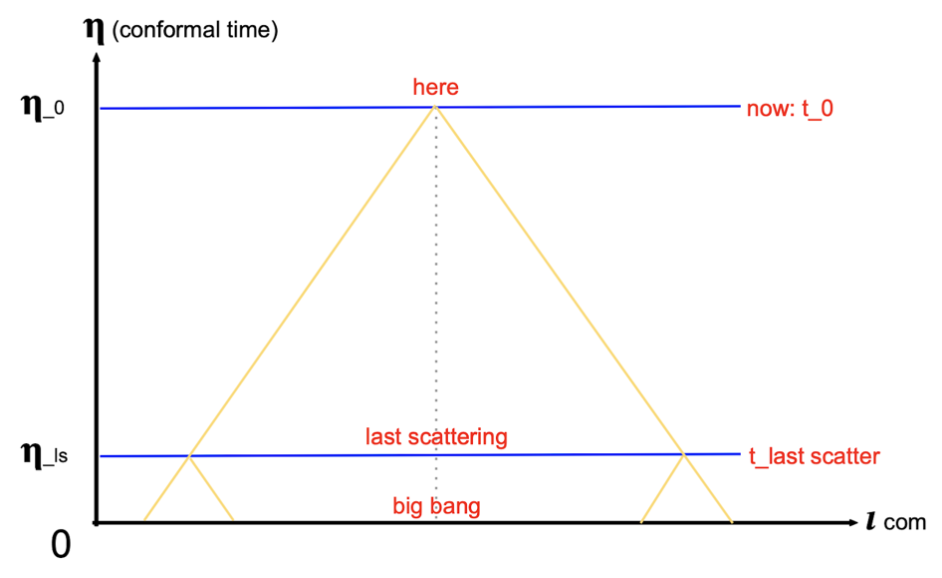
现在的 bug 是,CMB 的 δT∼10−5T\delta T\sim10^{-5}T,所以一开始整个宇宙一定有极强的整体关联,也就是把 radiation 反推回去到 CMB 的时间,所有的光在这时候都应该有相互关联. 用光锥的语言就是,从现在往回看光锥,回到 CMB 时期的两个最远的点,它们再往回推,两个过去光锥应该相交.
而 dτ=a−1dt∼t−1/2dt∼dt1/2\mathrm{d}\tau=a^{-1}\mathrm{d}t\sim t^{-1/2}\mathrm{d}t\sim\mathrm{d}t^{1/2},也就是 τ∼t1/2∼a\tau\sim t^{1/2}\sim a,因此光锥边界在图上是大致线性的,所以它们按照这个理论并不能产生相互关联. 到此人们决定提出暴涨.
此内容由惯性聚合(RSS阅读器)自动聚合整理,仅供阅读参考。 原文来自 — 版权归原作者所有。