


惯性聚合 高效追踪和阅读你感兴趣的博客、新闻、科技资讯
阅读原文 在惯性聚合中打开

推荐订阅源

Threat Intelligence Blog | Flashpoint
V
Vulnerabilities – Threatpost
L
LINUX DO - 热门话题
H
Hacker News: Front Page
Hacker News - Newest:
Hacker News - Newest: "LLM"
L
Lohrmann on Cybersecurity
Cisco Talos Blog
Cisco Talos Blog
O
OpenAI News
S
Securelist
Security Latest
Security Latest
T
Threat Research - Cisco Blogs
H
Heimdal Security Blog
C
CXSECURITY Database RSS Feed - CXSecurity.com
CTFtime.org: upcoming CTF events
Recorded Future
Recorded Future
Microsoft Azure Blog
MyScale Blog
MyScale Blog
Webroot Blog
Webroot Blog
The Hacker News
The Hacker News
Google Online Security Blog
Latest news
Latest news
N
Netflix TechBlog - Medium
N
News and Events Feed by Topic
D
Docker
D
DataBreaches.Net
A
About on SuperTechFans
T
Tor Project blog
V
V2EX
G
Google Developers Blog
博客园 - Franky
N
News | PayPal Newsroom
T
The Blog of Author Tim Ferriss
I
InfoQ
H
Help Net Security
V2EX - 技术
V2EX - 技术
cs.CL updates on arXiv.org
S
Security Affairs
SecWiki News
SecWiki News
The Register - Security
人人都是产品经理
人人都是产品经理
NISL@THU
NISL@THU
小众软件
小众软件
B
Blog
T
Threatpost
P
Palo Alto Networks Blog
博客园 - 【当耐特】
L
LangChain Blog
AWS News Blog
AWS News Blog
月光博客
月光博客
宝玉的分享
宝玉的分享

菲兹克斯喵

Lesson 17 引力波的功率 (2) Lesson 16 引力波的功率 Lesson 8 Atmospheres Lesson 16 习题课 Lesson 15 引力波 Lesson 14 Noether 定理 Lesson 7 Evolution Lesson 7 传粉的力量 Lesson 13 作用量原理 Lesson 13 配分函数的一些应用 Lesson 12 Penrose 过程与 Hawking 辐射 Lesson 6 Homology Lesson 11 带电荷和旋转的黑洞 Lesson 6 进食行为 Lesson 11 配分函数 Lesson 10 Penrose 图 Lesson 5 Diffusion Lesson 9 微观量与宏观量的联系 Lesson 5 捕食行为 Lesson 8 Schwarzschild 黑洞 Lesson 9 Schwarzschild 黑洞 (2) Lesson 8 近独立子体系分布 Lesson 4 Ignition of the Sun Lesson 7 统计力学绪论 Lesson 4 讲座:乌贼和章鱼的行为与智能 Lesson 7 Killing 矢量场和 Lie 导数 Lesson 6 Schwarzschild 解 Lesson 6 Landau 相变理论 (二) Lesson 3 Lane - Emden Equation Lesson 5 Landau 相变理论 Lesson 3 动物的感知 Lesson 5 Einstein 场方程 Lesson 4 协变的物理定律 Lesson 3 等效原理 & 广义协变性原理 Lesson 4 热力学第三定律 Lesson 2 Equation of State Lesson 3 热力学关系 Lesson 2 神经生物学基础 Lesson 2 度规和联络 Lesson 1 简介 Lesson 1 Lorentz 变换 Lesson 2 热力学定律 Lesson 1 Introduction & Light Lesson 1 介绍 流星监控项目 II - 树莓派配置 Lesson 15 Green 函数法 Lesson 29 散射 (二) Lesson 15 Spatial Patterns & Self-Organization Lesson 14 积分变换 Lesson 29 散射 Lesson 28 散射 (一) Lesson 27 绝热近似 Lesson 14 Dynamics of biological networks (2) Lesson 13 分离变量法总结 Lesson 26 变分法 (二) Lesson 14 Spatial Statistics Lesson 27 带电粒子和电磁场的相互作用 Lesson 13 磁性材料 & 拓扑绝缘体 Lesson 25 变分法 Lesson 13 Fast Radio Burst Lesson 13 Dynamics of biological networks Lesson 24 含时微扰 Lesson 26 相对论中的能量和动量守恒 Lesson 13 On the Intersection between Astronomy and AI Lesson 25 电磁场变换 Lesson 12 超导 Lesson 23 Zeeman Effect Lesson 12 China Jingping Labs and Related Physics Lesson 24 狭义相对论的速度变换 Lesson 22 微扰论 Lesson 11 Bessel 函数 Lesson 12 Time Series Analysis Lesson 23 狭义相对论 Lesson 21 能带理论 Lesson 11 量子多体系统 Lesson 11 Molecular Motor (3) Tianwen:The Beauty of the Cosmos Lesson 10 连带 Legendre 函数 Lesson 20 多电子原子 & 固体 Lesson 11 Truncated & Censored Data Lesson 21 偶极辐射 (二) Lesson 10 离子阱量子计算 & 超快分子摄影 Lesson 10 Molecular Motor (2) Lesson 19 多粒子系统 Neutron Stars Lesson 20 偶极辐射 Lesson 9 Legendre 多项式 (二) Lesson 18 双粒子系统 Lesson 10 Clustering & Classification Lesson 19 辐射 (二) Lesson 9 引力波探测 & 原子量子计算 Lesson 17 CG 系数 「三次量子化」:宏观量子能级及其相干叠加态 —— 解读今年的 Nobel Prize Lesson 9 Molecular Motor Exoplanet Lesson 18 辐射 Lesson 16 自旋 (二) Lesson 8 Legendre 多项式 Lesson 17 波导 Lesson 9 Density Estimation
Lesson 12 absorbing
2025-12-09 · via 菲兹克斯喵

有必要跟大家讲一讲 Maxwell's Demon. 实际上是在一个盒子里面放一块挡板,然后一个小妖精来控制这个挡板,当分子向这个挡板撞过来的时候,会推动挡板做功. 每做一次功,小妖就抽出挡板再重新放回去一次,使得挡板永远受到分子的碰撞做正功.

这样就实现了「从单一热源吸热做功,而不对外界造成任何影响.」问题出在「不对外界造成任何影响」上,小妖的记忆并没有在每一次操作之后回到初态.


吸收的不确定度:

σc2cˉ2=14πDacT\frac{\sigma_c^2}{\bar{c}^2}=\frac{1}{4\pi DacT}

细菌能够感知两个地方的浓度差异 Δc\Delta c,作为一个信号. 但是要求信噪比大于 1 才能提取出信号,如果浓度梯度为 gg,则要求

Δc=gΔl=gTv>δc∼c4DsT\Delta c=g\Delta l=gTv>\delta c\sim\sqrt{\frac{c}{4DsT}}

实际计算表明大约要 0.5 s0.5\text{ s} 才能够感知到浓度的变化. 结合我们上节课说的 E.coli 的 run and tumble,实验中测量它每次 run 的时间就是大概 1 s1\text{ s},这说明「感知浓度变化」是 run 这个时间的主要决定因素.

回到受体和配体的问题上来,膜上分布了大量的受体,有些结合了配体、有些没有结合,这个结合数的信息被记录为 ϕ\phiϕ=ϕ(L)=a(L)M\phi=\phi(L)=\displaystyle{\frac{a(L)}{M}},之后在信息处理中枢里面的信号是 R=f(ϕ)R=f(\phi).

最简单的机制是全部线性的:

R∼ϕ∼LMR\sim \phi\sim\frac{L}{M}

但是如果是这样,膜上的 101310^{13} 个受体应该要有很大一部分结合,才能产生可观的信号,而且难以分辨变化. 所以我们需要放大机制:

a(L)∼LnKn+Lna(L)\sim\frac{L^n}{K^n+L^n}

同时 f(ϕ)f(\phi) 是所谓 ultrasensitive 的放大函数,比如下面的 G 蛋白耦联机制:
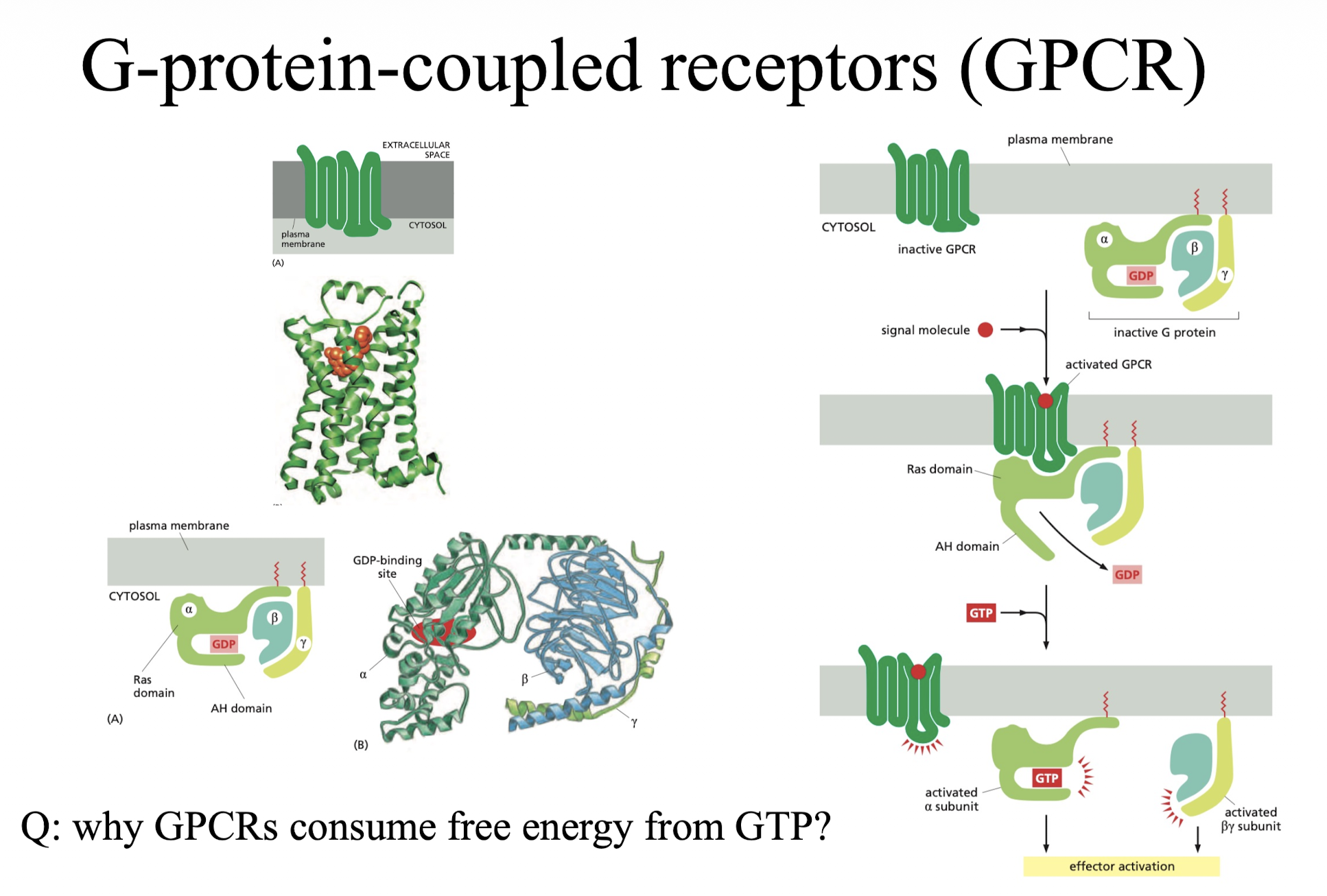
仍然回到我们之前多次讲的四态系统,这一次因为有 GTP 这种高能分子的存在,原来的细致平衡条件不再成立,有

k+(γω+)ck−(γω−)k−ω+k+ω−=γ2≠1\frac{k_+(\gamma\omega_+)ck_-(\gamma\omega_-)}{k_-\omega_+k_+\omega_-}=\gamma^2\neq1

激活状态和非激活状态的比例为

S([L]=0)=ω+ω++γω−,S([L]=∞)=ω+ω++ω−/γS([L]=0)=\frac{\omega_+}{\omega_++\gamma\omega_-},\quad S([L]=\infty)=\frac{\omega_+}{\omega_++\omega_-/\gamma}

对于 γ≫1\gamma\gg1 的情况 (驱动很强),

S≈[L]Kd+[L]S\approx\frac{[L]}{K_d+[L]}

产生一个 Hill 函数.

后面的放大由级联反应完成,就像光电倍增管一样,通过引入能量的方式不断指数放大信号:

两个酶反应:

E+K⇌q−1q1EK⇌q−2q2Ep+KEp+P⇌q−3q3Ep⋅P⇌q−4q4E+P\begin{aligned} &\text{E}+\text{K}\stackrel{q_1}{\underset{q_{-1}}{\rightleftharpoons}}\text{EK}\stackrel{q_2}{\underset{q_{-2}}{\rightleftharpoons}}\text{Ep}+\text{K}\\\\ &\text{Ep}+\text{P}\stackrel{q_3}{\underset{q_{-3}}{\rightleftharpoons}}\text{Ep}\cdot\text{P}\stackrel{q_4}{\underset{q_{-4}}{\rightleftharpoons}}\text{E}+\text{P} \end{aligned}

通过它们的稳态可以得到 ultrasensitive.

我们可以说,细致平衡阻碍了 Hill 系数的增大,也就拉低了超敏反应的敏感程度. 而维持非平衡态,就需要能量的输入. 所以又回到了我们提到的 Maxwell's Demon,这产生了「对外界的影响」.

下节课我们讲「适应」:我们知道 Hill 函数的图像是一个高速上升的曲线,但是这会导致这个反应只能测量一小段范围的浓度变化,一旦超出这个范围,系统就几乎没有响应. 所以需要平移这个曲线,在每一次测量之后调整基准值,这就是适应.

更新日志

  • 519e6-feat(note): add biophysics note