




MIAMI — Families of four Cuban exiles who were killed in 1996 when the Cuban military shot down their civilian planes said Wednesday’s indictment of former Cuban President Raúl Castro was a long time coming.
“I hope it’s justice for my dad and for the other three men. We have waited 30 years to the day,” said Marlene Alejandre, who attended the indictment’s announcement. She was 18 when her father, Armando Alejandre, was killed.
The indictment of Castro, who will be 95 next month, and five other Cuban nationals brings to the forefront a three-decade-old incident that roiled the international community and continues to profoundly affect U.S.-Cuba relations to this day.
Here’s a brief look at what took place then.
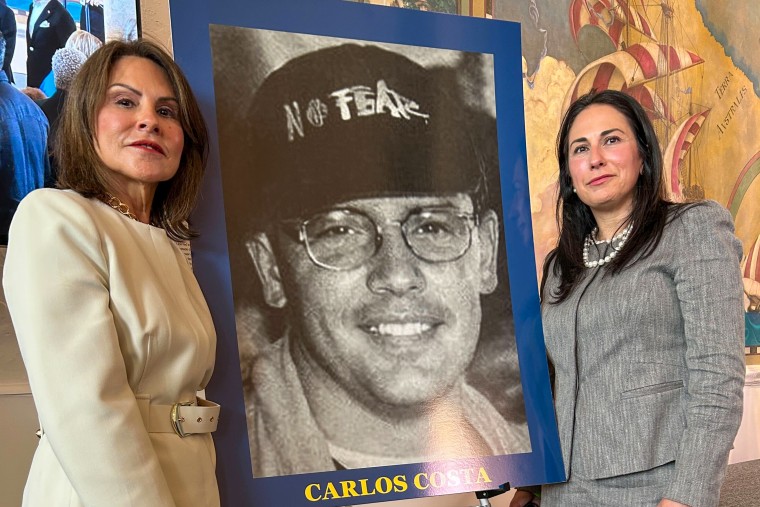
The civilian planes Cuba shot down belonged to Brothers to the Rescue, a group founded in 1991 by Cuban American pilot José Basulto and other U.S.-based Cuban exiles who were strongly opposed to the Cuban government. Basulto has said he participated in the botched Bay of Pigs invasion in 1961, which was sponsored by the CIA with the aim of ousting Fidel Castro.
Brothers to the Rescue operated search-and-rescue flights over the Florida Straits. In the early 1990s, communist-run Cuba was in a deep economic crisis following the collapse of the Soviet Union, which had heavily subsidized it for decades. There were extreme shortages of food and medicine, and thousands of Cubans were taking to the seas in dangerous makeshift boats and rafts trying to reach the U.S.
In 1994, Cuba and the U.S. signed an immigration agreement, and a subsequent “wet foot, dry foot” policy in 1995 sent Cubans back to the country if they were caught at sea, which helped stem the massive exodus. But Cubans still routinely tried to leave the country.
Brothers to the Rescue routinely flew small planes over the waters trying to spot fellow Cubans so they could alert the U.S. Coast Guard to assist them. But it also sometimes penetrated Cuban airspace, according to declassified U.S. records that cite an official warning from the Federal Aviation Administration about the group’s “taunting” of the Cuban government. The declassified records also note that the Cuban government had protested Brothers to the Rescue flights that flew over Cuba and dropped anti-government leaflets.
On Feb. 24, 1996, three Cessnas took off from Miami. During their mission, a Cuban MiG-29 shot down two of them in international airspace.
Cuba has said the planes were violating Cuban airspace. Reports from the United Nations’ International Civil Aviation Organization and the Inter-American Commission on Human Rights disagreed, concluding the Brothers to the Rescue planes were still in international airspace when they were shot down.
According to the U.N.’s report, “Cuba acted without using standard interception procedures” when it shot down the planes, resulting in the deaths of Alejandre, Carlos Alberto Costa, Mario Manuel de la Peña and Pablo Morales.
The men, according to the U.N. aviation organization, “died as a consequence of direct actions taken by agents of the Cuban State in international airspace.”
In an interview with Time magazine in 1996, Fidel Castro said he ordered his military to shoot down planes violating Cuban airspace.
Afterward, President Bill Clinton swiftly condemned Cuba’s actions.
Instead of launching strikes on Cuban military bases, Clinton opted to support a bill to impose much tougher restrictions on Cuba.
“It wasn’t gathering sponsors because it was considered too extreme and there wasn’t any real interest in Congress in moving it along,” said Ricardo Herrero, executive director of the Cuba Study Group, a nonpartisan group. “After the shootdown, there was a huge public uproar, and Clinton felt he had to act.”
The House and the Senate passed the Cuban Liberty and Democratic Solidarity (LIBERTAD) Act, also known as the Helms-Burton Act, and Clinton signed it into law.
The law has repercussions to this day, since it turned the sanctions into U.S. law. Now, only Congress can lift the restrictive embargo against Cuba and only if a series of conditions are met, including establishment of “a transition government.”
The Helms-Burton law also allowed the original owners of Cuban properties confiscated by Castro to sue the companies that are using them in U.S. courts. That part of the law had not been enforced until 2019 by President Donald Trump.
Some lawsuits have been settled out of court recently, including suits against the shipping companies Crowley Maritime and SeaBoard Marine.
Cuba’s top leadership had not been indicted over the shootdown. In 1998, five Cuban intelligence agents known as the “Cuban 5” were arrested and convicted on charges including conspiracy and failing to register as foreign agents. One of them, Gerardo Hernandez, was convicted of a murder conspiracy for having provided information to the Cuban government about the Brothers to the Rescue planes and had been serving two life sentences plus 15 years.
During President Barack Obama’s rapprochement with Cuba in 2014, the five spies were released in exchange for a Cuban spy who had worked with the U.S. for 20 years.
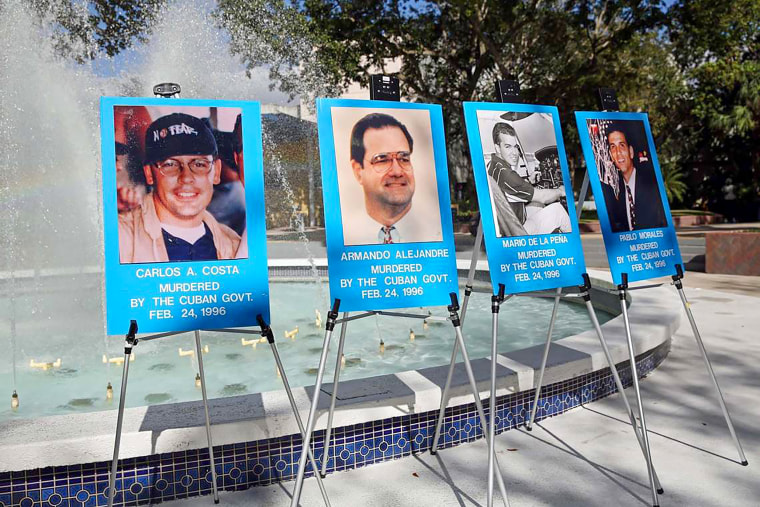
Nancy Morales, the sister of Pablo Morales, was still living in Cuba when he was shot down. She found out when a friend living in the U.S. called her. Morales told NBC News the period following the planes’ shootings were torturous because she was harassed by pro-government mobs. It lasted until she and her daughter were able to come to the U.S. a few months later.
On Wednesday, they drove two hours from their Florida home to attend the event at Miami’s Freedom Tower, where the indictments were announced. It is considered a symbolic place for Cuban Americans who left the communist country.
“I have always waited for this moment, and I’m very hopeful,” Morales said. “I hope the people of Cuba can have liberty very soon and that we can enjoy a free Cuba.”
Mirta Costa Méndez, the sister of Carlos Costa, said, “I’ve been waiting 30 years for this.”
She said she does not know how she would feel if Castro were extradited, because in the end “nothing is going to bring my brother back.”
此内容由惯性聚合(RSS阅读器)自动聚合整理,仅供阅读参考。 原文来自 — 版权归原作者所有。