Copyright case law
Cable firm Cox’s Supreme Court win may help all tech providers, not just ISPs.
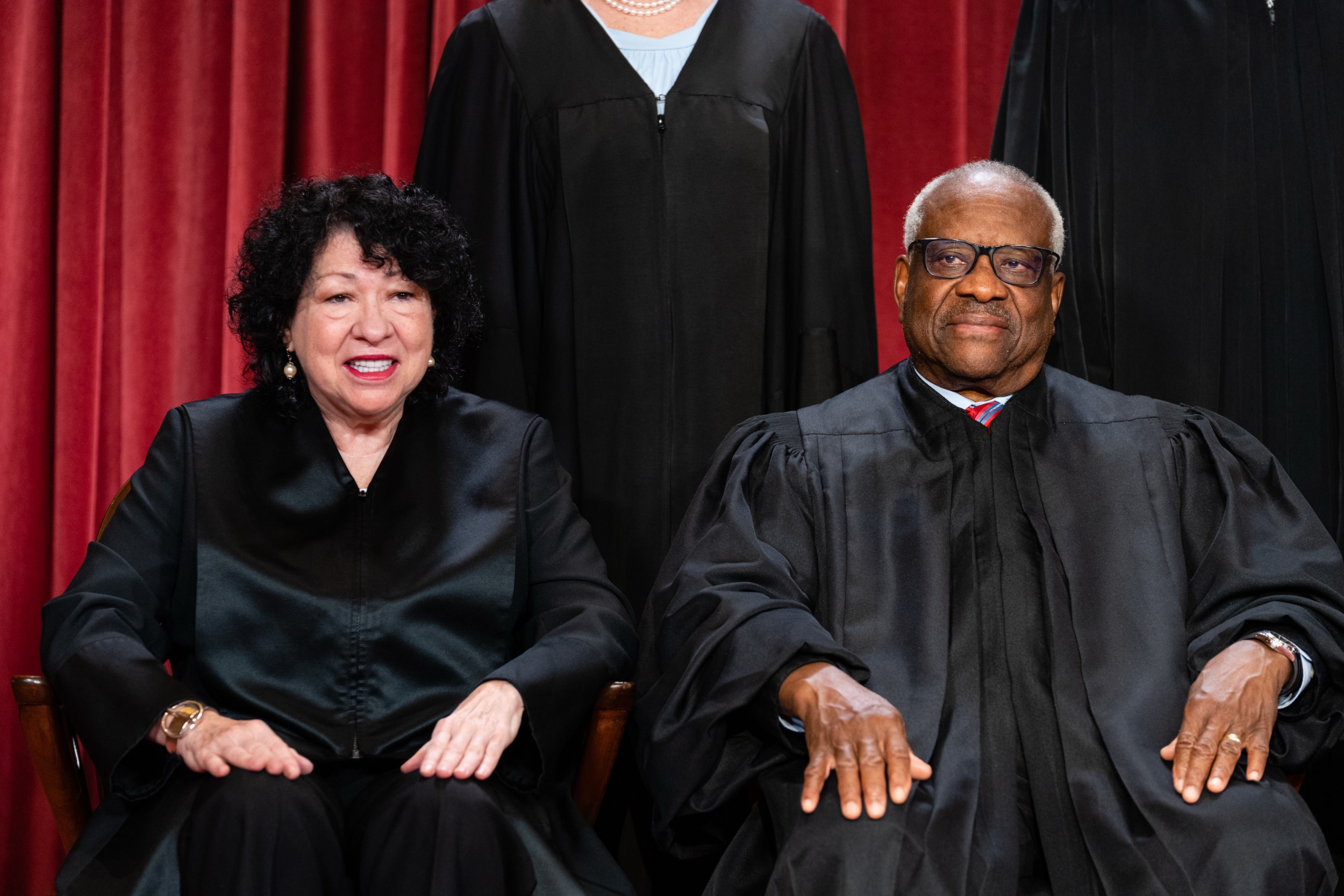
Supreme Court Justices Sonia Sotomayor and Clarence Thomas sit for a formal group photograph on October 7, 2022. Credit: Getty Images | Bloomberg
Supreme Court Justices Sonia Sotomayor and Clarence Thomas sit for a formal group photograph on October 7, 2022. Credit: Getty Images | Bloomberg
Sony and other major record labels recently suffered a thorough defeat at the Supreme Court in their attempt to make Internet service providers pay huge financial penalties for their customers’ copyright infringement. Sony’s loss is certain to have wide-ranging effects on copyright lawsuits, offering protection for ISPs, their customers, and potentially other technology companies whose services can be used for both legal and illegal purposes.
In Cox Communications v. Sony Music Entertainment, the Supreme Court ruled that cable Internet firm Cox is not liable under the Digital Millennium Copyright Act (DMCA) when its customers use their broadband connections to download or upload pirated materials. Music copyright holders claimed that once Cox was informed that specific users repeatedly infringed copyrights, it should have terminated their accounts.
A jury agreed with Sony in 2019, hitting Cox with a $1 billion verdict. While the damages award was overturned by an appeals court in 2024, that court gave Sony a partial win by finding that Cox was guilty of contributory copyright infringement—a type of secondary liability for contributing to others’ infringement.
Cox was facing the prospect of another damages trial until the Supreme Court took up its case and unanimously ruled in its favor on March 25 of this year. The court found that Cox isn’t liable for its customers’ misdeeds because it did not induce them to infringe copyrights and did not “tailor” the broadband service so that it could be used for infringement.
The Cox decision was also a loss for record labels Warner and Universal, which joined Sony in the case. The record labels reacted to the ruling by dropping similar cases against ISPs such as Verizon and Altice, and the impact may be felt well beyond the broadband industry.
“I think it applies to any technology provider”
Several defendants offering other types of tech products and services have filed briefs in lower courts, citing the Cox ruling in their defense against contributory infringement claims. Among them are Google, Meta, Elon Musk’s X social network, and Nvidia. Cox is also being cited by a much smaller entity known as Yout, which operates a website that can be used to convert YouTube videos into downloadable audio files.
While the Cox ruling’s most immediate effect is on other ISPs that were also sued by record labels, one of the attorneys who represented Cox at the Supreme Court told Ars that the decision seems to apply broadly to all other kinds of technology platforms.
“I think it applies to any technology provider. I didn’t see any basis in the opinion or its reasoning for limiting it only to a particular type of technology provider,” attorney Christopher Cariello said. Whether Cox applies to another case “basically just depends on if it’s the same configuration, providing technology that someone else uses for infringement, then it’s the same analysis,” he said.
Cariello, who works for Orrick, Herrington & Sutcliffe, was part of the outside legal team that defended Cox in its Supreme Court briefs. He spoke to Ars about the case but said he was not speaking on behalf of Cox.
“I don’t see how you could avoid applying Cox in any case with a contributory infringement claim against a technology provider. The opinion says to establish contributory liability, you need to show, effectively, culpable intent,” he said. When there is a company “in the sort of vast Internet ecosystem that sits between an end-user and a possible rightsholder who believes they’re being harmed, Cox applies,” he said.
Cariello argues that under the court’s “straightforward decision,” tweaking the context a bit for a different type of defendant doesn’t create new bases for liability. He said “the court is adopting a doctrinal framework,” not “a wishy-washy standard” or one that applies only “in this narrow circumstance to this particular type of service provider for X, Y, and Z reason.”
AI companies are among the firms that should benefit from the ruling because products based on large language models (LLMs) can be used for many non-infringing activities and thus aren’t specifically tailored to be used for infringement, Cariello said.
Contribution to infringement “has to be intentional”
Sony itself laid the groundwork for its 2026 defeat in 1984 when it convinced the court that the Betamax was capable of noninfringing uses and that selling it did not constitute contributory infringement. The 1984 Betamax case and the 2005 ruling in MGM Studios v. Grokster both factored heavily into the Cox decision authored by Justice Clarence Thomas.
A Sony victory against Cox could have made it easier for copyright owners to sue companies whose offerings have both legitimate and illegitimate uses. The firm’s loss will surely make such cases more difficult. As Thomas wrote in Cox, a service provider can be held contributorily liable “only if it intended that the provided service be used for infringement.” Such intent “can be shown only if the party induced the infringement or the provided service is tailored to that infringement,” he wrote.
This means that when a service is capable of “substantial” or “commercially significant” noninfringing uses, its provider can worry a bit less about being held liable for infringement. Users of those services can also worry a bit less about the service provider aggressively terminating accounts.
Cariello said it will be difficult to prove contributory infringement when an ISP charges a flat fee for access to the entire Internet or when another type of provider charges a flat fee for a broad set of capabilities. When a platform has many types of capabilities, “it’s very difficult to suggest that infringement itself is somehow the thing that is bringing users in,” he said.
Marquette University Law Professor Bruce Boyden told Ars that based on the Cox ruling, a company’s contribution to infringement “has to be intentional” through “either actively inducing infringement or designing or tailoring your service for infringement, and nothing else qualifies for contributory infringement.” This “really narrows contributory infringement to the extent that that’s followed” by lower courts, he said.
“It’s not surprising to me that a number of other online services are starting to raise that in arguments,” Boyden said. If those services can eliminate the risk of liability “for knowing about particular acts of infringement and providing services or facilities to those people, then it’s unclear what other theories of infringement might be available. They might be off the hook for infringement entirely.”
Professor: Lower courts need clearer guidance
Still, citing Cox may not be a slam-dunk strategy for defeating any and all contributory infringement claims in non-broadband cases. William & Mary Law School Professor Laura Heymann, who filed an amicus brief urging the court to side with Cox, told Ars that the Supreme Court ruling “highlights the particular concerns of Internet service providers, such as Cox, who ‘have limited knowledge about how their Internet services are used and who uses them.’”
The court said a company can’t be held liable simply for “providing a service to the general public with knowledge that it will be used by some to infringe copyrights.” Cox was informed that users at specific IP addresses were pirating copyrighted material, but the firm argued that infringement notices sent by record labels are unreliable and that terminating accounts used by multiple people would punish the innocent along with the guilty.
The Supreme Court said that Internet providers “know which IP address corresponds to which subscriber account but cannot distinguish individual users or directly control how services are used.” Heymann suggested that lower courts might decide the Cox precedent doesn’t apply to technology providers that have detailed knowledge of what each user is doing, rather than just general knowledge that some users will infringe. She also questioned whether the Supreme Court’s use of the word “service” will be interpreted by lower courts to include “goods.”
Still, Heymann said she isn’t surprised that tech companies are citing Cox in their defense. Although she hoped justices would issue clearer guidance to lower courts, she said the ruling “seems to suggest that lower courts should abandon their former reliance on cases like Gershwin Publishing Corp. v. Columbia Artists Management, [a 2nd Circuit ruling that] held that contributory liability could be based on materially contributing to another’s infringement with knowledge of the infringing activity.”
Heymann said that if lower courts apply the Cox holding to all service providers that host potentially infringing material, many types of companies will have broad protection against copyright claims.
“If the holding does apply broadly, it would seem that many hosting sites could escape liability on the basis that hosting services generally are capable of substantial noninfringing uses, assuming the sites are savvy enough not to encourage infringement in their advertising and marketing materials,” she said.
The court ruling doesn’t specifically state that it applies only to ISPs, but it “also doesn’t include a discussion of how its holding might apply to facts other than the ones before it,” Heymann said.
How tech companies are using the Cox ruling
Nvidia cited Cox in its defense against a lawsuit from authors who say they have registered copyrights in “books that Nvidia has admitted copying, storing, and using to develop its AI language models.” Nvidia copied the books from “notorious shadow libraries” such as The Pile, Bibliotik, and Anna’s Archive, the lawsuit said.
Cox won’t help defendants beat allegations of direct copyright infringement, those claims in which the company itself is accused of pirating. But the authors’ lawsuit additionally alleges that Nvidia should be liable for contributing to others’ infringement, which is where the Cox ruling becomes relevant. For the contributory infringement allegation, the authors allege that Nvidia “caused numerous third parties to download and store Plaintiffs’ copyrighted works by encouraging, facilitating, and promoting its customers to download copies of The Pile dataset.”
Arguing against the contributory infringement claim, Nvidia told a US District court in California on April 3 that its NeMo Megatron Framework “is a general-purpose AI development platform with substantial legitimate uses that cannot be deemed ‘tailored to infringement’ under Cox.” In Cox, the Supreme Court “rejected liability based on knowledge and inaction alone—the same theory Plaintiffs advance here,” Nvidia said.
Cariello told Ars that based on his initial reading of the motion, Cox seems to apply to the Nvidia case because it involves “a claim that says you’re providing technology to users who are allegedly using it to infringe.” Cariello said Cox also appears to apply in a lawsuit that music publishers filed against the X social network, which involves users uploading music to the platform.
X filed a brief in a Tennessee-based federal court on March 27, arguing that the music publishers’ case should be dismissed in light of the Cox holding. “If the Supreme Court had issued this opinion three years ago, X believes this Court would have dismissed Plaintiffs’ contributory-infringement claim in its entirety,” X told a US district court in Tennessee. “Indeed, virtually every contributory-infringement case Plaintiffs cited in opposing X’s motion to dismiss—including the Fourth Circuit case on which this Court relied—is no longer good law.”
Google: Precedent “has been categorically abrogated”
On April 17, Google told a US district court in New York that a lawsuit filed by book publishers should be tossed because the plaintiffs did not claim that Google induced its users to infringe or that the Google shopping platform is tailored to infringement. The lawsuit filed in 2024 accused Google of “systemic and pervasive advertising of unauthorized, infringing copies of the Publishers’ textbooks and educational works.”
Google said the Supreme Court’s “reasoning was not limited to the particular facts presented in Cox; instead, the Court vitiated the material contribution theory for all providers of services… As a result, precedent premising contributory copyright infringement liability on other grounds, like the Second Circuit’s cases imposing liability premised on knowledge of and material contribution to direct infringement, has been categorically abrogated.”
Meta cited Cox in its defense against a lawsuit alleging that it stole large quantities of copyrighted works to train its large language models (LLMs). Like the Nvidia case, the lawsuit against Meta makes a direct copyright infringement claim and a contributory copyright infringement claim. Meta is hoping that Cox will help it defeat the contributory allegation, which is that Meta’s use of peer-to-peer file-sharing networks made pirated works more easily accessible to others.
Yout cited Cox as part of a lawsuit it filed against the Recording Industry Association of America (RIAA). Yout has been seeking a declaratory judgment that its YouTube-ripping service does not violate the DMCA’s prohibition on circumventing technological measures that would otherwise prevent access to copyrighted works. Yout’s case hasn’t been successful so far, and it seems to recognize that citing Cox is a bit more of a long shot than it is in other lawsuits.
“Although Cox Communications is not an anti-circumvention case, it nonetheless may provide useful guidance to the Court in the present case as the Supreme Court discusses when a ‘service is tailored to infringement,’” Yout said in a filing in the US Court of Appeals for the 2nd Circuit.
The RIAA responded by calling Yout’s citation of Cox irrelevant. “The Cox decision addresses common law contributory liability for infringement,” the RIAA said. “Yout’s complaint involves statutory anti-circumvention claims. Because the claims in Cox and those at issue are different, the opinion’s discussion of whether a service is ‘tailored to infringement’ has no bearing on this appeal.”
Cariello said his initial reaction to the Yout filing is that it may be “a little bit of a further context beyond what Cox is dealing with” because the Cox case is “really about when someone is liable for someone else’s wrong under a common law formulation.”
Two paths for proving intent
The Supreme Court’s Cox ruling established two paths for imputing intent, Cariello said. One is if a product is deliberately designed to enable infringement and is good for nothing else. The other option is to prove there was “affirmative and active encouragement or steps to promote or facilitate or make infringement happen from the customers. Outside of those circumstances, when you have a technology provider, there’s no grounds for liability left after Cox,” he said.
Cariello agreed with Heymann that the ruling “seemingly recognized some concerns that are particularly salient as to ISPs.” But he maintains that the criteria set out by the court apply broadly to other technology providers.
The court “emphasized that there are only two paths to demonstrating contributory infringement and invoked the Patent Act, where those two paths are made explicit by statute and apply regardless of the nature of the defendant’s technology,” Cariello said. “So it’s hard to see any basis in the decision for saying that if you have a provider of a different service or a seller of goods, all of a sudden some additional path to contributory infringement opens up.”
Whenever a defendant is a technology provider and the direct infringer is a customer, “the touchstone is going to be that culpable intent, the purpose to bring about acts of infringement,” he said.
Shortly after deciding Cox, the Supreme Court overturned a 5th Circuit ruling that could have forced ISP Grande Communications to terminate broadband subscribers accused of piracy. The top court’s Grande decision was only two sentences long; it simply vacated the 5th Circuit judgment and instructed the appeals court to reconsider it “in light of” the Cox holding.
The record labels seem to have conceded that their other cases against ISPs were doomed. On April 22, record labels agreed to drop a lawsuit against Verizon and another one against Altice. Separately, a group of film studios agreed to drop a five-year-old case against cable company RCN.
The Recording Industry Association of America (RIAA) did its best to minimize the impact of the industry’s loss in Cox. It argued on the day of the ruling that the Supreme Court holding “is narrow, applying only to ‘contributory infringement’ cases involving defendants like Cox that do not themselves copy, host, distribute, or publish infringing material or control or induce such activity.” The RIAA declined to provide further comment to Ars for this article.
“This is a whole new concept”
In a Bloomberg opinion piece, Heymann said the Cox ruling authored by Thomas “was the right result on the facts” but “takes a ‘we said what we said’ approach to judging” instead of fully explaining a rationale. Appellate opinions “should, ideally, not just state a rule but also explain its underlying rationale, anticipate its implications, and provide guidance on its application by lower courts,” she wrote. “A rule may be simply stated in theory, but its simplicity may belie the complexity of its operation in practice.”
Despite that concern, Heymann and Boyden agree that the Cox ruling is significant because of its effect on the 2nd Circuit’s Gershwin ruling that lower courts previously relied on. As Boyden told Ars, the Supreme Court “clearly cast to the side the prevailing test from the Gershwin case back in 1971.”
The previous test was “knowledge plus material contribution,” he said. “And for a long time, it’s been thought that the main way in which Internet service providers of any sort could be liable for copyright infringement by users on their systems is if they know about that infringement occurring and are providing the facilities that permit it to happen.”
The Supreme Court ruling is clear that inducing and tailoring are “the only two theories available for contributory infringement for service providers,” but “all of copyright is vague to some degree,” Boyden said. He said it is not entirely clear what constitutes the intent that is needed to show inducement or what constitutes tailoring.
“I mean, this is a whole new concept,” Boyden said. Some plaintiffs might try “to spell out theories” about circumstances in which continuing to serve infringing customers may count as contributory infringement under the new standard, he said.
A plaintiff will have to “show that the defendants did something affirmatively to make their service better suit the needs of infringers,” Boyden said. It seems clear that just selling the same service to every potential customer is not tailoring, but “we don’t have any additional guidance about what might constitute tailoring your service,” he said.
Companies will test the boundaries
Boyden speculated that offering different prices based on how much a customer uses a service, or advertising in particular ways to entice customers who are more likely to infringe, might constitute tailoring a service for piracy. But this seems like a difficult task for plaintiffs, he said.
“It doesn’t seem to be that broad of a concept just from what the Supreme Court said,” and the court is “narrowing secondary liability quite a bit. So I wouldn’t expect it to be this whole huge can of worms,” Boyden said.
Heymann agreed it may be difficult for lower courts to determine whether a service provider actively encouraged infringement or offered a service that is not capable of substantial or commercially significant noninfringing uses. She said the challenge arises from “the spare nature of the court’s opinion.”
“Although the court limits contributory liability to instances in which the defendant intended that its service be used for infringement, and then says that intent can be shown only in one of two ways, it doesn’t provide any explanation of the rationale underlying these limitations beyond the fact that they were used in Grokster and Sony [the Betamax case],” she told Ars. “It’s likely, therefore, that we’ll now see parties litigating the boundaries of these limitations to try to fill in the analytical gaps left by the court’s opinion.”
DMCA safe harbor may be “meaningless” now
Although the Supreme Court unanimously sided against Sony, Justice Sonia Sotomayor filed a concurring opinion that objected to the majority limiting liability to the degree it did. Sotomayor’s opinion, which was joined by Ketanji Brown Jackson, said the majority “dismantles the statutory incentive structure that Congress created” in the DMCA.
Congress provided a safe harbor under the DMCA to ISPs as long as they “take reasonable steps to prevent copyright infringement on their networks,” Sotomayor said. Under the new prevailing order, there’s no reason for ISPs to even seek the safe harbor, she said.
Sotomayor and Jackson nonetheless agreed that Sony did not “prove that Cox had the requisite intent to aid copyright infringement for Cox to be liable on a common-law aiding-and-abetting theory.” Citing a case involving Smith & Wesson, in which “this Court rejected secondary liability for gun manufacturers whose guns were used by Mexican drug cartels to commit violence in Mexico due to insufficient allegations of intent,” Sotomayor wrote that mere indifference “is not enough for aiding and abetting liability to attach.”
Boyden said he agrees completely with Sotomayor “that the majority unnecessarily narrows secondary liability” with the copyright ruling. The order “has the risk of making section 512 basically meaningless,” he said, referring to the section that limits liability for service providers that qualify for a safe harbor.
The US Copyright Office says that Section 512 “shield[s] qualifying online service providers from monetary liability for copyright infringement based on the actions of their users, in exchange for cooperating with copyright owners to expeditiously remove infringing content and meeting certain conditions.”
For most types of service providers, this means participating in a notice-and-takedown system in which providers remove infringing material after receiving notices from copyright holders. For ISPs, the safe harbor was available if they enforced repeat-infringer policies that result in termination of infringing users’ accounts.
In the Cox majority opinion, Thomas said the law’s safe-harbor provision did not by itself make ISPs liable for users’ infringement. “The DMCA does not expressly impose liability for Internet service providers who serve known infringers; it merely creates new defenses from liability for such providers,” he wrote.
ISPs have argued that infringement notices are unreliable and that mass terminations would take a vital service away from both infringing and noninfringing users. The Trump administration agreed with Cox, telling the Supreme Court that a Sony victory could compel ISPs to “terminat[e] subscribers after receiving a single notice of alleged infringement.”
Despite its concerns about overzealous enforcement, Cox told the Supreme Court that it created an anti-infringement program, sent out hundreds of warnings a day, suspended thousands of accounts a month, and worked with universities to limit infringement.
Suing Internet users a bad option
Record labels seeking to stamp out piracy might try suing individuals instead of the broadband companies those individuals subscribe to. Sony, Warner, and Universal did exactly that in the past. A lawsuit they filed in 2007 against a man who downloaded and distributed songs resulted in a $675,000 damages award that was upheld on appeal in 2013.
Joel Tenenbaum, the defendant, filed for bankruptcy in 2015 and was able to get the debt discharged. Individual cases against Internet users do “little to stem the tide” against widespread online infringement, so “Sony attempted to enlist Internet service providers such as Cox to help it enforce its copyrights,” the Supreme Court said in its Cox ruling.
Pursuing such cases can damage the public image of companies suing individuals and wouldn’t be as lucrative as the billion-dollar judgments they were hoping to get from ISPs.
“I do think it’s difficult economically to just go after every individual user for what they’re doing in terms of stopping infringement, but it’s absolutely an avenue that’s still open to them,” Cariello said. “There’s no reason that a rightsholder can’t engage with a technology provider and try to come up with a cooperative solution. That generally hasn’t been what has happened. Instead, rightsholders have pursued litigation and huge, huge statutory damages awards.”
Cariello said it’s likely that rightsholders will “try to advance different theories” of liability after losing Cox. But he thinks the Cox ruling will “eliminate the style of claim that plaintiffs had become very fond of, which is this notion of ‘gave someone a product knowing that they might use it to infringe, among other things.’ That no longer is a viable style of claim, and I don’t think plaintiffs are going to bring them anymore.”

Jon is a Senior IT Reporter for Ars Technica. He covers the telecom industry, Federal Communications Commission rulemakings, broadband consumer affairs, court cases, and government regulation of the tech industry.