Not an Also-ran?
The company bets that software can create a distinct—and better—riding experience.
Credit: Also
E-bikes have started to blur what was once a basic feature of cycling: you push the pedals, which turns the wheels. Now, with throttles, you only have to pedal some of the time. And in mid-drive motors, the force you generate through pedaling is routed through a complex set of gearing and is merged with a motor’s output. The once-direct connection between your legs and the rear wheel has become much less straightforward.
An electric bicycle startup called Also wants to obliterate that connection entirely. When you pedal its bike, you’re turning a generator. The power you produce, perhaps with additional juice from a battery, is sent to a motor, which turns the wheels. How much this feels like a normal bicycle is determined entirely by software, which controls crank resistance and converts the force you’re generating into motor power.
Also says its software will convince you that you’re just pedaling a regular old bike most of the time. And when it doesn’t feel like that, it’s because the software can provide a better experience.
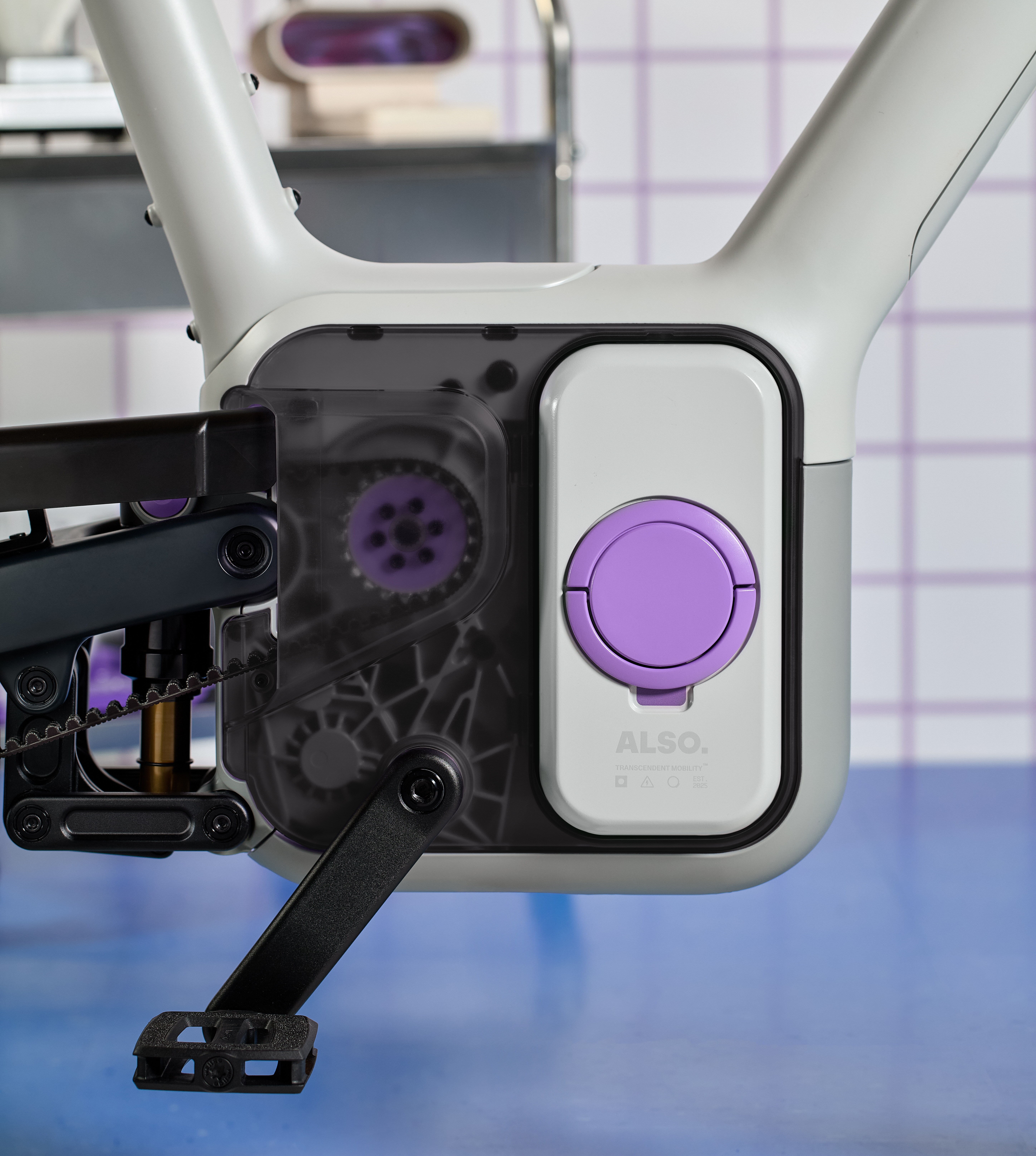
Some of the key features of the TM-B: A rear suspension (vertical cylinder at left) and belt drive, a swappable seat and support (upper left), and a central generator/motor/battery pack.
Credit: Also
Some of the key features of the TM-B: A rear suspension (vertical cylinder at left) and belt drive, a swappable seat and support (upper left), and a central generator/motor/battery pack. Credit: Also
Ars took a brief ride on a pre-production version of the company’s first bicycle and spoke with the team preparing it for release. There’s more to test in a full review, but we can safely say that Also appears to deliver on its promise. Most of the time, it feels like a normal bike, but push it harder, and it shifts into something radically different. That difference feels like an improvement.
Building a new kind of bicycle
Also is headquartered down the street from Rivian, the electric car company that helped launch it. It’s a building filled with the partial carcasses of the bike the company will be launching, the TM-B, so there is no mistaking it for a car company. Saul Leiken, the company’s director of product line, told me there is some cross-pollination—for example, the bike’s battery uses the same cells as a Rivian’s, just at a lower density. But the biggest overlap appears to be conceptual.
Chris Yu, Also’s president, said the idea took shape during conversations with people at Rivian. In an electric vehicle, he noted, software ultimately determines the vehicle’s behavior, as it sits between the driver’s inputs and the hardware that carries them out. Also was founded on the premise that other forms of transportation could benefit from the same approach.
Leiken said the biggest challenge was avoiding an uncanny valley effect: Riders come in with an ingrained sense of how riding a bike should feel, and straying too far from that might feel unnatural. At the same time, the promise of an electric bike is that it can enable rides that might otherwise be difficult or impossible for average people.
To find a balance, Also is making the whole widget (a philosophy it shares with Rivian). Its central motor assembly is housed in cast magnesium that plays a key structural role; both the generator and motor within it are custom-designed for the TM-B (Leiken said many e-bike motors are repurposed power steering units). The battery also sits within this square assembly. A handful of standard parts, like the shocks and belt, are contracted out to regular cycling manufacturers, but much of what makes the TM-B distinct is done in-house.
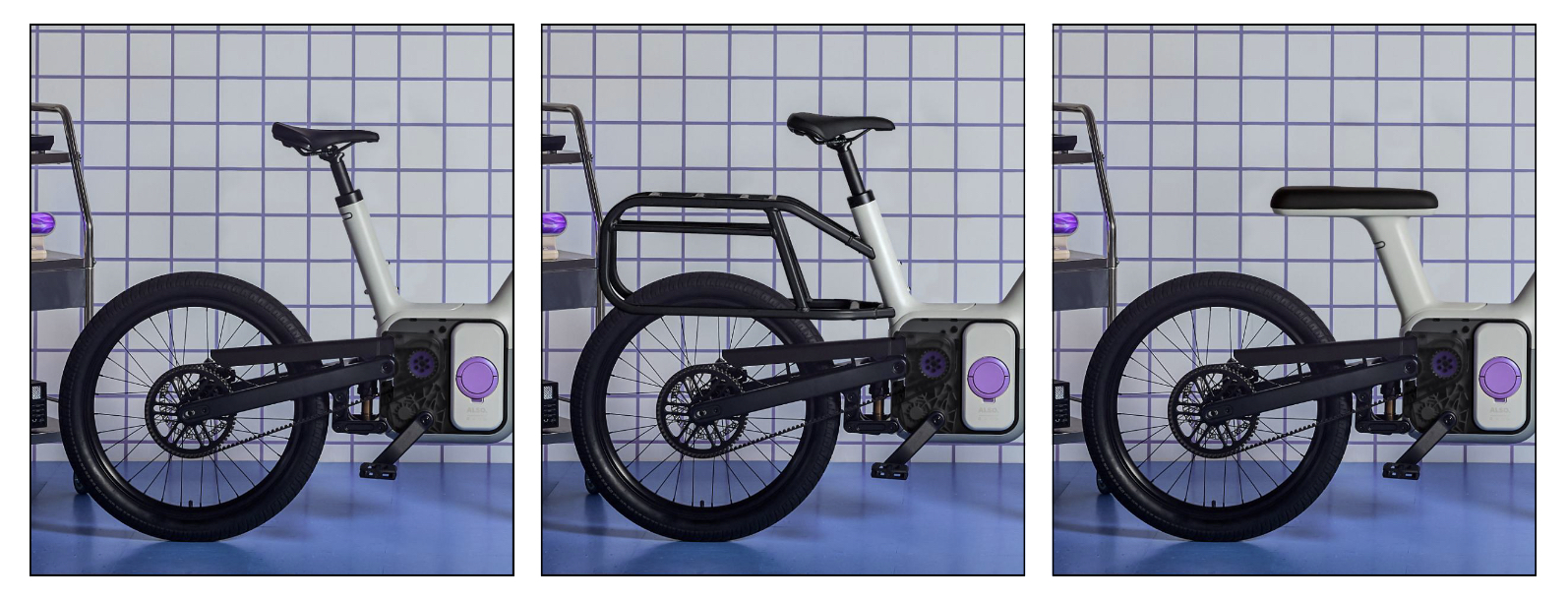
The seat assembly can be swapped out, providing a bit of flexibility to the bike.
Credit: Also
The seat assembly can be swapped out, providing a bit of flexibility to the bike. Credit: Also
Another distinction is its saddle and seatpost, which form a unit that plugs into a corner of the square motor/battery assembly. Also offers several options here—bench seating, a seat plus a cargo rack, or a sporty saddle—each built into a seating unit that power-locks into place, no tools required. Electronics in the seat enable user presets, letting a single bike body serve as two distinct setups. Switch between them in less than a minute by popping out one seat and inserting the other.
There’s also plenty of more conventional hardware, like lights and front fork shocks. Other features land somewhere in the middle, including a high-pivot rear suspension for cushioning against potholes and handling light trail use, as well as turn signals. The result is a bike that looks unusual but feels like a cohesive design.
That sense of cohesion likely comes from extensive prototyping. Also has a “museum” that includes the first test units, including one with a frame that let engineers vary the geometry to test different configurations (Leiken said the company ended up with something similar to a trail bike). The shop is full of in-house production tools like lathes and 3D printers, alongside automated endurance-testing machines. We saw hardware that can turn cranks with ankle-like motion or repeatedly run the wheels over a model of rough pavement.
Ultimately, the TM-B will be built in Taiwan, but it will be built using Also-owned machinery by Also-trained staff.
The software
There are two key aspects to an e-bike’s software, both central to the riding experience: the user interface and the motor control software. The former is what exposes the technology to the user, and Also has made its own. It’s a lot to take in at first, with multiple screens covering everything from basic ride stats to music from a paired smartphone. Options on each screen can be navigated through a mix of screen rotation, touch input, and handlebar-mounted buttons.
Overall, the UI was too much to take in during my short time with the bike. That’s not the screen’s fault; it was bright enough to be visible through sunglasses on a very sunny day. It just seems like a system that will require you to read the owner’s manual to learn all the features.
I’ll credit the company for attempting something both distinctive and comprehensive, but it will take more time to determine how it works in practice. Besides, after my ride, we ran into Yu, the company’s president, who said the demo bike was already two hardware and three software iterations behind the current version.
In any case, the TM-B defining feature is the software that sits between the cranks and the motor, shaping the whole cycling experience. Did Also avoid the uncanny valley?
To a large extent, yes. Once you find the right combination of settings and cadence, cruising down the street feels just like it does on any other bike. It’s impossible to tell that all your legs are doing is driving a generator and sending signals to a sensor or two.
But it didn’t take much to uncover behavior that felt very different. On a normal bike, a sudden pedal mash can often produce a short burst of acceleration followed by a spinout while shifting. On the TM-B, the software adjusts the resistance from the generator nearly instantly so it becomes much harder to pedal, all while boosting power to the motor.
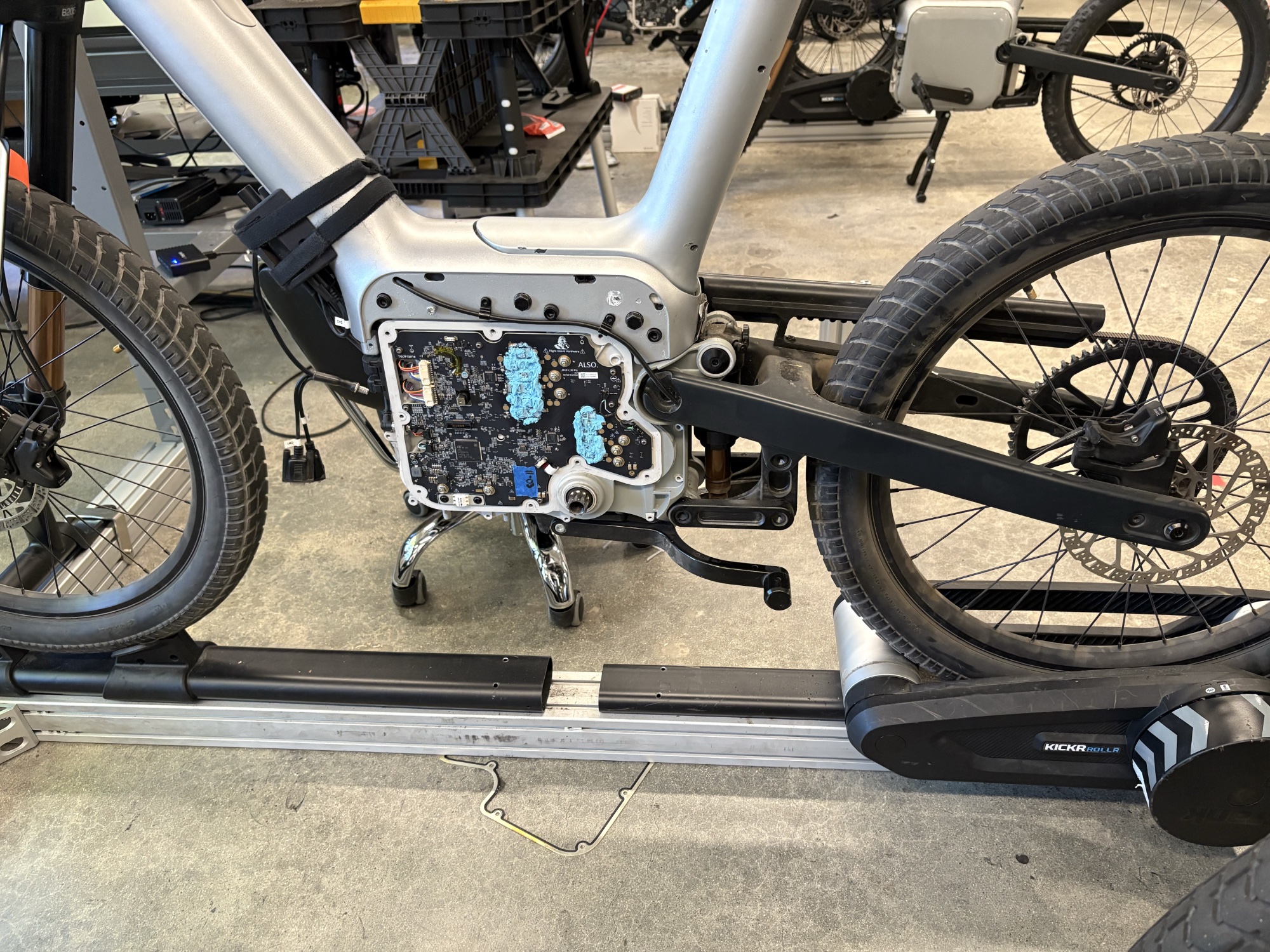
Much of the TM-B’s behavior is defined by its electronics.
Credit: John Timmer
Much of the TM-B’s behavior is defined by its electronics. Credit: John Timmer
In short, it did what I normally would have by shifting gears and adjusting cadence and force—and it did so very quickly, without requiring any intervention. It was a bit like having an automatic transmission on a bike.
The TM-B also avoided a problem I occasionally have on normal bikes: shifting into a gear my legs weren’t ready for. As soon as I started easing off the force I was supplying even slightly, the hardware responded by making it somewhat easier to pedal.
That doesn’t mean you can forget about shifting. There are two ways to set the assist, each with 10 settings. I didn’t have enough time to fully explore how they change the ride, nor did I run the battery flat to experience what Also calls “limp” mode, where nothing but the generator (meaning: your legs) is powering the motor. There’s still plenty to cover in the review.
Still, I came away with the sense that Also has put a lot of thought and effort into the TM-B, resulting in one of the most distinct riding experiences I’ve had, easily surpassing the continuous variable transmission bike I tested last year. And at least on an initial ride, it doesn’t feel like a case of Silicon Valley reinventing things that didn’t need it. The goal isn’t to replace every bike, and the design does seem to offer some real benefits.
In a field where most changes are evolutionary, it’s nice to see a company do a more fundamental rethink.

John is Ars Technica's science editor. He has a Bachelor of Arts in Biochemistry from Columbia University, and a Ph.D. in Molecular and Cell Biology from the University of California, Berkeley. When physically separated from his keyboard, he tends to seek out a bicycle, or a scenic location for communing with his hiking boots.