Rock weathering may release or draw down carbon dioxide—it depends on the rock.
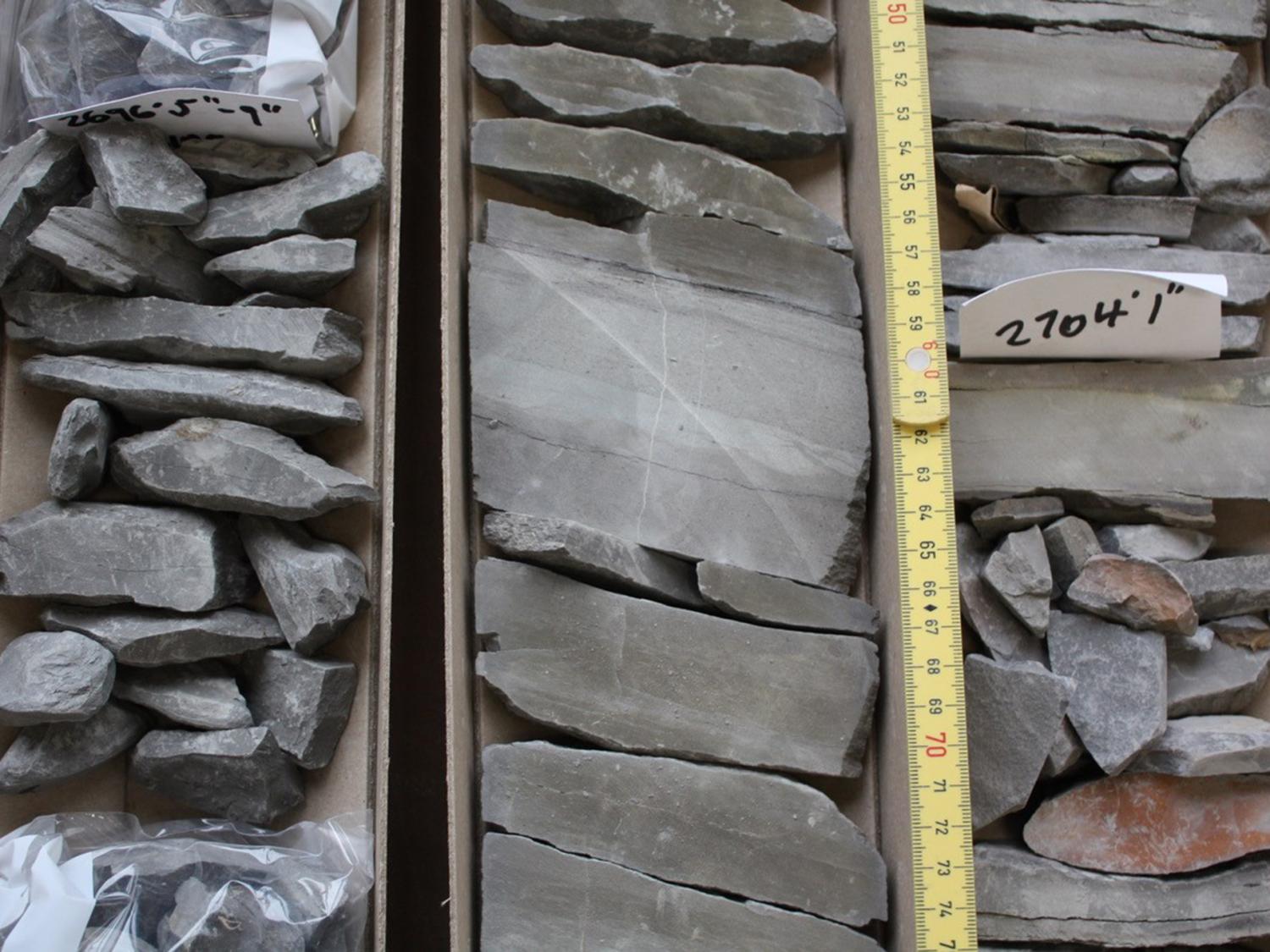
183-million-year-old mudstone from a hole drilled in Wales. Credit: Stephen Hesselbo
183-million-year-old mudstone from a hole drilled in Wales. Credit: Stephen Hesselbo
Since the early 1980s, Earth scientists have understood that erosion and weathering of rock slowly removes CO2 from the atmosphere, regulating Earth’s climate on geological timescales. But recent studies have shown that erosion can also emit CO2 by oxidizing organic carbon contained in eroding sediments. It hasn’t been clear how this competition between removal by rock weathering and emission by organic carbon weathering ends up affecting Earth’s climate.
A new study in the journal Nature Communications uses the geological past to test how these competing effects added up. Doctor Madeleine Stow of the University of Oxford, with colleagues from across the UK and France, examined a volcanically triggered episode of global warming that happened in the early part of the Jurassic period, 183 million years ago, known as the “Toarcian Ocean Anoxic Event.”
They found that eroding organic carbon amplified climate warming at the time, suggesting that the same process may apply to modern climate change. But the extent to which the past is prologue is uncertain.
Sampling the air using sediments from the seabed
The Toarcian warming event is one of a dozen or so periods of climate change in the geological past that were triggered by enormous volcanic phenomena known as large igneous provinces. Several are associated with mass extinctions, including the Great Dying at the end of the Permian period, which was caused by the Siberian Traps Large Igneous Province. The Toarcian event was triggered by massive volcanic eruptions across South Africa and Antarctica, which were joined together at the time. The resulting 6° to 7° C of global warming shuffled the makeup of plant and dinosaur species on land and caused a mass extinction of corals and other marine species.
“This event had been well studied before. We understand its drivers, we understand how it caused mass extinctions, and it’s driven by this Large Igneous Province release,” explained University of Oxford professor Bob Hilton, a coauthor and principal investigator in the study.
Organic carbon in rocks ranges from visible debris from fossil leaves and wood to molecular remains of plankton, algae, and microbes. In past global warming events, like the Toarcian, so much organic matter was buried at sea that the resulting shales are black with organic carbon. Later, after plate tectonics raises such sediments to the land surface, they can be eroded, and the organic carbon within them can be weathered into CO2.
To measure how much organic carbon was weathered on land during the Toarcian, Stow and colleagues turned to isotopes of the element rhenium extracted from rocks deposited on the seabed at the time. Rhenium works as a tracer of organic carbon oxidation because it binds chemically with organic matter in seabed sediments.
When organic carbon is weathered on eroding land, it’s released to the atmosphere as CO2 gas. But the rhenium that was bound to the organic carbon gets washed through rivers into the ocean, where it is incorporated into new seabed sediments. There, it acts as a tracer of the organic carbon that was oxidized from the older sediments.
The intensity of organic carbon oxidation changes the ratio of the isotope rhenium 187 to rhenium 185. This makes the ratio of these two isotopes in sediments a measure of the organic carbon weathering at the time.
The team used a 1,300-meter rock core of sediments deposited from the late Triassic to the early Jurassic. It was drilled in the 1960s in Wales and is now stored by the British Geological Survey.
The concentrations of rhenium in the rock are as low as one billionth of a gram per gram of rock, requiring exquisitely sensitive techniques to measure it. Recent improvements in the sensitivity of mass spectrometers have been “a bit of a game changer” in allowing studies like this, Hilton said.
The team chipped shale samples from different points along the drill core, with each sampling location representing a different point in time during the warming event. They digested the rock samples in a succession of different acids to break down the minerals and the organic matter, and after several further preparation steps, the rhenium isotopes were measured using “Inductively Coupled Plasma Mass Spectrometry” (ICP-MS).
The rhenium isotope values they measured changed as the Toarcian warming event unfolded, indicating that organic carbon weathering intensified as the climate heated up.
“This is a really important paper because it is one of the first to use rhenium isotopes in a past geologic context, and that really opens up this system to be able to study further in the past and to study others of these anomalous events to gain more understanding of our current Earth system,” said Dr. Katherine Grant of the Lawrence Livermore National Laboratory, who was not involved in the study.
Professor Jeremy Caves Rugenstein of Colorado State University, who was also not involved in the study, highlighted the importance of the paper in the context of earlier work by Hilton’s group. “This group… has revolutionized our understanding of how geologic organic carbon interacts with climate,” he said.
Mind the gap
“Our modern measurements of this process suggest if you warm up the planet, you should weather this material more intensely,” said Hilton, “and that’s exactly what we see in the core as we had this warming event. Weathering breakdown of rocks can actually be acting as a carbon dioxide source, and this can be quite large.”
A 2024 study by Professor Isabel Fendley of Penn State and colleagues used the same rock core to assess the amount of volcanic CO2 emitted in the Toarcian warming event. Using mercury as a tracer for the volcanic eruptions, they concluded that volcanic CO2 alone was insufficient to drive the warming, so there must have been an additional source of greenhouse gas emissions. The rhenium isotopes in the study show there was sufficient organic carbon weathering to fill that CO2 gap.
“Lo and behold, we end up finding that we can explain this apparent discrepancy,” said Hilton. In other words, weathering of organic carbon amplified the warming initiated by volcanic CO2, so the planet warmed more than it would have if only the volcanic CO2 had been emitted.
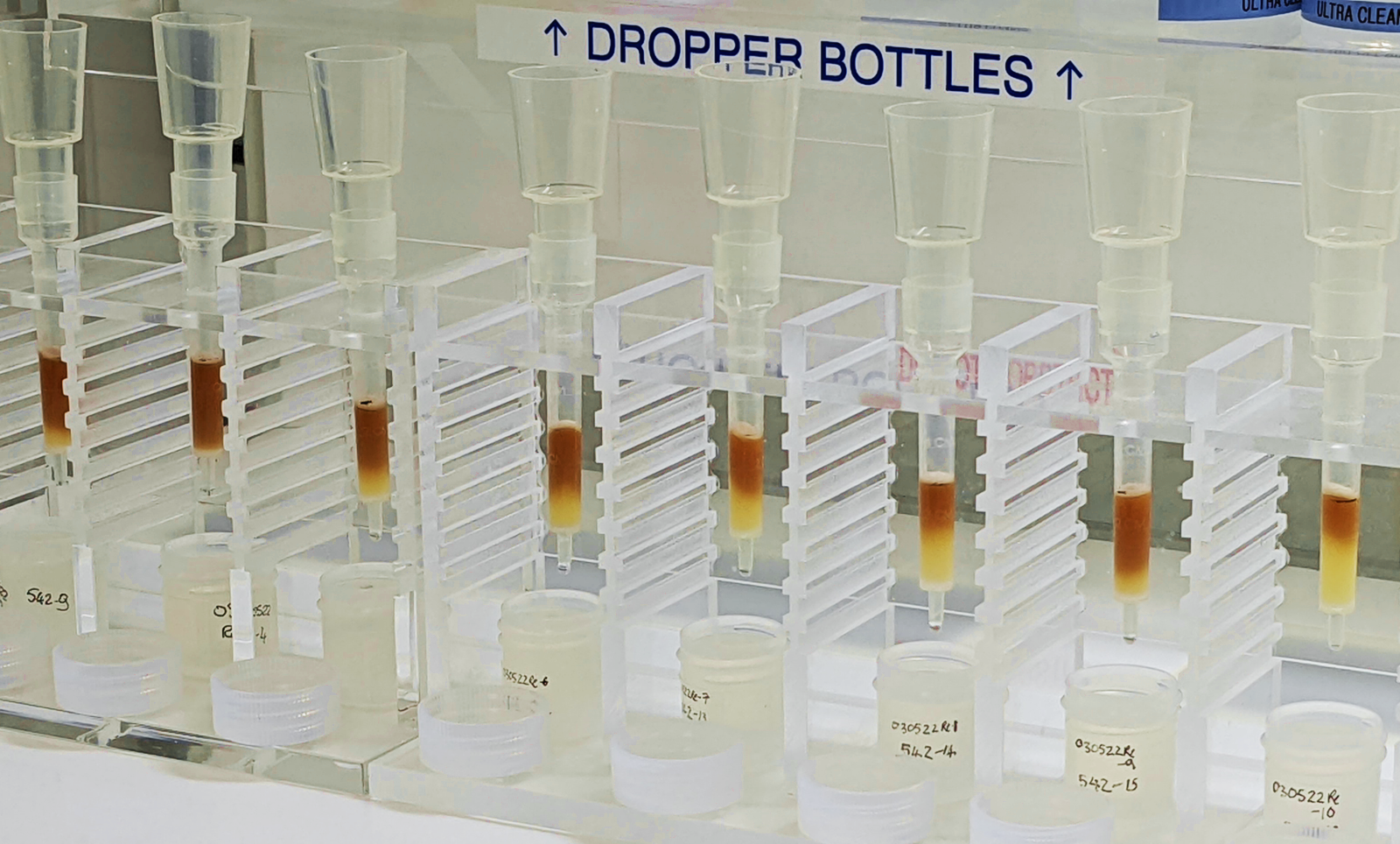
Acid-digested rock samples being prepared for analysis using column chromatography.
Credit: Bob Hilton
Acid-digested rock samples being prepared for analysis using column chromatography. Credit: Bob Hilton
But Rugenstein is skeptical of the amount of CO2 released by the weathering. “Their estimates of the total amount of carbon delivered by this feedback are enormous,” said Rugenstein. “I find it difficult to believe that these carbon fluxes are going to be as big as they think they are.”
Where does that leave Earth’s “thermostat”?
If rock weathering emits CO2, where does this leave our widely accepted understanding of Earth’s climate “thermostat,” where weathering of rock (specifically weathering of silicate minerals) reduces atmospheric CO2, preventing runaway global warming?
“Silicate weathering is still playing a major role. We’re not challenging that,” said Hilton. “It means that silicate weathering has to work harder.”
“While [organic carbon weathering] could be a big positive feedback, in the end, that tells you that the silicate weathering feedback has to be even stronger,” said Rugenstein.
The strength of the competition between silicate weathering and organic carbon weathering depends on the amount of organic-carbon-rich sediment that’s exposed on land. “At some point, you’re going to run out of organic carbon to oxidize, and that’s then going to place a hard limit on the strength of this feedback,” said Rugenstein.
In contrast, the volume of silicate minerals available to weather and draw down CO2 is much greater. “That’s why that feedback ultimately is a stronger one—we have a much bigger buffer to play with,” said Rugenstein.
A small, long-term, uncertain impact for humans
The study suggests that this feedback is likely to apply to other climate warming events, including our own today. Hilton foresees organic carbon weathering adding CO2 to the atmosphere over the next few centuries, with a small amplifying effect to human-caused warming. “It’s not disaster stations,” said Hilton, “but it is an amount of carbon that could be released at a rate more than it is right now, and that does eat into our carbon budget.”
Complex questions remain about how much organic carbon weathering eats into our carbon budget, and over what timescales.
For one thing, it will depend on where organic-rich sediments are eroding around the globe and how those locations are affected by changes to temperature and rainfall. “We have more extreme storms driving more debris flows, more landslides, and more erosion,” said Rugenstein. “Does that tend to enhance organic carbon oxidation, or does it actually dampen it because you end up shuttling all this organic carbon… to the [continental] shelf where it just gets buried?”
Grant also points to the complications. “We really have to understand the more complicated organic carbon system to be able to fully balance out CO2 mass balance, to be able to understand how that both operated in the past and how it’s operating now,” she said.
Rugenstein points to the huge scale of other human changes to the environment as a further source of uncertainty. “We have moved so much sediment around as humans and changed sedimentation patterns that it’s just difficult to know,” Rugenstein said. ”Have we accelerated or decelerated organic carbon burial that could counteract this kind of positive feedback?”
Rugenstein also points to CO2 emissions from permafrost and soils as a larger and more immediate concern for humans. “That’s going to be a bigger positive feedback than this geologic organic carbon will be—this [organic carbon weathering] could be sustained for longer, but at much lower rates,” said Rugenstein.
But even with all the uncertainty, the new results shed more light on how our planet works.
“It can just give us a greater understanding of how the Earth works mechanistically,” said Grant.
Nature Communications, 2026. DOI: 10.1038/s41467-026-71533-6

Howard Lee is a freelance science writer focusing on the evolution of planet Earth through deep time. He earned a B.Sc. in geology and M.Sc. in remote sensing, both from the University of London, UK.