


惯性聚合 高效追踪和阅读你感兴趣的博客、新闻、科技资讯
阅读原文 在惯性聚合中打开

推荐订阅源

The Last Watchdog
The Last Watchdog
C
Cyber Attacks, Cyber Crime and Cyber Security
L
LINUX DO - 热门话题
G
GRAHAM CLULEY
S
Schneier on Security
钛媒体:引领未来商业与生活新知
钛媒体:引领未来商业与生活新知
S
SegmentFault 最新的问题
IT之家
IT之家
阮一峰的网络日志
阮一峰的网络日志
Recorded Future
Recorded Future
I
Intezer
云风的 BLOG
云风的 BLOG
博客园 - Franky
月光博客
月光博客
大猫的无限游戏
大猫的无限游戏
T
Tenable Blog
The Hacker News
The Hacker News
T
The Blog of Author Tim Ferriss
Attack and Defense Labs
D
DataBreaches.Net
freeCodeCamp Programming Tutorials: Python, JavaScript, Git & More
N
News and Events Feed by Topic
有赞技术团队
有赞技术团队
Exploit-DB.com RSS Feed
N
News and Events Feed by Topic
Threat Intelligence Blog | Flashpoint
S
Secure Thoughts
The Register - Security
B
Blog
Security Archives - TechRepublic
The Cloudflare Blog
Webroot Blog
Webroot Blog
W
WeLiveSecurity
H
Heimdal Security Blog
博客园 - 三生石上(FineUI控件)
V
Vulnerabilities – Threatpost
G
Google Developers Blog
O
OpenAI News
V
V2EX
罗磊的独立博客
博客园_首页
N
News | PayPal Newsroom
cs.CL updates on arXiv.org
CTFtime.org: upcoming CTF events
TaoSecurity Blog
TaoSecurity Blog
Cloudbric
Cloudbric
H
Hacker News: Front Page
博客园 - 叶小钗
T
Tor Project blog
AI
AI

Ars Technica

Microsoft issues emergency update for macOS and Linux ASP.NET threat Anthropic tested removing Claude Code from the Pro plan Coyote vs. Acme is finally getting released—with a killer trailer Google unveils two new TPUs designed for the "agentic era" Tabloid reports linking 10 missing and dead scientists spur FBI probe Physicists think they've solved the muon mystery New court ruling blocks many of the government's anti-renewable policies Indian med student rakes in thousands with AI-generated MAGA hottie As EV batteries improve, ChargePoint debuts 600 kW fast charger Our favorite gear at Sea Otter Classic wasn't the bikes—it was the accessories Investors lost billions on Trump’s memecoin. Another gala won’t fix that. Pentagon wants $54B for drones, more than most nations’ military budgets Mozilla: Anthropic's Mythos found 271 security vulnerabilities in Firefox 150 Supreme Court arguments make it clear that FCC fines are "nonbinding" Silo S3 teaser hints at the wasteland's origins Framework's CEO on the RAM crisis and creating a "MacBook Pro for Linux users" Florida probes ChatGPT role in mass shooting. OpenAI says bot "not responsible." Report: Meta will train AI agents by tracking employees' mouse, keyboard use Microsoft removes Call of Duty from Game Pass, lowers subscription pricing Framework Laptop 13 Pro is a major overhaul for the modular, upgradeable laptop Framework Laptop 16 upgrades make it look less like an unfinished prototype Internal emails show how Amazon raises prices across the Internet, lawsuit says Anthropic gets $5B investment from Amazon, will use it to buy Amazon chips CATL's new LFP battery can charge from 10 to 98% in less than 7 minutes AMD Ryzen 9 9950X3D2 Dual Edition review: Tons of cache for tons of dollars What's the deal with spacesuits for the Moon? Will they be ready in time? Loneliness in older adults can often lead to memory impairment Contrary to popular superstition, AES 128 is just fine in a post-quantum world Pentagon pulls the plug on one of the military's most troubled space programs John Ternus will replace Tim Cook as Apple CEO Blue Origin's rocket reuse achievement marred by upper stage failure I’ve fired one of America’s most powerful lasers—here’s what a shot day looks like Great white sharks are overheating US-sanctioned currency exchange says $15 million heist done by "unfriendly states" Man with @ihackedthegovernment Instagram account tells judge, “I made a mistake" Trump picks qualified, normal health leader to head CDC; experts still cautious $25,000 buys plenty of used EVs: Here are some options Satellite and drone images reveal big delays in US data center construction Amazon won’t release Fire Sticks that support sideloading anymore Ridley Scott's post-apocalyptic The Dog Stars drops first trailer Artemis II pilot talks about what it was really like to fly and land in Orion Meta's AI spending spree is helping make its Quest headsets more expensive Rocket Report: Starship V3 test-fired; ESA's tentative step toward crew launch Recent advances push Big Tech closer to the Q-Day danger zone After a saga of broken promises, a European rover finally has a ride to Mars Lucasfilm drops The Mandalorian and Grogu final trailer at CinemaCon Intel refreshes non-Ultra Core CPUs with new silicon for the first time OpenAI starts offering a biology-tuned LLM As they got close to the Moon, Artemis II astronauts were eager to land Mozilla launches Thunderbolt AI client with focus on self-hosted infrastructure Ad firms settle with Trump FTC over claims they boycotted conservative media New Codex features include the ability to use your computer in the background The Ukraine war's deep impact on Metro 2039’s development, story New undersea cable cutter risks Internet’s backbone Microsoft and Stellantis want to use AI to help car owners Gemini can now create personalized AI images by digging around in Google Photos RFK Jr. forces FDA to reconsider 12 unproven peptides after 2023 ban First look: Also's upcoming e-bike disconnects the pedals and wheels Meet the Quantum Kid The race to Shackleton Crater is on—will Jeff Bezos or China get there first? Florida surgeon charged with killing man after removing liver instead of spleen Jury finds Live Nation/Ticketmaster is illegal monopoly that overcharged fans "TotalRecall Reloaded" tool finds a side entrance to Windows 11's Recall database Google releases new apps for Windows and MacOS Boston Dynamics’ robot dog now reads gauges and thermometers with Google's AI Prime Video shows “technical difficulties” sign instead of NBA game in overtime New teaser gives us first look at Godzilla Minus Zero Vulcan woes will "absolutely" be a factor in Pentagon's next rocket competition Adobe takes Creative Cloud into Claude Code-esque territory Good Omens S3 trailer sets up a blessed conclusion Bubble watch: Fashion brand Allbirds pivots hard to become AI services company New 3D map of Universe could solve dark energy mystery What’s the deal with Alzheimer’s disease and amyloid? Blue Origin has a new employee stock plan, but not everyone is happy It's Tax Day, and no one knows how to file for prediction market winnings Ukraine’s military robot surge aims to offset drone risks to humans Sony killing features for antenna, set-top box users of Bravia smart TVs in May Americans ask AI for health care. Hospitals think the answer is more chatbots. Shock from Iran war has Trump's vision for US energy dominance flailing The Artemis II mission has ended. Where does NASA go from here? AI models are terrible at betting on soccer—especially xAI Grok Four astronauts are back home after a daring ride around the Moon Californians sue over AI tool that records doctor visits New paper argues history, not mantle plume, powers Yellowstone F1 moves a step closer to fixing its 2026 hybrid problem Report: US demands Reddit unmask ICE critic, summons firm to grand jury Microsoft's "commitment to Windows quality" starts with overhaul of beta program "Oobleck" still holds some surprises YouTube increases Premium price again, says 90-second unskippable ads are a bug Oldest octopus fossil found to not be an octopus What leaked "SteamGPT" files could mean for the PC gaming platform's use of AI Here's what to expect from the fiery, 14-minute return of Artemis II Pro-Iran Explosive Media trolls Trump with AI-generated Lego cartoons Dad stuck in support nightmare after teen lied about age on Discord Rocket Report: Chinese version of Falcon 9 fails; Artemis depends on rapid heavy lift Orion helium leak no threat to Artemis II reentry but will require redesign RFK Jr. rewrites CDC panel's charter, opening door to anti-vaccine quacks AI on the couch: Anthropic gives Claude 20 hours of psychiatry Clinical trial shows gene editing works for β-Thalassaemia, too “Negative” views of Broadcom driving thousands of VMware migrations, rival says
Engineers at NASA's Jet Propulsion Lab make a breakthrough in rotor technology
Stephen Clark · 2026-05-08 · via Ars Technica

Skip to content

Well done

Testing shows rotor blades won’t disintegrate when they spin at supersonic speed.

Artist's illustration of the SkyFall helicopters preparing for deployment on Mars. Credit: NASA/JPL-Caltech

A little more than three years since NASA’s Ingenuity helicopter ended its pioneering mission at Mars, engineers at the Jet Propulsion Laboratory in California are designing next-generation Martian rotorcraft to carry heavier payloads longer distances through the planet’s low-density atmosphere.

Ingenuity was a resounding success, becoming the first airborne platform to explore another world. The dual-bladed helicopter made 72 flights, overachieving NASA’s original goal of five flights over 30 days, after delivery to Mars by the Perseverance rover. By the time the mission ended with a crash-landing in January 2024, Ingenuity had shown scientists a new way to explore other worlds, using air to travel longer distances and reach locations inaccessible to ground vehicles.

NASA plans to send three more helicopters to Mars on the SkyFall mission, which could launch as soon as late 2028. SkyFall is set to ride to the red planet aboard a nuclear-powered spacecraft named Space Reactor-1, or SR-1, one of the tech demo initiatives announced earlier this year by NASA Administrator Jared Isaacman.

Ingenuity‘s main body was not much larger than a tissue box, with a mass of just 4 pounds (1.8 kilograms) and counter-rotating rotors that spanned about 4 feet (1.2 meters). The SkyFall helicopters will be larger and heavier, and they will use a novel maneuver to land themselves on the Martian surface after entering the atmosphere cocooned inside a heat shield. This will require innovations in the helicopter’s design.

Breaking a barrier

Engineers at JPL and a private company named AeroVironment, the same partners that developed Ingenuity, recently made a breakthrough in the lab to nudge the SkyFall mission closer to reality. The tests involved the new, larger rotor blades that will convey the next-gen helicopters through the rarefied Martian atmosphere, just 1 percent the density of air at sea level on Earth.

Because of this thin atmosphere, helicopters flying on Mars must spin their rotors faster than on Earth to generate lift, and heavier vehicles need more lift than lighter ones. The rotors on the SkyFall helicopters will also be larger than those on Ingenuity, which spun its blades at 2,700 rpm, already 10 times faster than passenger helicopters on Earth. But engineers were careful to design Ingenuity not to spin its carbon-fiber rotors faster than the speed of sound out of concern that exceeding Mach 1 (roughly 540 mph on Mars) might cause the blades to shatter.

“If Chuck Yeager were here, he’d tell you things can get squirrely around Mach 1,” said Jaakko Karras, the rotor test lead at JPL, in a NASA press release. “With that in mind, we planned Ingenuity’s flights to keep the rotor blade tips at Mach 0.7 with no wind so that if we encountered a Martian headwind while in flight, the rotor tips wouldn’t go supersonic. But we want more performance from our next-gen Mars aircraft. We needed to know that our rotors could go faster safely.”

Recent testing at JPL pushed rotors past the speed of sound without damaging them, NASA announced Thursday. The rotor tips reached a top speed of Mach 1.08 in a test chamber simulating Mars’ atmosphere. Engineers didn’t know for sure what would happen to the rotors, so they lined part of the chamber with sheet metal to shield it from damage if the blades broke apart during the supersonic experiment, according to NASA.

“From a control room a few yards away from the chamber, the team watched displays showing data and a view inside the chamber as the rpm climbed as high as 3,750,” NASA said. “At that rate, the tips were traveling at Mach 0.98. Then the engineers activated a fan inside the chamber that pelted the rotors with headwinds. After each run, they increased in wind velocity for the next run.”
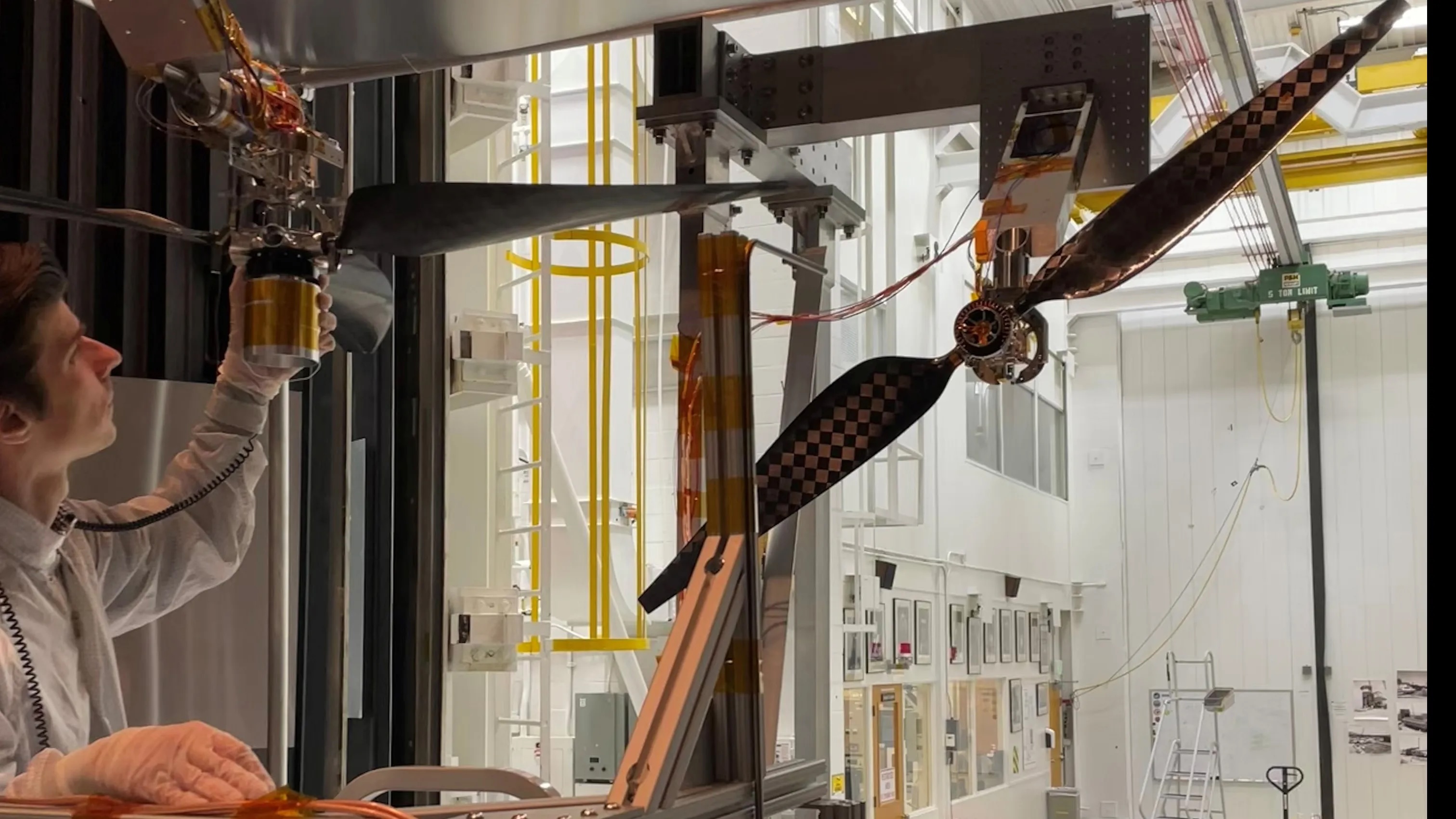
Engineer Jaakko Karras inspects a next-generation Mars helicopter rotor blade prior to testing it at supersonic speeds in the 25-foot Space Simulator at NASA’s Jet Propulsion Laboratory in November 2025.

Credit: NASA/JPL-Caltech

Engineer Jaakko Karras inspects a next-generation Mars helicopter rotor blade prior to testing it at supersonic speeds in the 25-foot Space Simulator at NASA’s Jet Propulsion Laboratory in November 2025. Credit: NASA/JPL-Caltech

The first series of tests used a three-bladed rotor design that could be flown on missions after SkyFall. A second test campaign used the actual two-bladed design that will fly on SkyFall. These blades are slightly longer, so they reached the same supersonic speed at a lower rpm. The faster spin resulted in a 30 percent boost in lift capability.

The team pushed rotor tip speeds to Mach 1.08, boosting the Mars vehicle’s lift capability by 30 percent. This breakthrough allows future missions to support heavier scientific payloads, including advanced sensors and larger batteries for extended flight.

“We thought we’d be lucky to hit Mach 1.05, and we reached Mach 1.08 on our last runs. We’re still digging into the data, and there may be even more thrust on the table. These next-gen helicopters are going to be amazing,” said Shannah Withrow-Maser, an aerodynamicist from NASA’s Ames Research Center.

At the same time that engineers are preparing to send more helicopters to Mars, NASA is working on a more massive rotorcraft named Dragonfly destined for Saturn’s moon Titan. Dragonfly will weigh nearly a ton, but flying on more distant Titan poses fewer challenges than on Mars because its atmosphere is thicker than Earth’s.

The only payloads on the Ingenuity helicopter were two cameras: a black-and-white imager for navigation and a higher-resolution color camera. Its longest flight in 2022 covered less than a half-mile and lasted 161 seconds. The aircraft had to land and recharge its batteries using solar arrays, and it used the nearby Perseverance rover as a base station to communicate with ground teams on Earth.

The SkyFall mission won’t have a rover nearby. The helicopters will have to communicate with mission controllers through orbiting relay satellites or a direct-to-Earth link. Future rotorcraft will use larger batteries to enable longer flights. Scientists would like to mount more sophisticated instruments on Mars helicopters to search for things like ice in the Martian soil. All of this will require heavier vehicles.

Breaking the sound barrier without breaking hardware moves us a step closer to fully exploiting this new mode of planetary exploration.

Photo of Stephen Clark

Stephen Clark is a space reporter at Ars Technica, covering private space companies and the world’s space agencies. Stephen writes about the nexus of technology, science, policy, and business on and off the planet.

152 Comments